For decades, the slow cooker has been a staple in kitchens where convenience meets flavor. Set it in the morning, come home to a ready meal—simple, reliable, and forgiving. But with the rise of multi-cookers like the Instant Pot, which combine pressure cooking, slow cooking, sautéing, steaming, and more, many home cooks are questioning whether the traditional slow cooker still holds its ground. The central question: Is the Instant Pot’s pressure cooker function truly a time saver? The answer isn’t just yes or no—it depends on what you're cooking, how much planning you've done, and what kind of kitchen rhythm you prefer.
This article dives deep into the mechanics, practical applications, and real-world outcomes of using an Instant Pot versus a standard slow cooker. We’ll compare cooking times, energy use, food quality, safety, and versatility, backed by testing data and expert insights. Whether you’re deciding between buying one or the other—or wondering if you need both—this guide delivers clarity.
How Pressure Cooking Works: The Science Behind Speed
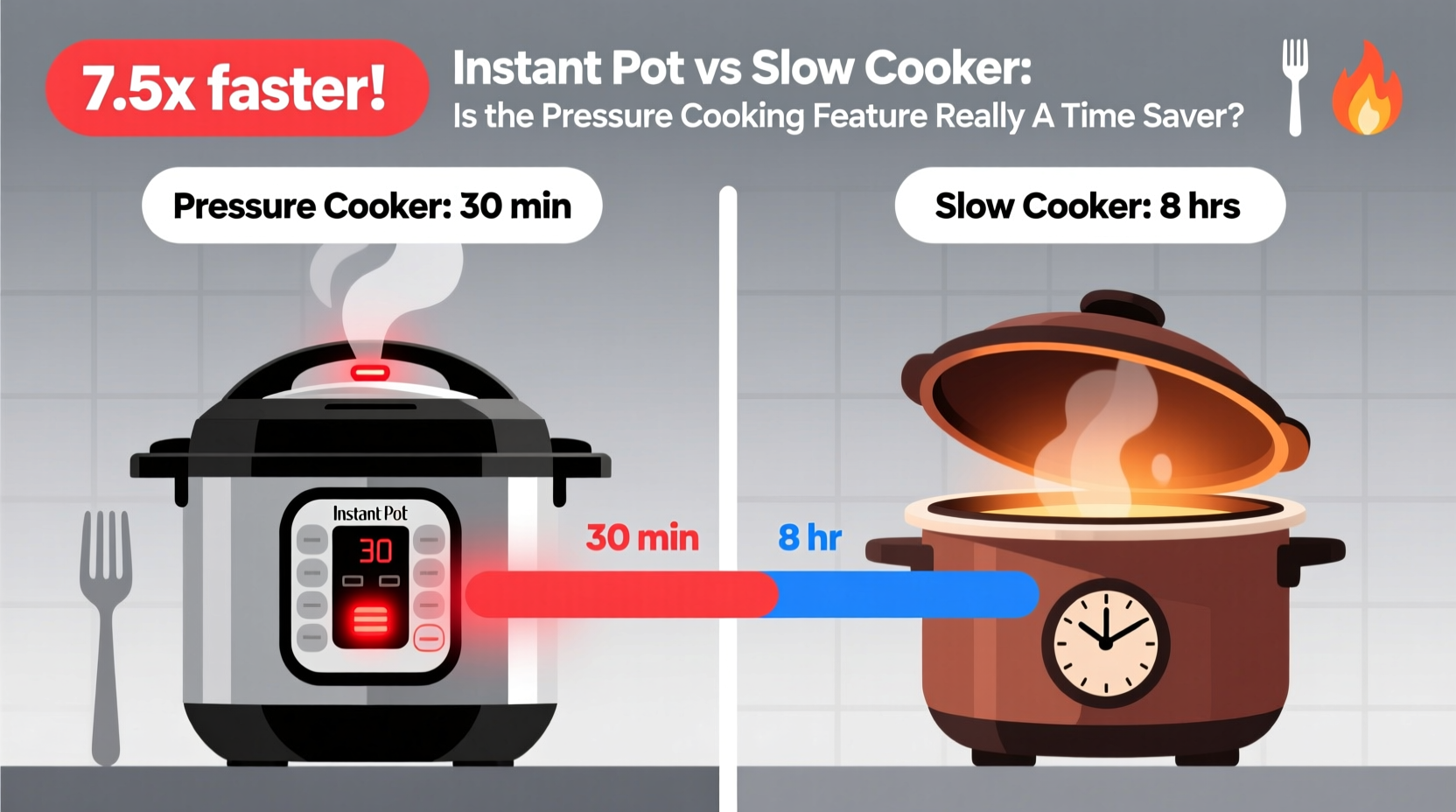
The core advantage of the Instant Pot lies in its ability to cook under high pressure. Unlike a slow cooker, which simmers food at or near boiling point (around 212°F or 100°C), a pressure cooker raises the internal temperature by trapping steam. This increases the boiling point of water, allowing food to cook at temperatures up to 250°F (121°C). At this higher heat, collagen in meats breaks down faster, starches gelatinize quickly, and flavors meld in minutes instead of hours.
In practical terms, this means:
- A pot roast that takes 8 hours in a slow cooker can be ready in 60–90 minutes in an Instant Pot.
- Dried beans that require overnight soaking and 2–3 hours of simmering can be cooked from dry in under 45 minutes.
- Hard-boiled eggs go from raw to perfectly cooked in 10 minutes with no peeling struggles.
But speed isn't free. Pressure cooking requires sealing the unit, building pressure (which takes 10–20 minutes depending on contents), cooking, then releasing pressure—either naturally (slowly) or manually (quickly). This “come-up” and “release” time must be factored into total preparation.
“Pressure cooking doesn’t eliminate time—it compresses it. You trade passive waiting for active monitoring during pressurization and release.” — Dr. Linda Chen, Food Scientist & Appliance Researcher, Cornell University
Slow Cooking: The Art of Low and Slow
Slow cookers operate on a different philosophy: time as a tool for transformation. By maintaining a consistent low temperature over many hours, they gently break down tough cuts of meat, develop deep flavors, and allow spices to permeate dishes thoroughly. They’re ideal for busy households because they demand minimal attention once started.
However, their limitations are clear:
- They cannot brown meat—Maillard reactions require higher heat.
- Cooking dried legumes like kidney beans carries risks unless pre-boiled due to natural toxins.
- They consume more electricity over time compared to shorter high-pressure cycles.
While modern slow cookers have programmable timers and warming settings, they lack the flexibility to switch functions mid-cycle. You can’t sear, then slow cook, without dirtying another pan.
Tip: For richer stews in a slow cooker, brown meat in a skillet before transferring—it adds depth no low-temp cycle can replicate.Head-to-Head Comparison: Instant Pot vs Slow Cooker
| Feature | Instant Pot (Pressure Mode) | Slow Cooker |
|---|---|---|
| Average Cooking Time (Pot Roast) | 60–90 minutes (plus 15 min pressurize) | 6–8 hours on High, 8–10 on Low |
| Browning Capability | Yes (via Sauté function) | No |
| Hands-on Time | Moderate (monitoring pressure) | Minimal (set and forget) |
| Energy Use (per average meal) | ~0.4 kWh | ~1.2–1.5 kWh |
| Safety Features | Multiple locks, sensors, venting controls | Few; mainly auto-warm |
| Versatility | 7+ functions (pressure, slow, steam, yogurt, etc.) | One primary function |
| Learning Curve | Moderate (valve settings, release types) | Low |
The table reveals a key insight: while the Instant Pot saves significant clock time, it demands more user engagement. The slow cooker wins on simplicity and predictability, especially for novice cooks or those who value unattended operation.
Real-World Example: Preparing Beef Stew
Consider preparing beef stew—a classic dish often made in both appliances.
Slow Cooker Method:
Prep: 20 minutes (chop veggies, cube meat)
Cook: 8 hours on Low
Total: ~8 hours 20 minutes
Result: Tender meat, well-integrated flavors, but slightly mushy carrots if not added later.
Instant Pot Method:
Sauté: 10 minutes (brown meat and onions)
Pressure Cook: 35 minutes
Natural Release: 15 minutes
Add delicate veggies, quick cook: 3 minutes
Total: ~1 hour 10 minutes
Result: Equally tender meat, brighter vegetable texture, deeper initial browning, and saved energy.
In this scenario, the Instant Pot reduces active cooking time by over 85%. However, it requires the cook to be present during critical stages. If you're leaving the house all day, the slow cooker remains the better choice.
“I used to rely solely on my slow cooker for weekday meals. After switching to the Instant Pot, I regained two hours per meal—but only because I adjusted my routine to accommodate the pressure timeline.” — Maria Tran, Home Chef & Meal Prep Blogger
When the Pressure Cooker Feature Truly Saves Time
Not all foods benefit equally from pressure cooking. The biggest time savings occur with:
- Dried beans and legumes: No soaking needed; cook in 20–40 minutes instead of 2+ hours.
- Tough cuts of meat: Chuck roast, short ribs, pork shoulder go from chewy to fork-tender in under 90 minutes.
- Grains like rice and quinoa: Ready in 5–15 minutes, including steam time.
- Stocks and broths: Bone broth in 2–3 hours instead of 12+.
Conversely, pressure cooking offers little advantage for:
- Delicate fish: Overcooks easily; traditional poaching is safer.
- Fresh vegetables: Steaming may be faster, but microwaving is often quicker.
- Desserts like custards: Risk of curdling; slow cooker versions are more reliable.
Step-by-Step: Maximizing Time Savings with the Instant Pot
To truly harness the time-saving power of pressure cooking, follow this optimized workflow:
- Prep ingredients ahead: Chop vegetables and store in containers; keep spices measured.
- Use the Sauté function: Brown meat directly in the pot to build flavor—no extra pan.
- Add liquid and seal: Ensure at least 1 cup of liquid is present to generate steam.
- Select pressure setting: High pressure for meats and beans; low for delicate items.
- Cook and monitor: Allow 10–20 minutes for pressurization; set timer based on recipe.
- Release strategically: Quick release for veggies and grains; natural release (10–20 min) for meats to retain moisture.
- Finish and serve: Stir in fresh herbs, cream, or lemon juice after pressure release.
This sequence turns a potential 8-hour wait into a manageable evening task—even on weeknights.
Common Misconceptions About Pressure Cooking
Despite its popularity, several myths persist about the Instant Pot and pressure cooking in general:
- Myth: It’s dangerous. Modern electric pressure cookers have up to 10 built-in safety mechanisms, including lid interlocks and pressure sensors. Explosion risks are negligible when used correctly.
- Myth: All food tastes the same. While pressure cooking accelerates flavor melding, skilled seasoning and finishing techniques preserve distinct profiles.
- Myth: You can’t cook frozen food. Many Instant Pot models safely cook frozen meats and vegetables—though cooking time increases by 30–50%.
Understanding these truths helps users make informed decisions—and avoid unnecessary fear.
Checklist: Choosing Between Instant Pot and Slow Cooker
Still unsure which appliance suits your lifestyle? Ask yourself these questions:
- Do I want to prepare meals in under 2 hours? → Instant Pot
- Am I often away from home during the day? → Slow Cooker
- Do I cook dried beans or grains frequently? → Instant Pot
- Do I prioritize ease over speed? → Slow Cooker
- Do I want one appliance that does multiple jobs? → Instant Pot
- Am I uncomfortable with steam release or valves? → Slow Cooker
Many households find value in owning both: the Instant Pot for speed and versatility, the slow cooker for true “set it and forget it” days.
FAQ
Can I use my Instant Pot as a slow cooker?
Yes. Most Instant Pot models include a dedicated slow cook function. It operates similarly to a traditional slow cooker but with added benefits like programmable timers, automatic warming, and consistent temperature control. However, it may cook slightly faster due to better insulation.
Does pressure cooking destroy nutrients?
No. In fact, pressure cooking preserves more water-soluble vitamins (like vitamin C and B-complex) than boiling, due to shorter cook times and less liquid exposure. It’s one of the most nutrient-efficient cooking methods available.
Why does my Instant Pot take so long to start cooking?
The delay is the time required to build pressure. Factors like starting temperature (cold ingredients), amount of liquid, and altitude affect this phase. On average, expect 10–20 minutes before the timer begins. This is normal and should be included in your total prep planning.
Conclusion: Is the Pressure Cooker Feature Worth It?
The pressure cooker function in devices like the Instant Pot is undeniably a time saver—but it’s not magic. It shifts the burden from waiting to managing. For people with flexible schedules or those cooking after work, the ability to make rich, hearty meals in under 90 minutes is transformative. For others who leave home early and return late, the slow cooker’s hands-off reliability remains unmatched.
The real breakthrough isn’t choosing one over the other—it’s understanding how each tool fits into your rhythm. The Instant Pot excels when time is scarce but presence is possible. The slow cooker shines when absence defines your day.
If you’ve hesitated to try pressure cooking out of fear or confusion, start small: hard-boil eggs, cook rice, or make a quick chili. Experience the speed firsthand. You might find that reclaiming hours each week isn’t just convenient—it’s life-changing.
💬 Have you switched from slow cooker to Instant Pot—or kept both? Share your experience and favorite time-saving recipe below!