There’s something undeniably magnetic about a watch that lets you see inside. Gears turning, balance wheels oscillating, springs coiling—mechanical watches are miniature marvels of engineering. But when it comes to hollow dial and skeleton designs, the question isn’t just about function. It’s about taste. Is revealing the inner workings a celebration of craftsmanship, or is it a performative flex—an attempt to look horologically sophisticated without substance?
The answer depends on context, execution, and intent. These two styles—hollow dial and skeleton—share a fascination with transparency but achieve it differently. One peels back parts of the dial; the other strips away almost everything. Understanding their differences, strengths, and cultural reception helps separate genuine artistry from aesthetic posturing.
What’s the Difference Between Hollow Dial and Skeleton Watches?
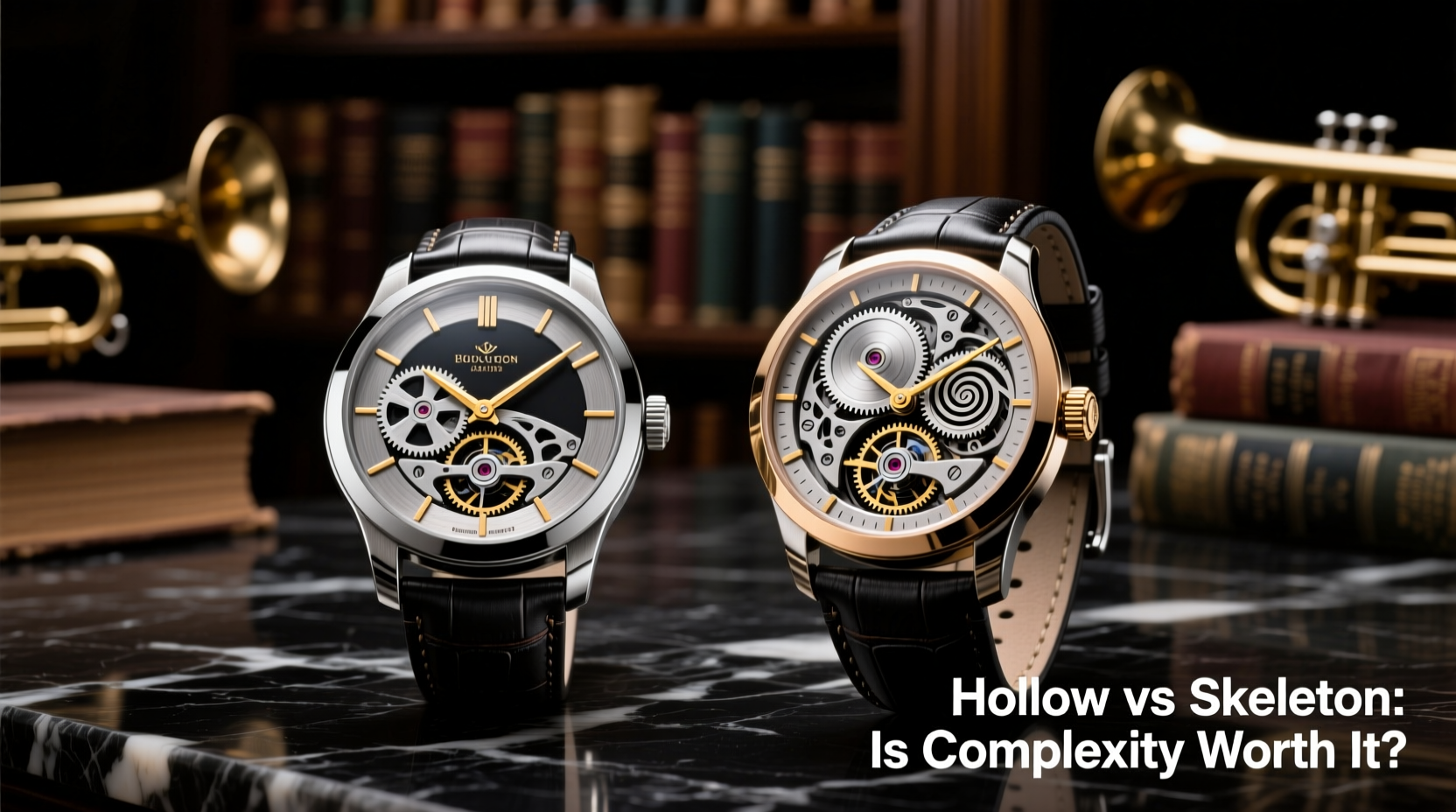
At first glance, both styles expose mechanical components, but their construction philosophies diverge significantly.
- Hollow dial watches retain much of the traditional dial structure but feature cutouts—often around the center or subdials—that reveal select parts of the movement beneath. The hands still move over a semi-solid surface, and branding, indices, and date windows often remain intact. Think of it as a “peek-a-boo” approach.
- Skeleton watches, by contrast, involve a radical re-engineering of the movement. Bridges are reshaped, plates are milled down, and nearly every non-essential piece of metal is removed to showcase the mechanics in full. The result is a latticework of gears suspended in space, where even the rotor might be open-worked for visibility.
This distinction matters because it affects legibility, durability, and intention. A hollow dial can enhance a classic design with a touch of intrigue. A skeletonized movement, however, is a declaration—one that says, “Look at what’s underneath.”
Design Intent: Celebration or Showboating?
The best skeleton and hollow dial watches serve a dual purpose: they honor the complexity of mechanical watchmaking while delivering visual drama. When done well, the open architecture highlights finishing techniques like perlage, Geneva stripes, and hand-beveled edges—details usually hidden from view.
But not all executions are equal. Mass-market brands sometimes apply skeletonization as a cosmetic filter—laser-cutting cheap movements and slapping on reflective coatings to simulate craftsmanship. In these cases, the effect feels hollow (pun intended). There’s no real finishing, no structural innovation, just the illusion of complexity.
“True skeletonization isn’t about removing material—it’s about reimagining how the movement supports itself while maximizing visual flow. It’s architecture, not vandalism.” — Antoine Morel, Master Watchmaker at Atelier Horlogerie Suisse
In high-end pieces from brands like Jaeger LeCoultre, Richard Mille, or Parmigiani, skeleton watches undergo years of development. Components are redesigned to be both functional and beautiful. Angles are chamfered by hand, surfaces are micro-blasted or satin-brushed, and the layout is choreographed like a ballet of precision parts.
Hollow dial designs, meanwhile, walk a subtler line. They’re more accessible and often preserve readability better than full skeletons. Brands like Tissot, Hamilton, and Oris use them to add modern flair to otherwise conservative models. Here, the goal isn’t to impress purists but to engage casual admirers with a hint of mechanical romance.
Practical Considerations: Form vs Function
Beyond aesthetics, there are tangible trade-offs between these styles:
| Feature | Hollow Dial | Skeleton |
|---|---|---|
| Legibility | Generally good—most markers and hands remain visible | Poor to moderate—cluttered visuals can distract from time-telling |
| Durability | Similar to standard watches—minimal structural compromise | More fragile—reduced plate integrity may affect shock resistance |
| Maintenance Access | Easier—standard caseback access remains unobstructed | Harder—open works can trap dust; servicing requires extra care |
| Production Cost | Moderate—requires dial modification only | High—movement must be reengineered and finished extensively |
| Cool Factor | Subtle intrigue—appeals to design-conscious wearers | High impact—draws attention, especially under light |
Real-World Example: Two Watches, Two Philosophies
Consider two real-life examples:
A Tissot PRX Powermatic 80 with a hollow dial uses a clean cutout at 6 o’clock to reveal the oscillating weight and part of the gear train. The rest of the dial is crisp, minimalist, and highly legible. It’s a modern take on a vintage design, using transparency as an accent—not the centerpiece.
Now compare that to the Roger Dubuis Excalibur Spider Huracán, a fully skeletonized timepiece with a transparent caseback and openworked dial. Every component is sculpted, polished, and arranged for maximum visual drama. It’s loud, expensive, and unapologetically theatrical. You don’t wear this to check the time; you wear it to make a statement.
Neither is objectively better. The Tissot respects the everyday user. The Roger Dubuis caters to collectors who value spectacle as much as precision. The “try-hard” critique usually targets mid-tier brands trying to emulate the latter without the budget or skill to pull it off.
When Transparency Works—and When It Doesn’t
So, is seeing all those gears actually cool?
Yes—when the movement is thoughtfully designed, finely finished, and integrated into a cohesive whole. No—when it’s a gimmick layered over a generic automatic movement with zero attention to detail.
The most respected skeleton watches earn their transparency. They don’t just show gears; they elevate them. The bridges become artistic elements, the screws are polished, and the motion has rhythm. You don’t just see the mechanism—you appreciate it.
Hollow dials succeed when they feel intentional. A small aperture framing the escapement, for instance, draws focus like a spotlight. But if the cutout feels random or disrupts the dial symmetry, it distracts rather than delights.
Checklist: Is Your Open-Worked Watch Actually Well-Designed?
- Are visible components decorated (beveled, brushed, engraved)?
- Does the layout guide the eye naturally through the movement?
- Is legibility preserved despite the openness?
- Does the case design complement, rather than compete with, the dial?
- Is the watch from a brand known for movement expertise?
If most answers are “yes,” you’re likely looking at a thoughtful design. If not, it might just be trying too hard.
Frequently Asked Questions
Can a skeleton watch be worn every day?
Yes, but with caveats. High-quality skeleton watches from reputable brands are built to last. However, their reduced structural mass can make them slightly more vulnerable to shocks. For rugged daily use, a solid-dial or hollow-dial model may be more resilient.
Do skeleton watches need more maintenance?
Not inherently, but their open design can allow more dust and moisture to settle on the movement. Regular servicing (every 5–7 years) is crucial, especially if worn frequently.
Are hollow dials just cheaper versions of skeleton watches?
Not necessarily. While hollow dials are generally less complex, they serve a different purpose. They offer a balanced blend of aesthetics and function, making them ideal for dress-sport or lifestyle watches where subtlety matters.
Final Thoughts: Cool or Try-Hard?
The truth is, neither hollow dial nor skeleton watches are inherently cool—or inherently pretentious. It comes down to execution and context. A beautifully finished skeleton from a master watchmaker is a work of art. A poorly executed one from a trend-chasing brand is just jewelry pretending to be horology.
Likewise, a hollow dial that enhances design harmony feels modern and clever. One that awkwardly carves out space for gears without regard to proportion feels like an afterthought.
Ultimately, the gears themselves aren’t the point. It’s what they represent: respect for engineering, pride in craftsmanship, and a desire to share beauty usually kept behind closed doors. When that intent shines through, the watch isn’t trying hard—it’s succeeding brilliantly.
💬 What do you think—do exposed movements enhance a watch or distract from it? Share your thoughts and favorite open-worked designs in the comments.