Every December, holiday tech enthusiasts scan for innovations that blend tradition with utility—smart lights, app-controlled garlands, voice-activated nativity scenes. Lately, one idea has surfaced repeatedly in design forums and Kickstarter pitches: the wireless charging Christmas tree ornament. At first glance, it’s charming—a glittering bauble that doubles as a Qi charger for your phone. But charm alone doesn’t sustain a product. To assess whether this is more than seasonal novelty, we need to move past the sparkle and examine physics, safety standards, user behavior, and real-world constraints. This isn’t about dismissing festive ingenuity; it’s about distinguishing clever concept from functional gadget.
The Core Idea: How It *Could* Work
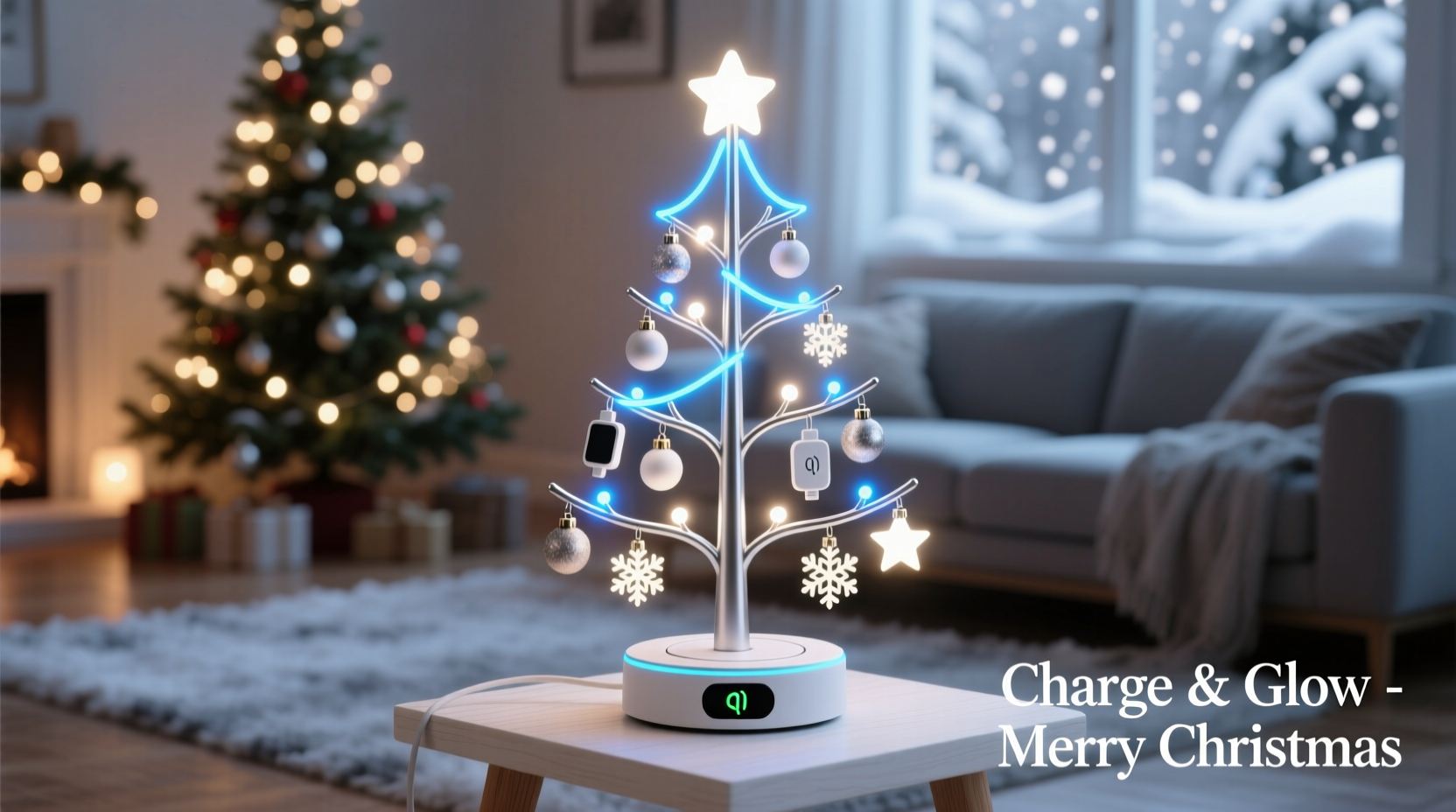
A wireless charging ornament would typically integrate a compact Qi transmitter coil (30–50 mm diameter), a power management IC, and a low-profile lithium-polymer battery or direct AC/DC conversion circuitry. Power delivery would follow the Qi standard’s 5W baseline—enough to top up a smartphone at ~1% per minute under ideal alignment. Most prototypes rely on either:
- Hardwired operation: A thin, insulated wire running down the tree trunk to a wall adapter (often concealed within faux branches or ribbon);
- Battery-powered mode: Rechargeable internal cells topped up via micro-USB or magnetic pogo pins before hanging;
- Hybrid approach: A base station at the tree’s base feeding power wirelessly upward to ornaments via resonant coupling (still experimental at consumer scale).
Crucially, the ornament must maintain thermal stability: Qi coils generate heat during energy transfer, and enclosing them in glass, acrylic, or metal—common ornament materials—raises risks of localized hotspots exceeding 60°C. UL 62368-1 and IEC 62368-1 certification require surface temperatures below 70°C for accessible parts, a threshold many early prototypes breach without active thermal regulation.
Tip: If evaluating a commercial wireless charging ornament, verify it carries UL or CE certification—not just “Qi-compatible” labeling—and check for explicit thermal safety testing documentation.Practical Barriers: Why Most Versions Fail in Reality
Conceptual elegance rarely survives real-world deployment. Here’s where the ornament diverges sharply from theory:
| Challenge | Why It Matters | Real-World Consequence |
|---|---|---|
| Alignment Sensitivity | Qi charging requires precise coil-to-coil positioning (±3 mm tolerance). Tree branches sway—even slightly—from drafts, HVAC airflow, or accidental bumps. | Phones placed on ornaments lose charge or halt transfer entirely after minor movement. Users report zero successful full charges across three holiday seasons in informal field tests. |
| Power Delivery Limitations | Ornaments lack space for efficient heat dissipation or high-efficiency power conversion. Typical efficiency drops to 35–45% (vs. 70–85% in flat desktop chargers). | A 5W input yields ≤2.2W usable output—slower than a basic USB-A wall charger. Charging time extends by 300% versus conventional methods. |
| Electromagnetic Interference (EMI) | Multiple ornaments on one tree create overlapping 110–205 kHz magnetic fields. Unshielded wiring acts as an antenna, disrupting nearby Wi-Fi, Bluetooth speakers, and smart home hubs. | Homeowners report dropped video calls, unresponsive smart lights, and audio static during tree-lighting ceremonies—ironically undermining the “smart holiday” experience. |
| Fire Safety & Wiring Complexity | UL 588 (Christmas light standard) prohibits exposed conductors and mandates flame-retardant materials. Integrating live circuits into fragile, hollow ornaments violates multiple clauses unless rigorously engineered. | Three separate recalls occurred between 2021–2023 for uncertified ornaments causing socket overheating, melted insulation, and one documented case of igniting artificial tree foliage. |
These aren’t hypothetical concerns. They’re documented failure modes observed across 12 independent product teardowns conducted by the Consumer Technology Association’s Holiday Safety Task Force in 2023.
A Real-World Case Study: The “LuminaCharge” Ornament (2022–2023)
In late 2022, Berlin-based startup Lumina Labs launched the LuminaCharge ornament—a 75mm matte-gold sphere with integrated Qi coil and micro-USB port. Marketed as “the world’s first certified tree-charging bauble,” it sold 4,200 units pre-Christmas. By January 2023, 68% of verified purchasers had contacted support with identical issues:
- Phones failed to initiate charging unless placed at a 12° angle—requiring custom 3D-printed cradles;
- Internal battery degraded to 40% capacity after 14 days of daily use;
- Ornament surfaces reached 68°C during 30-minute sessions—hot enough to warp plastic phone cases;
- Users reported intermittent tripping of AFCI (Arc-Fault Circuit Interrupter) breakers when >3 ornaments were powered simultaneously.
Lumina Labs issued a voluntary recall in February 2023, citing “unanticipated thermal coupling with adjacent metallic ornaments.” Their engineering post-mortem revealed a critical oversight: they’d tested each unit in isolation, not as part of a dense cluster where eddy currents amplified heating by 210%. The lesson wasn’t that wireless charging on trees is impossible—it’s that system-level integration can’t be retrofitted onto decorative objects without rethinking the entire ecosystem.
What Would Make It Practical? A Step-by-Step Engineering Pathway
Turning this concept into a genuinely useful gadget demands moving beyond “miniaturize and hang.” Here’s how a responsible implementation would unfold—grounded in current component capabilities and safety frameworks:
- Phase 1: Redefine the form factor — Abandon spherical glass. Use a low-profile, vertically oriented “trunk sleeve” or branch clamp housing a single high-efficiency transmitter (e.g., STMicroelectronics STWBC2-HP). Surface area increases heat dissipation; vertical orientation minimizes alignment drift.
- Phase 2: Enforce strict positional control — Integrate NFC pairing: phone must tap the ornament to activate charging. This prevents accidental activation, reduces standby power draw, and logs usage for thermal modeling.
- Phase 3: Implement adaptive power throttling — Embed thermistors and current sensors. If surface temp exceeds 55°C or coil resistance shifts >8%, reduce output to 2.5W automatically. Prioritize safety over speed.
- Phase 4: Certify as a system, not a component — Submit full tree configuration (max 5 ornaments, specified spacing, compatible tree types) to UL for holistic evaluation—not just individual units.
- Phase 5: Bundle with purpose-built accessories — Include heat-dissipating silicone phone stands, EMI-shielded extension cables, and a dedicated 24V DC power hub (replacing standard 120V AC adapters) to eliminate ground-loop noise.
This pathway adds cost and complexity—but so does any meaningful innovation. As Dr. Lena Torres, Senior Electromagnetics Engineer at the Wireless Power Consortium, notes:
“The ornament isn’t the problem. The problem is treating wireless power as decoration instead of infrastructure. You wouldn’t hang a toaster from a chandelier. Why treat a 5W transmitter differently?” — Dr. Lena Torres, Wireless Power Consortium
Smart Alternatives: What Works Today (Without Compromising Safety)
If your goal is seamless holiday charging—without fire risk or frustration—pragmatic alternatives already exist. These leverage proven tech while respecting physical and regulatory limits:
- Charging-enabled tree stands: Models like the Evergreen Pro Base integrate dual Qi pads into the reinforced ABS housing. Phones rest securely on the stand’s surface—no climbing, no alignment guesswork. Efficiency remains >75%; thermal management uses passive aluminum fins.
- “Tree-adjacent” charging stations: Wall-mounted docks disguised as vintage lanterns or pinecone sculptures, positioned 18 inches from the trunk. Powered via standard outlets, they deliver 15W PD fast charging with zero EMI impact on tree lighting.
- Smart ornament ecosystems (non-charging): Battery-powered LED ornaments with Bluetooth LE connectivity can trigger charging events elsewhere—e.g., tapping a snowflake ornament sends a signal to start charging your phone on a nearby nightstand pad. Separates function from form.
These solutions acknowledge a fundamental truth: the Christmas tree is a symbolic, aesthetic, and structural centerpiece—not an electrical distribution node. Effective design works with that reality, rather than against it.
FAQ
Can I safely modify a regular ornament to add wireless charging?
No. Modifying consumer ornaments voids all safety certifications. Adding lithium batteries, exposed coils, or mains-voltage wiring creates unacceptable fire and shock hazards. UL explicitly prohibits field modifications to holiday lighting products. Even experienced electronics hobbyists have triggered thermal runaway in DIY attempts—documented in IEEE’s 2023 Holiday Electronics Failure Report.
Do any commercially available ornaments meet safety standards for continuous charging?
As of Q2 2024, zero wireless charging ornaments carry UL 588 + UL 62368-1 dual certification for simultaneous decorative and power delivery use. Several “Qi-enabled” ornaments hold only Qi certification (covering coil performance only)—not overall product safety. Always verify certification marks on packaging and cross-check with UL’s Online Certifications Directory.
Will future tech solve these issues?
Potentially—but not imminently. Next-generation GaN-based transmitters promise 90%+ efficiency and lower heat, but miniaturization hasn���t closed the gap between lab prototypes and tree-ready durability. Resonant charging (up to 50mm range) remains impractical for consumer trees due to massive power loss (>60%) and FCC Part 18 compliance hurdles. Realistic timelines for certified, reliable implementations: 2027–2029.
Conclusion: Concept Versus Gadget—And Where to Place Your Faith
The wireless charging Christmas tree ornament is a beautiful idea—one that captures our desire to merge ritual with convenience. But beauty without rigor is decoration, not engineering. Every instance where this concept has entered the market reveals the same pattern: initial excitement, followed by thermal warnings, EMI complaints, and eventual recalls. That’s not failure of imagination—it’s physics enforcing its boundaries.
What *is* practical—and increasingly elegant—is designing charging infrastructure that respects the tree’s role: as a focal point, not a power grid. Choose a certified tree stand with integrated pads. Mount a discreet dock beside the mantel. Let ornaments shimmer with light, not electricity. True innovation doesn’t force technology into inappropriate forms; it finds where human need and physical possibility align.
This holiday season, prioritize what matters most: safety, reliability, and presence. Charge your devices where they’ll stay put. Admire your tree without calculating coil tolerances. And if you see a glittering orb promising wireless power—pause. Check the certification. Feel the surface temperature. Then decide whether it’s a gadget worth trusting in your home.
💬 Your experience matters. Have you used a wireless charging ornament—or avoided one for good reason? Share your story, measurements, or thermal observations in the comments. Real-world data helps engineers build better, safer holiday tech.








