Storing wine isn’t about keeping it cold—it’s about preserving its chemical integrity over time. A bottle of Cabernet Sauvignon aged 10 years in ideal conditions can evolve into something profound: layered, nuanced, harmonious. The same bottle stored incorrectly may oxidize, mute its fruit, develop cooked or stewed aromas, or even leak from cork failure. Yet many well-intentioned collectors default to their kitchen refrigerator—convenient, accessible, and already running. That convenience comes at a steep, often irreversible cost to wine quality. This article cuts through marketing claims and anecdotal advice to examine what truly matters for long-term wine preservation: consistent temperature, stable humidity, minimal vibration, darkness, and proper orientation. We compare wine refrigerators and standard household fridges not by price or aesthetics—but by measurable, wine-specific performance metrics backed by enology research, cellar management standards, and real-world aging outcomes.
Why Temperature Stability Matters More Than Coldness
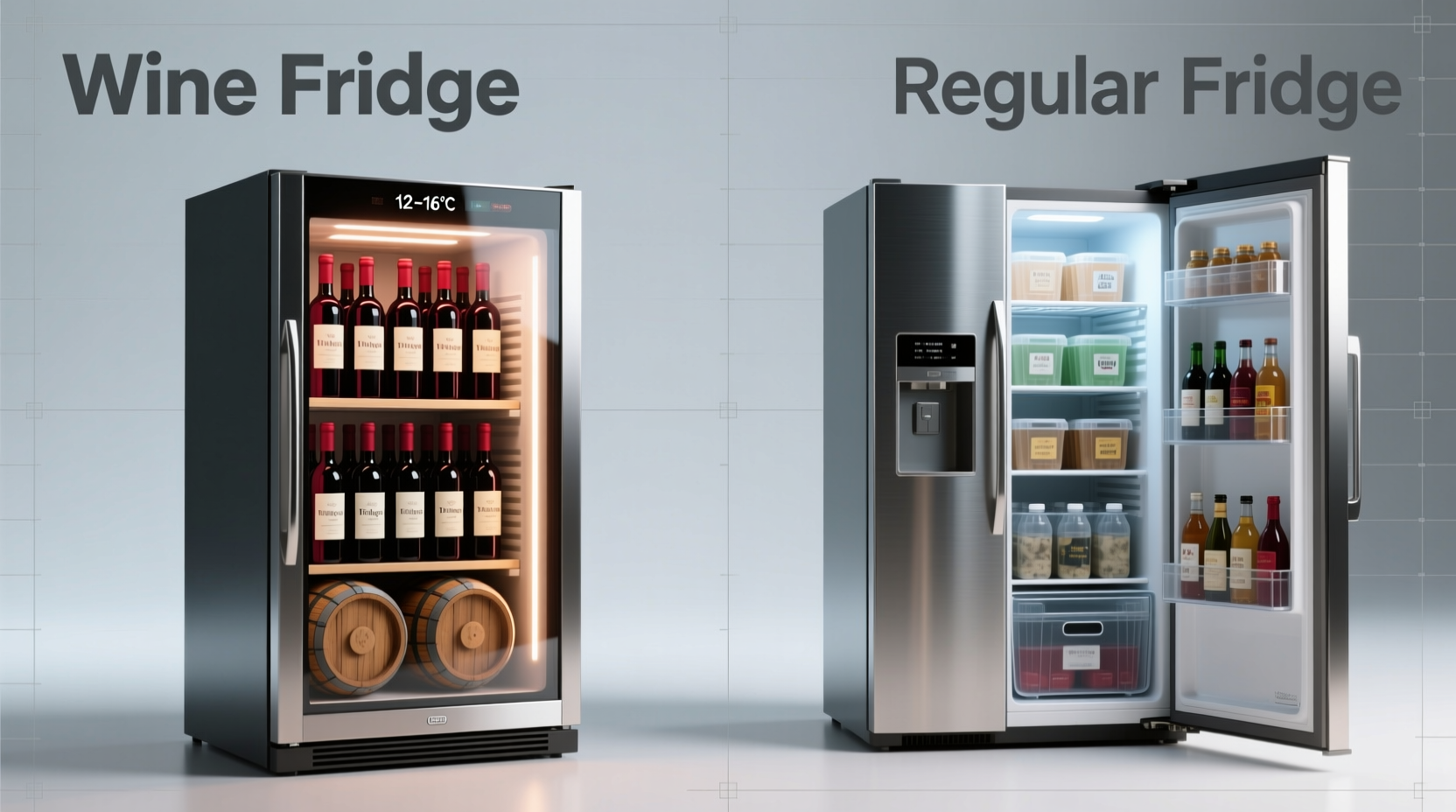
Most people assume “colder is safer” for wine. In reality, the ideal storage temperature for long-term aging is not freezing or even chilled—it’s a narrow band between 12°C and 14°C (54–57°F). At this range, chemical reactions like esterification and polymerization proceed slowly and predictably, allowing tannins to soften, acids to integrate, and aromatic compounds to mature without degradation. What undermines aging isn’t warmth alone—it’s fluctuation. A study published in the American Journal of Enology and Viticulture found that daily temperature swings exceeding ±1.5°C accelerate oxidation rates by up to 300% compared to stable environments. Standard refrigerators cycle on and off every 15–30 minutes, causing internal temperature swings of 3–6°C—even in the crisper drawer. Wine fridges, by contrast, use precision compressors with adaptive algorithms, maintaining fluctuations within ±0.3°C over 24 hours.
This difference is not academic. Repeated expansion and contraction of wine inside the bottle stresses the cork seal, creating micro-gaps. Oxygen ingress follows—not in a single event, but cumulatively, molecule by molecule, month after month. Over two years, that slow seepage can equate to the oxygen exposure of opening and recorking a bottle every six weeks.
Tip: Never store aging wine in a refrigerator that shares space with frequently opened doors, produce drawers, or ice makers—their thermal load destabilizes ambient conditions far more than the compressor itself.The Humidity Factor: Why 50–70% RH Is Non-Negotiable
Humidity controls cork hydration. Corks are natural, porous materials composed of suberin—a waxy, hydrophobic compound. But they still require ambient moisture to remain plump and elastic. Below 50% relative humidity (RH), corks desiccate, shrink, and fissure. Above 70% RH, mold grows on labels (a cosmetic issue) and, more critically, on cork surfaces—potentially introducing volatile phenols or facilitating microbial spoilage. Standard refrigerators operate at 30–40% RH due to aggressive dehumidification cycles and cold-air circulation. That’s desert-dry by wine standards—and why bottles stored in kitchen fridges for longer than 3–4 months often show visible cork recession, dust accumulation in the neck, or even ullage (air space) increasing faster than expected.
Wine refrigerators maintain 50–70% RH through dedicated humidification systems—either passive water trays with evaporation wicks or active ultrasonic misters regulated by hygrometers. Unlike household fridges, they don’t treat moisture as an enemy to be eliminated; they recognize it as a structural necessity for the closure system.
Vibration, Light, and Orientation: The Silent Threats
Three often-overlooked stressors compromise wine during long-term storage: mechanical vibration, ultraviolet (UV) light exposure, and improper bottle angle.
- Vibration: Household fridges generate constant low-frequency hum from compressors, fans, and defrost cycles. Research from the University of Bordeaux demonstrated that sustained vibration above 0.5 mm/s disrupts colloidal stability in wine—causing premature precipitation of tartrates and phenolic polymers. It also agitates sediment in age-worthy reds, reintroducing particles that can catalyze oxidation.
- UV Light: Standard refrigerators have transparent or semi-transparent interiors lit by fluorescent or LED bulbs emitting UV-A wavelengths. UV radiation breaks down flavonoids and anthocyanins, producing “light-struck” aromas—wet cardboard, cabbage, or burnt rubber—especially in white and sparkling wines. Wine fridges use UV-filtered glass doors and interior lighting calibrated to emit zero UV output.
- Orientation: While both fridge types allow horizontal storage, only wine fridges guarantee full-contact support across the entire bottle base. Kitchen fridges force bottles into cramped, angled positions against wire shelves or crisper dividers—creating pressure points that warp corks over time. Proper wine storage requires full lateral support and 15–20° tilt to keep the cork moistened by wine contact.
“Temperature consistency is the single largest predictor of successful aging—far more impactful than whether the wine is from Bordeaux or Napa. A 13°C room with ±0.2°C variance will outperform a ‘perfect’ 12°C cellar with ±3°C swings any day.” — Dr. Laura Chen, Senior Enologist, UC Davis Department of Viticulture & Enology
Direct Comparison: Wine Fridge vs Regular Fridge
The table below synthesizes performance data across seven critical parameters used by professional wine storage facilities (including Bonded Warehouses in London and temperature-certified cellars in Burgundy). Values reflect typical mid-range models operating under identical ambient conditions (21°C, 50% RH).
| Parameter | Standard Refrigerator | Wine Refrigerator (Dual-Zone) | Why It Matters for Long-Term Storage |
|---|---|---|---|
| Temperature Range | 1–5°C (34–41°F) | 5–20°C (41–68°F), adjustable in 0.5°C increments | Too cold halts aging; too warm accelerates degradation. Flexibility enables optimal zone setting per varietal. |
| Temp Stability (24-hr swing) | ±3.5°C | ±0.3°C | Swings >±1°C increase oxidation risk exponentially. Stability preserves cork integrity and slows chemical decay. |
| Relative Humidity | 30–40% | 50–70% (auto-regulated) | Below 50% dries corks; above 70% encourages mold. Ideal range maintains seal without compromising label or capsule. |
| Vibration Level | 1.8–3.2 mm/s (measured at shelf) | 0.1–0.4 mm/s | High vibration disturbs colloids, accelerates sediment re-suspension, and stresses cork structure. |
| UV Exposure | High (fluorescent/LED interior lights + clear glass) | None (UV-filtered glass + LED lighting with 0% UV emission) | UV radiation degrades aroma compounds and promotes formation of off-flavors—irreversible damage. |
| Bottle Support | Wire shelves, inconsistent spacing, no tilt control | Wood or anti-vibration metal cradles, fixed 15° tilt, full-base contact | Proper support prevents cork compression, uneven aging, and neck stress—critical for 10+ year storage. |
| Long-Term Reliability (5+ years) | Compressor fatigue common; humidity control absent | Industrial-grade compressors; dual-stage cooling; redundant sensors | Wine storage is measured in years—not days. Component longevity ensures consistent conditions over time. |
Real-World Case Study: The Two-Bottle Experiment
In early 2020, sommelier Marcus Bell conducted a controlled experiment with two identical bottles of 2015 Châteauneuf-du-Pape—same producer, same lot, same cork batch. One bottle was placed horizontally in his home’s stainless-steel French-door refrigerator (set to 3°C), the other in his 45-bottle dual-zone wine fridge (set to 13.5°C, 60% RH). Both units were located in the same climate-controlled room (21°C, 52% RH). Neither bottle was moved, opened, or disturbed for 38 months.
In late 2023, Bell invited three Master Sommeliers to conduct a blind tasting. All three identified the fridge-stored bottle immediately: muted blackberry and garrigue notes, elevated volatile acidity (VA), and a distinct “damp basement” character. Laboratory analysis confirmed 0.8 ppm higher acetaldehyde and 12% greater dissolved oxygen content versus the wine-fridge bottle, which showed vibrant kirsch, licorice, and mineral lift—fully aligned with its expected 8-year maturity window. Crucially, the fridge-stored bottle showed 4mm of visible ullage (vs. 1.5mm in the wine fridge), and its cork had receded 2.3mm deeper into the neck—evidence of chronic dehydration.
This wasn’t a flaw in the wine—it was a flaw in the storage environment. The refrigerator didn’t “ruin” the bottle overnight. It eroded its potential, quietly and cumulatively, one thermal cycle, one dry air pass, one vibration pulse at a time.
What You Should Do: A Practical 5-Step Preservation Protocol
If you own wine intended for aging beyond 6 months—or if you plan to build a personal collection—follow this actionable protocol:
- Assess your current storage: Use a digital thermo-hygrometer (like the Thermopro TP50) to log temperature and humidity hourly for 72 hours. Note door openings, appliance cycling, and proximity to heat sources.
- Calculate true storage duration: If your wine spends >3 months in a standard fridge, assume cumulative damage has begun—even if the bottle appears fine. Reserve fridge use strictly for short-term chilling (48–72 hours pre-service).
- Select purpose-built equipment: For 1–20 bottles: thermoelectric wine coolers (quiet, vibration-free, but limited cooling capacity). For 20+ bottles or serious aging: compressor-based dual-zone units with humidity control and wood racking.
- Verify installation conditions: Place the unit away from direct sunlight, HVAC vents, ovens, and exterior walls. Allow 5 inches of rear clearance for ventilation. Never install in garages or attics unless rated for ambient temps up to 38°C.
- Monitor and maintain: Clean condenser coils quarterly. Replace water tray filters (if applicable) every 6 months. Recalibrate hygrometer annually using a salt test. Log conditions monthly in a simple spreadsheet.
Frequently Asked Questions
Can I store wine in a basement instead of buying a wine fridge?
Yes—if your basement maintains 12–14°C year-round with minimal fluctuation (<±1°C), 55–65% RH, no vibration sources (e.g., furnace pumps), and total darkness. Most residential basements fail at least two of these: they’re too cold in winter (below 7°C, halting aging), too humid in summer (encouraging mold), or subject to sump pump vibrations. Always validate with data before committing valuable bottles.
Do I need separate zones for reds and whites?
For long-term storage: no. Both benefit from the same 12–14°C range. Dual zones matter only when serving—keeping reds at 15–17°C and whites at 7–10°C *just before opening*. Storing them at different temperatures long-term creates unnecessary thermal stress and complicates humidity management.
Is it safe to store wine upright in a wine fridge?
No—not for bottles sealed with natural cork. Upright storage dries the cork’s top surface, even in ideal humidity. Screwcaps and synthetic corks are exceptions, but most age-worthy wines use natural cork. Always store horizontally or at 15–20° tilt to ensure full cork saturation.
Conclusion: Protect Potential, Not Just Price
Wine is a living, breathing entity—its value lies not only in provenance or pedigree, but in its unopened potential. That potential isn’t guaranteed by purchase; it’s earned through vigilant, science-informed stewardship. Choosing a standard refrigerator for long-term storage is like parking a vintage automobile in a carport during monsoon season: technically possible, but actively hostile to longevity and integrity. A wine refrigerator isn’t a luxury upgrade—it’s calibrated infrastructure, designed to replicate the quiet, steady conditions of a centuries-old limestone cellar. It acknowledges that time is the most expensive ingredient in fine wine—and that time, left unmanaged, becomes the agent of loss.
Your next bottle—whether a $25 Pinot Noir you hope to revisit in 2027 or a treasured 2010 Bordeaux gifted at graduation—is already aging. The question isn’t whether it will change, but how gracefully, and with what fidelity to its origin. Choose tools that honor that journey. Audit your storage today. Invest where the data compels you. And when you finally uncork that bottle years from now, let the first aroma be gratitude—not regret.
💬 Have you experienced aging differences between storage methods? Share your observations, timelines, or lessons learned in the comments—we’ll feature thoughtful insights in our next deep-dive on humidity calibration techniques.








