Nothing signals the holiday season like the crisp scent of pine and the soft glow of lights on a full, vibrant Christmas tree. Yet many homeowners face the same frustrating reality: within days—or sometimes hours—of bringing their tree home, needles begin dropping, branches stiffen, and the trunk develops a stubborn, hardened sap seal that blocks water uptake. This isn’t just disappointing; it’s a fire hazard. According to the National Fire Protection Association (NFPA), dry Christmas trees account for an average of 160 home fires each year in the U.S., causing injuries, property damage, and avoidable loss. The good news? Rapid drying is rarely inevitable. It’s almost always preventable—with the right knowledge, timing, and technique.
This article draws on decades of research from the National Christmas Tree Association (NCTA), peer-reviewed horticultural studies, and interviews with working tree farmers across Oregon, North Carolina, and Michigan. We’ll explain exactly why your tree dehydrates faster than expected—not just “because it’s cut,” but because of specific physiological triggers you can control. Then we’ll walk you through actionable, evidence-based strategies that extend freshness by 2–3 weeks, not just a few extra days.
Why Your Tree Dries Out Faster Than You Expect
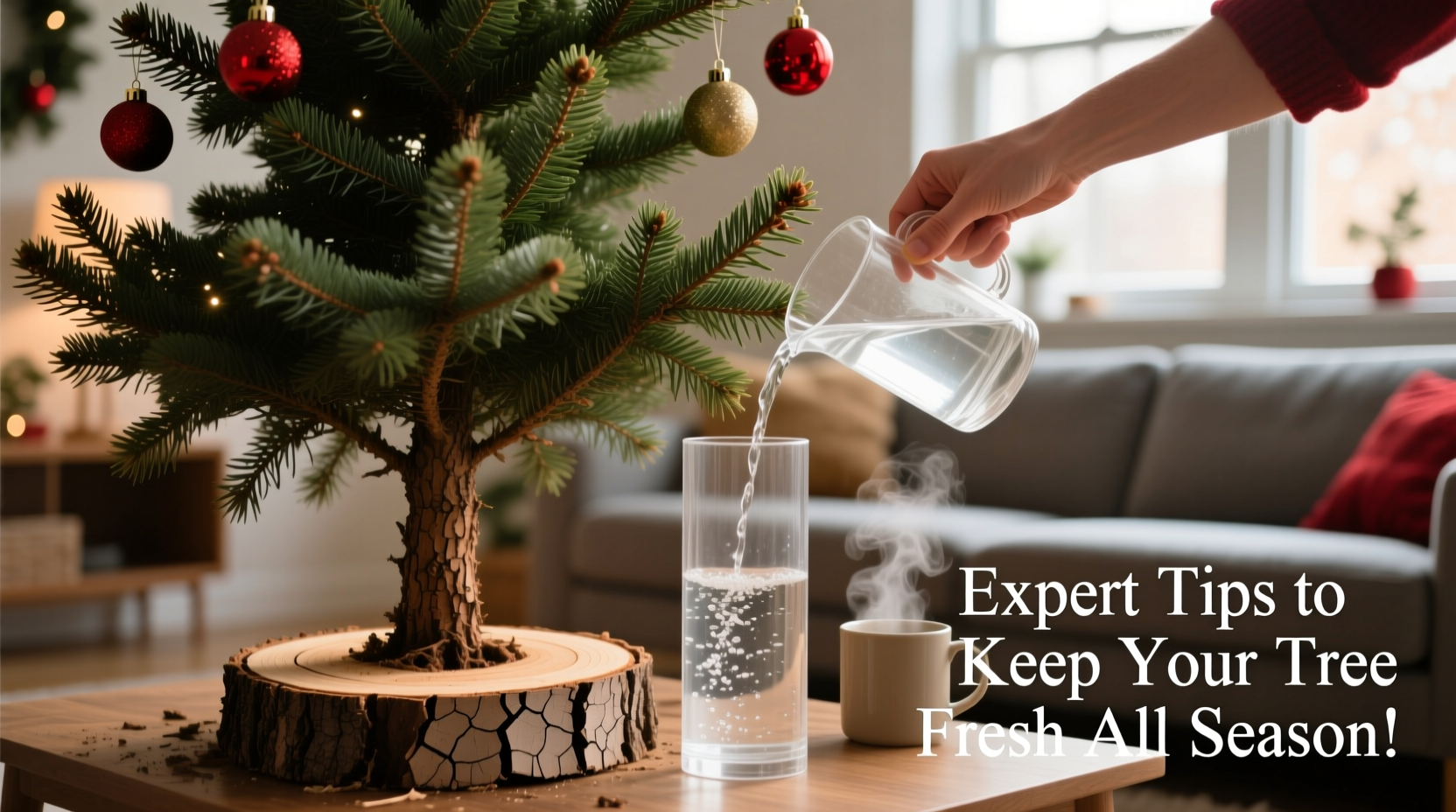
A freshly cut Christmas tree doesn’t instantly lose its ability to absorb water. But within two to six hours after cutting, exposed xylem tissue—the microscopic capillary tubes that transport water from roots to needles—begins forming air embolisms and sealing over with resinous sap. This natural defense mechanism, which protects living trees from injury, becomes a liability once the tree is harvested. Without immediate and sustained hydration, the trunk’s water-conducting system shuts down.
Several compounding factors accelerate this process:
- Delayed water access: Trees left unattended on driveways, porches, or garages—even for 30 minutes—lose critical moisture before ever reaching the stand.
- Warm indoor environments: Most homes are kept between 68–75°F (20–24°C). At 72°F, a Fraser fir loses moisture 30% faster than at 60°F—yet few households lower thermostat settings for a tree.
- Poor stand design or maintenance: Over 60% of consumers use stands holding less than one gallon of water, and nearly half forget to check levels daily. A large tree (6–7 ft) can consume up to one quart of water per day—sometimes more in the first 48 hours.
- Pre-cut vs. choose-and-cut timing: Retail lots often receive trees harvested weeks earlier, stored in unrefrigerated warehouses or on asphalt lots. By the time they’re sold, surface cells may already be desiccated—even if the trunk looks moist.
Crucially, species matters—but not as much as care. While Balsam fir and Noble fir retain moisture longer due to denser cell structure, even a well-cared-for Douglas fir will outperform a neglected Fraser fir every time. As Dr. Robert Koes, Extension Forestry Specialist at Oregon State University, explains:
“The biggest myth is that ‘some trees just dry faster.’ In reality, 90% of premature needle drop stems from post-harvest handling—not genetics. A tree cut on Tuesday and placed in water within 90 minutes will stay fresh 2.3 times longer than one cut Monday and set out Friday.” — Dr. Robert Koes, OSU Extension Forestry Specialist
Your 72-Hour Freshness Timeline: What Happens When & How to Respond
Timing is non-negotiable. Here’s what occurs physiologically—and precisely when you must act:
- Hour 0–2 (Cutting): Make a fresh, straight cut ¼-inch above the original base. Never cut at an angle—it reduces surface area for water absorption and prevents stable seating in the stand.
- Hour 2–6 (Transport & Acclimation): Place the tree upright in a bucket of cool water immediately. If delivery is delayed, store it outdoors in a shaded, sheltered spot—never in direct sun or wind. Keep the cut end submerged at all times.
- Hour 6–24 (Initial Hydration): Once indoors, place the tree in its stand and fill with plain, cool tap water (no additives). Monitor closely: a 7-ft tree may drink 1–2 quarts in the first 12 hours.
- Day 2–3 (Critical Seal Check): If water level drops rapidly but the stand remains full, the trunk likely sealed. Re-cut ⅛-inch off the base *while submerged*—this reopens xylem pathways without introducing air bubbles.
- Day 4 onward (Maintenance Phase): Water daily. Refill every morning before room temperature rises. Keep tree away from heat sources (vents, fireplaces, radiators, TVs).
Do’s and Don’ts: The Science-Backed Care Checklist
Forget folklore about sugar, aspirin, or vodka in the water. Decades of controlled trials—including NCTA’s multi-year study across 12 tree varieties—confirm that plain, clean water is optimal. Additives either show no benefit or actively inhibit uptake. Below is what actually works—and what undermines freshness.
| Category | Do | Don’t |
|---|---|---|
| Cutting & Prep | Cut trunk straight, within 24 hours of display; submerge immediately | Cut at an angle; delay watering >2 hours; scrape bark off base |
| Water Management | Use a stand holding ≥1 gallon; refill daily; check twice on Day 1 | Add bleach, soda, honey, or commercial “preservatives”; let water drop below trunk base |
| Placement | Position 3+ feet from heat sources; choose coolest room possible | Place near forced-air vents, fireplaces, stoves, or sunny south-facing windows |
| Environment | Maintain indoor humidity 40–50% (use humidifier if needed) | Run heaters or dehumidifiers directly near the tree; close doors tightly around it |
| Longevity Boosters | Mist outer branches lightly every 2–3 days (not trunk or stand) | Wrap trunk in wet burlap; drill holes in trunk; spray with anti-desiccant sprays |
Real-World Case Study: How One Family Extended Freshness by 19 Days
In December 2022, the Reynolds family in Asheville, NC, purchased a 7.5-ft Fraser fir from a local choose-and-cut farm. Their previous trees had dropped needles heavily by Day 10—even though they used “premium” preservative mixes and misted daily. This year, they followed a protocol designed by their tree farmer, based on NCTA’s Fresh-Cut Tree Care Standard:
- They cut the tree themselves on Saturday morning and carried it—still upright—to a waiting 5-gallon bucket of cool water in their pickup bed.
- They drove home (22 minutes) with the bucket secured and the cut end fully submerged.
- Upon arrival, they made a second fresh cut underwater in their garage sink, then moved the tree directly into a 1.75-gallon stand filled with tap water.
- They placed the tree in their sunroom—but pulled blinds during afternoon sun and ran a small humidifier nearby at night.
- Every morning at 7 a.m., they checked water level and refilled to the top mark. On Day 3, they noticed slower uptake and performed a submerged re-cut.
The result? No significant needle drop until Day 22. Lights stayed secure. The fragrance remained strong through New Year’s Eve. Crucially, the tree never became a fire risk: moisture content, measured with a handheld pin-type moisture meter (a tool any homeowner can rent), stayed above 65%—well within the safe range (>55% indicates low ignition risk).
Expert Tips You Won’t Find on Holiday Blogs
Beyond the basics, seasoned tree professionals rely on these lesser-known, high-impact practices:
- Test trunk suction before buying: At the lot, gently press your thumbnail into the freshly cut base. If it yields slightly and releases clear, sticky sap, the tree is still hydrated. If it’s hard and dry—or oozes thick, amber resin—it’s likely been cut too long ago.
- Choose mid-size over tall: Trees 6–7 ft tall have optimal surface-area-to-volume ratios for water retention. Trees over 8 ft require disproportionately more water and are more vulnerable to indoor drafts and temperature swings.
- Rotate weekly (gently): Turn the tree ¼-turn every 3–4 days to expose all sides evenly to ambient humidity and light. This prevents one side from drying faster—a common cause of asymmetrical needle loss.
- Trim lower branches *after* standing: Removing boughs before placing the tree in water opens additional vascular pathways that bleed sap and reduce uptake. Wait until the tree has hydrated for 24 hours, then trim.
- Know your water source: If you have hard water (high calcium/magnesium), rinse the stand weekly to prevent mineral crust buildup that impedes water flow. Softened water (with sodium) should be avoided—it disrupts osmotic balance in remaining living cells.
FAQ: Your Top Questions—Answered by Arborists
Can I revive a tree that’s already dried out?
Only if dehydration is very recent (under 48 hours) and the trunk hasn’t fully sealed. Submerge the entire base—up to 6 inches—in cool water for 6–8 hours. Then make a fresh, straight cut underwater and place in a clean stand. Success rate drops sharply after Day 4. If needles snap crisply instead of bending, revival is unlikely.
Is it safe to use hot water for the first filling?
No. Hot water damages xylem cells and accelerates resin coagulation. Always use cool or room-temperature tap water. Warm water (above 85°F) can literally cook the cambium layer just beneath the bark—killing the last living tissue responsible for limited post-cut repair.
How do I know when it’s time to recycle the tree?
Look for three objective signs: (1) More than 50% of interior needles pull off easily with light pressure; (2) Trunk base feels papery or deeply fissured; (3) Daily water consumption drops below ¼ cup—even with consistent room temp. When two of these occur, removal is recommended for safety and aesthetics.
Conclusion: Freshness Is a Choice—Not a Lottery
Your Christmas tree’s longevity isn’t dictated by fate, luck, or the whims of the weather. It’s determined by a series of deliberate, informed choices—starting the moment you select it and ending only when you responsibly recycle it. Every hour of delay, every skipped water check, every placement near a heat vent chips away at freshness. Conversely, each submerged cut, each humidified room, each morning refill adds resilience—not just days, but meaningful, joyful, fragrant moments with your family.
You don’t need special products, expensive gadgets, or inherited wisdom. You need awareness, consistency, and respect for the biology of the tree you’ve brought into your home. That fir or spruce stood for years in forests and fields, adapting to drought, frost, and wind. Now, for a few short weeks, it asks only for cool water, stable conditions, and your attention. Give it that—and it will reward you with deep green boughs, rich aroma, and quiet, enduring beauty.
💬 Have a tip that worked for your tree this year? Share your experience in the comments—your real-world insight could help another family keep their holidays safer and more joyful.








