Cats are enigmatic creatures. One moment they’re curled up in serene silence, the next they’re swiping a water glass off your coffee table with laser precision. If you’ve ever found yourself cleaning up shattered ceramics or chasing a runaway pen across the floor, only to lock eyes with an unrepentant feline staring back at you, you're not alone. This seemingly destructive behavior has puzzled pet owners for years. But according to animal behaviorists, there’s more to this act than mere mischief. It’s rooted in instinct, curiosity, communication, and sometimes even boredom. Understanding the psychology behind why your cat knocks things off the table can help you respond appropriately—without resorting to punishment or frustration.
The Evolutionary Roots of Object Manipulation
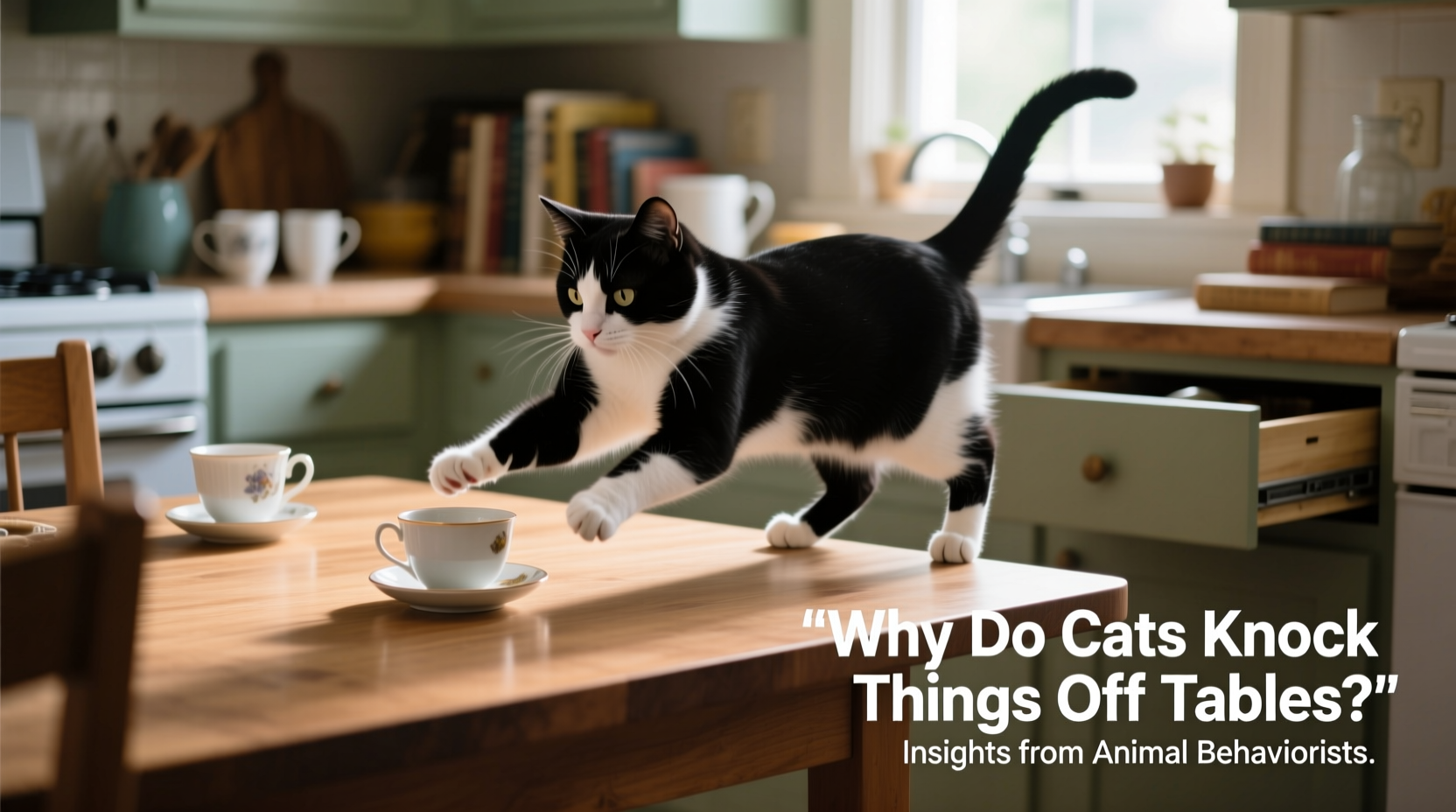
Cats are natural predators. Even domesticated housecats carry genetic blueprints shaped by thousands of years of hunting small prey in the wild. Their paws aren’t just for walking—they’re sensitive tools used for exploration, testing movement, and capturing prey. When a cat bats at an object on a table, it’s often replicating behaviors seen in kittenhood when young cats practice hunting skills on leaves, insects, or moving shadows.
In the wild, felines use their paws to test whether something is alive or inert. A twitch, roll, or fall triggers their predatory sequence: stalk, pounce, capture. A pen rolling off a desk mimics the erratic motion of a fleeing mouse. The resulting crash may further stimulate their attention—not because they intended destruction, but because the sensory feedback confirms that the object responded like potential prey.
“Cats don’t knock things over to annoy us. They’re exploring cause and effect, refining motor skills, and satisfying deeply ingrained instincts.” — Dr. Sarah Ellis, Feline Behavior Scientist, University of Bristol
This behavior isn’t unique to certain breeds or ages; it’s widespread across the species. Kittens do it while learning about their environment, and adult cats continue it as mental stimulation—especially if their surroundings lack enrichment.
Curiosity and Environmental Investigation
Cats are highly curious animals. Their world is experienced through touch, sound, smell, and movement. Unlike humans, who rely heavily on vision, cats gather information through interaction. An object sitting still on a shelf offers little data. But once it moves—rolls, spins, or crashes—it becomes interesting.
When a cat nudges an item, it’s essentially conducting a scientific experiment: “What happens if I touch this?” The auditory feedback (a clatter), visual change (the object falling), and tactile sensation (resistance or smoothness) all contribute to cognitive processing. This investigative tendency is especially strong in indoor cats who have fewer opportunities to explore dynamic outdoor environments.
Tip: Rotate household objects regularly to provide novelty without encouraging destructive habits.Interestingly, studies show that cats are more likely to interact with objects near the edge of surfaces. From a behavioral standpoint, these items appear unstable—therefore more likely to produce a reaction when touched. This makes them inherently more appealing than centrally placed decor.
Communication Through Action
While instinct plays a major role, knocking things over can also be a form of communication. Cats are masters of subtle signaling, and when verbal cues fail, they turn to action. If your cat consistently targets items near you—especially during work, meals, or phone calls—it may be seeking attention.
A falling mug gets a reaction. You look up. You speak. You move. To a cat, this is successful engagement. Even negative reactions—like scolding—are still attention, which reinforces the behavior. Over time, cats learn that certain actions reliably produce human responses, making object-knocking a learned social strategy.
This is particularly common in households where cats spend long periods alone. Without sufficient interactive play or mental challenges, they create their own entertainment—and if that entertainment results in owner interaction, the cycle continues.
Recognizing Attention-Seeking Patterns
- Timing: Does the behavior occur when you’re focused elsewhere?
- Selectivity: Are only specific items targeted (e.g., keys, glasses)?
- Repetition: Is the same object knocked off multiple times?
- Eye contact: Does your cat watch you after the knock?
If these signs are present, the motivation is likely social rather than purely exploratory.
Environmental Enrichment Checklist
Preventing unwanted object-knocking starts with addressing the root causes: under-stimulation and lack of appropriate outlets. Use this checklist to assess and improve your cat’s environment:
- Provide daily interactive play sessions (at least 10–15 minutes twice a day)
- Offer puzzle feeders or treat-dispensing toys
- Install window perches for bird watching
- Rotate toys weekly to maintain novelty
- Use vertical space with shelves or cat trees
- Introduce safe, movable objects (e.g., crumpled paper balls, ping pong balls)
- Limit access to fragile or dangerous items on edges
Enrichment doesn’t require expensive gear. Simple changes—like dangling a shoestring from a door handle or placing a cardboard box upside-down for batting—can redirect energy productively.
Do’s and Don’ts of Managing Table-Knocking Behavior
| Do’s | Don’ts |
|---|---|
| Redirect gently: Offer a toy when you catch your cat mid-swat. | Yell or punish: This increases anxiety and damages trust. |
| Secure valuables: Keep breakables out of reach or anchor them. | Ignore repeated signals: Frequent knocking may indicate unmet needs. |
| Use deterrents: Double-sided tape or aluminum foil on tables can discourage jumping. | Assume malice: Cats don’t act out of spite or revenge. |
| Engage before incidents: Proactive play reduces opportunistic mischief. | Leave tempting items unattended: Pens, bottles, and phones attract paw-testing. |
Consistency matters. Reacting only occasionally sends mixed messages. If you want to discourage the behavior, ensure all household members respond the same way—preferably by redirecting, not reprimanding.
A Real-Life Example: Luna and the Coffee Table Chronicles
Sophie, a graphic designer working from home, noticed her cat Luna had developed a habit of knocking over her water glass every afternoon around 3 PM. At first, she assumed it was random. But after tracking patterns, she realized it always happened during video calls. Luna would sit silently, then suddenly push the glass off the table—right as Sophie was presenting.
Concerned, Sophie consulted a certified cat behavior consultant. After reviewing videos and lifestyle details, the expert concluded that Luna wasn’t being destructive—she was trying to get Sophie’s attention. With no other pets and limited playtime due to work demands, Luna had learned that disrupting meetings guaranteed immediate interaction, even if it was scolding.
The solution? Scheduled play sessions before and after work hours, plus introducing a “distraction station” near the desk: a small tray with lightweight, noisy toys Luna could bat without consequence. Within two weeks, the water glass remained upright. Luna still watched calls intently—but now she played with her jingle ball instead.
This case illustrates how context shapes behavior. What looked like defiance was actually a cry for engagement, solved not by suppression but by understanding.
Medical and Psychological Considerations
While most object-knocking is normal, sudden or obsessive behavior warrants closer inspection. In rare cases, repetitive paw-swiping or fixation on falling objects can signal underlying issues:
- Cognitive dysfunction: Older cats may develop compulsive behaviors due to neurological changes.
- Vision loss: Impaired sight can make depth perception difficult, leading to accidental knocks.
- Anxiety or stress: Environmental changes (new pets, moves, loud noises) may trigger displacement behaviors.
- Pain avoidance: A cat with arthritis might avoid stepping onto a surface but still test objects from a distance.
If your cat begins knocking things over excessively—or shows other signs like vocalization, litter box avoidance, or aggression—consult your veterinarian. Ruling out medical causes ensures humane and effective intervention.
Frequently Asked Questions
Is my cat being malicious when it knocks things down?
No. Cats lack the human concept of malice. They don’t understand that breaking a vase will upset you. Their actions are driven by instinct, curiosity, or learned outcomes—not intentional harm.
Can I train my cat to stop knocking things over?
You can’t eliminate the instinct, but you can redirect it. Training focuses on providing acceptable alternatives and managing the environment. Positive reinforcement for playing with designated toys works better than punishment.
Why does my cat only knock over full glasses and not empty ones?
Full glasses are heavier and produce more dramatic sensory feedback—the sound of liquid spilling, the weight shift, the splash. These elements make them more stimulating than lightweight or empty containers.
Conclusion: Understanding Over Judgment
Your cat isn’t trying to sabotage your home. Every swipe, nudge, and topple is a window into a complex mind shaped by evolution, emotion, and environment. By viewing this behavior through the lens of science rather than frustration, you gain deeper insight into your companion’s needs and motivations.
Instead of asking, “Why does my cat do this?” try asking, “What is my cat trying to tell me?” The answer might be simple: curiosity, boredom, or a desire for connection. Meet those needs with empathy, structure, and playful engagement, and you’ll likely see fewer casualties on your floors—and a stronger bond with your feline friend.
💬 Have a story about your cat’s tabletop antics? Share your experience in the comments below—your insight could help another confused cat parent find clarity.








