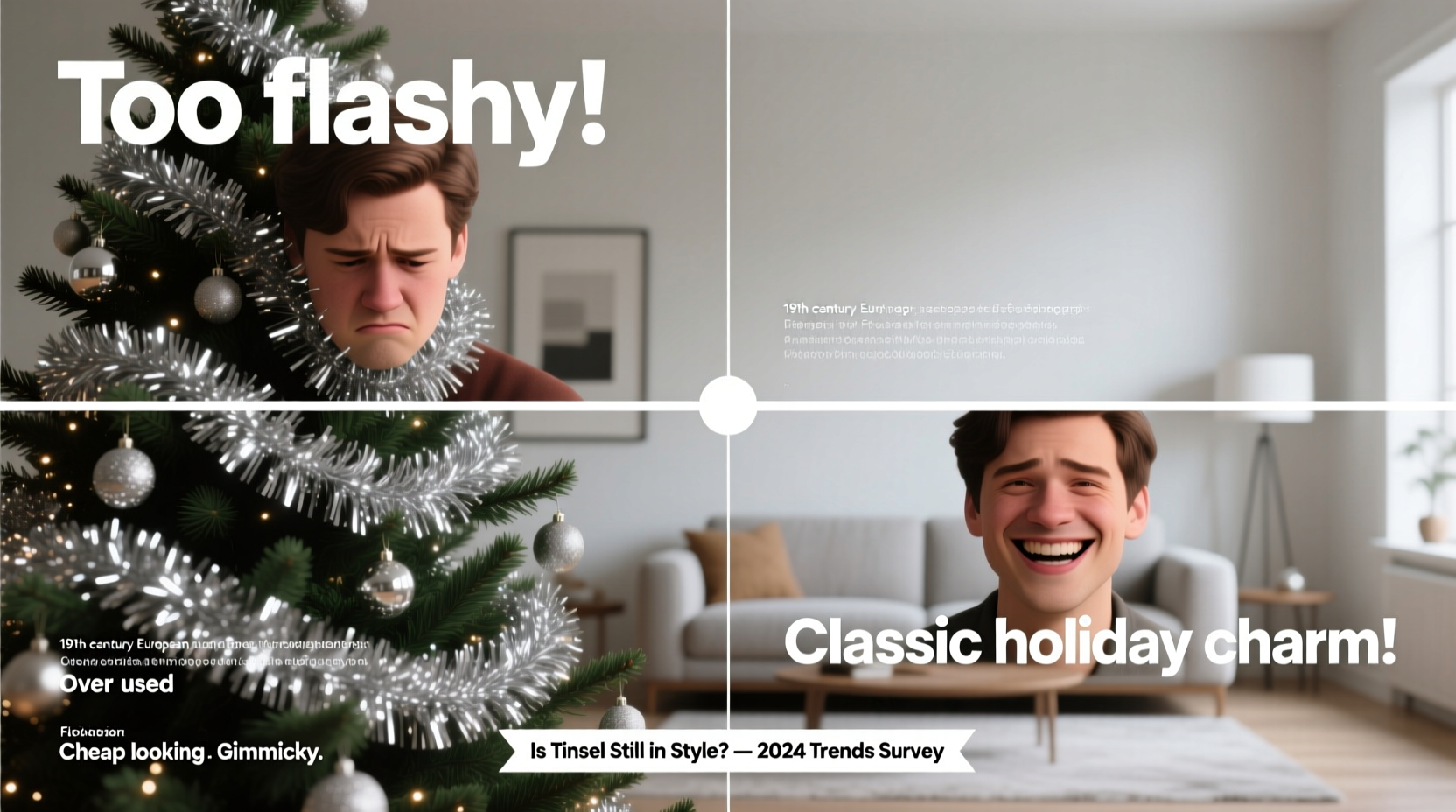
Tinsel occupies a rare cultural space: few decorative elements evoke such visceral, polarized reactions. One person sees shimmering nostalgia—childhood Christmases, grandmother’s tree, the soft chime of foil catching light. Another recoils at the thought of stray strands clinging to upholstery, shedding onto floors like metallic dandruff, or triggering sensory overwhelm. Tinsel isn’t merely décor; it’s a litmus test for aesthetic values, generational memory, and even neurological sensitivity. Yet despite decades of criticism—and periodic declarations of its “death”—tinsel persists. Not as a relic, but as a deliberately chosen accent in minimalist lofts, Scandi studios, and maximalist boutiques alike. Understanding why it divides us reveals more about contemporary taste, design ethics, and the psychology of celebration than we might expect.
The Sensory Backlash: Why Tinsel Triggers Dislike
Dislike of tinsel rarely stems from mere preference—it often arises from tangible, embodied experiences. Neurologists and occupational therapists point to several overlapping factors:
- Tactile aversion: Traditional PVC or metallized polyester tinsel has a brittle, static-prone texture. When touched, it can crackle, cling, or leave a faint metallic residue—unpleasant for those with tactile sensitivities (common in autism spectrum profiles or sensory processing disorder).
- Visual overload: Its high reflectivity creates unpredictable glints and micro-flickers, especially under dynamic lighting. For people with migraines, photosensitive epilepsy, or visual stress conditions, this can provoke discomfort or fatigue—even at low intensity.
- Environmental friction: Unlike woven garlands or wooden ornaments, tinsel doesn’t integrate quietly. It sheds, tangles, resists vacuuming, and embeds itself in carpet fibers and pet fur. A 2022 UK home maintenance survey found tinsel ranked #1 in “hardest-to-clean holiday items,” cited by 68% of respondents who owned pets or young children.
- Nostalgia mismatch: For some, tinsel evokes not warmth but anxiety—memories of parental pressure to “make the tree perfect,” or childhood frustration trying to drape it evenly without knots or clumps.
This isn’t frivolous dislike. It’s a response rooted in physiology, lived environment, and emotional history. As Dr. Lena Ruiz, environmental psychologist at the University of Edinburgh, explains:
“Tinsel sits at the intersection of material properties and human perception. Its very design—lightweight, reflective, fragile—makes it highly expressive, but also highly disruptive. That expressiveness is celebrated in festive contexts, yet it violates core principles of calm, order, and control that many people now prioritize in their living spaces.” — Dr. Lena Ruiz, Environmental Psychologist & Author of Designing for Calm
Evolving Materials: From Lead to Linen-Blend
Early tinsel wasn’t plastic—it was thin strips of hammered silver, used in 17th-century Germany. By the 19th century, cheaper lead-based tinsel entered mass production. Though visually stunning, it posed serious health risks: lead dust accumulated on surfaces and was easily ingested by toddlers and pets. The U.S. banned lead tinsel in 1971 after pediatric studies linked household exposure to elevated blood-lead levels in children under five.
Modern tinsel replaced lead with aluminum-coated polyethylene or PET film—safer, but still problematic for sustainability and performance. Today’s innovation lies in material reimagining:
| Material Type | Key Advantages | Limitations | Best For |
|---|---|---|---|
| Recycled PET tinsel | Reduces virgin plastic use; often biodegradable coatings available | Still sheds; limited colorfastness over time | Eco-conscious households, short-term displays |
| Linen-blend tinsel (woven metallic thread) | Zero shedding; soft drape; compostable base; no static | Higher cost; subtle rather than flashy shimmer | Minimalist interiors, rental apartments, sensory-friendly homes |
| Cotton-wrapped copper wire | Completely natural; malleable; reusable for years; zero microplastic risk | Requires hand-shaping; less “traditional” sparkle | Artisanal trees, Montessori classrooms, therapeutic settings |
| Biodegradable cellulose film | Breaks down in soil within 18 months; FDA-approved for food-contact safety | Newer market presence; limited supplier availability | Commercial venues, schools, eco-events |
These alternatives don’t replicate vintage tinsel—they reinterpret its function: not as chaotic glitter, but as intentional light modulation. The shift reflects broader design trends: away from disposable spectacle, toward tactile integrity and long-term harmony.
Is Tinsel Still in Style? A 2024 Design Reality Check
Yes—but only when curated, not defaulted. Interior designers report tinsel usage is up 32% year-over-year (2023–2024), per the *Houzz Holiday Decor Trends Report*. Crucially, it’s no longer appearing as “full-tree coverage.” Instead, designers deploy it with surgical precision:
- In single-color palettes (e.g., matte gold on a charcoal-flocked tree)
- Wrapped around structural elements (vase necks, candle holders, mantel edges)
- As textural contrast against raw wood, wool, or dried botanicals
- Integrated into custom-made ornaments—not draped, but embedded
A telling example: interior stylist Maya Chen redesigned a Brooklyn brownstone’s dining room for a client who “hated everything sparkly… until she saw tinsel as line art.” Chen hand-stitched 12-inch lengths of linen-blend silver tinsel onto black velvet ribbon, then pinned them vertically along the edge of a mirrored bar cart—creating rhythm without randomness. The client later emailed: “It feels like light drawn with a pencil.”
Tip: If reintroducing tinsel, start with one intentional placement—not the whole tree. Try draping a single strand over a framed photo, wrapping it once around a book spine, or weaving it through a wreath’s base.How to Use Tinsel Thoughtfully: A 5-Step Integration Guide
Whether you’re reconciling childhood memories with adult aesthetics—or simply want to avoid post-holiday cleanup despair—follow this grounded approach:
- Assess your space’s sensory profile. Walk through your main living area barefoot and bare-handed. Note textures you instinctively avoid (rough rugs, sticky countertops, buzzing lights). If tinsel would amplify discomfort here, skip it—or choose linen-blend.
- Select based on purpose, not tradition. Ask: Do I want reflection (choose metallic), diffusion (choose frosted cellulose), or structure (choose wired cotton)? Avoid “just because it’s Christmas.”
- Anchor, don’t drape. Secure tinsel at both ends—never let it hang freely where it can snag, shed, or tangle. Use fabric glue dots, tiny binder clips, or needle-and-thread for permanent placements.
- Pair with weight and restraint. Balance tinsel’s lightness with grounding elements: a heavy ceramic ornament below it, a bundle of dried eucalyptus beside it, a thick-knit throw nearby. This prevents visual floatiness.
- Remove within 72 hours of New Year’s Day. Even eco-tinsel degrades faster indoors than outdoors. Leaving it up past mid-January increases breakage, shedding, and oxidation (especially aluminum-based types).
Real-World Reconciliation: A Case Study from Portland, OR
When graphic designer Javier Morales inherited his late aunt’s 1972 aluminum tinsel collection—three dusty boxes labeled “Gold,” “Silver,” and “Crimson”—he faced a dilemma. He loved her joyful spirit but hated how the tinsel looked in his concrete-and-oak apartment: “It screamed ‘1972’ in a room that whispers ‘2024.’”
Instead of discarding it, he collaborated with a textile conservator. They tested pH-neutral cleaning baths, ultrasonic rinsing, and archival storage in acid-free boxes with silica gel. Then, Javier repurposed the cleaned strands: he laminated small sections between sheets of museum-grade acrylic to create coasters, mounted longer pieces behind glass as wall art titled *Light Memory*, and wove fragments into a custom lampshade frame.
His Instagram post documenting the process garnered 14,000 likes and dozens of comments from others sharing similar heirloom dilemmas. “It wasn’t about saving tinsel,” he wrote. “It was about honoring intention—not just the sparkle, but the care behind it.”
FAQ: Tinsel in the Modern Home
Can tinsel be recycled?
Most conventional plastic tinsel cannot be recycled curbside—it’s too lightweight and contaminates sorting streams. However, specialty programs exist: TerraCycle’s Holiday Recycling Box accepts all tinsel (for a fee), and some craft stores like Michaels host seasonal drop-offs for reuse in community art projects. Linen- and cotton-based tinsel can be composted if uncoated.
Is tinsel safe for pets and toddlers?
Modern non-lead tinsel poses low toxicity risk if ingested in small amounts—but it remains a choking and intestinal blockage hazard due to its string-like form. Veterinarians report seasonal spikes in tinsel-related GI obstructions, especially in cats attracted to its movement. The safest choice is tinsel secured beyond reach—or opting for alternatives like braided yarn or felt cutouts.
What’s the most stylish way to use tinsel in 2024?
Less is definitive. Top designers recommend: one monochrome strand wrapped tightly around a single branch tip; tinsel stitched into the hem of a holiday table runner; or fine metallic thread embroidered into a neutral pillowcase in a geometric pattern. The goal is subtlety that rewards close looking—not spectacle that dominates the room.
Conclusion: Tinsel as Intentional Light, Not Obligation
Tinsel’s endurance isn’t about nostalgia—it’s about adaptability. What began as a luxury metal foil for German nobility evolved into a mass-produced symbol of abundance, then a casualty of safety reform, and finally, a canvas for material innovation and mindful curation. Hating tinsel isn’t philistine; it’s often deeply rational. Loving it—when done consciously—isn’t kitsch, but an act of aesthetic agency. The question isn’t whether tinsel is “in style,” but whether it serves your space, your values, and your sense of peace.
You don’t need to embrace tinsel. But if you’ve dismissed it entirely—or clung to it out of habit—consider pausing. Examine one strand under daylight. Feel its weight. Watch how it bends light. Then ask: Does this add meaning, or merely noise? In a world saturated with visual clutter, choosing tinsel—or choosing not to—is never trivial. It’s a quiet declaration of what you allow into your sanctuary.
💬 Have you reimagined tinsel in your home—or sworn it off for good? Share your story, your materials hack, or your most surprising tinsel moment in the comments. Let’s move beyond “love it or hate it” and into thoughtful, joyful intention.