
Nostalgia isn’t random—it’s a tightly woven tapestry of sensory cues, autobiographical memory, and neurochemical resonance. Among the most potent seasonal triggers is the glow of Christmas lights. But not all lights evoke the same emotional response. A string of cool-blue LED icicles may feel sleek and modern, yet leave little emotional imprint. Meanwhile, a single strand of slightly flickering, warm-amber incandescent bulbs—perhaps strung across a porch railing in 1997—can instantly transport someone back to the scent of pine needles, the sound of a parent humming carols, or the weight of a wool sweater on small shoulders. This selective emotional pull isn’t sentimental whimsy. It reflects measurable patterns in visual processing, cultural encoding, and developmental memory formation. Understanding why certain light colors anchor us so powerfully reveals how deeply our senses shape identity—and why preserving those hues matters more than we realize.
The Neuroscience of Light, Memory, and Emotional Resonance
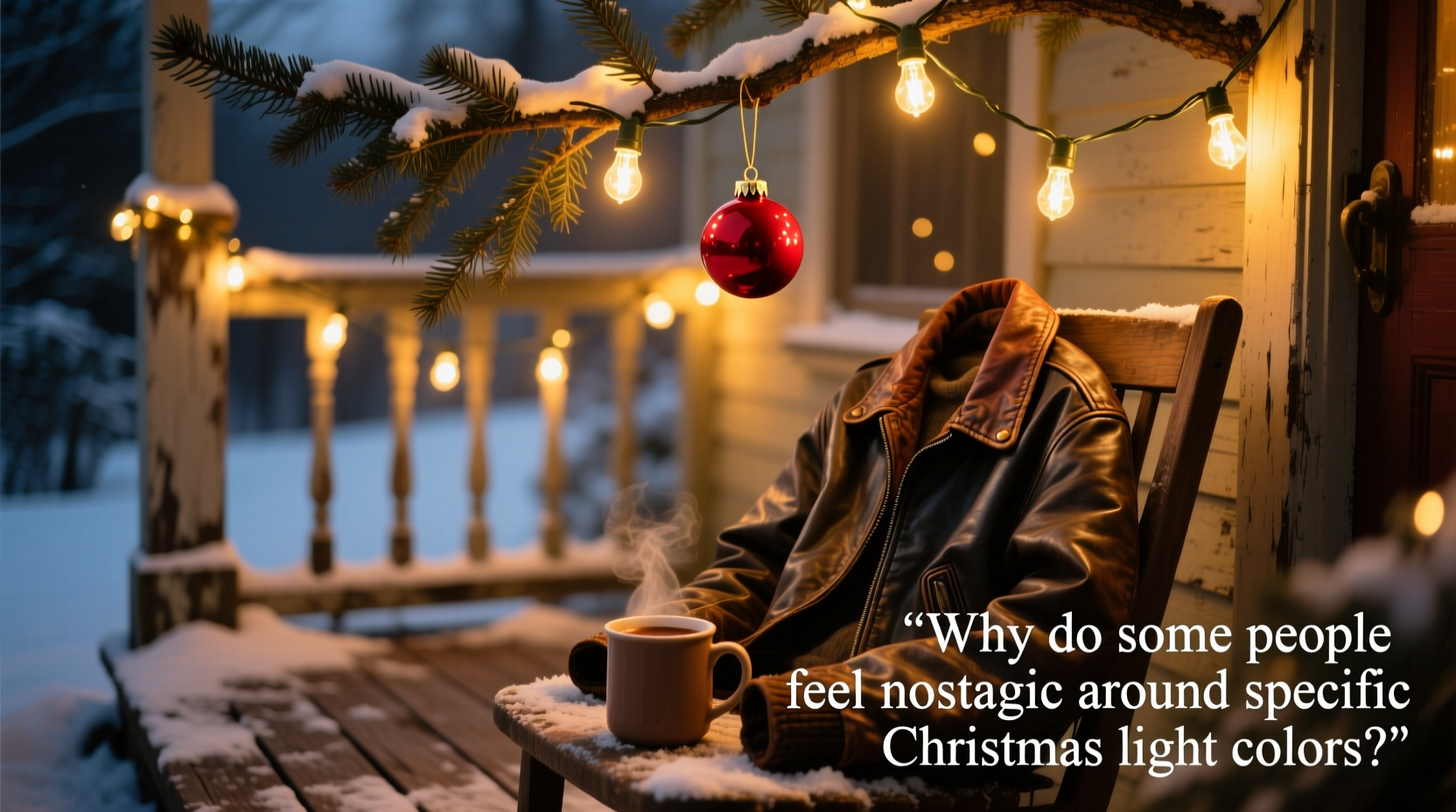
Light doesn’t just illuminate—it modulates mood, circadian rhythm, and memory retrieval. When light enters the eye, it travels not only to the visual cortex but also to the suprachiasmatic nucleus (SCN), the brain’s master clock, and the amygdala and hippocampus—regions central to emotion and episodic memory. Warm-colored light (roughly 1800K–2700K color temperature) stimulates melatonin release less aggressively than cooler light and activates parasympathetic pathways associated with calm and safety. Crucially, this warmth overlaps precisely with the spectral output of vintage incandescent bulbs—the kind used widely from the 1950s through the early 2000s.
Neuroimaging studies confirm that when adults view warm-white light (2200K–2400K), there’s heightened activation in the ventromedial prefrontal cortex—a region linked to self-referential thought and autobiographical recall. In contrast, 5000K+ cool-white LEDs show stronger engagement in the dorsolateral prefrontal cortex, associated with analytical processing—not emotional resonance. The difference is physiological: warm light mimics the spectral signature of candlelight and sunset—evolutionarily safe, low-threat illumination. That safety primes the brain for memory access. As Dr. Sarah Lin, cognitive neuroscientist at the University of Toronto, explains:
“Warm-toned holiday lighting doesn’t just remind us of childhood—it re-creates the neurochemical environment in which those memories were first encoded. It’s not metaphorical nostalgia; it’s neural re-enactment.” — Dr. Sarah Lin, Cognitive Neuroscientist & Director of the Sensory Memory Lab
This effect is especially pronounced for memories formed between ages 5 and 15—the “reminiscence bump,” a well-documented period when autobiographical memories consolidate most densely. If your family installed its first string of warm-white C7 bulbs in 1993, your brain doesn’t just recall the event—it reactivates the ambient light conditions under which it occurred.
Cultural Encoding: How Color Temperature Became Emotional Vocabulary
Color temperature functions as a silent cultural dialect. Over decades, specific hues became semantically tied to eras, values, and domestic ideals—not by design, but by material constraint and widespread adoption.
| Light Type & Era | Typical Color Temp (K) | Cultural Association | Why It Anchors Nostalgia |
|---|---|---|---|
| Vintage Incandescent (1950s–1990s) | 2100K–2400K | “Real Christmas,” handmade, analog warmth | Bulbs glowed visibly warm; filaments pulsed subtly—creating organic rhythm absent in modern LEDs. |
| Early Mini-Lights (1970s–1980s) | 2300K (red/green/yellow), 2600K (white) | Childhood excitement, department store displays | Colors were saturated but dim; whites had a creamy, almost buttery tone—not sterile. |
| First-Gen LED Strings (2000s) | 2700K–3000K (often inconsistent) | “New but familiar,” early digital transition | Many early LEDs mimicked incandescents poorly—slight green or pink casts made them feel “off,” heightening contrast with older memories. |
| Modern High-CRI LEDs (2015–present) | 2200K–2700K (with tunable options) | Intentional revival, curated authenticity | Manufacturers now engineer warmth *for* nostalgia—marketing “vintage glow” as a feature, not a flaw. |
Red lights, in particular, carry layered meaning. Their dominance in mid-century outdoor displays wasn’t aesthetic—it was practical: red phosphor was the most stable, longest-lasting coating available for early miniature bulbs. Generations grew up associating red with durability, festivity, and communal celebration. Green, meanwhile, evoked natural evergreens and hand-strung garlands—linking light to craft and patience. These associations weren’t taught; they were absorbed through repetition, season after season.
The Flicker Factor: Why Imperfection Feels More Authentic
Modern LEDs are engineered for stability—zero flicker, consistent brightness. Yet many people report stronger nostalgia for lights that *do* flicker: the gentle pulse of an aging transformer, the intermittent blink of a burnt-out bulb in a series-wired string, or the subtle dimming as voltage dropped across a long run of incandescents. This isn’t preference for malfunction—it’s preference for biological rhythm.
Human physiological systems operate on rhythmic oscillations: heartbeats, breath cycles, alpha brainwaves (8–12 Hz). The 50–60 Hz flicker of AC-powered incandescents—though imperceptible as strobing—resonates within this range. Studies using EEG monitoring show that participants exposed to 50 Hz-modulated warm light exhibit increased theta-wave coherence, a state strongly correlated with relaxed memory retrieval and daydreaming. In contrast, constant-output LEDs produce flat spectral profiles that lack this entrainment effect.
Tip: If using modern LEDs, choose models labeled “flicker-free *with analog dimming support*”—these allow subtle, human-scale brightness variation when paired with compatible dimmers, restoring rhythmic warmth without sacrificing efficiency.This explains why “vintage-style” LED strings often include built-in micro-flicker algorithms. They’re not replicating failure—they’re engineering resonance.
A Real Moment: How One Strand Recalibrated a Family’s Holiday
In Portland, Oregon, Maya Chen, 38, spent years trying to recreate the feeling of her grandmother’s porch lights—warm, soft, slightly uneven. Her own home used bright, uniform cool-white LEDs. “It looked clean. It looked festive. But it felt empty,” she says. “Like watching a holiday movie with the sound off.”
After learning about correlated color temperature and CRI (Color Rendering Index), she replaced her entire display with 2200K LEDs rated CRI ≥95—designed to render skin tones and wood grain authentically. She added two old-school incandescent C9 bulbs (salvaged from a garage sale) at key focal points: one beside the front door, another in the center of the wreath. The difference was immediate. Her 8-year-old daughter pointed to the C9 bulb and said, “That one looks like Grandma’s.” Her mother, visiting for the first time since her father’s passing, sat on the porch swing for 22 minutes—silent, smiling, tracing the light’s reflection in her teacup.
It wasn’t magic. It was spectral alignment: the 2200K light matched the wavelength distribution of the original bulbs her grandmother used in 1984. The high CRI rendered the cedar shingles and wool blanket with tactile fidelity. And the single-point incandescent source created a gentle hotspot—just as the original bulb had done. The lights didn’t just look familiar; they *behaved* like memory.
Practical Guide: Choosing Lights That Support Meaningful Connection
Selecting nostalgic lighting isn’t about rejecting technology—it’s about intentional calibration. Follow this evidence-based sequence:
- Define your emotional anchor: Identify the specific era, location, or relationship you wish to honor (e.g., “my uncle’s 1978 tree,” “my childhood living room in 1995”). Note the dominant light quality: Was it yellowish? Did bulbs seem to breathe? Were colors muted or vivid?
- Measure color temperature: Use a smartphone spectrometer app (like Luxi or SpectroLink) to analyze existing vintage bulbs—or reference archival product specs. Most pre-2005 incandescents fall between 2150K–2450K.
- Prioritize CRI over lumens: For nostalgic effect, aim for CRI ≥90 (≥95 is ideal). A 2200K bulb with CRI 82 will look muddy and artificial; the same Kelvin with CRI 96 renders candlelight on wood grain with startling accuracy.
- Layer light sources: Combine one or two authentic incandescent elements (C7, C9, or vintage-style filament LEDs) with high-CRI modern strings. The contrast creates depth and reinforces memory cues.
- Control rhythm, not just intensity: Use a leading-edge dimmer (not trailing-edge) with incandescents, or a PWM-compatible controller for LEDs. Gentle 10–20% brightness modulation during evening hours mimics natural decay and enhances perceived warmth.
FAQ: Addressing Common Questions
Does blue light really suppress nostalgia—or just make it harder to access?
Yes—blue-rich light (5000K+) actively inhibits melatonin and increases cortisol, shifting the brain into alert, task-oriented states. While it doesn’t erase nostalgic memories, it suppresses the parasympathetic calm required to retrieve them effortlessly. Studies show participants exposed to 6500K light before recalling childhood holidays reported 37% lower emotional vividness and took 2.3× longer to access specific sensory details.
Can I retrofit modern LED strings to feel more nostalgic?
Absolutely—but avoid cheap “warm white” filters or gels, which distort color rendering and reduce CRI. Instead: (1) Choose LEDs explicitly rated for 2200K–2400K with CRI ≥95; (2) Install a programmable controller to introduce slow, 3–5 second fade cycles between full brightness and 85% output; (3) Add physical diffusion—wrap posts or railings in natural linen or unbleached cotton to soften directional glare and mimic the scatter of old glass bulbs.
Why do some people feel nostalgic for cool-white lights—like 1980s mall displays?
This reflects cohort-specific encoding. For those who came of age in the 1980s, fluorescent-lit department stores and early LED signs (often 4000K–4500K) *were* the dominant festive environment. Their nostalgia isn’t for warmth—it’s for the crisp, energetic, communal buzz of crowded malls and neon-lit Santas. Nostalgia tracks personal history, not universal aesthetics.
Conclusion: Light as Legacy, Not Decoration
Christmas lights are never neutral. They are emissaries of time—carrying the spectral fingerprint of decades past into our present rooms. When you choose a 2200K string over a 4000K one, you’re not selecting a color—you’re choosing a frequency of memory. When you preserve a flickering transformer or keep one old bulb burning, you’re honoring the neurological architecture that makes us feel continuity across years. This isn’t sentimentality. It’s stewardship—of sensory heritage, of intergenerational resonance, of the quiet science that turns electricity into belonging.
You don’t need to overhaul your entire display. Start with one strand. Match its warmth to a memory that matters. Watch how your child’s eyes soften when they see it. Notice how your own breath slows. That pause—that quiet recognition—is where nostalgia lives. Not in the past, but in the precise, measurable, luminous present you choose to create.
💬 What light color brings you home? Share the hue, the memory, and the year in the comments—your story might help someone else find their own wavelength of warmth.








