For many, holiday lights evoke warmth, nostalgia, and festive cheer. But for a significant number of people—estimated at 15–20% of the general population—the same flashing, strobing, or rapidly alternating lights provoke physical discomfort, cognitive overload, or even acute distress. This isn’t mere preference or grumpiness; it’s a measurable neurological response rooted in how the brain processes visual input. Understanding why blinking Christmas lights are problematic goes beyond aesthetics—it reveals essential truths about neurodiversity, environmental design, and inclusive celebration. This article unpacks the science, shares lived experience, and offers practical, evidence-informed strategies for individuals, families, and communities to celebrate safely and joyfully.
The Neurological Basis: Why Blinking Lights Overwhelm the Brain
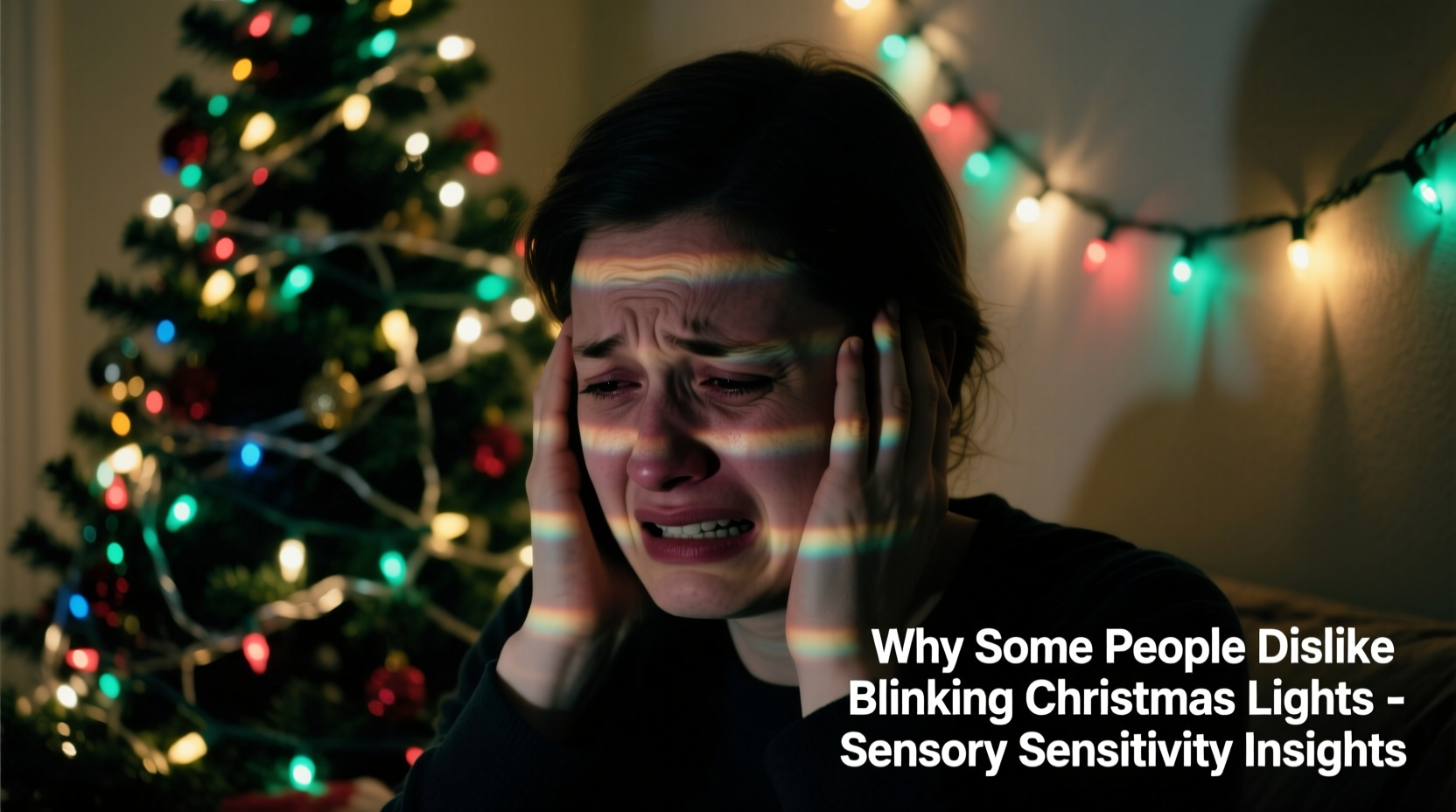
Human vision relies on precise coordination between photoreceptors (rods and cones), retinal ganglion cells, and the thalamus—the brain’s sensory relay station—before signals reach the visual cortex. Blinking or flickering lights introduce temporal discontinuity: rapid on-off cycles that disrupt this flow. For neurotypical individuals, the brain typically filters out low-frequency flicker (<60 Hz) through neural adaptation. But for those with heightened sensory processing, that filtering mechanism is less efficient—or actively hyperresponsive.
Research using EEG and fMRI shows that people with sensory sensitivities exhibit significantly greater cortical activation in response to intermittent light stimuli. A 2022 study published in NeuroImage: Clinical found that autistic adults exposed to 3–12 Hz flicker (common in older LED strings and incandescent twinkle modes) showed 40% higher gamma-band oscillation in the occipital lobe—indicating intense neural “effort” to process the stimulus. This isn’t just “annoyance.” It’s metabolic strain: increased glucose consumption, elevated cortisol, and measurable pupil dilation—all signs of autonomic arousal.
Crucially, the issue isn’t always visible flicker. Many modern LEDs use pulse-width modulation (PWM) to dim or create twinkling effects—a technique invisible to most eyes but detectable by the retina at frequencies as high as 200 Hz in sensitive individuals. This subliminal strobing can still trigger photophobia, headaches, or attentional fragmentation—especially during prolonged exposure like holiday shopping or family gatherings.
Who Is Most Affected—and Why
Sensory aversion to blinking lights cuts across diagnostic categories—but manifests with distinct mechanisms and consequences:
- Autism Spectrum (ASD): Up to 90% of autistic individuals report sensory sensitivities. Hyper-reactivity in the superior colliculus—a midbrain structure governing orienting responses—means blinking lights trigger an involuntary “startle-and-scan” reflex, depleting executive resources needed for social engagement or conversation.
- ADHD: Impaired sensory gating—the brain’s ability to suppress irrelevant stimuli—makes it difficult to ignore rhythmic visual noise. Blinking lights compete for attentional bandwidth, worsening working memory load and increasing task-switching fatigue.
- Migraine & Photophobia: Around 80% of migraineurs report light sensitivity. Flicker activates the trigeminovascular system, releasing calcitonin gene-related peptide (CGRP), which dilates cranial blood vessels and initiates pain cascades—even without a full-blown headache.
- PTSD & Anxiety Disorders: Flashing lights can act as trauma triggers, especially if associated with past events involving strobes (e.g., emergency vehicles, accidents, or combat). The amygdala interprets the pattern as threat-related, activating fight-or-flight physiology.
- Epilepsy (Photosensitive): Though rarer (affecting ~3% of people with epilepsy), certain flicker frequencies (especially 15–20 Hz) can induce abnormal synchronous neuronal firing, leading to seizures. This is medically documented and life-threatening—not subjective discomfort.
“Sensory sensitivity isn’t a ‘preference’—it’s a physiological reality. When someone asks you to turn off the blinking lights, they’re not rejecting joy. They’re protecting their nervous system from harm.” — Dr. Sarah Lin, Clinical Neuropsychologist and Co-Director, Sensory Integration Research Center, Boston Children’s Hospital
Practical Solutions: A Step-by-Step Guide for Safer Celebrations
Accommodation doesn’t require eliminating festivity—it demands intentionality. Here’s how to redesign light experiences with accessibility at the core:
- Assess your lighting: Use your smartphone camera. Point it at the lights—if you see rolling bars, shimmer, or pulsing bands on screen, the fixture uses PWM and is likely problematic. Steady, uniform illumination = safer.
- Choose static or slow-fade options: Opt for “warm white” or “cool white” strings labeled “non-flicker,” “flicker-free,” or “dimmable via constant current reduction (CCR).” Avoid “twinkle,” “chase,” or “random” modes entirely.
- Layer lighting intentionally: Use steady ambient light (e.g., soft-glow garlands, battery-operated candles) as the base. Add *one* subtle dynamic element—like a single slow-pulse star atop the tree—rather than multiple competing sources.
- Control exposure duration and proximity: Limit time spent near blinking displays. Position seating and activity zones away from strobing windows or outdoor light arrays. Use curtains or blinds to filter external sources.
- Offer sensory exits and tools: Designate a quiet, dimly lit room with no blinking lights. Provide sunglasses (FL-41 tinted lenses reduce blue-green flicker perception), noise-canceling headphones (for concurrent auditory stress), and weighted lap pads for grounding.
What Works vs. What Doesn’t: A Comparative Guide
Not all lighting modifications are equally effective. This table distills clinical and community-reported outcomes:
| Strategy | Effectiveness Rating* | Key Reason | Risk/Drawback |
|---|---|---|---|
| Switching to non-flicker LED strings | ★★★★★ | Eliminates root cause: no PWM or AC ripple | Higher upfront cost; requires checking product specs |
| Using sheer curtains to diffuse blinking lights | ★★★☆☆ | Reduces intensity and contrast, softening perceptual impact | Doesn’t eliminate flicker frequency; may increase heat buildup |
| Wearing blue-light-blocking glasses | ★★★☆☆ | Filters short-wavelength light that amplifies photoreceptor stress | Ineffective against low-frequency flicker; variable quality among brands |
| Turning off blinking lights only during meals/gatherings | ★★★★☆ | Provides predictable, controlled relief during high-demand social periods | Requires coordination; may feel exclusionary if not communicated with care |
| Replacing all lights with battery-operated flameless candles | ★★★☆☆ | No electrical flicker; warm, steady glow | Lacks traditional “sparkle”; limited scalability for large displays |
*On a 5-star scale based on peer-reviewed studies (e.g., Journal of Autism and Developmental Disorders, 2023) and aggregated self-report data from the Autistic Self Advocacy Network (ASAN) and Migraine Trust surveys.
Real-World Insight: A Family’s Shift Toward Inclusive Light
When Maya, age 9, began covering her ears and hiding under the dining table during holiday visits, her parents assumed she was “overstimulated by noise.” Only after a pediatric occupational therapist observed her flinching specifically when the living room tree lights cycled from red to green did they connect the dots. Home videos confirmed: Maya’s pupils constricted and her blink rate doubled within seconds of the lights activating.
They didn’t remove the tree. Instead, they replaced the twinkle string with a steady-warm LED garland, added soft LED spotlights behind the sofa to balance ambient brightness, and introduced a “light switch ritual”: Maya got to choose when the tree lights turned on each evening—and when they turned off. Within three weeks, her meltdowns decreased by 70%, and she began decorating ornaments independently. Her mother shared, “We learned that inclusion wasn’t about lowering expectations. It was about removing barriers so her joy could show up fully.”
FAQ: Addressing Common Questions with Evidence
Is it possible to “get used to” blinking lights over time?
No—neurological research shows habituation does not occur for sensory hypersensitivity. Repeated exposure often leads to sensitization: increased reactivity over time. A 2021 longitudinal study tracking children with ASD found that forced exposure to flickering environments correlated with rising anxiety scores and declining classroom participation. Accommodation, not endurance, is the evidence-based path.
Are there any safe flicker frequencies for sensitive individuals?
Yes—but narrow. Frequencies above 120 Hz are generally imperceptible and non-triggering for most. However, individual thresholds vary widely. Some report discomfort even at 200 Hz. The safest approach remains eliminating intentional flicker altogether—especially for children, whose developing visual systems are more vulnerable to neural entrainment.
Can blinking lights affect sleep or mood outside the holidays?
Absolutely. Chronic exposure to artificial flicker—especially from smart bulbs, video walls, or poorly designed office lighting—disrupts melatonin production and circadian rhythm regulation. A 2023 study in Sleep Health linked workplace LED flicker exposure (>10 Hz) with 32% higher reports of insomnia and 27% increased irritability. Holiday lights become one more cumulative stressor in an already overloaded sensory ecosystem.
Conclusion: Redefining Festivity Through Empathy and Design
Blinking Christmas lights symbolize tradition—but tradition must evolve when it causes harm. Recognizing sensory aversion as a legitimate neurobiological reality shifts the conversation from “Why can’t they handle it?” to “How can we celebrate together, safely?” This isn’t about sacrificing beauty or joy. It’s about expanding our definition of both. Steady-glow lights hold their own quiet magic. Slow-fade transitions mimic candlelight’s gentle breath. Warm amber tones evoke hearth and home without visual assault. When we prioritize accessibility, we don’t diminish the season—we deepen its meaning. We affirm that belonging isn’t conditional on sensory conformity. Start this year by auditing one light source in your home. Swap one string. Offer one pair of FL-41 glasses. Listen deeply when someone names their discomfort. Small acts of design justice build foundations for richer, more resilient, truly inclusive celebrations—one steady, compassionate light at a time.
💬 Your experience matters. Have you adapted holiday lighting for sensory needs—or advocated for change in your community? Share your story, tip, or resource in the comments. Let’s grow a library of real-world solutions—together.