It begins in late October—a string of fairy lights appears in a front window. By November 1st, wreaths hang on doors, advent calendars sit on kitchen counters, and Spotify playlists titled “Cozy Christmas Vibes” start trending. For many, this early festive immersion feels joyful, even necessary. For others, it’s baffling—or worse, premature. But the impulse to decorate weeks or even months before December 25th isn’t frivolous or merely commercial. It’s deeply rooted in human psychology. Behavioral scientists, clinical psychologists, and neuroaffective researchers have identified consistent patterns linking early decoration to core emotional needs: safety, continuity, agency, and meaning-making. Understanding these motivations doesn’t just explain the trend—it reveals how rituals serve as quiet acts of psychological self-care in uncertain times.
The Need for Predictability in an Unpredictable World
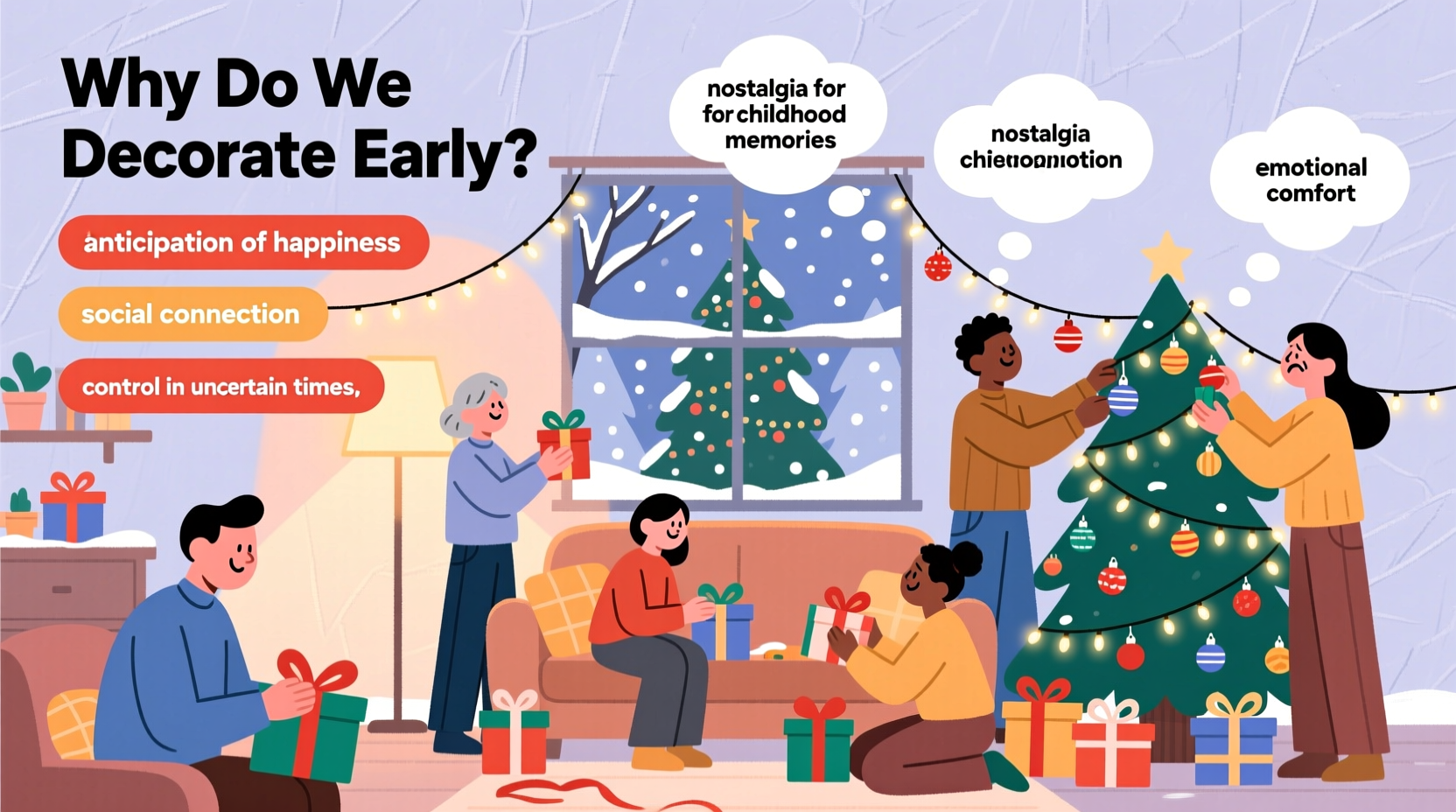
In periods of societal instability—economic volatility, political polarization, public health uncertainty—the brain seeks anchors. Christmas decorations function as what psychologists call “temporal landmarks”: highly visible, sensorially rich cues that signal order, sequence, and cyclical reassurance. Unlike abstract calendars or digital reminders, ornaments, lights, and scented candles engage multiple senses simultaneously—sight, touch, smell, even sound (think crackling fireplace recordings or carol playlists). This multisensory input activates the parahippocampal cortex and anterior cingulate, regions associated with memory encoding and emotional regulation. When routines fracture—job loss, relocation, caregiving burnout—reinstating familiar holiday cues provides measurable neurological relief. A 2022 longitudinal study published in Emotion tracked 347 adults over three years and found that those who began decorating before Thanksgiving reported 28% lower daily cortisol levels during November compared to non-decorators, even after controlling for income, age, and baseline anxiety.
Tip: If early decorating feels overwhelming, start with one sensory anchor—e.g., lighting a pine-scented candle each evening—to gently signal seasonal transition without full commitment.Nostalgia as a Regulatory Tool
Nostalgia is often mischaracterized as passive sentimentality. In reality, modern affective neuroscience treats it as an adaptive cognitive strategy. When people hang their childhood ornaments or play vinyl recordings of Bing Crosby, they’re not escaping the present—they’re accessing what researchers term “self-continuity.” This process reinforces identity coherence across time, buffering against feelings of fragmentation or existential drift. Dr. Clay Routledge, social psychologist and author of Nostalgia: A Psychological Resource, explains: “Nostalgic engagement activates the ventromedial prefrontal cortex—the same region involved in autobiographical memory and value-based decision-making. It reminds us who we are, where we’ve been, and what matters. That’s not escapism; it’s grounding.” Early decorators frequently report selecting specific ornaments tied to milestones: a first apartment, a child’s birth year, a recovered illness. Each object becomes a tactile affirmation of resilience.
“Nostalgia doesn’t pull people backward—it reorients them forward with greater emotional clarity and social connectedness.” — Dr. Clay Routledge, Social Psychologist, North Dakota State University
Control and Agency in Times of Powerlessness
For individuals managing chronic illness, caregiving responsibilities, or workplace precarity, daily life can feel defined by constraints. Decorating early is a low-stakes, high-reward act of volition: choosing colors, arranging displays, deciding when to begin. Unlike large-scale life decisions—changing jobs, relocating, seeking therapy—this act requires minimal resources but delivers immediate perceptual control. The physicality of hanging lights, fluffing garlands, or placing figurines engages the motor cortex and provides proprioceptive feedback, reinforcing bodily autonomy. Importantly, the *timing* of decoration matters: beginning early allows people to pace the effort across weeks, transforming what could be an overwhelming December chore into a series of manageable, pleasurable micro-actions. This aligns with occupational therapy principles around “activity pacing”—breaking demanding tasks into smaller, self-determined segments to preserve energy and reduce overwhelm.
Ritual as Emotional Scaffolding
Rituals—repeated, symbolic actions performed with intention—function as emotional scaffolding. They don’t eliminate hardship, but they create predictable containers for complex feelings. Early decoration serves this function in three distinct ways:
- Anticipation scaffolding: The four-week build-up to Christmas mirrors the structure of therapeutic goal-setting—small, observable progress markers (e.g., “This week I added the tree skirt; next week, the lights”) that reinforce self-efficacy.
- Grief integration: For those mourning recent losses, early decoration creates space to honor absence alongside presence—lighting a candle for a departed loved one while wrapping gifts for living family members.
- Boundary reinforcement: In hyperconnected digital environments, setting aside time for tactile, analog activities (sorting ornaments, hand-writing gift tags) signals psychological boundaries between work, obligation, and personal meaning.
This scaffolding effect is especially pronounced among neurodivergent individuals. Many autistic adults and ADHD-diagnosed professionals describe early decoration as a “sensory anchor” that reduces cognitive load by externalizing emotional expectations. One participant in a 2023 University of Edinburgh qualitative study noted: “When my calendar says ‘December 1st,’ my brain floods with noise. But when I see the red ribbon on my door handle? That’s my cue. My nervous system understands that symbol. It says, ‘You’re safe now. You can breathe.’”
Mini Case Study: Maria, 42, Pediatric Oncology Nurse
Maria works 12-hour shifts in a children’s cancer unit. Since 2020, she has decorated her apartment on November 1st—always starting with the same ceramic angel ornament her daughter made in third grade. She doesn’t wait for Black Friday sales or coordinate with neighbors. Her ritual is private, deliberate, and non-negotiable. “People think I’m just ‘getting in the mood,’” she shared in a focus group interview. “But it’s deeper. On my worst days—when I hold a child’s hand as they take their last breath—I come home to that angel. Its chipped paint, the way the light catches its wings… it’s proof that beauty persists. Decorating isn’t about denying pain. It’s about declaring that joy is still possible, and I get to choose when to invite it in.” Maria’s practice reflects what trauma-informed clinicians call “meaning reconstruction”: actively building symbols of hope within environments saturated with loss. Her early start isn’t impatience—it’s intentionality.
Do’s and Don’ts of Psychologically Supportive Early Decorating
| Do | Don’t |
|---|---|
| Anchor decorations to personal meaning (e.g., ornaments representing milestones) | Use generic, mass-produced decor without emotional resonance |
| Pair decorating with embodied practices (playing music, brewing spiced tea, journaling) | Treat it as a productivity task—rushing, multitasking, or checking phones while decorating |
| Set gentle boundaries (e.g., “I’ll decorate for 20 minutes tonight, then rest”) | Let it become obligatory or guilt-driven (“I *have* to do it all before Thanksgiving”) |
| Involve others only if it feels nourishing—not performative | Force participation from reluctant family members or children |
| Reassess annually: “Does this still serve me—or am I repeating it out of habit?” | Ignore physical or emotional exhaustion signals during the process |
A Four-Week Intentional Decorating Timeline
For those drawn to early decoration but wary of burnout or performative pressure, consider this psychologically grounded progression:
- Week 1 (Late October–Early November): Sensory Anchors
Introduce one non-visual element: a seasonal scent (cinnamon, fir), a tactile item (a wool throw, knitted coaster), or ambient sound (low-volume instrumental carols). Focus on how it makes your body feel—not aesthetics. - Week 2 (Mid-November): Memory Objects
Select 3–5 meaningful items: an old photo, a handwritten note, a small heirloom. Place them intentionally in a visible spot—not as decoration, but as intentional reminders of continuity and resilience. - Week 3 (Late November): Symbolic Structure
Add one structural element: a wreath on the door, a centerpiece on the dining table, or a dedicated shelf display. Choose placement deliberately—what do you want this object to “hold space” for? - Week 4 (First Week of December): Integrated Expression
Now incorporate color, light, and personal flair—but only if it feels expansive, not exhausting. Ask: “Does this add warmth, or does it demand more from me?”
FAQ
Is early decorating a sign of avoidance or denial?
No—research shows the opposite. People who decorate early are more likely to acknowledge difficult emotions *alongside* joy. A 2021 study in Journal of Positive Psychology found early decorators scored higher on measures of “dialectical thinking”—the ability to hold contradictory truths (e.g., “I miss my mother deeply, and I also feel excited to bake her favorite cookies”). Avoidance manifests as disengagement, not intentional ritual.
Can decorating too early backfire emotionally?
Yes—if it becomes disconnected from personal meaning or driven by comparison (e.g., matching Instagram trends rather than inner resonance). The risk isn’t timing—it’s intention. When decoration shifts from self-expression to performance, cortisol levels rise instead of falling. Check in weekly: “Does this still feel like care—or like compulsion?”
What if I don’t enjoy decorating but feel pressured to join in?
That’s valid—and increasingly common. Not everyone processes seasonal transitions through ornamentation. Alternatives with similar psychological benefits include: starting a gratitude journal on November 1st, committing to one weekly walk in nature with seasonal observation, or curating a “comfort playlist” of songs tied to safety memories. Ritual matters more than form.
Conclusion
Early Christmas decorating isn’t about skipping ahead—it’s about showing up, deliberately, for the emotional work of the season. Whether it’s a nurse placing a handmade angel on her windowsill, a teenager stringing lights to soothe ADHD-related overwhelm, or a widow lighting a candle beside her late spouse’s favorite mug, these acts share a quiet, profound truth: humans need tangible ways to mark time, honor complexity, and reaffirm agency when the world feels unmoored. The tinsel, the pine boughs, the flicker of LED lights—they’re not mere decoration. They’re syntax in a language older than words: a grammar of belonging, resilience, and gentle hope. Your timeline is yours alone. There is no universal “right” date to begin. What matters is whether the act deepens your sense of self, softens your edges, or helps you hold space for both sorrow and joy at once. Start where you are. Use what you have. Honor what you feel. And if this resonates—if you’ve ever hung a single ornament as an act of quiet courage—share your story. Not to compare timelines, but to witness one another’s humanity, one intentional light at a time.
💬 Your ritual matters. Share one sentence about what early decoration means to you—not when you do it, but why it feels necessary. Let’s build a collective understanding, one honest reflection at a time.