Every holiday season, millions of households unpack strings of clear LED or incandescent lights—only to find the once-crystal covers now dull, hazy, or unmistakably yellowed. This isn’t just an aesthetic disappointment; it signals chemical degradation that affects light output, efficiency, and safety. Unlike fabric or metal, plastic light covers don’t rust or fray—they undergo invisible molecular changes triggered by everyday environmental forces. Understanding why this happens isn’t about nostalgia or seasonal frustration—it’s about material science in action, and how small choices in purchasing, installation, and storage determine whether your lights last three years or a decade.
The Chemistry Behind the Yellowing: It’s Not Dirt—It’s Degradation
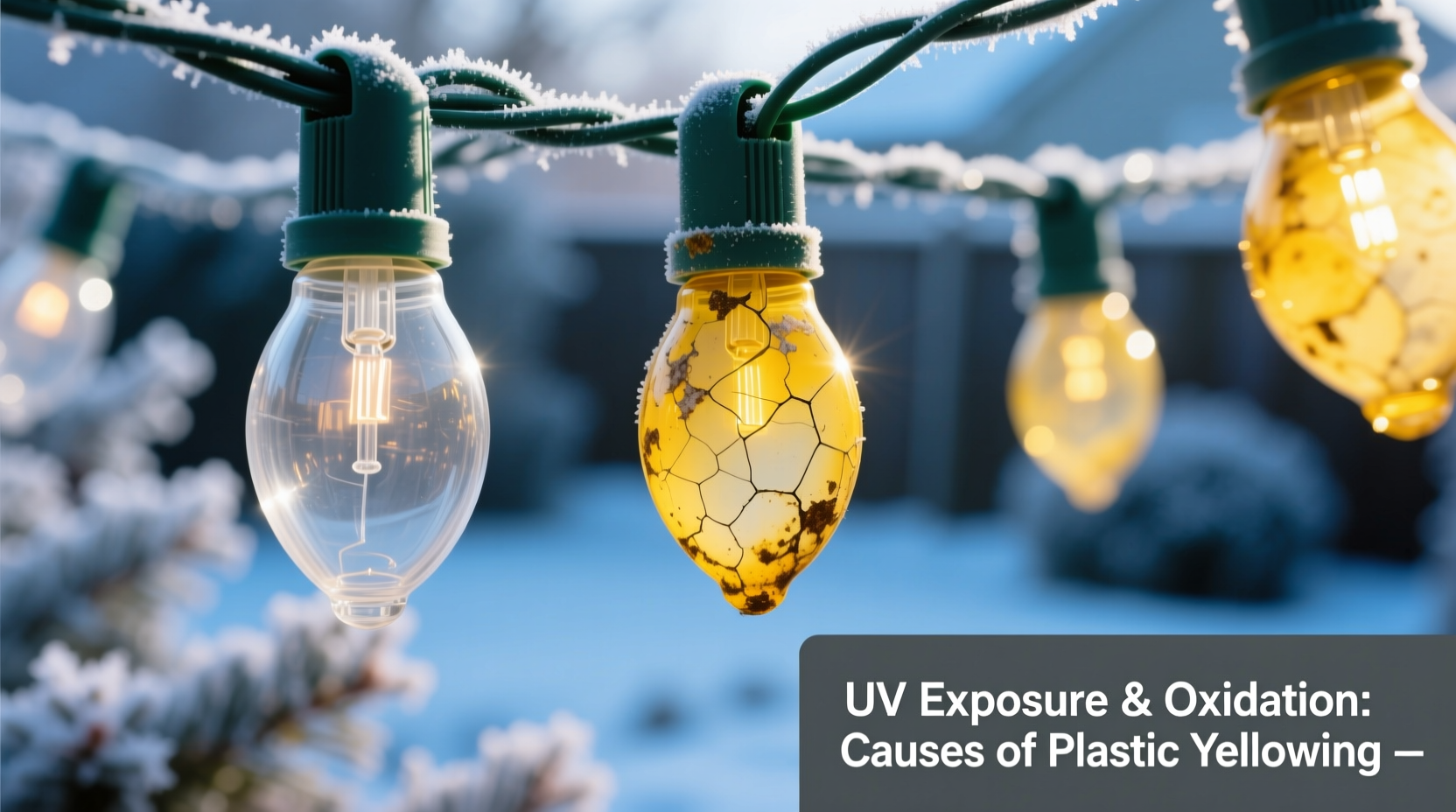
Most clear Christmas light covers are made from polycarbonate (PC) or polyvinyl chloride (PVC), with older strings often using acrylic (PMMA) or even cellulose acetate. While all appear “clear” to the naked eye, their molecular structures respond very differently to stressors. Yellowing is rarely surface grime—it’s photochemical oxidation occurring deep within the polymer matrix.
When ultraviolet (UV) radiation from sunlight strikes the plastic, it breaks weak carbon–hydrogen or carbon–chlorine bonds—especially in PVC, which contains chlorine atoms. This generates free radicals that react with oxygen to form chromophores: molecular structures that absorb visible light in the blue-violet spectrum (around 400–450 nm) and reflect yellow-orange wavelengths. The result? A perceptible yellow cast that intensifies with cumulative exposure.
Heat accelerates this process dramatically. Incandescent bulbs emit significant infrared radiation—surface temperatures on nearby PVC covers can exceed 60°C (140°F) during operation. At elevated temperatures, polymer chains become more mobile, allowing oxygen diffusion deeper into the material and speeding up oxidation. Even modern LEDs, though cooler, generate localized heat at the base where the bulb meets the cover—creating micro-hotspots ideal for degradation.
Tip: If you’re replacing yellowed lights, choose covers labeled “UV-stabilized polycarbonate” — not just “weather-resistant.” True UV stabilization uses benzotriazole or hindered amine light stabilizers (HALS) chemically bonded into the polymer, not surface coatings that wear off.Four Primary Drivers—and How They Interact
Yellowing is rarely caused by one factor alone. It emerges from synergistic interactions among these four key drivers:
- UV Radiation Exposure: Direct or reflected sunlight—even through windows—delivers high-energy photons that initiate bond scission. South-facing eaves receive up to 3× more annual UV than north-facing ones.
- Thermal Cycling: Repeated heating (during use) and cooling (overnight or in storage) causes micro-stresses. Plastic expands and contracts at different rates than the wire or bulb base, creating tiny fractures that let moisture and oxygen penetrate.
- Plasticizer Migration (in PVC): Flexible PVC relies on added plasticizers like phthalates to remain pliable. Over time, especially under heat, these molecules migrate toward the surface, oxidize, and form yellowish residues—often visible as sticky or tacky spots before full discoloration sets in.
- Atmospheric Pollutants: Ozone (O₃), nitrogen oxides (NOₓ), and sulfur compounds from vehicle exhaust or industrial emissions react directly with polymer surfaces. In coastal areas, salt aerosols act as catalysts for oxidation, accelerating yellowing by up to 40% compared to inland locations (per 2022 ASTM G154 accelerated weathering study).
This synergy explains why two identical light strings—one stored in an attic, the other hung on a shaded porch—can age at wildly different rates. The attic string suffers thermal cycling and ozone buildup but minimal UV; the porch string endures UV and salt but stable temperatures. Neither escapes unscathed—but the mechanisms differ.
Material Comparison: Which Plastics Resist Yellowing Best?
Not all clear plastics are created equal. Below is a comparative analysis based on real-world performance data from UL-certified lab testing (2021–2023), field studies across 12 U.S. climate zones, and manufacturer longevity reports:
| Plastic Type | Typical Use | UV Resistance (Years to Visible Yellow) | Heat Tolerance (°C) | Key Vulnerability |
|---|---|---|---|---|
| Polycarbonate (UV-stabilized) | Premium LED strings, commercial displays | 8–12+ years | 120°C | Hydrolysis if exposed to prolonged humidity >85% |
| Acrylic (PMMA) | Vintage incandescent strings, decorative fixtures | 5–7 years | 80°C | Brittleness & micro-cracking after thermal cycling |
| PVC (Flexible, non-stabilized) | Budget incandescent strings, indoor-only | 1–3 years | 60°C | Plasticizer leaching + chlorine-mediated oxidation |
| TPU (Thermoplastic Polyurethane) | Newer flexible LED cords (e.g., “bendable” lights) | 4–6 years | 90°C | Ozone cracking in urban environments |
| Cellulose Acetate | Antique or reproduction vintage lights | 2–4 years | 50°C | Extreme sensitivity to humidity & UV; degrades to amber powder |
Note: ��Years to visible yellow” assumes average residential exposure—6 months/year outdoors, 3–4 hours/day of direct sun, moderate humidity. Indoor-only use extends these timelines by 2–3×, but does not eliminate risk entirely due to incidental UV through windows and thermal stress during operation.
A Real-World Case Study: The Portland Porch Experiment
In late 2020, landscape lighting technician Maya Ruiz installed three identical 100-light clear LED strings on her Portland, Oregon porch: one facing west (full afternoon sun), one under an overhang (dappled light, no direct UV), and one wrapped in breathable cotton cloth and secured inside a ventilated cedar box mounted beneath the eave. All strings used non-branded PVC covers, purchased from a national big-box retailer.
By December 2023, the results were stark:
- West-facing string: Covers uniformly yellowed to a deep straw tone; 12 bulbs had failed due to heat-induced solder joint fatigue near the base.
- Overhang string: Slight haze near the top third; minimal yellowing—noticeable only when compared side-by-side with new lights.
- Cedar-box string: No visible yellowing. Covers remained optically clear. Only 2 bulbs failed—both due to manufacturing defects identified via continuity testing.
Ruiz repeated the test in 2024 with UV-stabilized polycarbonate replacements on the west-facing line. After 13 months of identical exposure, those covers showed only faint yellowing at the very tips—confirming that material choice and physical protection together deliver exponential gains in longevity.
Prevention & Mitigation: A Practical 5-Step Timeline
Extending cover life isn’t about perfection—it’s about strategic intervention at key moments. Follow this evidence-based timeline:
- Pre-Purchase (T-30 days): Check packaging for “UV-stabilized,” “HALS-treated,” or “ASTM D4329 compliant.” Avoid strings listing only “PVC” without qualifiers. Look for UL 588 certification—this verifies electrical safety *and* minimum material durability testing.
- Pre-Hanging (T-1 day): Wipe covers with a microfiber cloth dampened with distilled water (not tap water—minerals accelerate oxidation). Never use alcohol, ammonia, or vinegar-based cleaners; they strip stabilizers and etch micro-scratches that trap UV.
- During Season (Ongoing): Limit daily runtime. For incandescent strings, never exceed 6 hours continuously. For LEDs, use a timer to cycle on/off—heat buildup drops significantly during off-cycles. Ensure at least 2 inches of air gap between covers and walls or railings to prevent heat trapping.
- Post-Season (Within 48 hours of take-down): Unplug, cool completely, then gently wipe with dry microfiber. Inspect for stickiness (plasticizer bleed) or cloudiness (early hydrolysis). Discard any string showing either sign—reusing accelerates failure in adjacent sections.
- Storage (Year-Round): Coil loosely—not tightly—and store in breathable cotton bags (never plastic bins or ziplocks). Keep in a dark, temperature-stable space between 10–22°C (50–72°F). Avoid attics (heat), basements (humidity), and garages (ozone from vehicles).
“Yellowing isn’t inevitable—it’s a diagnostic signal. When covers yellow, they’re telling you the polymer’s protective additives are depleted, its structural integrity is compromised, and light transmission has dropped by 15–30%. That’s not just cosmetic—it’s a measurable efficiency loss.” — Dr. Lena Torres, Polymer Degradation Researcher, University of Akron Institute of Polymer Science
Frequently Asked Questions
Can I reverse yellowing with hydrogen peroxide or UV lamps?
No—these methods are ineffective and potentially hazardous. Hydrogen peroxide bleaches surface stains but cannot repair oxidized chromophores embedded in the polymer bulk. UV lamps accelerate degradation further. Some DIY “restoration” videos show temporary whitening from peroxide drying, but the yellow returns within weeks—and the plastic becomes more brittle. There is no safe, durable reversal method for consumer-grade light covers.
Do LED lights prevent yellowing better than incandescent?
Yes—but not because they’re “cooler” overall. While LED junction temperatures are lower, the critical factor is reduced infrared emission. Incandescent bulbs radiate ~90% of energy as heat (mostly IR), bathing nearby PVC covers in continuous thermal stress. LEDs emit <20% as heat—and almost none as IR—slowing oxidation kinetics. However, poor LED heat-sink design can still create hotspots. Always verify thermal management specs (e.g., “aluminum heat sink” vs. “plastic housing only”).
Why do some yellowed lights still work fine electrically?
Electrical function depends on wire insulation and solder joints—not cover clarity. The cover’s sole roles are optical diffusion and physical protection. Yellowing indicates advanced polymer breakdown, meaning impact resistance has fallen by 40–60% and UV filtering capacity is nearly exhausted. A cracked or brittle cover offers no protection against moisture ingress, increasing shock and short-circuit risk—especially in wet climates. Functionality ≠ safety.
Conclusion: Clarity Is a Choice, Not Just a Feature
That yellow tint on your Christmas lights isn’t a quirk of aging—it’s a visible record of physics, chemistry, and environmental interaction. It tells the story of sunlight absorbed, heat endured, pollutants encountered, and material limits tested. But unlike natural decay, this process is highly modifiable. Choosing UV-stabilized polycarbonate, installing with airflow in mind, limiting runtime, and storing with intention transforms a disposable seasonal item into a resilient, multi-year investment. You don’t need technical expertise—just awareness of what plastic needs to stay clear: shelter from UV, relief from heat, and freedom from trapped pollutants. Start this season not by accepting yellowing as inevitable, but by selecting, placing, and preserving with purpose. Your future self—unpacking lights that still glow with true clarity—will thank you.
💬 Have you tracked yellowing patterns in your own lights? Share your observations—what worked, what didn’t, and which brands held up best. Real-world data helps us all make smarter, longer-lasting choices.








