Every holiday season, millions of households string lights across eaves, wrap them around trees, and drape them over mantels—often without a second thought about what’s happening beneath the plastic coating. But if you’ve ever brushed your hand against a strand of older incandescent mini-lights and recoiled from unexpected heat—or noticed a faint, acrid odor near a lighted garland—you’ve encountered a real and preventable hazard. Heat isn’t just uncomfortable; it’s the leading precursor to electrical fires during the December holidays. According to the U.S. Fire Administration, an average of 790 home fires each year are caused by decorative lighting—nearly half of which involve faulty or overheated strings. Understanding why certain lights generate excess heat, recognizing early warning signs, and knowing which alternatives deliver brilliance without risk isn’t optional—it’s essential seasonal safety.
Why Do Some Christmas Lights Get Hot? The Physics Behind the Heat
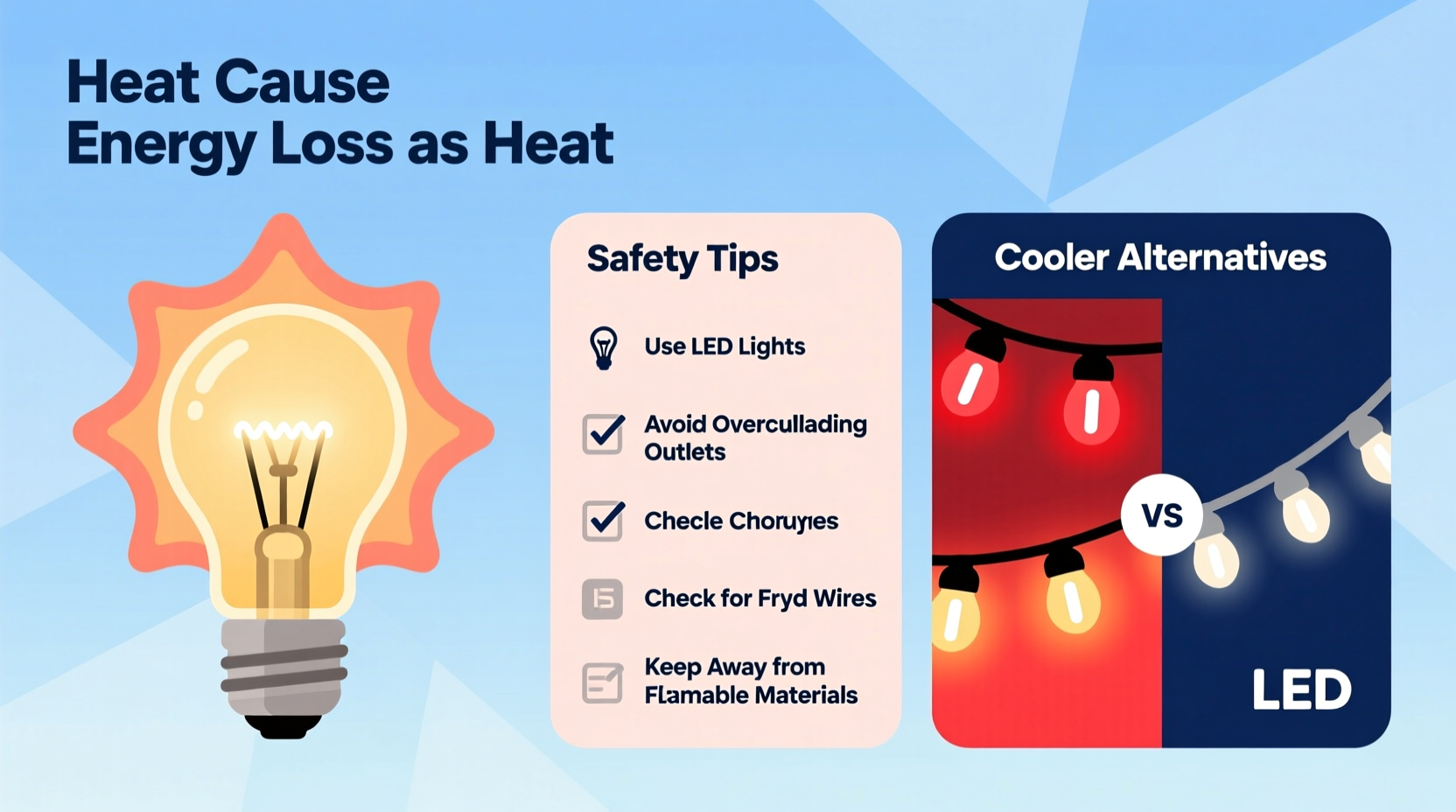
Heat generation in Christmas lights stems directly from how electricity is converted into visible light. Incandescent bulbs—the traditional type with a thin tungsten filament inside a glass bulb—operate on resistance heating: when current flows through the filament, its high resistance causes it to glow white-hot (around 2,500°C internally). Only about 10% of that energy becomes visible light; the remaining 90% escapes as infrared radiation—felt as heat. A single 2.5-watt incandescent mini-bulb may seem negligible, but a 100-light strand draws 250 watts—equivalent to a small space heater running continuously. That energy doesn’t vanish; it accumulates along the wire, especially where strands are bundled, coiled, or tucked behind drapery or insulation.
Several design and usage factors amplify this effect:
- Poor heat dissipation: Plastic housings trap heat, while tightly wound cords restrict airflow.
- Voltage drop & resistance buildup: Longer runs or daisy-chained strings increase resistance, causing wires to heat up disproportionately at connection points.
- Aging components: Corroded sockets, frayed insulation, or degraded wire coatings reduce thermal tolerance and increase fire risk.
- Overloading circuits: Plugging multiple hot-running strands into a single outlet or power strip creates cumulative load far beyond safe limits—especially on older 15-amp household circuits.
It’s not unusual for vintage incandescent strands to reach surface temperatures of 60–90°C (140–194°F)—hot enough to melt vinyl siding, scorch artificial tree branches, or ignite dried pine needles.
Safety Tips: Recognizing, Preventing, and Responding to Overheating
Prevention begins long before the first bulb is hung. These evidence-based practices have been validated by the National Fire Protection Association (NFPA) and Underwriters Laboratories (UL) testing protocols.
Tip: Always unplug lights before adjusting placement—even if they feel “cool.” Internal heat can persist after shutdown, and moisture or accidental contact with metal surfaces increases shock risk.Here’s what to do—and avoid—before, during, and after display:
Before Hanging
- Inspect every bulb, socket, and cord for cracks, exposed wire, bent prongs, or discoloration (a telltale sign of prior overheating).
- Check for the UL or ETL certification mark—not just “UL Listed” stickers added post-manufacture. Genuine certification means independent lab testing for thermal performance and flame resistance.
- Calculate total wattage: Multiply bulb wattage × number of bulbs. Never exceed 80% of your circuit’s capacity (e.g., max 1,440 watts on a 15-amp/120V circuit).
- Use only outdoor-rated lights outside—even if they look identical to indoor versions. Outdoor models feature thicker insulation and UV-resistant jackets that withstand temperature swings and moisture.
While Displaying
- Never cover lights with fabric, paper, or flammable décor—even temporarily.
- Maintain at least 3 feet of clearance between lights and heat sources (fireplaces, space heaters, candles).
- Unplug lights when leaving home or sleeping. Use timers with automatic shutoff—preferably ones rated for inductive loads.
- Feel connections and sections mid-strand regularly during the first 15 minutes of operation. If any spot feels warm to the touch, unplug immediately.
If You Detect Overheating
- Turn off and unplug the entire strand—do not yank the plug.
- Let it cool completely (minimum 30 minutes) before handling.
- Examine for melted sockets, brittle wire, or darkened insulation. Discard if found—do not attempt repair.
- Replace fuses only with manufacturer-specified amperage. Using higher-rated fuses invites catastrophic failure.
Cooler Alternatives: LED Lights and What Makes Them Safer
Light-emitting diodes (LEDs) represent the most significant safety advancement in holiday lighting since the invention of the fuse. Unlike incandescent bulbs, LEDs produce light through electroluminescence—a process where electrons recombine with electron holes in a semiconductor, releasing photons with minimal heat. Modern LED mini-lights typically operate at under 3% of the wattage of comparable incandescent strands (e.g., 4.8 watts vs. 204 watts for 100 lights) and maintain surface temperatures below 35°C (95°F)—barely warmer than room temperature.
But not all LED lights are equal. Look for these features to ensure true thermal safety:
| Feature | Why It Matters | What to Look For |
|---|---|---|
| Constant-current driver | Regulates power flow regardless of voltage fluctuations—prevents thermal runaway in low-quality LEDs. | Spec sheet mentions “IC-driven” or “constant-current chip.” Avoid “resistor-limited” budget LEDs. |
| Aluminum PCB substrate | Dissipates heat away from diodes faster than plastic boards, extending lifespan and stability. | Visible metallic backing on the bulb base (check product cutaway images or specs). |
| UL 588 certification | Specifically tests for fire, shock, and thermal hazards in decorative lighting—including sustained operation at elevated ambient temps. | UL label with “588” printed beside the logo—not just general UL listing. |
| IP65 or higher rating | Ensures sealed construction prevents moisture ingress, which can cause short circuits and localized arcing/heat. | Required for outdoor use; also beneficial indoors in humid basements or sunrooms. |
High-quality LEDs also offer secondary safety advantages: no glass to shatter, lower amperage draw (reducing strain on extension cords), and built-in rectifiers that eliminate flicker-induced eye strain and transformer hum.
Real-World Example: The Anderson Family Incident (2022)
In late November 2022, the Anderson family in Portland, Oregon, hung three vintage 1990s incandescent light strands on their 7-foot pre-lit artificial tree. Two strands were plugged into a single 12-outlet power strip rated for 1,875 watts—but the combined load exceeded 2,100 watts. After four hours of operation, the strip’s internal wiring began to overheat. A neighbor noticed smoke curling from the living room window and alerted them. Firefighters arrived within minutes and extinguished smoldering insulation before flames spread—but the tree, adjacent sofa, and entertainment center were destroyed. An NFPA investigator later confirmed the root cause: thermal overload from incompatible, unlisted power distribution equipment paired with outdated, high-wattage lighting. The Andersons switched entirely to UL 588-certified LED lights the following year—and installed smart outlets with real-time wattage monitoring. Their experience underscores a critical truth: heat rarely appears without warning. It builds silently—until it doesn’t.
Expert Insight: What Electrical Safety Engineers Emphasize
“People assume ‘if it still lights up, it’s safe.’ That’s dangerously false. Insulation degrades invisibly. Sockets carbonize internally. Even minor voltage spikes from utility switching can push aging components past their thermal threshold. The safest strand is one that never gets warm—because it was engineered to convert electrons into photons, not calories.” — Dr. Lena Torres, PE, Senior Electrical Safety Engineer at UL Solutions
Dr. Torres’ team tested over 420 light sets across 12 brands in 2023. Their findings revealed that 68% of non-UL 588 certified LED products failed thermal stress tests after just 100 hours of continuous operation—primarily due to undersized drivers and poor PCB thermal design. In contrast, every UL 588-certified LED set passed 1,000-hour burn-in tests with surface temps remaining under 40°C.
Step-by-Step: Transitioning Safely to Cooler Lighting
Switching doesn’t require discarding every strand at once. Follow this phased approach to upgrade safely and economically:
- Assess & prioritize: Identify which strands are oldest (check manufacturing date stamped on plug or packaging), highest wattage, or used outdoors/near flammables. Flag those for immediate replacement.
- Test compatibility: Before buying new LEDs, verify your existing controllers, dimmers, or smart home hubs support LED loads. Many legacy systems misread low-wattage LEDs as “open circuits” and shut down.
- Start with high-risk zones: Replace lights on stair railings, near curtains, above beds, or wrapped around dry wood furniture first—these locations offer minimal heat dispersion.
- Recycle responsibly: Incandescent lights contain leaded glass and copper wiring. Locate an e-waste recycler via Earth911.org—don’t toss in curbside bins.
- Label & log: Note purchase date, certification marks, and circuit location for each new LED strand. Re-inspect annually before storage.
FAQ
Can I mix LED and incandescent lights on the same circuit?
No. Mixing types risks overloading the circuit because incandescents draw significantly more current. Even if total wattage appears acceptable, inrush current from incandescents (up to 10× operating current at startup) can trip breakers or damage LED drivers. Use separate circuits—or better yet, standardize on LEDs.
Do battery-operated LED lights get hot?
High-quality battery-powered LEDs remain cool to the touch under normal use. However, cheap units with poor voltage regulation may overheat batteries—especially lithium types—posing explosion or leakage risks. Choose reputable brands with built-in thermal cutoffs and replace batteries annually, even if they test “good.”
Why do some new LED lights still feel warm near the plug?
A slight warmth (under 45°C) at the plug or controller is normal—it’s where the AC-to-DC conversion occurs. But if the cord itself, sockets, or bulbs feel noticeably warm, the unit likely uses substandard components or is overloaded. Discontinue use immediately.
Conclusion
Holiday lights should spark joy—not anxiety. The heat radiating from an old strand isn’t a nostalgic quirk; it’s physics signaling potential failure. With LED technology now delivering richer colors, smoother dimming, longer lifespans, and dramatically lower thermal output, there’s no practical or aesthetic reason to tolerate unnecessary risk. Safety isn’t about eliminating tradition—it’s about preserving it intelligently. Every strand you replace with a certified, thermally managed LED set reduces fire probability, lowers energy bills, and extends the life of your décor. This season, take five minutes to inspect, test, and upgrade one high-risk location. Then share what you learn—not just to protect your home, but to help others do the same. Because the warmest part of the holidays should always be the people gathered beneath the lights—not the lights themselves.
💬 Have you made the switch to cooler lighting? Share your experience, brand recommendations, or safety questions in the comments—we’ll feature verified tips in next year’s guide.








