Every year, as December approaches, homes transform into festive displays of light, color, and seasonal cheer. Yet, not all decorations are met with joy. Some elicit eye rolls, social media rants, or even neighborhood disputes. Why do certain Christmas decorations provoke such strong reactions? The answer lies not in mere taste but in deep-rooted psychological, cultural, and social dynamics that shape our perception of holiday aesthetics.
The backlash against inflatable snowmen, synchronized light shows, or neon-pink tinsel isn’t just about garishness—it reflects identity, belonging, cognitive dissonance, and the tension between tradition and novelty. Understanding these forces helps explain not only what we love or loathe in holiday decor but also how trends emerge, spread, and eventually fade.
The Psychology of Aesthetic Disgust
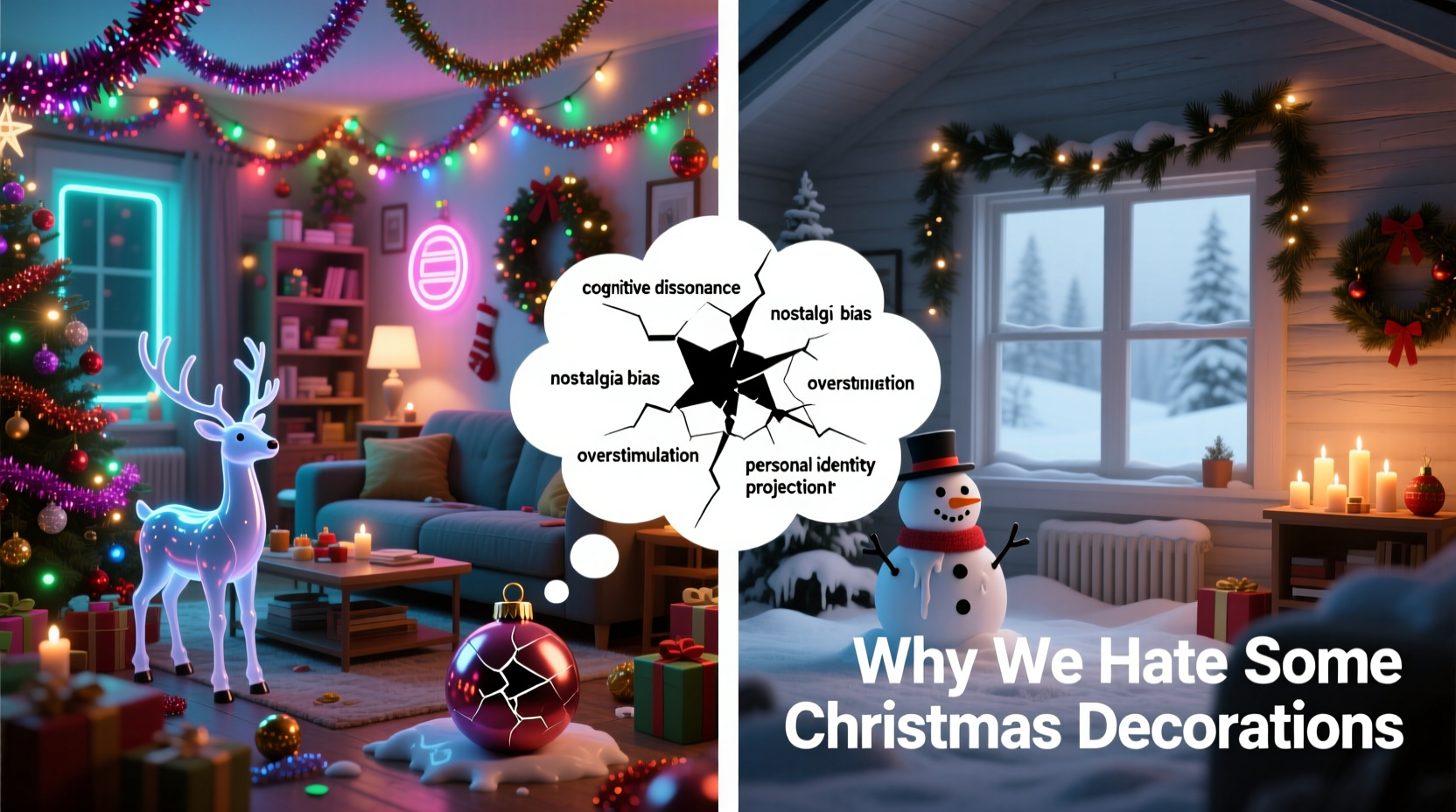
Dislike for specific Christmas decorations often goes beyond simple preference. Psychologists refer to this phenomenon as “aesthetic disgust”—a visceral reaction triggered when visual stimuli violate deeply held expectations of beauty, order, or appropriateness.
Dr. Sarah Lin, a cognitive psychologist specializing in visual culture, explains:
“Holiday decor occupies emotional territory. When someone sees an oversized, flashing Santa on a neighbor’s roof, it may trigger more than annoyance—it can feel like a violation of shared norms, especially if that person associates Christmas with quiet reverence or minimalist elegance.”
This emotional response is amplified by context. Christmas is culturally loaded: tied to family memories, religious meaning, or personal nostalgia. Decorations that clash with those internal narratives can activate discomfort akin to cognitive dissonance—where reality conflicts with expectation.
- Overstimulation: Flashing lights, loud music, or chaotic color schemes overwhelm sensory processing, leading to mental fatigue.
- Nostalgia mismatch: Younger generations may embrace irony or pop-culture themes (e.g., ugly sweater motifs), while older viewers interpret them as disrespectful.
- Social signaling: Display choices communicate values—tasteful restraint versus exuberant celebration—and deviation from group norms can be perceived as social transgression.
Cultural Norms and Regional Identity
Holiday aesthetics are not universal. What reads as joyful in one region may seem excessive or inappropriate in another. These differences stem from regional traditions, climate, religion, and urban-rural divides.
In suburban Southern California, palm trees wrapped in white lights evoke a unique form of holiday spirit—one that might puzzle residents of snowy New England, where icicle lights mimic natural frost. Similarly, Las Vegas’ extravagant drive-through light displays celebrate spectacle, whereas Scandinavian homes favor candles and pine boughs, emphasizing stillness and warmth.
This divergence creates friction when people encounter unfamiliar styles. Cognitive bias known as the mere exposure effect means we tend to prefer things we’ve seen before. Novelty, even if well-intentioned, can be misinterpreted as gaudy or tacky simply because it’s outside one’s experiential frame.
| Region | Common Decorations | Potential Misinterpretations |
|---|---|---|
| Rural Midwest | Nativity scenes, wreaths, classic bulb lights | Bright LEDs = commercialized; inflatables = childish |
| Urban Coastal Cities | Minimalist trees, metallic accents, art-inspired ornaments | Traditional red/green = cliché; lawn displays = kitsch |
| Southern U.S. | Porches lit year-round, magnolia garlands, animated figures | Restraint = unfriendly; no lights = lack of spirit |
| Scandinavian-Influenced Areas | Candles, handmade crafts, muted tones | Bright colors = jarring; plastic decor = low effort |
These patterns show that decoration preferences are less about objective beauty and more about cultural grammar—the unspoken rules governing acceptable expression within a community.
The Role of Social Media and Trend Cycles
Social platforms have transformed Christmas decorating from a private ritual into a public performance. Instagram, TikTok, and Pinterest accelerate trend adoption—and rejection—by turning individual choices into viral moments.
A single video of a synchronized light display set to Mariah Carey’s “All I Want for Christmas Is You” can inspire thousands to replicate it—while simultaneously triggering backlash from those who view it as performative or disruptive.
Trends follow a predictable arc:
- Innovation: One person tries something new (e.g., projector-based yard art).
- Adoption: Early adopters share online; engagement rises.
- Normalization: Mass retailers sell kits; mainstream media covers it.
- Backlash: Overexposure leads to fatigue; critics label it “cringe” or “try-hard.”
- Decline: Enthusiasts move on; the trend becomes ironic or nostalgic.
This cycle explains why certain decorations become polarizing. Once novel and charming, they risk becoming symbols of excess when overused. The same inflatable reindeer that delighted a neighborhood in 2015 might now symbolize aesthetic laziness due to saturation.
“Trends thrive on contrast. What starts as joyful rebellion against minimalism eventually becomes its own kind of conformity.” — Dr. Marcus Tran, Cultural Anthropologist
Case Study: The Great Grinch Light Controversy of 2022
In a quiet Denver suburb, one homeowner installed a 12-foot-tall illuminated Grinch figure that blinked rhythmically with holiday music played through outdoor speakers. Initially popular with children, it soon drew complaints after midnight noise disturbances and glare affecting bedroom windows.
The city received 37 formal noise complaints in three weeks. Local Facebook groups split: supporters called it “joyful,” opponents labeled it “a nuisance disguised as tradition.”
What made this case notable wasn’t just the scale of the display—but how quickly sentiment shifted. Within days, memes circulated mocking the Grinch as “the face of holiday entitlement.” By January, the owner dismantled the setup and issued a public apology.
This illustrates how social tolerance for festive expression has limits. Even well-meaning efforts can cross into territorial or sensory intrusion, triggering collective pushback rooted in respect for boundaries—not just taste.
Do’s and Don’ts of Holiday Decorating (Without Alienating Others)
To balance self-expression with community harmony, consider these guidelines grounded in environmental psychology and urban sociology.
| Do | Don't |
|---|---|
| Use warm-white LED lights—they’re less disruptive to circadian rhythms | Install blinding strobes or laser projectors facing neighboring homes |
| Keep sound elements contained or motion-sensor activated | Play music at high volume past 9 PM |
| Engage in “decor dialogue” with neighbors before major installations | Assume everyone shares your enthusiasm for full-yard animatronics |
| Highlight personal heritage (e.g., Las Posadas, Hanukkah, Kwanzaa) with educational signage | Monopolize public spaces like sidewalks or utility poles |
| Rotate themes annually to avoid visual fatigue | Leave decorations up year-round “because they’re efficient” |
When Tradition Clashes with Innovation
One of the deepest tensions in holiday decorating lies between preservation and evolution. Older generations often associate authenticity with handmade ornaments, real trees, and heirloom pieces. Younger decorators may prioritize convenience, humor, or pop culture references—think Darth Vader tree toppers or “Die Hard” themed stockings.
This generational gap isn’t trivial. It reflects differing views on what Christmas represents: sacred tradition versus inclusive celebration. Research from the University of Michigan found that individuals who strongly identify with religious or familial roots are 3.2 times more likely to express disdain for non-traditional decor than those who see holidays as secular events.
Yet innovation plays a crucial role in keeping traditions alive. Without adaptation, customs risk irrelevance. The key is integration—not replacement. A tree can feature both vintage glass balls and a funny ornament referencing a family inside joke. Balance allows multiple meanings to coexist.
Checklist: Creating Inclusive, Thoughtful Holiday Displays
- ✅ Assess visibility from neighboring homes—will lights or sounds intrude?
- ✅ Consider energy use—opt for LED and solar-powered options where possible.
- ✅ Reflect your identity while acknowledging community diversity.
- ✅ Rotate decor every few years to prevent aesthetic fatigue.
- ✅ Label multicultural elements to educate and invite connection (e.g., “This candle honors Kwanzaa’s principle of Unity”).
- ✅ Set clear start and end dates for display installation and removal.
Frequently Asked Questions
Why do some people hate inflatable Christmas decorations?
Inflatables often trigger dislike due to their mass-produced appearance, which contrasts with ideals of craftsmanship and authenticity. Their size and brightness can also disrupt neighborhood aesthetics, creating a sense of visual imposition. Additionally, they became widely associated with commercialization during the 2000s, making them symbolic of holiday excess for some.
Is there a psychological reason people get upset about Christmas decorations going up too early?
Yes. Premature decorating—such as putting up lights in October—can cause temporal dissonance. Our brains rely on seasonal cues to regulate mood and anticipation. When holiday symbols appear too soon, it disrupts natural emotional pacing, leading to stress or resentment. For some, especially those grieving or struggling with mental health, early decor can feel like forced joy, amplifying feelings of isolation.
Can ugly Christmas sweaters and ironic decor offend people?
While intended humorously, ironic decor can unintentionally dismiss the solemn or spiritual aspects of the season for others. In homogeneous or highly traditional communities, sarcasm-laden ornaments may be interpreted as mockery rather than playfulness. Context matters: what works among friends may not translate in public or intergenerational settings.
Conclusion: Beyond Like and Dislike
The emotions stirred by Christmas decorations reveal far more than personal taste—they expose how we navigate identity, memory, and community in a shared cultural space. What seems like a simple choice between colored or white lights carries layers of meaning shaped by psychology, history, and social dynamics.
Instead of dismissing detractors as “Grinches” or defenders as “over-the-top,” we can use these reactions as opportunities for reflection. Are our displays inviting or imposing? Do they honor the past while embracing change? Can joy coexist with restraint?
Ultimately, the most enduring holiday spirit isn’t measured in wattage or yard coverage—it’s found in awareness, empathy, and the willingness to let different kinds of celebrations exist side by side.
💬 Have a decoration dilemma or a story about a neighborhood holiday clash? Share your experience in the comments—let’s build a more thoughtful, inclusive understanding of what the season can look like for everyone.








