For millions of people around the world, the act of putting up the Christmas tree is more than just a seasonal chore—it’s a ritual steeped in meaning, memory, and emotion. Often accompanied by music, hot drinks, and family laughter, the moment the first ornament is hung can bring tears to someone’s eyes, even if they don’t fully understand why. This emotional response isn’t random; it’s deeply rooted in psychological processes involving memory, identity, attachment, and the human need for continuity and belonging.
The Christmas tree serves as a powerful symbolic anchor. It marks the beginning of a sacred season—not necessarily religious, but emotionally significant—for individuals and families alike. The feelings that surface during this ritual are not simply about decoration or aesthetics. They reflect a complex interplay between past experiences, cultural conditioning, and neurological responses to familiar stimuli. Understanding the psychology behind these emotions offers insight into how traditions shape our mental and emotional well-being.
Nostalgia and Memory: Reconnecting with the Past
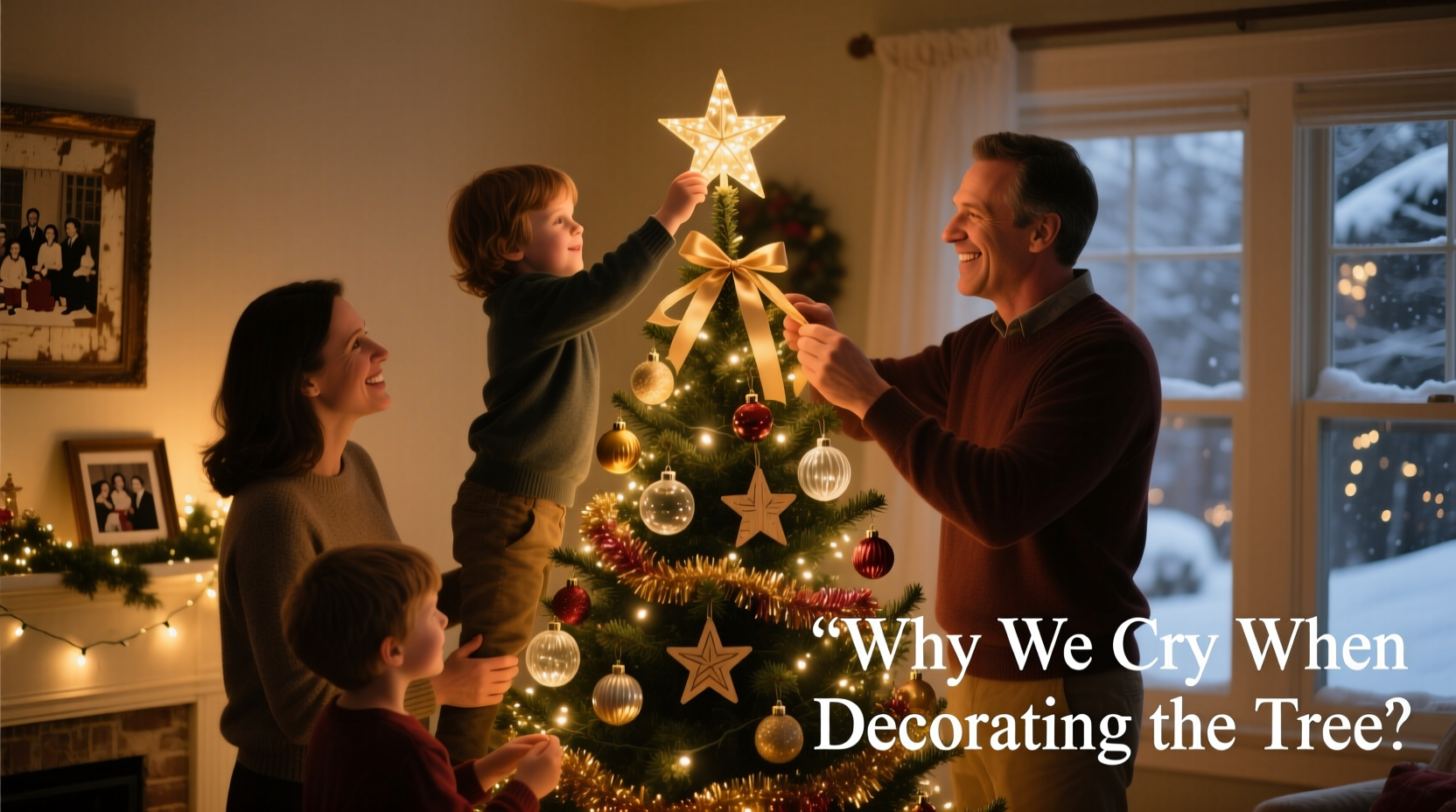
One of the most potent reasons people become emotional when decorating the Christmas tree is nostalgia—the bittersweet longing for moments gone by. Psychologists define nostalgia as a self-relevant, social, and often positive emotional state triggered by cues associated with one’s personal past. The Christmas tree functions as a rich repository of such cues: the scent of pine, the sound of carols, the texture of handmade ornaments, and the presence of loved ones.
When individuals unpack their decorations each year, they’re not just handling tinsel and baubles—they’re handling fragments of their life story. A chipped glass ball might remind someone of childhood clumsiness; a lopsided paper snowflake could evoke a parent’s proud smile. These objects serve as tangible links to earlier versions of themselves and the people who shaped them.
“Nostalgia acts as a psychological buffer. It reminds us that we’ve been loved, that we belong to something larger, and that joy has existed before—even when present circumstances are difficult.” — Dr. Constantine Sedikides, Professor of Social Psychology, University of Southampton
Neurological studies show that nostalgic memories activate brain regions tied to reward (the ventral striatum) and self-processing (the medial prefrontal cortex). This means recalling warm holiday memories doesn’t just feel good—it reinforces our sense of identity and emotional stability. For those grieving a lost loved one or navigating life transitions, the tree becomes a vessel through which connection is reestablished, even if only symbolically.
Tip: If you're feeling overwhelmed by emotion while decorating, pause and reflect on what specific ornament or moment triggered the feeling. Naming the memory can help process it constructively.Sensory Triggers and Emotional Recall
The human brain stores memories not just as facts, but as multi-sensory experiences. Smell, sound, touch, and sight work together to encode moments in time—and few occasions activate all five senses like setting up a Christmas tree.
- Smell: The aroma of real pine contains terpenes like pinene, which some research suggests may have mild mood-lifting effects. More importantly, smell bypasses the thalamus and goes directly to the limbic system—the brain’s emotional center—making it uniquely capable of triggering vivid emotional recall.
- Hearing: Holiday music, whether joyful or melancholic, primes the brain for emotional release. Songs heard repeatedly over years form strong associative networks linked to specific times and relationships.
- Touch: Handling delicate ornaments, stringing lights, or fluffing tinsel engages tactile memory. The physical act of decorating mirrors routines performed in childhood, creating a somatic echo of past selves.
- Sight: The visual transformation of a dark room into a softly glowing space mimics the psychological shift from ordinary time to “holiday time,” activating dopamine pathways related to anticipation and reward.
This convergence of sensory input creates what psychologists call a “memory cascade”—a flood of associated recollections that emerge almost involuntarily. When a person sees their grandmother’s angel topper being placed on the tree, they may simultaneously remember her voice, her kitchen, the way she wrapped presents, and the warmth of her hugs—all within seconds.
Tradition, Identity, and Belonging
Humans are meaning-making creatures. We rely on rituals to mark time, affirm values, and reinforce group identity. The Christmas tree ritual—whether secular or religious—functions as a cultural milestone signaling safety, celebration, and togetherness.
From a developmental perspective, traditions provide children with a sense of predictability and security. As adults, continuing these rituals reaffirms personal continuity—the feeling that despite changes in career, location, or relationships, core aspects of the self remain intact. Decorating the tree becomes an annual declaration: I am still me. My family is still my family. Some things endure.
| Psychological Need | How Tree Decoration Fulfills It |
|---|---|
| Belonging | Shared activity strengthens family bonds and reinforces inclusion (\"We do this together\") |
| Continuity | Repeating the same actions year after year creates narrative cohesion across time |
| Identity | Choice of ornaments, tree type, and décor style reflects personal or cultural values |
| Meaning-Making | Ritual transforms mundane objects into symbols of love, faith, or heritage |
Even minor deviations from tradition—like using LED lights instead of incandescent bulbs or opting for an artificial tree—can provoke subtle emotional resistance because they disrupt the expected sensory script. Conversely, adapting traditions (e.g., adding a new ornament after a wedding or birth) allows the ritual to evolve while preserving its emotional function.
Grief, Loss, and Emotional Release
Not all emotions stirred by the Christmas tree are joyful. For many, the season amplifies feelings of absence. The empty chair at the dinner table, the missing voice in the carol sing-along, the realization that a parent will never again climb the step stool to hang the star—these absences can make the act of decorating unexpectedly painful.
Yet paradoxically, this pain often coexists with gratitude. The very fact that someone feels grief indicates the depth of prior love. Psychologists refer to this as “continuing bonds”—the idea that healthy mourning involves maintaining emotional connections with the deceased rather than severing them. Decorating the tree becomes a form of remembrance, a quiet ceremony honoring those no longer physically present.
“We don’t stop loving people when they die. Rituals like decorating the tree allow us to express that ongoing love in a safe, structured way. It’s not about dwelling in sadness—it’s about affirming that love lasts.” — Dr. Alan Wolfelt, Director, Center for Loss and Life Transition
In therapeutic settings, counselors often encourage clients to incorporate intentional acts of remembrance into holiday routines. Examples include:
- Dedicating an ornament specifically to a lost loved one
- Playing their favorite holiday song during setup
- Sharing stories about them while decorating
Step-by-Step: Creating a Mindful Tree-Decorating Ritual
To deepen the emotional benefits of this tradition—and manage difficult feelings—consider approaching tree decoration as a mindful, intentional practice. Here’s a practical timeline:
- Prepare mentally (1–2 days before): Reflect on your intentions. Are you celebrating joy? Honoring memory? Rebuilding after hardship? Acknowledge your emotional state without judgment.
- Set the environment: Choose music intentionally—uplifting songs for energy, softer melodies for reflection. Light candles or dim overhead lights to create warmth.
- Unpack with awareness: As you open storage boxes, take time to notice each ornament. Ask: Who made this? Where was it bought? What memory does it carry?
- Assign roles: Involve others by giving meaningful tasks—let a child hang the first ornament, ask a partner to choose the tree topper, invite elders to share stories.
- Pause for tribute (optional): If grieving, set aside a moment to speak the name of someone missed, light a candle, or place a special ornament in their honor.
- Capture the moment: Take a photo, write a short note, or record a voice memo describing the evening. This builds a new layer of memory for future reflection.
Real-Life Example: A Family’s Healing Journey
After losing her mother in January, Sarah delayed putting up the Christmas tree for the first time in 35 years. By early December, anxiety mounted—how could she decorate without her mom’s famous eggnog or her insistence on symmetrical ornament placement?
With encouragement from her therapist, Sarah invited her siblings over for a “memory night.” They played their mother’s favorite vinyl records, recreated her cookie recipe (burnt edges and all), and agreed to leave one branch deliberately uneven—\"just like Mom used to do.\" Each sibling brought an ornament representing a shared memory. One hung a tiny knitting needle charm; another placed a miniature cookbook.
By the end of the evening, tears had given way to laughter. The tree wasn’t perfect—but it felt authentic. In subsequent years, Sarah added a new tradition: writing a letter to her mother and placing it beneath the tree. The ritual didn’t erase grief, but it transformed it into something bearable, even beautiful.
Frequently Asked Questions
Is it normal to cry when putting up the Christmas tree?
Yes, it’s entirely normal. Tears may stem from joy, nostalgia, grief, or a mix of emotions. The Christmas tree often acts as an emotional catalyst, unlocking feelings that may have been suppressed during the year. Crying is a natural response to deep connection and memory.
What if I don’t have happy holiday memories? Should I still decorate a tree?
Absolutely. You’re not required to replicate someone else’s idealized version of the holidays. Decorating a tree can be an act of self-definition—an opportunity to create new traditions on your own terms. Even lighting a single strand of lights in a quiet room can signal hope and intentionality.
Can this emotional response happen with other holiday rituals?
Yes. Similar emotional surges occur during baking family recipes, attending religious services, sending cards, or hearing certain songs. Any repeated, sensory-rich ritual tied to personal history can trigger profound psychological responses.
Final Thoughts: Embracing the Emotional Weight of Tradition
The emotional reaction to putting up the Christmas tree is neither irrational nor excessive—it’s profoundly human. It reflects our capacity to love, remember, grieve, and rebuild. In a world that often prioritizes productivity over presence, this annual ritual invites us to slow down, reconnect, and honor both joy and sorrow as valid parts of life.
Whether your tree is tall or small, real or artificial, glittering or modest, it stands as a testament to continuity. It says: I remember. I belong. I care. And sometimes, that’s enough to bring anyone to tears—not out of sadness, but because, for a moment, they feel truly seen by their own history.
🚀 Take a moment this season to reflect on what your tree represents. Share your story with someone you trust, write it down, or simply stand in its glow. Let the emotion move through you. In doing so, you’re not just decorating—you’re healing.








