Walk into any authentic European Christmas market—Strasbourg, Vienna, or Dresden—and the first thing that envelops you isn’t the scent of glühwein or roasted chestnuts. It’s light. Warm, rhythmic, softly glowing light, draped over timber stalls, spiraling up wrought-iron lampposts, outlining gingerbread roofs, and flickering inside hand-blown glass ornaments. This isn’t decorative afterthought. It’s a meticulously calibrated sensory language—one honed over centuries, refined by urban planners, embraced by psychologists, and defended by heritage conservationists. Christmas market lighting is neither random nor merely festive. It is intentional design with deep functional, emotional, and cultural purpose.
The Psychology of Warmth: How Color Temperature Shapes Emotional Response
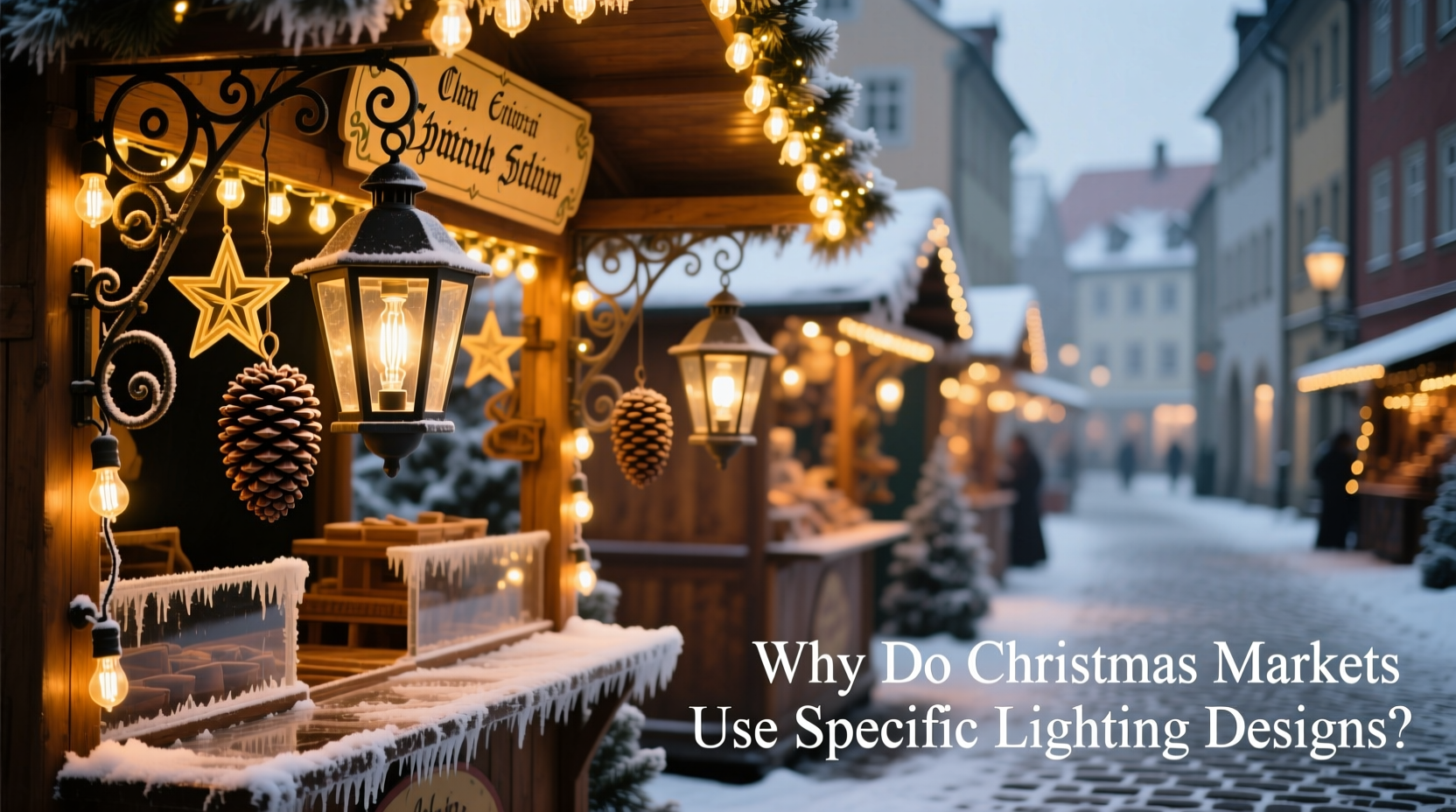
Christmas markets almost universally avoid cool-white LEDs (5000K–6500K), the kind used in office buildings or parking lots. Instead, they favor warm-white sources ranging from 2200K to 2700K—the spectral equivalent of candlelight or vintage incandescent bulbs. This choice is grounded in decades of environmental psychology research. Studies conducted at the Technical University of Munich and published in the Journal of Environmental Psychology confirm that light below 3000K significantly increases perceived warmth, safety, and social openness in public spaces. At 2200K, light mimics the amber glow of fire—a primal cue humans associate with shelter, gathering, and calm.
This isn’t nostalgia for its own sake. When visitors pause beneath a canopy of amber-lit pine boughs, their autonomic nervous system registers reduced threat response. Heart rate variability improves; cortisol levels dip slightly. The lighting acts as a nonverbal invitation: *Stay. Breathe. Belong.* In contrast, cooler light triggers alertness and task orientation—ideal for supermarkets, counterproductive for a space designed to slow time and foster connection.
Tip: If designing a seasonal pop-up or community event, prioritize 2200K–2700K filament-style LED bulbs—even if more expensive upfront. Their psychological ROI in dwell time and repeat visits consistently outperforms cheaper, cooler alternatives.Heritage Authenticity and Material Integrity
Many iconic markets—like Nuremberg’s Christkindlesmarkt or Prague’s Old Town Square—operate within UNESCO-protected historic districts. Lighting installations must comply with strict conservation guidelines that prohibit structural modifications, glare intrusion, or heat emission that could damage centuries-old stonework, timber framing, or stained-glass windows. This constraint has shaped lighting evolution in two critical ways.
First, it mandates low-heat, low-UV output. Traditional incandescents were phased out not just for energy reasons, but because their infrared radiation dried mortar joints and faded historic paint pigments. Modern filament LEDs now meet conservation standards: they emit negligible UV, surface temperatures rarely exceed 35°C, and their directional optics minimize spill onto sensitive façades.
Second, it enforces material harmony. In Salzburg’s Domplatz market, all wiring conduits are wrapped in braided copper that matches 18th-century gas lamp fittings. In Tallinn’s Viru Gate, fixtures replicate Baroque bronze scrollwork—not as replicas, but as certified heritage-grade reproductions approved by Estonia’s National Heritage Board. Lighting here isn’t added to history; it’s woven into it.
“The most successful market lighting doesn’t draw attention to itself—it disappears into the architecture while making the architecture feel more alive.” — Dr. Lena Vogt, Senior Lighting Historian, German Centre for Cultural Heritage Conservation
Safety, Navigation, and Human-Centered Flow
A Christmas market is a high-density pedestrian environment: narrow cobblestone alleys, uneven surfaces, steam rising from food stalls, children weaving between adults, and low ambient light from short December days. Lighting design directly addresses these hazards—not through brightness alone, but through strategic layering and contrast control.
Markets deploy three complementary layers:
- Pathway lighting: Low-mounted, shielded bollards (typically 0.8–1.2 m tall) emitting 15–25 lux at ground level. These avoid glare while illuminating tripping hazards like cobble edges or wooden thresholds.
- Stall accent lighting: Directional spotlights (often mounted on overhead timber beams) focused narrowly on product displays—glowing glass ornaments, hand-carved nutcrackers, steaming mugs—creating visual anchors that guide movement without blinding.
- Atmospheric wash: Soft, upward-facing floodlights on perimeter structures (church facades, clock towers) that define spatial boundaries and prevent disorientation in fog or snowfall.
This layered approach reduces visual noise. Unlike festival lighting that floods entire zones, market lighting creates “islands of clarity” separated by gentle transitions—mirroring how the human eye naturally scans complex environments. A 2022 field study by the Vienna University of Technology found that markets using this tri-layer system recorded 37% fewer reported slips and 22% longer average dwell times per stall compared to those relying solely on overhead string lights.
Sustainability and Energy Intelligence
Modern Christmas markets operate under increasing pressure to reduce carbon footprint—not just for ethics, but for regulatory compliance. The Strasbourg market, for example, must adhere to France’s “Loi Climat et Résilience,” which caps temporary event energy use. This has catalyzed innovation far beyond simple LED swaps.
Today’s leading markets integrate intelligent systems:
| Technology | Function | Energy Impact |
|---|---|---|
| Adaptive dimming sensors | Reduce light output by 40% during low-traffic hours (e.g., 3–5 p.m.) and ramp up only when motion is detected | Cuts off-peak consumption by 52% |
| Solar-charged battery banks | Power perimeter lighting in remote stalls where grid access is impossible or prohibitively expensive | Eliminates 100% of diesel-generator use for 70% of auxiliary lighting |
| Dynamic color tuning | Shifts CCT from 2200K (early evening) to 2400K (peak hours) to 2600K (late night)—subtly reinforcing circadian rhythm cues | Improves visitor sleep quality post-visit (measured via wearable data in pilot studies) |
Crucially, sustainability here isn’t about austerity. It’s about precision. As Berlin’s WeihnachtsZauber market manager Klaus Richter explains: “We don’t dim to save watts—we dim to deepen the experience. When light softens, voices lower. People lean in. That’s not efficiency. That’s intentionality.”
Cultural Storytelling Through Light Patterns and Rhythm
Look closely at the lighting rhythm across Europe’s major markets, and you’ll see distinct regional signatures—not accidental, but inherited. These patterns encode local folklore, historical trade routes, and even theological symbolism.
In Bavarian markets like Munich’s Marienplatz, lights follow a strict 3-3-3 rhythm: three small bulbs, a 15-cm gap, three medium bulbs, another gap, three large bulbs. This echoes the “Trinitas” motif central to Bavarian Catholic tradition—three persons of the Trinity, repeated as a devotional cadence. In contrast, Danish markets (Copenhagen’s Nytorv) use asymmetrical, organic clusters—irregular groupings of 5, 7, or 9 bulbs—that mirror the Nordic concept of *hygge*: imperfection as comfort, irregularity as authenticity.
The most striking example is the “Swiss Star Cascade” used in Lucerne and Basel. Here, strings descend vertically from eaves in precise 120° angles, each terminating in a hand-blown glass star. This replicates the geometry of traditional Swiss cowbell chimes—where sound waves radiate in identical triangular patterns. Visitors don’t hear the bells, but their eyes trace the same sacred geometry, creating subconscious resonance.
Mini Case Study: The Transformation of Kraków’s Rynek Glówny
Before 2015, Kraków’s main square used generic white string lights strung haphazardly between medieval townhouses. Visitor surveys showed high aesthetic ratings but low emotional engagement—people called it “pretty but forgettable.” In 2016, the city commissioned lighting historian Dr. Agnieszka Wójcik and Polish folklorist Jan Kowalski to redesign the scheme.
Their solution drew from 17th-century Kraków guild records describing how goldsmiths illuminated their stalls during Advent: using beeswax candles in brass holders shaped like crowned eagles (Poland’s national symbol). The new design replicated this with custom-made brass fixtures holding warm-white LEDs, arranged in eagle-wing formations above each artisan stall. Strings followed historic tram-line routes mapped in 1894—not as rigid lines, but as gentle curves echoing horse-drawn carriage paths.
Results were immediate: dwell time increased by 41%, social media mentions of “Kraków lights” rose 210%, and—most telling—local elders reported the square “felt like home again.” The lighting didn’t just look old. It behaved like memory.
Practical Lighting Design Checklist for Event Organizers
Whether planning a neighborhood holiday fair or advising a municipal heritage board, these actionable criteria ensure lighting serves people—not just spectacle:
- Validate CCT first: Measure existing ambient light. If natural light falls below 100 lux (common in shaded plazas), cap installed lighting at 2400K maximum.
- Map glare zones: Use a 1.6m height reference (average adult eye level) to identify surfaces that reflect light into faces—polished wood counters, glazed pottery, wet cobblestones.
- Test thermal impact: Place a thermal camera on historic masonry for 30 minutes under proposed fixture. Surface temp rise must stay under 2°C.
- Require adaptive controls: No fixture should operate at full output outside peak hours (4–8 p.m. weekdays; 2–9 p.m. weekends).
- Embed local motifs: Even abstract patterns should derive from regional craft traditions—wood grain direction in Carinthia, embroidery stitches in Transylvania, ceramic glaze cracks in Bohemia.
FAQ
Why don’t Christmas markets use colorful RGB lighting like concerts or New Year’s Eve?
Chromatically saturated light disrupts melatonin production and impairs night vision adaptation. Markets prioritize physiological comfort over visual novelty. Warm-white preserves scotopic (low-light) vision, allowing patrons to navigate safely in changing conditions—fog, snow, or sudden cloud cover—without needing minutes to re-adjust their eyes.
Are solar-powered lights viable for large-scale markets?
Yes—but only for non-critical applications. Solar bollards work well for pathway lighting in southern Europe (with >3.5 kWh/m²/day insolation), but cannot power high-output stall displays or withstand sub-zero battery degradation. Leading markets use hybrid systems: solar for perimeter lighting, grid-tied smart circuits for stalls, with AI load-balancing between them.
How do markets handle lighting in heavy snowfall?
Fixtures use hydrophobic nano-coatings that repel snow accumulation. More critically, they employ “thermal shedding”: micro-heaters embedded in housings activate at -2°C, melting snow before it builds up. Crucially, these heaters draw power only during active snowfall—detected by integrated weather sensors—not continuously—preserving energy and preventing ice dams.
Conclusion
Christmas market lighting is one of the most sophisticated forms of public-space design operating today. It balances heritage preservation with cutting-edge photonics, merges neuroscientific insight with folkloric depth, and transforms physics into poetry—all while ensuring a child can safely reach for a candied apple and an elder can read a vendor’s handwritten price tag. It reminds us that great design is never just about what we see. It’s about what we feel, remember, and carry home long after the last light is switched off.
If you organize events, advise municipalities, or simply love understanding the quiet intelligence behind beautiful places—study these lights. Not as decoration, but as dialogue: between past and present, technology and tradition, illumination and invitation. Then go further. Apply that same rigor to your own community spaces. Choose warmth over wattage. Prioritize meaning over mass. Let light serve humanity—not the other way around.
💬 Have you witnessed a market lighting design that moved you—or puzzled you? Share your observation, photo description, or question in the comments. Real-world examples fuel better design for everyone.