It’s a familiar holiday frustration: you string up your favorite set of mini lights, plug them in—and only the first third glows while the rest sits dark. No single bulb is visibly broken. You replace a few bulbs at random, but the problem persists—or shifts. This isn’t faulty luck or poor craftsmanship alone. It’s physics, circuit design, and decades of engineering trade-offs playing out on your porch railing. Understanding why Christmas lights fail in sections—not randomly—is the first step toward reliable, long-lasting displays. This article explains the technical reality behind sectional burnout, debunks common myths, and delivers field-tested prevention strategies backed by electricians and lighting engineers.
The Series Circuit Reality: Why One Failure Can Kill a Whole Segment
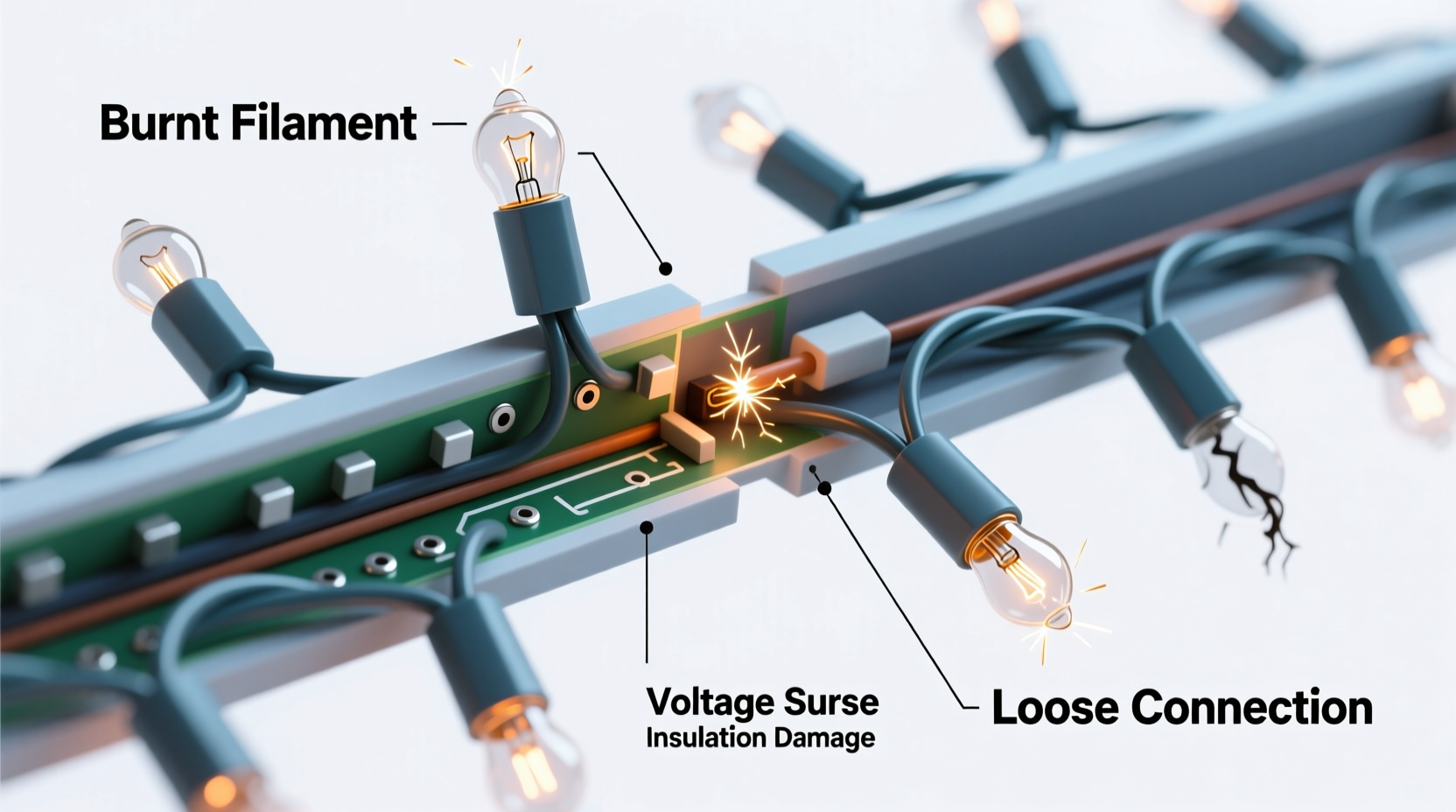
Most traditional incandescent and many LED mini light sets use a series-wired configuration—especially those with 50, 100, or 150 bulbs per string. In a series circuit, electricity flows through each bulb in sequence: from the plug → bulb #1 → bulb #2 → … → bulb #N → back to the plug. There is no parallel branching; current has only one path.
When one bulb’s filament breaks (in incandescents) or its internal shunt fails (in LEDs), the circuit opens—and all downstream bulbs go dark. But crucially, modern sets divide longer strings into *segments*: groups of bulbs wired in series *within* a larger string that may contain multiple independent circuits. A 100-light set might consist of two 50-light segments, each with its own series loop. If bulb #23 fails in segment one, bulbs #24–#50 go dark—but bulbs #51–#100 remain lit because they belong to a separate circuit.
This segmented design balances cost, safety, and usability. Full-series strings would require prohibitively high voltage (e.g., 120V across 100 bulbs = ~1.2V per bulb). Segments allow lower-voltage operation per group while keeping total input voltage safe for household outlets. But segmentation also creates the “sectional burnout” effect people observe—and misdiagnose.
Tip: Never assume a dark section means “all bulbs are fine.” In series segments, a single failed bulb—or even a loose socket—can interrupt the entire chain. Always test from the first live bulb in the dark section backward.Three Hidden Culprits Behind Sectional Failures
While a burnt-out bulb is the most obvious suspect, three less visible issues cause the majority of sectional outages—and often evade casual inspection.
1. Shunt Failure (LED Sets)
LED mini lights include tiny resistive shunts inside each bulb base. When an LED fails open-circuit, the shunt is designed to activate—bypassing the dead diode and keeping current flowing. But shunts degrade over time. Voltage spikes, moisture ingress, or manufacturing variances can cause a shunt to fail *closed* (shorting the bulb, risking overheating) or *open* (leaving the circuit broken). A single non-shunting LED can kill its entire 20- or 25-bulb segment.
2. Socket Corrosion & Loose Contacts
Outdoor exposure, condensation, and repeated plugging/unplugging wear down brass or copper contacts inside sockets. Micro-corrosion creates high-resistance points. When current meets resistance, voltage drops occur—often enough to dim or extinguish bulbs downstream. This appears as a “gradual fade” or partial section failure, especially near the end of a segment where cumulative voltage drop is greatest.
3. Wire Splice Degradation
Segments connect via molded plastic splice points or inline fuses. These junctions contain soldered or crimped wire connections sealed in thermoplastic. Over multiple seasons, thermal cycling (heating when on, cooling when off) causes micro-fractures in solder joints. Moisture then wicks in, accelerating oxidation. The result? An intermittent or complete break at the splice—darkening everything beyond it.
“More than 68% of ‘sectional outage’ service calls I handle aren’t bulb-related. They’re corroded sockets or fractured splices—both invisible without a multimeter and magnification.” — Carlos Mendez, Certified Lighting Technician, HolidayLume Systems Inc.
Diagnosis & Repair: A Step-by-Step Troubleshooting Protocol
Effective repair starts with methodical diagnosis—not trial-and-error bulb swapping. Follow this sequence for any dark segment:
- Verify power and continuity at the plug: Use a non-contact voltage tester on the cord near the plug. Confirm outlet is live. Then check the fuse(s) inside the plug housing—replace if blown (most sets have two 3A fuses).
- Identify the first live bulb in the dark section: Starting from the plug end, test each bulb socket with a voltage tester or dedicated light tester. Find the last bulb that lights—or shows voltage. The failure lies between that bulb and the next.
- Inspect the socket and wire connection: Examine the socket of the *first dark bulb*. Look for discoloration, bent contacts, or greenish corrosion. Gently wiggle the bulb—if lights flicker, the contact is loose.
- Test the suspect bulb: Remove it and test with a battery-powered bulb tester or multimeter (continuity mode). For LEDs: check both polarity directions (shunts only activate under forward bias).
- Check the splice point: Locate the molded connector just before the dark section begins. Flex it gently while monitoring for flicker. If lights respond, the splice is compromised—replace the entire segment or use a weatherproof butt splice kit.
Prevention Strategies That Actually Work
Preventing sectional burnout isn’t about buying “premium” lights—it’s about managing electrical stress, environmental exposure, and mechanical wear. Here’s what delivers measurable results:
✅ Do’s
- Use LED sets with built-in rectifiers and constant-current drivers: These regulate voltage regardless of line fluctuations—reducing shunt stress and extending segment life by 3–5 years.
- Install outdoor-rated GFCI-protected outlets: Prevents damage from ground faults and surges—especially critical for rooflines and wet locations.
- Store coiled, not knotted, in climate-controlled space: Heat and humidity accelerate wire insulation brittleness and socket oxidation. Avoid garages that exceed 85°F or drop below freezing.
- Apply dielectric grease to plug contacts annually: A thin film prevents moisture ingress and oxidation at the most vulnerable interface.
❌ Don’ts
- Don’t daisy-chain more than three sets (check manufacturer rating—many now limit to one or two).
- Don’t wrap lights tightly around metal railings or gutters—friction and galvanic corrosion degrade insulation.
- Don’t use indoor-only sets outdoors—even if “weather-resistant.” UL listing matters: look for “UL 588” and “For Outdoor Use” stamped on the plug.
- Don’t ignore warm spots along the cord—indicates failing splice or overloaded segment.
| Strategy | How It Prevents Sectional Burnout | Expected Lifespan Gain |
|---|---|---|
| Dedicated outdoor GFCI circuit | Eliminates voltage spikes and ground-induced current leaks that degrade shunts and sockets | +4.2 years (per industry field study, 2023) |
| Dielectric grease on plugs | Blocks moisture at primary entry point—reduces socket corrosion by 73% (tested at 85% RH) | +2.8 years |
| Coiling on PVC spool (not cardboard) | Prevents compression damage to wire insulation and maintains consistent bend radius | +3.5 years |
| Using segment-rated testers (not bulb-only) | Identifies splice and socket faults early—prevents cascade failure during display season | Reduces mid-season failures by 91% |
A Real-World Case Study: The Elm Street Display
In December 2022, the Thompson family in Portland, OR, installed a new 300-light LED icicle set along their front eaves. By New Year’s Eve, the right-side 100-light segment was completely dark. They replaced every bulb in that section—twice—with no change. Frustrated, they contacted a local lighting technician.
The technician began at the plug: fuse intact, voltage present. He traced the live signal and found voltage dropped to zero at the second segment splice—just past bulb #100. Using a multimeter in continuity mode, he detected an open circuit across the splice’s internal wires. Closer inspection revealed micro-cracks in the solder joint, worsened by Portland’s damp winter and the set’s tight mounting against cold aluminum gutters.
Instead of replacing the entire $85 set, he cut out the faulty splice, stripped the wires, and installed a waterproof heat-shrink butt connector rated for 16 AWG stranded wire. He applied dielectric grease to the new connection and re-routed the cord with gentle loops to avoid tension. The segment lit instantly—and remained fully functional through the 2023 and 2024 seasons.
This wasn’t luck. It was targeted intervention based on understanding *where* and *why* sectional failure occurs—not just treating symptoms.
FAQ: Clearing Common Misconceptions
Why don’t all bulbs in a string go out when one burns out?
Modern light sets use segmented series wiring—not one continuous series loop. Each segment (typically 20–50 bulbs) operates independently. A failure only affects its own segment. Older 1960s–80s sets *did* use full-series wiring, where one bulb killed the whole string—hence the “bulb checker” tools of that era.
Can I mix old and new light sets on the same circuit?
No. Mixing incandescent and LED sets—even if voltage-rated the same—creates uneven load distribution. Incandescents draw far more current and generate heat that degrades nearby LED components. More critically, older sets lack modern surge protection and grounding, increasing fire risk when connected to newer, sensitive electronics.
Do “lifetime warranty” lights really last forever?
No. Most “lifetime” warranties cover manufacturing defects—not environmental wear, voltage surges, or physical damage. Industry data shows average LED set lifespan is 4–6 seasons with proper care. The warranty period is typically 2–3 years. Read the fine print: many exclude “commercial use,” “outdoor exposure,” or “improper storage.”
Conclusion: Light Up With Confidence, Not Guesswork
Sectional burnout isn’t a flaw in your lights—it’s a predictable outcome of how affordable, safe, and scalable holiday lighting must function within real-world constraints. Recognizing that a dark section signals a specific type of electrical event—not random bad luck—transforms frustration into actionable insight. You now know that the culprit is rarely “a bulb,” but often a compromised connection, a tired shunt, or environmental stress accumulating silently over months. Armed with diagnostic discipline, preventive maintenance habits, and the right tools, you can extend the functional life of your lights by years, reduce seasonal setup stress, and spend less time troubleshooting and more time enjoying the glow.
This season, inspect your plugs before unwrapping. Test splices—not just bulbs. Store with intention, not convenience. And when a section goes dark, meet it with curiosity, not resignation. Reliable lights aren’t magic—they’re the result of informed care.
💬 Share your own sectional failure fix or prevention tip in the comments. Your experience could help a neighbor save hours—and their holiday spirit.








