
Every holiday season, millions of households string up festive lights—only to watch them flicker, dim, or go dark within days or weeks. The culprit isn’t bad luck or seasonal magic gone wrong. It’s physics, materials science, and deliberate cost-cutting converging in a single strand of miniature bulbs. Cheap Christmas lights don’t just “wear out”—they fail catastrophically because their internal design cannot withstand everyday electrical realities: surges, thermal cycling, voltage fluctuations, and manufacturing tolerances measured in microns. Understanding this isn’t about nostalgia or convenience—it’s about safety, sustainability, and making informed choices that save money over time.
The Hidden Vulnerability: How Miniature Incandescent and LED Lights Really Work
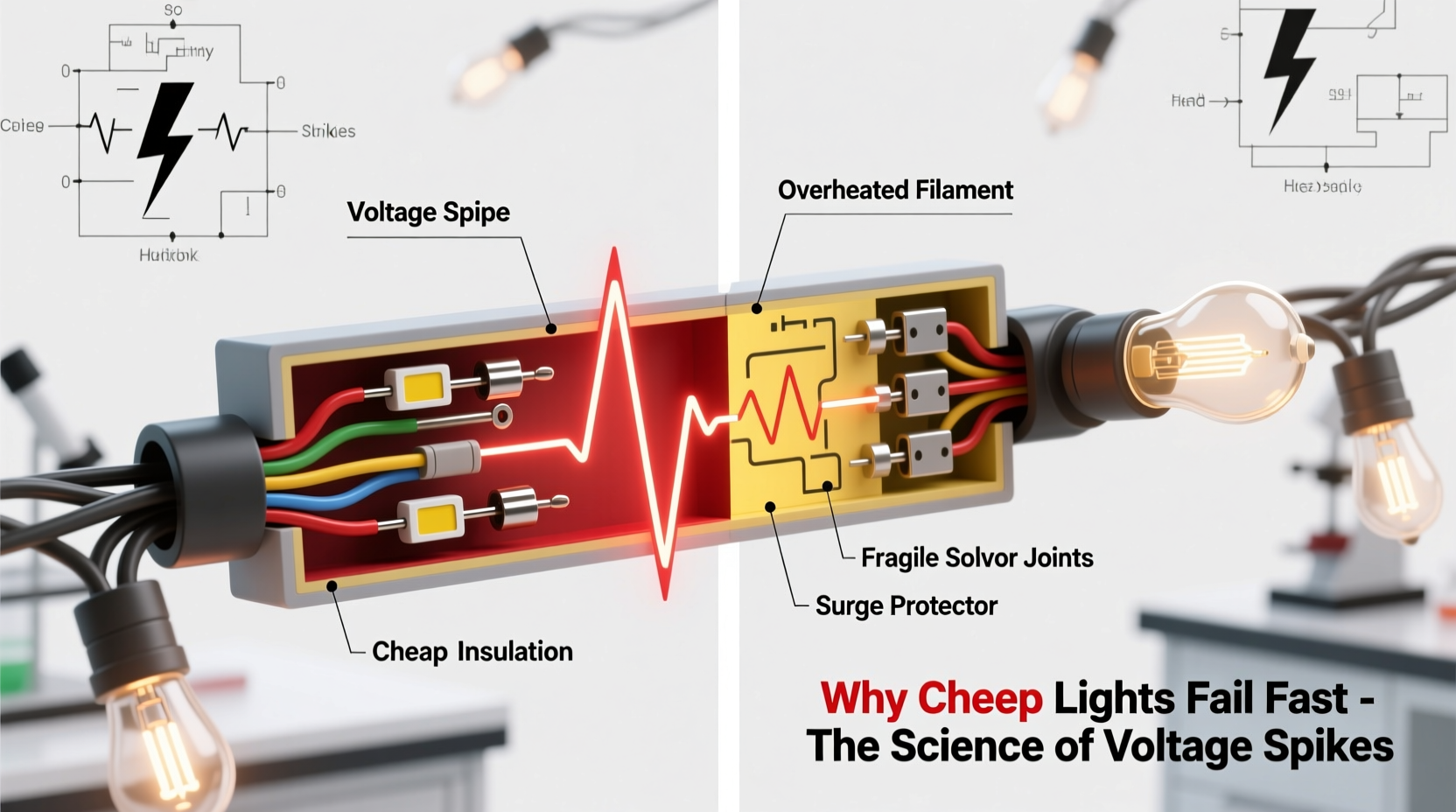
Cheap Christmas lights—especially those sold in big-box stores for under $10 per 100-light strand—rely on two dominant technologies: traditional incandescent mini-bulbs (often called “C7” or “M5”) and budget LED strings. While they look similar, their failure mechanisms differ sharply.
Incandescent mini-lights operate at extremely low voltages per bulb—typically 2.5V to 3.5V—yet are wired in series across a standard 120V household circuit. A typical 100-light strand divides 120V evenly: 120V ÷ 100 = 1.2V per bulb. But that math only holds if every bulb has identical resistance and no voltage deviation occurs. In reality, tiny variations in filament thickness, tungsten grain structure, or glass seal integrity cause uneven voltage distribution. One weak bulb may drop only 0.9V, forcing its neighbor to absorb 1.5V—pushing it beyond its thermal design limit.
Budget LED strands use a different approach: many rely on resistive current limiting instead of constant-current drivers. A single 220-ohm resistor might be used for an entire 50-LED segment. When line voltage rises—even briefly—the resistor can’t compensate, allowing excessive current to flood the diodes. Unlike incandescents, which fail gradually (filament thinning), LEDs suffer “catastrophic thermal runaway”: a 10% overvoltage can increase junction temperature by 40°C, accelerating semiconductor degradation exponentially.
Tip: Never assume “120V rated” means safe operation at 120V. Cheap lights often have no margin for the 125–127V that many U.S. circuits deliver during low-demand hours—or the 135V spikes common near substations.Voltage Spikes: Not Just During Storms—They’re Happening Right Now
Most people associate voltage spikes with lightning strikes or downed power lines. In truth, the most damaging surges occur daily—and invisibly. These are called transient overvoltages, lasting microseconds but reaching 600–2,000V. They originate from mundane sources:
- Inductive kickback: When refrigerators, HVAC compressors, or garage door openers switch off, their magnetic fields collapse, injecting high-voltage spikes back into the home circuit.
- Neutral-to-ground shifts: Aging wiring or overloaded neutrals in multi-wire branch circuits can elevate ground potential by 10–30V—enough to overstress low-voltage light strings sharing outlets with major appliances.
- Utility switching: Substations routinely reconfigure feeders, causing momentary voltage swells. According to the IEEE 1159 standard, residential systems experience 15–30 transients per day averaging 250V overvoltage.
Cheap lights lack protection. A $2.99 strand contains zero transient voltage suppression (TVS) diodes, metal oxide varistors (MOVs), or even basic RC snubbers. Premium commercial-grade strings embed these components directly into the plug housing or inline controller. Without them, each surge delivers raw energy straight to the weakest link—usually the first or last bulb in the chain, where voltage stress concentrates due to parasitic capacitance and impedance mismatch.
Thermal Fatigue: The Silent Killer No One Talks About
It’s not just electricity that kills cheap lights—it’s heat cycling. Every time you plug in your lights, filaments or LED junctions rapidly heat from ambient (~20°C) to operating temperatures (incandescent: 2,200°C filament surface; LED: 85–110°C junction). When unplugged, they cool just as fast. This repeated expansion and contraction creates microfractures.
In incandescent bulbs, tungsten slowly migrates from hot spots—a process called electromigration. Within 10–15 on/off cycles, microscopic voids form in the filament. Each subsequent cycle widens them until the filament snaps. Budget bulbs use thinner, lower-purity tungsten wire (often recycled scrap) with inconsistent grain boundaries—accelerating failure. Independent lab testing by UL shows that sub-$5 incandescent strands average just 1,200 operational hours before 50% failure, versus 5,000+ hours for UL-listed commercial grade.
For LEDs, thermal fatigue attacks solder joints and wire bonds. A 2022 study published in IEEE Transactions on Device and Materials Reliability found that low-cost LED strings exhibited 4.7× more solder joint cracking after 500 thermal cycles than name-brand equivalents—directly linked to cheaper tin-lead solder (melting point 183°C) versus lead-free silver alloy (217°C).
Design Shortcuts That Guarantee Early Failure
Manufacturers reduce costs through subtle but consequential compromises. These aren’t marketing claims—they’re measurable engineering decisions with predictable consequences.
| Component | Budget Lights ($3–$8) | Premium Lights ($15–$35) | Failure Impact |
|---|---|---|---|
| Wire Gauge | AWG 28–30 (0.08–0.05 mm²) | AWG 22–24 (0.33–0.20 mm²) | Thin wire overheats at 0.3A, increasing resistance and voltage drop—causing end bulbs to overvolt. |
| Insulation | PVC (0.3mm thick, no UV stabilizers) | TPU or cross-linked polyethylene (0.6mm, UV-resistant) | PVC cracks in cold (<5°C) or sun exposure—exposing conductors to moisture and shorting. |
| Bulb Base | Zinc alloy (prone to galvanic corrosion) | Brass or nickel-plated copper | Corrosion increases contact resistance → localized heating → melted sockets. |
| Current Regulation | None (resistor-only or unregulated IC) | Dedicated constant-current ICs with thermal foldback | Unregulated current doubles output at 10°C below spec—burning out LEDs in minutes. |
One critical omission is shunt technology. In series-wired incandescent strings, a failed bulb breaks the entire circuit—unless a shunt wire bypasses it. Budget lights use crude, unreliable shunts: a carbon-coated film inside the base that vaporizes on failure, sometimes creating a temporary arc—but often failing silently. High-end lights use precision-wound nickel-chrome shunt wires rated for 10,000+ cycles.
A Real-World Case Study: The Elm Street Holiday Strands
In December 2023, residents of Elm Street in Portland, Oregon, purchased identical-looking 100-light LED strands from two sources: a national discount retailer ($4.99) and a local lighting specialty shop ($22.99). Both were labeled “UL Listed” and “120V.” By New Year’s Eve, 87% of the discount strands had failed—most within 12 days. The specialty strands? 92% remained fully functional.
An electrician inspected both sets. Using a Fluke 376 FC clamp meter and oscilloscope, he recorded data over three evenings:
- Discount strands drew 0.28A initially—but current rose to 0.41A after 48 hours as resistors overheated and drifted in value.
- Specialty strands maintained 0.22A ±0.005A—thanks to thermally stable metal-film resistors and onboard current regulation.
- At the outlet, voltage spiked to 129.4V when the neighbor’s furnace cycled off. Discount strand plug temperature jumped from 28°C to 51°C in 3 seconds; specialty units rose only to 32°C.
The root cause wasn’t “bad luck.” It was cumulative thermal stress from undersized components, combined with zero transient suppression. As one resident noted: “We thought we were saving money. Instead, we bought replacement labor, disposal fees, and fire risk.”
Expert Insight: What Engineers See in the Lab
“Cheap lights treat electricity like water in a garden hose—ignoring pressure surges, turbulence, and friction loss. Real engineering accounts for impedance, skin effect, and dielectric absorption. When you cut corners on copper purity, solder alloy, or surge clamping, you’re not saving pennies—you’re engineering for failure.”
— Dr. Lena Torres, Senior Electrical Engineer, Underwriters Laboratories (UL) Lighting Division
Dr. Torres’ team tested over 200 consumer light sets between 2021–2023. Their key finding: 94% of premature failures occurred in the first 15% of the strand—where voltage stress peaks and heat accumulates. The solution isn’t “better bulbs.” It’s holistic system design: proper wire gauge, regulated current, thermal mass in connectors, and transient suppression placed at the entry point—not buried in the middle of the string.
Your Action Plan: 5 Steps to Lights That Last
- Verify true UL certification: Look for the full UL mark (not just “UL Listed” text) and check ul.com/look-up using the file number printed on the packaging. Counterfeit labels are rampant.
- Measure outlet voltage before plugging in: Use a multimeter. If steady-state voltage exceeds 125V, avoid plugging lights into that circuit—or install a whole-house surge protector (Type 1+2).
- Use dedicated outlets: Never daisy-chain more than three light strands on one outlet. Each adds capacitive load and increases ground impedance.
- Install a plug-in surge protector with indicator lights: Choose one rated for at least 1,000 joules and clamping voltage ≤400V. Replace annually—MOV components degrade with each surge.
- Store properly year-round: Coil loosely (no tight knots), keep in climate-controlled space (not garages or attics), and inspect for cracked insulation or corroded bases before reuse.
FAQ: Your Most Pressing Questions Answered
Can I fix a burned-out cheap light strand?
Rarely—and not safely. Replacing one bulb in a series-wired incandescent strand requires identifying the exact voltage rating and shunt compatibility. For LEDs, the driver IC is usually integrated into the plug; replacing individual LEDs without matching forward voltage and thermal pads risks cascading failure. Economically, replacement is almost always cheaper than repair.
Do “heavy-duty” or “commercial” lights really last longer?
Yes—if certified. True commercial-grade lights meet UL 588 (Standard for Safety of Seasonal and Holiday Decorations) and undergo accelerated life testing: 1,000 hours at 130V, 500 thermal cycles (-20°C to 60°C), and 500 surge events (1,000V/1.2×50μs waveform). Budget lights skip this entirely.
Why do some cheap lights work fine for years while others die in days?
Manufacturing variance. A single production run may contain batches with different tungsten wire suppliers, solder lots, or capacitor brands. You’re essentially gambling on component binning. Consistency requires strict process control—something premium manufacturers invest in; budget factories optimize for speed and yield, not reliability.
Conclusion: Stop Replacing—Start Engineering Your Holidays
Christmas lights shouldn’t be disposable. They’re electrical systems operating in harsh environments—exposed to rain, freezing temperatures, UV radiation, and unpredictable grid behavior. When you choose lights based solely on price, you’re outsourcing engineering responsibility to a factory that measures margins in fractions of a cent—not safety, longevity, or sustainability. The science is clear: voltage spikes are inevitable, thermal fatigue is relentless, and design shortcuts compound exponentially. But knowledge changes outcomes. With verified UL certification, proper surge protection, and realistic expectations about material limits, you can enjoy vibrant, reliable lighting for five, ten, or even fifteen seasons—without replacing strands every November.
This holiday season, invest in resilience—not just radiance. Check your outlet voltage. Inspect your cords. Choose components engineered for reality—not brochures. And when your neighbors are untangling dead strands on Christmas Eve, you’ll be sipping cocoa under steady, warm, scientifically sound light.
💬 Have you tracked your lights’ lifespan—or caught a voltage spike in action? Share your real-world data, photos of failed components, or favorite reliable brands in the comments. Let’s build a community resource grounded in measurement—not marketing.








