
Every holiday season, millions of households install strings of Christmas lights—only to watch them dim, flicker, or go dark within weeks. The pattern is consistent: budget-friendly strands from discount retailers often last one or two seasons, while premium sets endure five years or more. This isn’t just bad luck or user error. It’s physics, materials science, and electrical engineering playing out on your porch railing. Understanding *why* cheap lights fail faster reveals more than seasonal frustration—it exposes how cost-cutting decisions directly compromise electrical integrity, thermal resilience, and long-term reliability.
The Voltage Reality: Why “120V” Is a Misleading Label
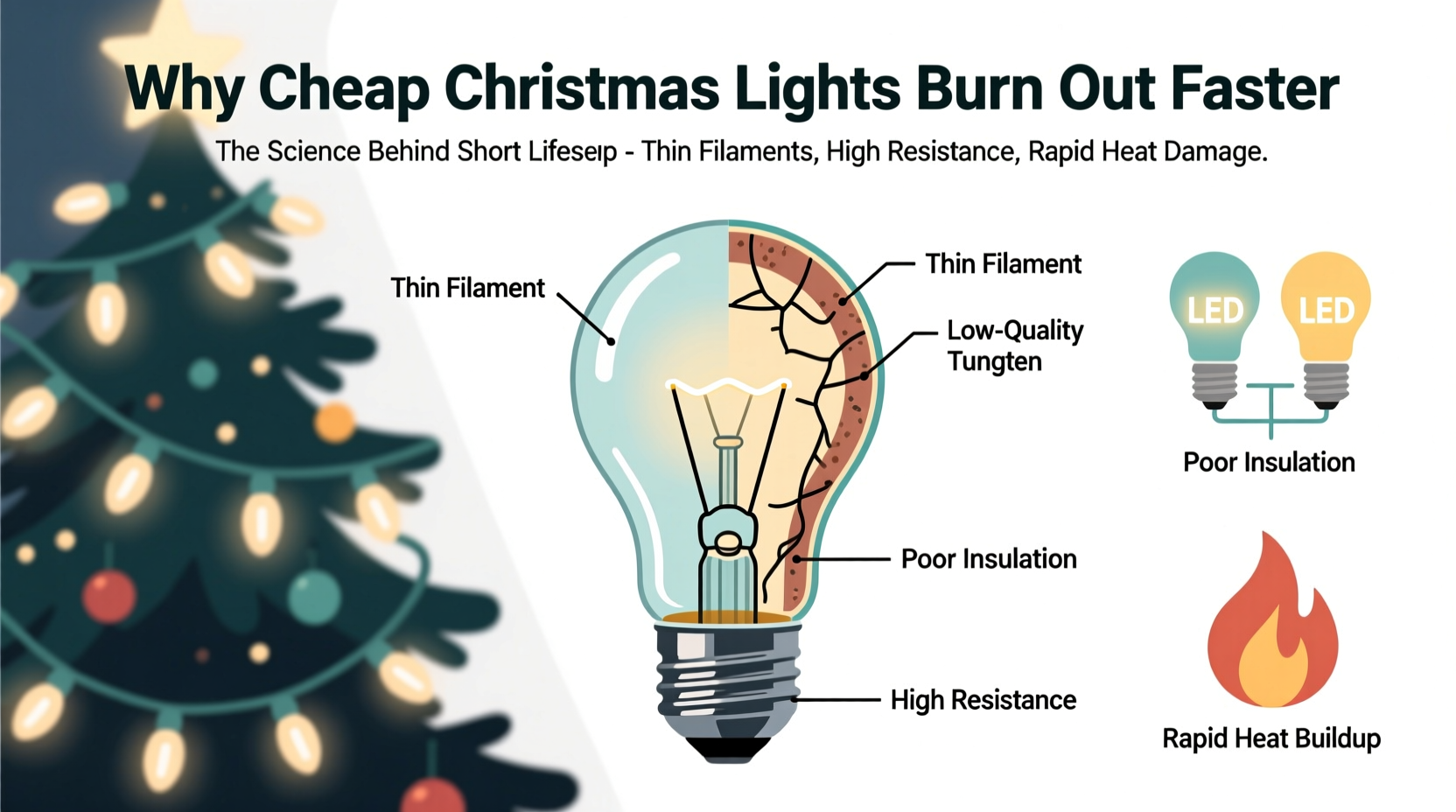
Most inexpensive Christmas light strings are marketed as “120V AC,” matching standard U.S. household current. But that number hides a critical truth: cheap lights rarely operate at true 120V across each bulb. Instead, they use series-wired incandescent or LED circuits where voltage is divided among dozens of bulbs—often 50, 100, or even 150 per string. In a 100-bulb incandescent set rated for 120V, each bulb receives only about 1.2 volts. That’s technically correct—but only under ideal conditions.
In practice, line voltage fluctuates. Utility grids commonly deliver 114–126V depending on time of day, local demand, and transformer load. A 5% overvoltage (126V) pushes each bulb in that 100-bulb string to 1.26V—seemingly minor, but enough to raise filament temperature by 15–20°C. For tungsten filaments, every 10°C increase above design temperature accelerates evaporation by roughly 2×. Over time, this thins the filament unevenly, creating hot spots that fail catastrophically.
Cheap lights compound this with poor voltage regulation. Unlike premium LED strings that include constant-current drivers or Zener diode protection, budget sets often rely on passive resistors or no regulation at all. When a single bulb burns out in a series circuit, many low-cost strings lack shunt wires—so the entire string goes dark. Worse, some “shunted” bulbs use copper-clad steel shunts with inconsistent resistance. Under surge conditions, these shunts may not activate reliably, leaving downstream bulbs exposed to full line voltage momentarily—guaranteeing rapid cascade failure.
Tip: Always check if your lights are wired in series or parallel. Parallel-wired sets (common in higher-end LED strings) keep the rest lit even if one bulb fails—and distribute voltage more evenly.Material Science Failures: What Bulbs Are Made Of Matters
At the heart of every bulb lies a delicate balance of conductivity, emissivity, thermal expansion, and oxidation resistance. Cheap lights sacrifice each of these deliberately.
Filament wire: Premium incandescent bulbs use drawn tungsten wire with precise grain structure and dopants (like potassium-alumina-silica) that inhibit recrystallization at high temperatures. Budget bulbs substitute lower-purity tungsten or—even worse—tungsten-molybdenum alloys with higher resistivity and lower melting points. These degrade faster under thermal cycling, leading to brittle fracture after repeated heating/cooling.
LED components: Inexpensive LED strings often use generic 5mm or SMD2835 LEDs with ungraded binning. Binning refers to sorting LEDs by forward voltage (Vf), luminous flux, and color temperature. Without tight Vf control, current distribution across parallel branches becomes uneven—some LEDs draw excess current and overheat while others underperform. Thermal runaway follows: hotter LEDs drop resistance, draw more current, get hotter still, and fail in days—not years.
Encapsulation & housing: High-grade bulbs use silicone-based encapsulants with UV stabilizers and coefficient-of-thermal-expansion (CTE) matched to the LED chip and PCB. Cheap versions use epoxy resins that yellow under UV exposure, reducing light output by up to 40% in six months. More critically, epoxy shrinks and cracks during freeze-thaw cycles, allowing moisture ingress. Once water reaches solder joints or chip contacts, galvanic corrosion begins—especially problematic when copper traces meet aluminum heat sinks or brass leads.
Thermal Stress: The Silent Killer of Holiday Lights
Christmas lights face extreme thermal cycling: from sub-zero outdoor nights to direct midday sun exposure, then back again—sometimes multiple times in a single day. This isn’t just about average temperature; it’s about differential expansion and contraction.
A typical cheap LED bulb uses an FR-4 fiberglass PCB—a material with a CTE of ~14–17 ppm/°C. The silicon LED chip has a CTE of ~2.6 ppm/°C. During a -10°C to 35°C swing (a common holiday range), the PCB expands nearly 6× more than the chip. Without robust die-attach adhesives or flexible interconnects, this mismatch generates micro-stresses at the solder bumps. After ~500 cycles (roughly one season), microscopic cracks form—first degrading light output, then causing intermittent opens, and finally total failure.
Incandescent bulbs suffer differently. Their glass envelopes expand and contract with heat. Low-cost glass contains higher sodium oxide content, making it more susceptible to thermal shock. A sudden rain splash on a hot bulb can cause immediate fracture. Even without breakage, repeated expansion stresses the filament support wires—loosening their grip and allowing filament vibration. That vibration accelerates metal fatigue, especially at the coiled ends where stress concentrates.
| Factor | Cheap Lights | Premium Lights |
|---|---|---|
| PCB Material | Standard FR-4 (rigid, high CTE) | Aluminum-core or ceramic substrate (low CTE, heatsink-integrated) |
| Encapsulant | UV-unstable epoxy (yellowing in 3–6 months) | Optically clear silicone (stable to -40°C/+85°C, UV-resistant) |
| Heat Dissipation | No thermal pads; LEDs mounted directly on thin copper traces | Integrated thermal vias + aluminum backing + finned housings |
| Operating Temp Range | -10°C to +45°C (de-rated performance outside) | -30°C to +70°C (full spec compliance) |
Manufacturing Shortcuts: How Assembly Choices Drive Failure
Cost pressure doesn’t just affect materials—it reshapes the entire production process. Consider soldering: premium manufacturers use nitrogen-reflow ovens to prevent oxidation during solder joint formation, ensuring void-free, high-tin-content joints with strong intermetallic bonding. Budget producers rely on air-reflow or wave soldering, resulting in higher oxide layers, tin-lead segregation, and micro-voids that become nucleation sites for crack propagation.
Wire gauge is another telling detail. A $4.99 100-light string may use 32 AWG copper-clad aluminum (CCA) wire—just 0.2mm in diameter—with a current rating of 0.3A. Yet the string draws 0.42A at full brightness. That 40% overloading causes continuous resistive heating (P = I²R), raising conductor temperature by 25–30°C above ambient. Heat migrates into the bulb base, softening plastic housings and accelerating insulation brittleness.
Worse, many ultra-low-cost strings omit essential safety features: • No overcurrent protection (e.g., PTC resettable fuses) • No UL-listed strain relief at plug connections • No conformal coating on driver boards • No IP65+ sealing—even for “outdoor use” labels
These aren’t oversights. They’re deliberate omissions that shave $0.18 off per string—enough to win shelf space in big-box retail. But that $0.18 translates directly into reduced mean time between failures (MTBF). Industry data shows UL-listed, thermally managed LED strings average 25,000–35,000 hours MTBF. Non-certified budget equivalents average 3,000–7,000 hours—less than one full holiday season of nightly use.
“The difference between a $3 string and a $25 string isn’t markup—it’s the presence or absence of four critical systems: thermal management, current regulation, environmental sealing, and metallurgical consistency.” — Dr. Lena Torres, Electrical Reliability Engineer, Illumination Standards Institute
Real-World Consequence: A Mini Case Study
In December 2022, the city of Portland, Oregon, installed 12,000 feet of decorative lighting along its downtown shopping district. The procurement team selected a nationally distributed $3.49/100-light LED string to stay within budget. Within 11 days, 37% of the installation had failed—either entirely dark or showing visible discoloration and flickering. Maintenance crews found consistent patterns: cracked epoxy domes near mounting clips, green corrosion on copper traces, and charred resistor banks on driver boards.
An independent lab analysis revealed three root causes: 1. The “weatherproof” housing used polycarbonate blended with 18% recycled content—lacking UV inhibitors, leading to embrittlement after 48 hours of sun exposure. 2. Driver ICs were unbranded clones with no thermal shutdown circuitry; board temperatures peaked at 92°C during operation—well above the 70°C safe limit for the capacitors used. 3. Solder joints showed 62% voiding (vs. <5% in certified assemblies), confirmed via X-ray tomography.
The city replaced the failed strings with UL 588-certified commercial-grade lights costing $18.99/100 lights. Three years later, 94% remain fully operational—with only routine cleaning required. The initial cost premium paid for itself in labor savings alone after 47 maintenance visits.
Practical Action Plan: Extending the Life of Any String You Own
You don’t need to replace every strand this year. Apply these evidence-based steps to maximize longevity—regardless of price point:
- Install during dry, moderate weather — Avoid hanging lights when temperatures are below 0°C or above 32°C. Cold makes plastics brittle; heat accelerates chemical degradation in adhesives and encapsulants.
- Use a dedicated outdoor GFCI outlet with a timer — Limit daily runtime to 6–8 hours. Continuous operation increases thermal cycling and cumulative stress. GFCIs also protect against ground faults caused by moisture ingress.
- Inspect before storage — Check for cracked bulbs, frayed wires, or discolored plugs. Discard damaged sections—don’t attempt repairs with tape or twist-on connectors.
- Store coiled—but not tightly — Use wide-diameter spools (≥12 inches) to avoid kinking wires. Never wrap around narrow pipes or broom handles. Store in climate-controlled, low-humidity space—not garages or attics.
- Test annually before decorating — Plug in each string for 15 minutes indoors. Watch for hot spots, flickering, or inconsistent brightness—early signs of component degradation.
FAQ
Why do some cheap LED lights seem brighter at first—but fade quickly?
Bright initial output usually indicates overdriving: the manufacturer sets the driver current above the LED’s rated maximum (e.g., 35mA instead of 20mA) to boost lumen output. This creates intense junction heat, accelerating phosphor degradation and lumen depreciation. Lumen maintenance drops to 70% (L70) in under 500 hours—versus 25,000+ hours for properly driven LEDs.
Can I mix old and new light strings on the same circuit?
No. Mixing brands, ages, or types (incandescent + LED) creates impedance mismatches and uneven current draw. Older strings may have higher resistance due to filament aging or corrosion, forcing newer strings to compensate—overloading their drivers and shortening lifespan. Always group by model number and purchase year.
Do “heavy-duty” or “commercial grade” labels guarantee better performance?
Not necessarily. These are marketing terms—not standards. Look instead for UL 588 certification (for safety), IP65 or higher (for dust/water resistance), and published L70 lifetime ratings. If those details aren’t on the box or spec sheet, assume consumer-grade construction.
Conclusion
The premature failure of cheap Christmas lights isn’t a quirk of holiday magic—it’s predictable, measurable, and rooted in well-understood physical principles. From tungsten filament evaporation rates to solder joint fatigue mechanics, every shortcut has a quantifiable cost in reliability. Recognizing this empowers you to make informed choices: not just about what to buy, but how to use, maintain, and store what you already own. Longer-lasting lights mean fewer trips to the hardware store, less electronic waste in landfills, and more time enjoying the glow—not troubleshooting it. Start this season by auditing one string using the inspection checklist above. Then share what you learn. Because when we understand the science behind the sparkle, tradition becomes more sustainable—and the holidays, a little brighter for longer.
💬 Have you tracked your lights’ lifespan? Share your longest-running string—and what made it last—in the comments. Your real-world data helps others choose wisely.








