
Every holiday season, strings of twinkling Christmas lights adorn homes, trees, and streets, creating a festive atmosphere. But if you’ve ever stared closely at these blinking bulbs—especially under certain lighting conditions—you may have noticed something strange: the lights appear to stop blinking altogether, as if frozen in time. This isn’t a malfunction. It’s a fascinating illusion rooted in human biology and physics. The phenomenon occurs due to how our eyes and brain process rapid light changes, influenced by factors like flicker fusion thresholds, ambient lighting, and even motion. Understanding this trick of perception not only satisfies curiosity but also reveals deeper insights into how we see the world.
The Science Behind Flicker Fusion Threshold
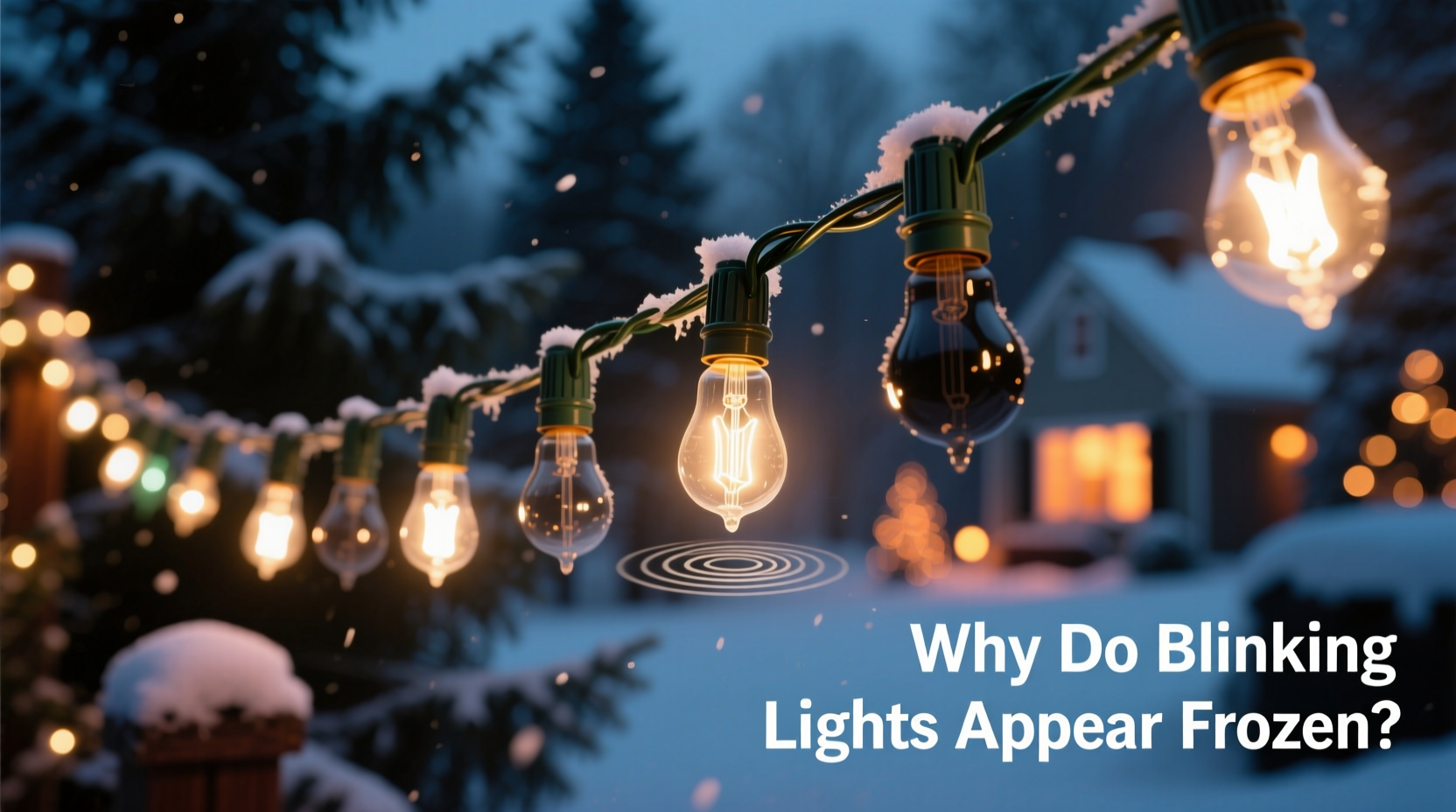
At the heart of the “frozen light” illusion is a concept known as the flicker fusion threshold (FFT). This refers to the frequency at which a flashing light appears steady to the human eye. Below this threshold, we perceive distinct flashes. Above it, the flickering blends into continuous illumination due to the persistence of vision—a physiological lag in how photoreceptors in the retina respond to light.
Most blinking Christmas lights operate between 1 and 5 hertz (flashes per second), well within the range that humans can detect. However, when additional variables come into play—such as dim lighting, peripheral vision, or interaction with artificial light sources—the brain may misinterpret the timing of flashes, causing them to seem paused or synchronized.
The average human flicker fusion threshold is around 60 Hz under bright conditions, but it drops significantly in low light. In a dark room lit only by Christmas lights, your eyes become more sensitive to subtle changes, yet paradoxically, they’re also more prone to perceptual errors. This creates ideal conditions for optical illusions.
“Flicker fusion is not a fixed number—it varies with brightness, color, retinal location, and individual physiology. What looks steady to one person might still be flickering to another.” — Dr. Lena Torres, Vision Scientist, University of California, Berkeley
Stroboscopic Effect and Environmental Lighting
One of the most common reasons blinking lights appear frozen is the stroboscopic effect. This occurs when a moving object—or a pulsing light—is observed under intermittent illumination, such as from fluorescent lamps or LED fixtures that themselves flicker at high frequencies. When the frequency of the ambient light source aligns closely with the blinking rate of the Christmas lights, interference patterns emerge.
For example, consider a string of lights blinking at 4 Hz viewed under a 60 Hz LED ceiling light. If the phase relationship between the two rhythms momentarily synchronizes, the blinking light may appear to flash once every few seconds—or not at all. This is similar to how a spinning wheel in a movie can appear to rotate backward: the sampling rate of perception doesn't match the actual motion.
This effect is especially noticeable in videos recorded on smartphones, where camera frame rates (typically 30 or 60 fps) interact with light frequencies. But it happens in real life too, particularly when multiple artificial light sources coexist.
Tip: To observe the true blinking pattern of Christmas lights, view them in complete darkness using only battery-powered flashlights or natural moonlight—sources without inherent flicker.Peripheral Vision and Temporal Resolution
Your eyes don’t process motion and flicker uniformly across the visual field. Central vision (the fovea) excels at detail and color but has moderate temporal resolution—the ability to distinguish rapid changes over time. In contrast, peripheral vision is optimized for detecting motion and flicker, thanks to a higher density of rod cells and faster neural pathways.
When you look directly at blinking Christmas lights, your central vision may smooth out the flicker, especially if the blink rate approaches the fusion threshold. But when you shift your gaze away and observe the lights indirectly through your peripheral vision, they often appear more erratic or pronounced. Conversely, under certain conditions, peripheral processing can cause lights to seem \"locked\" in place because the brain prioritizes spatial consistency over temporal accuracy.
This discrepancy explains why some people report that lights “freeze” only when not looked at directly. It's not imagination—it's a quirk of neurobiology. Your brain fills in gaps based on expectation, and when input is ambiguous, it defaults to stability.
How Motion Influences Perception
Movement—both of the observer and the lights—can dramatically alter how blinking is perceived. Try walking past a string of blinking Christmas lights at night. Depending on your speed and the blink frequency, the lights may appear to pulse slowly, freeze, or even move in waves along the strand. This is an example of motion-induced flicker suppression, where self-motion interferes with the brain’s ability to parse rapid temporal signals.
In dynamic environments, the visual system integrates spatial and temporal data to maintain coherence. When you're moving, your brain anticipates changes in the visual scene. If a blinking light’s on/off cycle coincides with predictable intervals in your motion—say, each step—you may perceive fewer transitions than actually occur. The result? A light that seems stuck in the “on” or “off” state.
A similar phenomenon occurs when viewing blinking lights from a moving vehicle. At certain speeds, the rhythmic alternation of light pulses matches the rate at which new visual information enters your field of view, creating standing wave-like effects or apparent stillness.
Mini Case Study: The Frozen Tree Illusion
In December 2022, Sarah Kim, a graphic designer in Denver, noticed something odd while decorating her living room. Her newly purchased LED Christmas tree, programmed to simulate gentle twinkling, appeared completely static when viewed from her sofa. Curious, she walked closer—and the blinking resumed. She tested it repeatedly: from five feet away, the lights seemed frozen; up close, they pulsed normally.
After ruling out technical issues, she recorded the tree with her phone. The video confirmed active blinking. Confused, she posted the footage online, sparking discussion among vision enthusiasts. A neuroscientist in the thread explained that Sarah was experiencing a combination of low ambient light, peripheral observation, and slight head movements that caused her visual system to suppress the flicker.
She later adjusted the blink frequency via the tree’s app and added a secondary warm-white lamp to reduce contrast. The freezing effect diminished significantly. Her experience highlights how environmental design and biological perception intersect in everyday moments.
Do’s and Don’ts: Managing Visual Perception of Blinking Lights
| Action | Recommendation | Reason |
|---|---|---|
| Use consistent light frequencies | ✅ Do | Matching blink rates across displays reduces interference and stroboscopic effects. |
| Mix different types of LEDs | ❌ Avoid | Varying driver circuits can create conflicting flicker patterns, increasing perceptual confusion. |
| Observe blinking lights in total darkness | ⚠️ Use caution | Low light lowers flicker fusion threshold, making illusions more likely. |
| Record blinking lights with smartphones | ✅ Do for analysis | Captures actual timing unaffected by human perception. |
| Rely solely on visual inspection | ❌ Avoid for diagnostics | Perception is subjective; use tools for accurate assessment. |
Step-by-Step Guide: Testing Whether Lights Are Truly Frozen
- Isolate the environment: Turn off all other light sources to eliminate interference from ambient flicker.
- Change viewing position: Observe the lights from different angles and distances, noting any changes in perceived motion.
- Use a camera: Record the lights with a smartphone or digital camera. Play back the video frame by frame to verify actual blinking behavior.
- Introduce motion: Walk past the lights or wave your hand in front of them. If the blinking reappears during movement, it suggests perceptual suppression.
- Adjust lighting: Add a constant, non-flickering light source (like an incandescent bulb) to raise overall luminance and increase flicker fusion threshold.
- Modify blink rate: If possible, change the frequency of the lights (e.g., from 2 Hz to 6 Hz) to move beyond typical perceptual ambiguity zones.
FAQ
Are frozen-looking Christmas lights broken?
No. In nearly all cases, the lights are functioning normally. The appearance of stillness is due to visual perception quirks, not hardware failure. Always verify with a camera recording before assuming a defect.
Can everyone see this effect?
No. Sensitivity to flicker varies widely based on age, eye health, medication, and genetics. Younger individuals typically detect flicker at higher frequencies than older adults. Some people are simply less susceptible to stroboscopic illusions.
Why do some LED lights seem to flicker more than others?
Cheaply made LEDs often use poor drivers that produce irregular or low-frequency current pulses, resulting in visible flicker. High-quality LEDs use constant-current drivers or high-frequency pulse-width modulation (PWM), minimizing perceptible fluctuations.
Checklist: Optimizing Holiday Lighting for Visual Comfort
- Choose LED strings with high flicker frequency (above 100 Hz) for smoother appearance
- Avoid mixing AC-powered blinking lights with DC battery-operated ones
- Test displays at night under real viewing conditions
- Use diffusers or covers to soften light transitions
- Position blinking elements away from areas of frequent motion
- Include steady-burn lights in displays to anchor visual reference points
- Consider smart lighting systems that allow precise control over blink patterns
Conclusion
The illusion of frozen Christmas lights is more than a seasonal curiosity—it’s a window into the complex interplay between technology and human perception. These blinking bulbs haven’t stopped working; our brains have simply chosen to interpret their signals differently. From the stroboscopic effect to peripheral vision quirks, the mechanisms behind this phenomenon underscore a fundamental truth: seeing is not always believing.
By understanding the science of flicker fusion, environmental interactions, and neurological processing, we gain greater control over how we experience light—not just during the holidays, but in all aspects of modern life filled with LEDs, screens, and artificial illumination. Next time you spot a seemingly motionless twinkle on your tree, pause and appreciate the invisible dance of photons, neurons, and cognitive shortcuts making it happen.
💬 Have you experienced frozen Christmas lights? Share your story or test results in the comments—let’s map how perception shapes our holiday magic.