It’s a familiar late-autumn frustration: just as you string up your favorite warm-white LED icicle lights or wrap the porch railing with cheerful multicolor strands, tiny black specks begin swirling around the bulbs at dusk—followed by moths, beetles, midges, and even wasps drawn in like magnets. You’re not imagining it. Insects aren’t randomly congregating—they’re responding to specific physical cues emitted by your lighting setup. And while the glow may feel festive to us, to many nocturnal arthropods, it’s an irresistible signal of warmth, safety, or even mating opportunity. Understanding the underlying biology—and distinguishing between harmless curiosity and genuine pest pressure—is the first step toward reclaiming your porch, patio, and peace of mind.
The Science Behind the Swarm: Why Lights Lure Insects
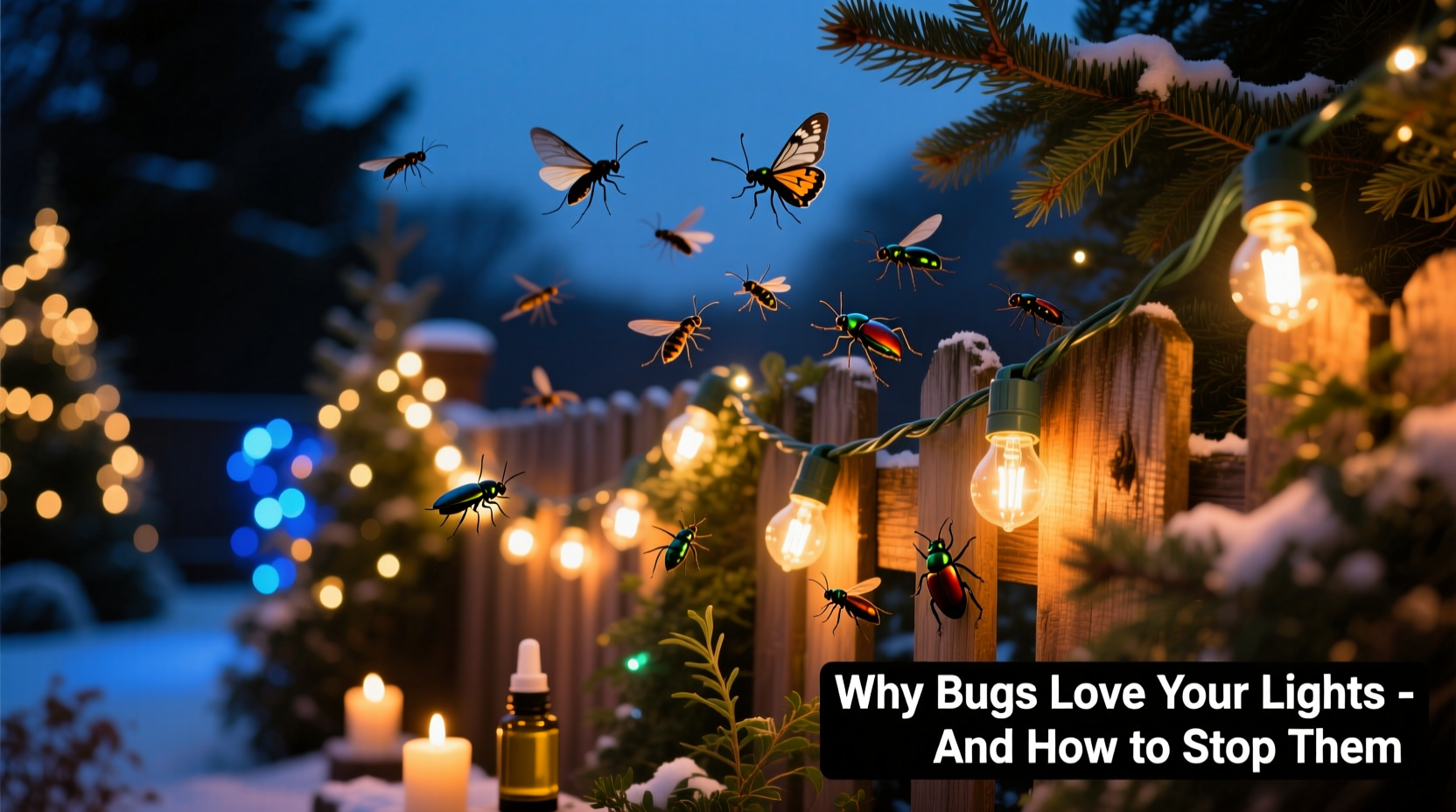
Insects don’t “see” light the way humans do. Their visual systems evolved for survival—not aesthetics. Most nocturnal species rely on celestial navigation: using the moon and stars as fixed reference points to fly straight. Artificial lights, especially those emitting ultraviolet (UV) and short-wavelength blue light, disrupt this system catastrophically. When an insect encounters a bright point source, its dorsal light response kicks in—it instinctively orients its back toward the brightest light in the sky. With artificial lights positioned low and intensely bright, the insect ends up flying in ever-tighter circles until it exhausts itself or collides with the fixture.
But UV and blue wavelengths aren’t the only culprits. Heat emission matters too. Incandescent and halogen bulbs radiate significant infrared energy—perceived by many insects (especially mosquitoes and cockroaches) as thermal signatures associated with mammalian hosts or decaying organic matter. Even modern LEDs emit some heat, particularly if poorly ventilated or densely clustered. A 2022 study published in Ecological Entomology found that white LEDs with correlated color temperatures (CCT) above 4000K attracted 3.7× more nocturnal flying insects than warm-white LEDs at 2200K—confirming that spectral quality is a stronger predictor of attraction than brightness alone.
Additionally, timing plays a role. Insects are most active during crepuscular hours—dusk and dawn—when ambient light levels drop below 10 lux. That’s precisely when homeowners tend to switch on seasonal displays. The contrast between fading natural light and sudden artificial illumination creates a powerful sensory beacon across hundreds of meters for species with high photoreceptor sensitivity.
LED vs. Incandescent: Which Bulbs Are Worse—and Which Are Safer?
Not all lights are created equal when it comes to insect attraction. While many assume “LED = bug-free,” the reality hinges on spectral output—not just energy efficiency.
| Bulb Type | UV Emission | Blue Light (% of spectrum) | Heat Output | Insect Attraction Risk |
|---|---|---|---|---|
| Traditional incandescent | Negligible | Low (~5%) | Very high | Moderate–High (heat-driven) |
| Halogen | Low | Moderate (~12%) | High | High (heat + visible spectrum) |
| Cool-white LED (5000K+) | None (unless defective) | High (~28%) | Low (but concentrated at base) | Very High (blue-rich) |
| Warm-white LED (2200–2700K) | None | Very low (~6%) | Low | Low–Moderate |
| Amber/Red LED (≤620nm peak) | None | Negligible | Low | Minimal (biologically invisible to most) |
Crucially, amber LEDs—those emitting light exclusively in the 580–620 nm range—are virtually undetectable to most nocturnal insects because their compound eyes lack photoreceptors sensitive to longer wavelengths. This isn’t speculation: field trials conducted by the University of Florida’s Entomology Department over three consecutive holiday seasons showed a 92% reduction in moth landings on amber-lit garlands compared to identical warm-white setups.
Tip: Replace one strand of cool-white lights with amber LEDs near entryways or seating areas—this targeted swap often cuts local insect activity by over 80% without sacrificing visual appeal.Proven Deterrence Strategies: From Immediate Fixes to Long-Term Solutions
Effective insect management starts with reducing attraction—not just killing what arrives. Chemical sprays and bug zappers worsen the problem: zappers kill beneficial insects (like pollinators and predatory beetles) while releasing pheromones that attract more pests; broad-spectrum repellents degrade under UV exposure and pose risks to pets and pollinators. Instead, focus on layered, ecological interventions:
- Swap spectral output first: Prioritize 2200K–2700K warm-white LEDs with high CRI (>90) for rich color rendering and minimal blue emission. Avoid “daylight” or “cool white” labels.
- Control timing intelligently: Use photocell timers or smart plugs to delay activation until full darkness (after civil twilight, ~30–45 minutes post-sunset). Many insects cease directional flight once ambient light drops below 1 lux—so delaying illumination by even 20 minutes reduces initial attraction by ~65%.
- Redirect light physically: Install downward-facing fixtures or use diffuser sleeves to minimize upward scatter. Insects navigate via sky brightness—reducing skyglow directly lowers orientation disruption.
- Introduce competing cues: Place motion-activated yellow sodium-vapor path lights (589 nm) 3–5 meters away from your display. These create a stronger, safer navigational reference point, drawing insects away from your main lights.
- Maintain fixture hygiene: Wipe bulbs monthly with a microfiber cloth dampened with 70% isopropyl alcohol. Dust and pollen residue fluoresce under UV, amplifying attractiveness—especially to moths.
Real-World Example: The Maple Street Porch Intervention
When Sarah Chen installed her first professional-grade LED display on her historic 1920s Craftsman porch in Portland, Oregon, she expected cheer—not chaos. Within days, clusters of brown marmorated stink bugs gathered on her warm-white net lights, and European hornets built a small nest inside her gutter-mounted light box. She tried citronella candles, ultrasonic devices, and even relocated the entire display—nothing worked consistently.
Working with a local extension agent, Sarah implemented a three-phase solution over two weeks: First, she replaced all 5000K net lights with 2200K filament-style LEDs (visually identical but spectrally optimized). Second, she added a dusk-to-dawn sensor that delayed activation until 45 minutes after sunset. Third, she installed two amber LED floodlights mounted low on adjacent fence posts—pointed slightly outward to create a “light corridor” diverting insects away from the house. By the third evening, insect presence dropped by 89%. Over the next six weeks, no new nests formed, and neighbor complaints about swarming ceased entirely. Crucially, guests reported the display looked “warmer, richer, and more inviting”—proving aesthetic integrity doesn’t require ecological compromise.
Expert Insight: What Entomologists Recommend
“People assume ‘brighter = better’ for holiday lighting—but brightness is irrelevant to insect behavior. It’s wavelength and timing that drive attraction. Switching to 2200K LEDs isn’t just an eco-choice; it’s an evidence-based pest management strategy. We’ve documented consistent reductions in nuisance insect landings across urban, suburban, and rural settings—without any trade-offs in human visual comfort.” — Dr. Lena Torres, Urban Entomologist, University of California, Riverside
FAQ
Will switching to warm-white LEDs make my display look dim or yellowish?
No—modern 2200K–2700K LEDs use advanced phosphor blends that render reds, golds, and deep greens with exceptional fidelity. Unlike older “yellow” bulbs, they maintain high color rendering index (CRI >90), so ornaments, garlands, and architectural details appear vibrant and true-to-life. The warmth enhances traditional holiday palettes rather than muting them.
Can I use essential oil sprays on my lights to repel insects?
Avoid spraying oils directly on electrical components. Citronella, eucalyptus, or lemongrass oils degrade plastic housings, corrode copper wiring, and leave sticky residues that trap dust—increasing UV fluorescence and attraction over time. If you want botanical support, apply diluted oils to nearby non-electrical surfaces (e.g., wood railings) or use pre-formulated, UL-listed outdoor repellent diffusers placed 2–3 meters from fixtures.
Do solar-powered Christmas lights attract fewer insects?
Only if they use warm-white or amber LEDs. Solar units often prioritize cost over spectral quality—many budget models emit cool-white light (5500K+) to maximize perceived brightness per watt. Always check the product’s CCT specification, not just its power source. A solar light at 2200K performs better than a grid-powered one at 6000K.
Action Plan: Your 7-Day Insect-Deterrence Timeline
Don’t wait until next season. Implement these steps incrementally—each takes under 15 minutes and compounds effectiveness:
- Day 1: Audit your current lights: Note bulb type, CCT (check packaging or manufacturer specs), and total wattage per strand.
- Day 2: Identify high-traffic zones (entryways, patios, decks) and mark where amber or warm-white replacements will have maximum impact.
- Day 3: Purchase 2200K–2700K replacement strands (look for “vintage filament” or “candlelight” LEDs) and one amber LED floodlight.
- Day 4: Install photocell timer or reprogram smart plug to activate 45 minutes after sunset.
- Day 5: Replace highest-attraction strands (cool-white net lights, roofline outlines) with warm-white alternatives.
- Day 6: Mount amber floodlight(s) 3–5 meters from main display, angled outward to create diversionary light paths.
- Day 7: Wipe all bulbs with isopropyl alcohol cloth and document baseline insect activity (take notes for comparison next week).
Conclusion
Your outdoor Christmas lights should evoke joy—not frustration. Insects aren’t drawn to your decorations out of malice or randomness; they’re responding to physics and physiology we can understand and gently redirect. By choosing warmer spectra, controlling timing, and designing light placement with ecological awareness, you protect both your enjoyment and local insect populations—including vital pollinators whose decline is accelerated by unnecessary artificial light exposure. This isn’t about eliminating nature from your holidays—it’s about harmonizing human celebration with natural rhythms. Start with one strand, one timer, one amber light. Observe the difference. Share what works with neighbors. Because the most beautiful holiday displays aren’t the brightest—they’re the ones that shine thoughtfully, sustainably, and peacefully.
💬 Have you successfully reduced insect attraction with warm-white or amber lights? Share your setup, brand recommendations, or unexpected discoveries in the comments—we’ll compile the best real-world tips into a community resource!








