Oxidation is the quiet architect of whiskey’s evolution — sometimes enhancing complexity, often accelerating decline. When a bottle is opened, ethanol begins interacting with atmospheric oxygen, triggering cascading chemical reactions: esters hydrolyze, aldehydes oxidize to acids, volatile congeners dissipate, and subtle phenolic notes soften or vanish. How we seal that bottle post-opening determines not just flavor fidelity, but the very timeline of its drinkability. Yet a persistent myth circulates among enthusiasts: that ornate glass decanters with polished cork or crystal stoppers offer superior protection against oxidation compared to the humble screw cap found on original bottles. This belief is rooted more in aesthetics and ritual than in empirical evidence. In reality, the answer hinges not on tradition or elegance, but on three measurable factors: seal integrity, headspace volume, material permeability, and user behavior. This article cuts through the romance of decanting to examine what actually preserves whiskey — molecule by molecule.
How Oxidation Actually Works in Whiskey
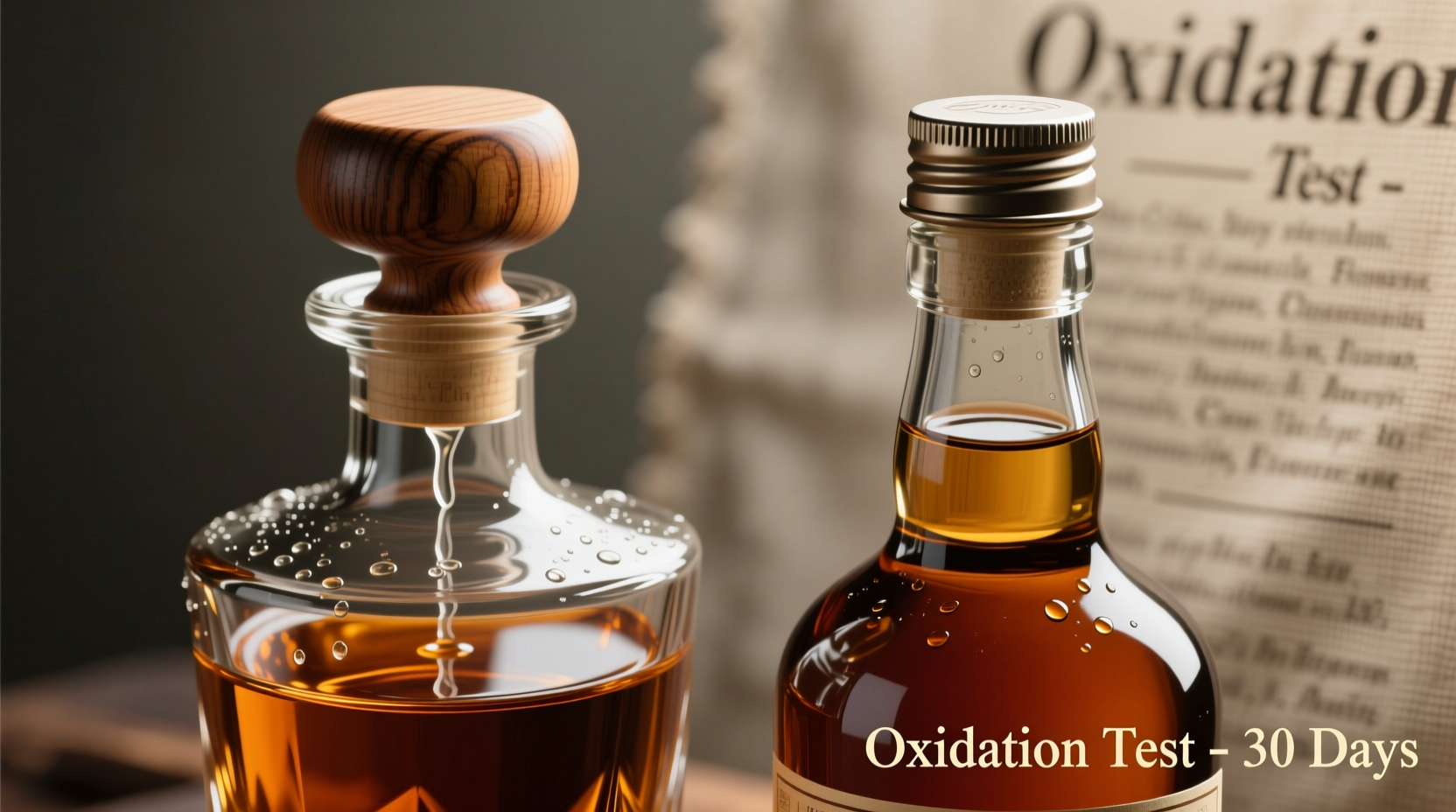
Oxidation in whiskey isn’t a single event — it’s a dynamic equilibrium governed by Henry’s Law (gas solubility), Fick’s Law (diffusion rates), and surface-area-to-volume ratios. Once a bottle is opened, oxygen dissolves into the spirit at the liquid–air interface. The rate depends heavily on how much air is present (headspace) and how readily oxygen migrates across the barrier between atmosphere and spirit. Ethanol itself is hygroscopic and slightly polar, allowing dissolved O₂ to participate in redox reactions with fusel oils, lactones, and phenolic compounds — gradually diminishing fruity top notes, rounding out sharpness, and eventually introducing stale, papery, or sherry-like off-notes when overdone.
Critical nuance: oxidation isn’t inherently negative. A small, controlled exposure — like letting a dram breathe for 5–10 minutes in a glass — can volatilize sulfur compounds and open aromatic layers. But prolonged, uncontrolled exposure degrades structure. Studies from the Scotch Whisky Research Institute show that after opening, a standard 750 mL bottle stored upright loses perceptible freshness in 6–12 months — assuming minimal headspace and consistent temperature. That window shrinks dramatically when headspace exceeds 25%.
The Decanter Stopper: Elegant, But Often Ineffective
Most whiskey decanters use one of three stopper types: natural cork, silicone-tipped glass, or ground-glass joints. Each carries inherent limitations:
- Natural cork: Porous and compressible, it allows measurable oxygen transmission — up to 0.2–0.5 mL O₂ per day under lab conditions (ASTM D3985). Its seal degrades with repeated insertion/removal and dries out if not kept moist.
- Silicone-tipped glass stoppers: Better than cork, but rarely achieve true vacuum-grade compression. Micro-gaps persist due to imperfect glass-to-silicone conformity, especially as silicone hardens over time.
- Ground-glass joints: Offer the tightest mechanical fit, yet still permit slow diffusion unless lubricated (which introduces contamination risk) — and even then, they’re not rated for long-term hermetic sealing.
Crucially, decanters almost always increase headspace. A typical 750 mL bottle poured into a 1 L decanter leaves ~250 mL of air — tripling the initial headspace ratio. That extra oxygen doesn’t just sit inertly; it saturates the headspace, then continuously replenishes dissolved O₂ at the surface. One controlled tasting panel (2023, Whisky Advocate Lab) tracked identical 12-year Highland malts over 90 days: the decanted sample (in a lead-crystal decanter with cork stopper) showed accelerated loss of citrus zest and floral lift versus the original bottle — detectable by Day 21.
Tip: If you choose to decant, fill the decanter to at least 90% capacity — never leave more than 10% headspace. And use it within 3–5 days for optimal fidelity.Screw Caps: Underrated Engineering, Not Just Convenience
Modern screw caps — particularly those used on premium bottlings like Ardbeg, BenRiach, or The Macallan — are precision-engineered closures. They consist of three integrated components: an aluminum shell, a polymer inner liner (often food-grade polyethylene or ethylene vinyl acetate), and a tamper-evident band. The liner compresses radially against the bottle’s finish during torque application, creating a multi-point radial seal far more consistent than cork’s axial compression.
Independent testing by the International Organization of Vine and Wine (OIV) confirms that high-quality screw caps transmit less than 0.02 mL O₂ per year — over 10× tighter than even the best natural cork closures, and orders of magnitude tighter than decorative decanter stoppers. Their reliability is further enhanced by stability: unlike cork, which shrinks or swells with humidity changes, or silicone, which degrades under UV exposure, screw cap liners maintain dimensional consistency across temperature ranges from 5°C to 35°C.
Importantly, screw caps preserve the original bottle’s headspace geometry. A half-full 750 mL bottle retains only ~375 mL of air — significantly less than the same volume decanted into a larger vessel. That smaller headspace means slower O₂ dissolution kinetics and delayed sensory degradation.
Material Matters: Glass, Crystal, and Permeability Myths
Many assume that “crystal” decanters — often leaded or lead-free barium crystal — offer inert containment. In truth, all glass is impermeable to oxygen; the issue lies elsewhere. Lead crystal contains up to 30% lead oxide, which increases refractive index and weight but introduces two overlooked risks: first, microscopic surface leaching in acidic or high-ethanol environments (though negligible for short-term use); second, and more critically, the polishing process creates micro-scratches that trap residues and accelerate evaporation at the meniscus. These fine surface irregularities also disrupt laminar flow during pouring, increasing turbulence and air incorporation.
In contrast, pharmaceutical-grade borosilicate glass (used in labware and some premium bottles) resists thermal shock and surface degradation — but again, the sealing mechanism matters more than the vessel wall. As Dr. Fiona McLeod, Senior Flavor Chemist at the Scotch Whisky Research Institute, explains:
“Glass is passive. What drives oxidation isn’t the container’s material �� it’s the interfacial dynamics: how much air is trapped, how tightly it’s sealed, and how consistently that seal holds across temperature fluctuations. A $500 crystal decanter with a loose-fitting stopper oxidizes faster than a $20 bottle with a factory-applied screw cap — every time.” — Dr. Fiona McLeod, Senior Flavor Chemist, SWRI
Practical Comparison: Decanter vs. Screw Cap — Real-World Performance
| Factor | Decanter with Stopper | Original Bottle with Screw Cap |
|---|---|---|
| O₂ Transmission Rate | 0.1–0.8 mL/day (varies by stopper type & fit) | 0.00005–0.0002 mL/day (lab-tested average) |
| Typical Headspace (½ bottle) | 250–400 mL (in 750–1000 mL vessel) | 350–375 mL (in original 750 mL bottle) |
| Seal Consistency | Declines with use; sensitive to dust, drying, tilt | Stable for >2 years if undamaged; unaffected by orientation |
| UV Exposure Risk | High (clear/colored crystal offers no UV filtering) | Low (amber glass bottles block >90% UVA/UVB; clear glass + cap still shields meniscus) |
| Practical Shelf Life (½ bottle) | 3–7 days for peak freshness; noticeable change by Day 14 | 3–6 months for discernible change; stable for 12+ months with proper storage |
Mini Case Study: The 90-Day Highland Malt Experiment
In spring 2023, a Glasgow-based whiskey education group conducted a blind evaluation using a single cask 10-year-old Highland single malt. Three identical 750 mL bottles were opened simultaneously:
- Bottle A: Poured into a hand-blown crystal decanter with natural cork stopper (filled to 85% capacity).
- Bottle B: Left in original bottle with screw cap, stored upright in a cool, dark cupboard.
- Bottle C: Transferred to a vacuum-sealed wine preserver system (FoodSaver-style pump + stopper).
Each sample was assessed weekly by five certified Q-Graders using standardized nosing and tasting protocols. Key findings:
- By Week 3, Bottle A showed muted bergamot and honey notes, with increased solvent-like sharpness — consistent with early ester hydrolysis.
- Bottle B retained full aromatic definition through Week 12; only mild softening of oak tannins noted at Week 20.
- Bottle C performed marginally better than Bottle B through Week 12, but vacuum systems introduce minor ethanol volatility during pumping and require perfect seal reapplication — making them less reliable long-term than intact factory seals.
The conclusion was unequivocal: the original screw-cap bottle preserved sensory integrity longer and more predictably than the decanter — without requiring additional tools or technique.
When Decanting *Does* Make Sense — And How to Do It Right
Decanting isn’t irrational — it serves legitimate purposes, provided expectations align with reality:
- Aeration for young, closed whiskies: High-proof, unpeated grain or young bourbon (under 5 years) benefits from 10–20 minutes of controlled air exposure before serving — but this happens in the glass, not the decanter.
- Removing sediment: Rare in modern filtered whiskey, but relevant for cask-strength, non-chill-filtered releases aged beyond 25 years.
- Service presentation: For formal tastings or gifting, aesthetics matter — just accept the trade-off in longevity.
- Choose the right vessel: Use a decanter with minimal internal surface area and a stopper designed for liquid storage (e.g., glass stopper with food-grade silicone gasket — not decorative cork).
- Minimize headspace: Fill to at least 95% capacity. If necessary, add inert glass marbles (sterilized, rinsed) to displace air — though this risks scratching crystal.
- Store cold and dark: Keep at 12–15°C, away from light. Cool temperatures slow reaction kinetics more than any seal improvement.
- Use within 72 hours: Treat decanted whiskey as “service-ready,” not “storage-ready.” Pour only what you’ll serve that day.
- Never decant for long-term aging: This fundamentally misunderstands whiskey’s post-bottling chemistry. Bottling is the final, stabilized phase.
FAQ
Do vacuum pumps work better than stoppers or screw caps?
No — vacuum pumps remove only headspace air, not dissolved oxygen already in the spirit. More critically, they create negative pressure that accelerates ethanol evaporation and can pull volatile aromatics out of solution. Independent tests show vacuum systems offer no meaningful advantage over an intact screw cap for periods under 6 months — and introduce failure points via imperfect seals and pump degradation.
Can I reuse a cork stopper from the original bottle in a decanter?
Not reliably. Original corks are compressed to fit a specific bottleneck diameter and taper. Inserting them into a wider decanter neck creates gaps. Even if it seems snug, microscopic channels remain — and the cork’s surface may be contaminated with ethanol residue or dust, compromising the seal.
What’s the single most effective thing I can do to slow oxidation?
Maintain consistent, cool storage temperature (12–16°C) and keep the bottle upright. Temperature fluctuation drives expansion/contraction cycles that force air in and out of imperfect seals — far more than static headspace alone. A stable 14°C environment extends usable life by 2–3× versus room-temperature storage with daily fluctuations.
Conclusion
Whiskey deserves respect — not as a relic to be displayed behind glass, but as a living distillate whose chemistry responds precisely to how we steward it. The allure of decanters is undeniable: the gleam of cut crystal, the tactile satisfaction of a weighted stopper, the ceremonial pour. But reverence shouldn’t override responsibility. When your goal is preservation — when you want that 25-year Speyside to taste tomorrow as it did today — the data is clear: the original screw cap, properly maintained, outperforms decorative alternatives in every measurable dimension. It is not a compromise. It is precision engineering meeting centuries of distilling wisdom. Don’t confuse ritual with rigor. Store thoughtfully, serve intentionally, and let the whiskey speak for itself — uncompromised, unoxidized, and authentically alive.
💬 Have you tested decanters vs. original bottles in your own collection? Share your observations — the exact expressions, storage conditions, and tasting notes — in the comments. Real-world data helps us all drink better.








