Retro glam isn’t just about color palettes or vintage ornaments—it lives in the *texture*, the *light*, and the quiet confidence of a detail that whispers mid-century modern or shouts 1970s disco without saying a word. When it comes to defining that unmistakable nostalgic sparkle on your Christmas tree, two contenders dominate the conversation: tinsel garland and bead garland. Both evoke memory—of childhood trees lit by incandescent bulbs, of living rooms draped in shimmering abundance—but they speak different dialects of retro. Choosing between them isn’t about preference alone; it’s about intentionality. It’s about whether you want the kinetic shimmer of movement or the sculptural weight of craftsmanship, the playful imperfection of foil or the precise rhythm of hand-strung glass. This isn’t decoration—it’s storytelling with light and material.
Understanding the Origins: Why Era Matters for Authentic Glam
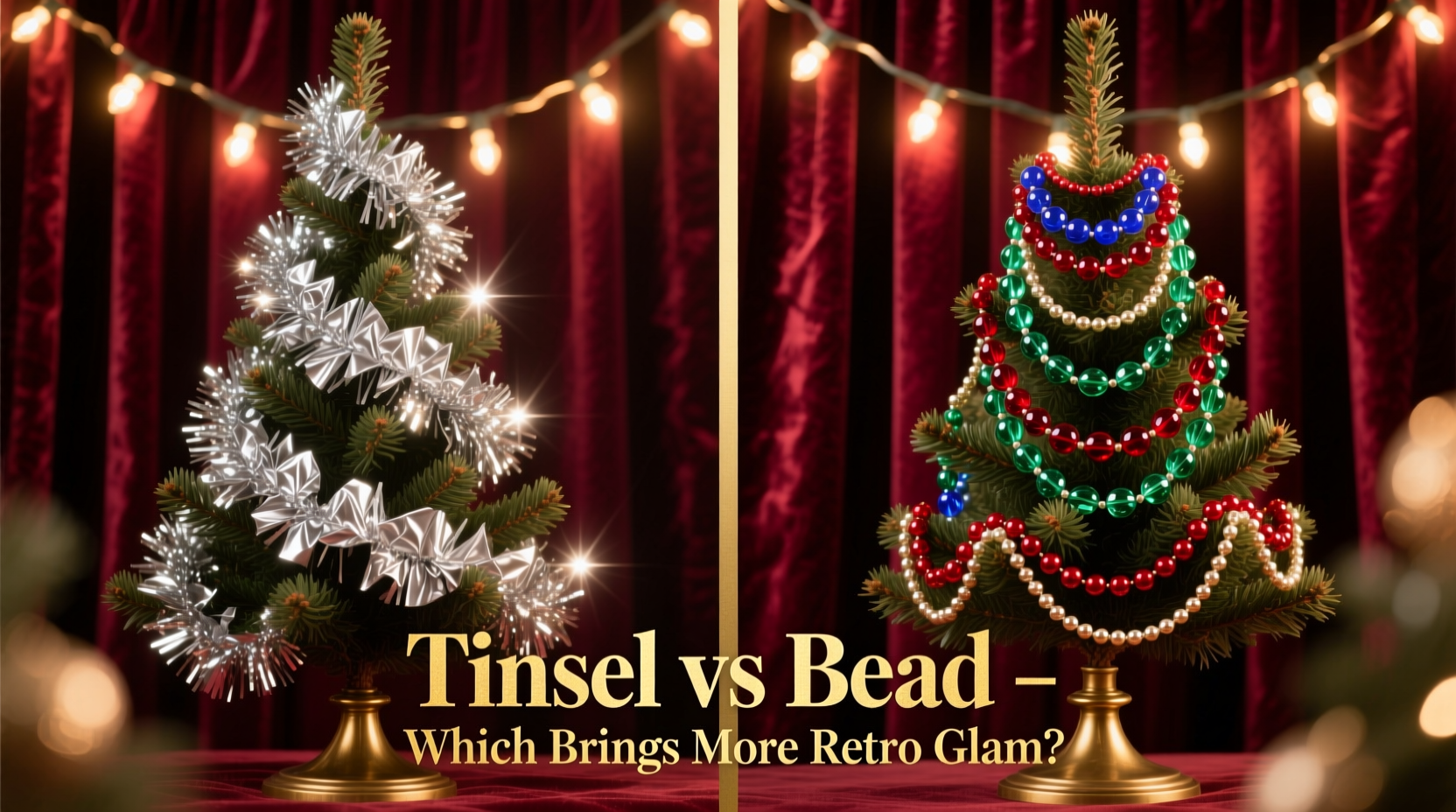
To assess which garland delivers *more* retro glam, we must first anchor ourselves in historical context—not as trivia, but as design evidence. Tinsel entered American holiday tradition in the early 20th century, but its golden age of mass appeal was the 1950s through early 1970s. Made originally from real silver (later aluminum), tinsel was prized for its ability to catch and multiply candlelight—and later, the warm glow of vintage incandescent bulbs. Its loose, cascading drape mimicked icicles and evoked opulence without cost. It was democratic glamour: affordable, abundant, and unapologetically shiny.
Bead garlands, by contrast, trace their lineage to Victorian-era “bead chains” and evolved into refined, artisanal statements in the 1930s–1960s. Early versions used hand-blown Czech glass beads, often in graduated sizes or alternating colors (ruby red, cobalt blue, amber). By the 1950s, machine-strung acrylic and lucite beads became popular—lighter, more durable, and perfectly aligned with the era’s love of clean lines and geometric repetition. Unlike tinsel’s spontaneity, bead garlands were deliberate, architectural, and tactile. They didn’t just reflect light—they *organized* it.
As interior designer and mid-century holiday historian Lila Chen observes:
“Tinsel is nostalgia in motion—the way it shivers when someone walks past, how it catches light from three angles at once. Beads are nostalgia in stillness: the weight of a strand in your hand, the quiet precision of each sphere catching the bulb behind it. One is jazz; the other is Bauhaus.” — Lila Chen, author of Holiday Modern: Designing Mid-Century Christmas
Texture & Light Play: The Core of Retro Glam
Glamour in retro decor hinges on how materials interact with light—not just brightness, but *quality*. Here’s where tinsel and beads diverge most meaningfully:
- Tinsel garland creates a high-frequency, diffused sparkle. Its thin, flexible strands flutter with air currents, generating thousands of tiny, fleeting highlights. Under warm white bulbs (the only kind used before LED dominance), tinsel produces a soft, luminous halo—not sharp glare, but ambient radiance. Its texture is feathery, slightly chaotic, and deeply tactile. Run your fingers through it: it resists, then yields, then springs back with gentle resistance. That subtle unpredictability is inherently mid-century—think Eames lounge chairs with their forgiving upholstery or the wobble of a Sputnik chandelier.
- Bead garland delivers focused, directional light. Each bead acts like a miniature lens, refracting and concentrating light into defined points. Glass beads offer clarity and depth; vintage lucite beads have a warm, honeyed translucence. The effect is rhythmic, almost musical—especially with alternating colors or graduated sizes. Texture here is smooth, cool, and deliberate. There’s no flutter—only presence. A well-strung bead garland feels substantial, even ceremonial, echoing the structured elegance of 1960s mod interiors or the curated minimalism of a George Nelson holiday display.
A Side-by-Side Comparison: Practical & Aesthetic Impact
The decision isn’t purely aesthetic—it’s logistical, sensory, and long-term. This table breaks down key considerations beyond sparkle:
| Feature | Tinsel Garland | Bead Garland |
|---|---|---|
| Era Accuracy | Highest for 1950s–early 1970s (especially silver/aluminum) | Strongest for late 1930s–1960s (glass/lucite); peaks in 1950s mod |
| Tree Integration | Drapes fluidly over branches; hides gaps; best for full, traditional trees | Requires careful placement; defines silhouette; ideal for sparse, sculptural, or slim-profile trees |
| Durability & Longevity | Prone to tangling, static cling, and gradual dulling; aluminum lasts longer than plastic | Highly durable if made with quality stringing; glass beads last decades; lucite may yellow slightly over time |
| Sensory Experience | Soft rustle, slight coolness, lightweight, slightly messy feel | Smooth glide, cool density, satisfying weight, precise alignment |
| Retro Styling Versatility | Excels in maximalist, joyful, “more-is-more” settings (e.g., 1960s suburban living room) | Shines in minimalist, curated, or high-design contexts (e.g., 1950s ranch house with atomic accents) |
Real-World Application: A Case Study from Portland’s Mid-Century Home Tour
In December 2023, interior stylist Marcus Bell restored a 1957 Eichler home for Portland’s annual Mid-Century Holiday Tour. His client requested “glamorous but not kitschy”—a tree that felt authentically 1962, not like a theme park. Marcus tested both options on identical Douglas fir trees (6.5 feet, full but balanced).
He began with tinsel: 12 yards of vintage-style aluminum tinsel in classic silver. The result was immediate joy—light bounced everywhere, filling the open-plan living space with a soft, enveloping glow. But under close inspection, the tinsel clashed with the home’s clean lines. Its looseness felt visually noisy against the Eichler’s precise wood grain ceilings and built-in cabinetry. “It looked beautiful,” Marcus noted in his design journal, “but it didn’t *belong*. It belonged in a Cape Cod, not a California modern.”
He switched to a custom bead garland: 18 feet of hand-strung, faceted Czech glass beads in graduated sizes—small amber, medium ruby, large cobalt—on heavy-duty nylon cord. The difference was architectural. The beads followed the tree’s natural taper, emphasizing its shape rather than obscuring it. Each bulb behind the garland ignited individual beads like tiny beacons, creating rhythm without chaos. Guests consistently paused at the tree, drawn not by flash, but by the quiet sophistication of light meeting geometry. “That,” said one 72-year-old tour attendee who’d decorated her own Eichler tree in 1964, “is exactly how my mother did it—with the beads she bought at the Gump’s holiday boutique.”
This wasn’t about “better”—it was about *fit*. The tinsel delivered retro emotion; the beads delivered retro intelligence. For this specific context, beads won—not because they’re inherently superior, but because retro glam, at its most powerful, is contextual harmony.
Your Retro Glam Decision Guide: 5 Steps to Choose Confidently
Don’t guess. Use this actionable sequence to determine which garland deepens your tree’s retro narrative:
- Define your era anchor: Is your vision 1950s optimism (pastels, chrome, soft curves)? Go tinsel—or mix tinsel with matte-finish ornaments. Is it 1960s mod (bold geometry, monochrome + one accent color, lucite)? Beads are your foundation.
- Assess your tree’s architecture: Does it have dense, layered branches (ideal for tinsel’s drape)? Or is it tall, slender, and sculptural (where beads will define form)? A sparse tree overwhelmed by tinsel looks accidental; a full tree strangled by rigid beads looks constrained.
- Test light interaction: Drape a 3-foot sample of each garland over a branch near your existing lights. Observe at dusk—not under overhead lighting. Which creates the light quality you associate with your favorite retro film scene or family photo?
- Consider longevity and storage: Will you use this garland for 5+ years? Prioritize aluminum tinsel or glass-bead garlands with professional knotting. Avoid plastic tinsel or cheap acrylic beads—they yellow, crack, or lose luster within 2–3 seasons.
- Layer intentionally: Neither garland needs to stand alone. Try tinsel wrapped loosely around the trunk base (evoking a “snow-dusted trunk”), topped with a single, bold strand of large lucite beads spiraling upward. Or use fine silver tinsel as filler between larger bead strands for textural contrast.
Frequently Asked Questions
Can I mix tinsel and bead garlands on the same tree?
Absolutely—and it’s historically accurate. Mid-century decorators often layered textures: a base of silver tinsel for ambient glow, overlaid with strategic strands of red-and-green glass beads for focal points. Key rule: let one dominate (e.g., 70% tinsel, 30% beads) and ensure color families align (warm silver tinsel with amber/red beads, not cool blue).
Are modern “tinsel” garlands actually retro?
Most are not. Today’s common plastic tinsel lacks the weight, drape, and light-refractive properties of vintage aluminum. It’s stiffer, shinier, and prone to static. True retro tinsel feels lighter yet more substantial, moves fluidly, and has a soft, non-mirror finish. Look for “aluminum foil tinsel” or “vintage-style matte tinsel” from heritage craft suppliers.
Do bead garlands work on artificial trees?
Yes—often better than on real trees. High-quality artificial firs have consistent branch spacing, making bead placement precise and repeatable. Just ensure your tree’s branch tips aren’t overly stiff or sharp, which could snag delicate stringing. For best results, choose a tree with “hinged” or “padded” tips.
The Verdict: Which Adds *More* Retro Glam?
Neither wins outright. Glamour isn’t additive—it’s relational. Tinsel garland delivers retro glam through *movement, abundance, and emotional resonance*. It’s the laughter in a 1958 home movie, the shimmer of a cocktail dress under a spinning ballroom light, the generous spirit of an era learning to celebrate again. Its glam is visceral, immediate, and deeply human.
Bead garland delivers retro glam through *intention, craft, and visual intelligence*. It’s the clean line of a Noguchi coffee table, the precision of a Swiss watch, the quiet confidence of a woman in a perfectly tailored sheath dress. Its glam is curated, enduring, and architecturally aware.
So which adds *more*? If your goal is to evoke the feeling of stepping into a warmly lit, slightly imperfect, joyfully abundant mid-century home—choose tinsel. If you aim to channel the sleek, confident, design-forward energy of a 1960s showroom or a Palm Springs living room at golden hour—choose beads. And if your vision is nuanced? Then layer them—not as equals, but as complementary voices in the same retro dialect.
Retro glam isn’t about replicating the past. It’s about honoring its emotional truth and design wisdom—and letting that authenticity shine, literally and figuratively, from your tree.
💬 Your turn: Which garland tells your story? Share your retro tree vision—era, palette, and why you chose tinsel, beads, or both—in the comments. Let’s build a gallery of authentic, intentional holiday glam—one thoughtful strand at a time.








