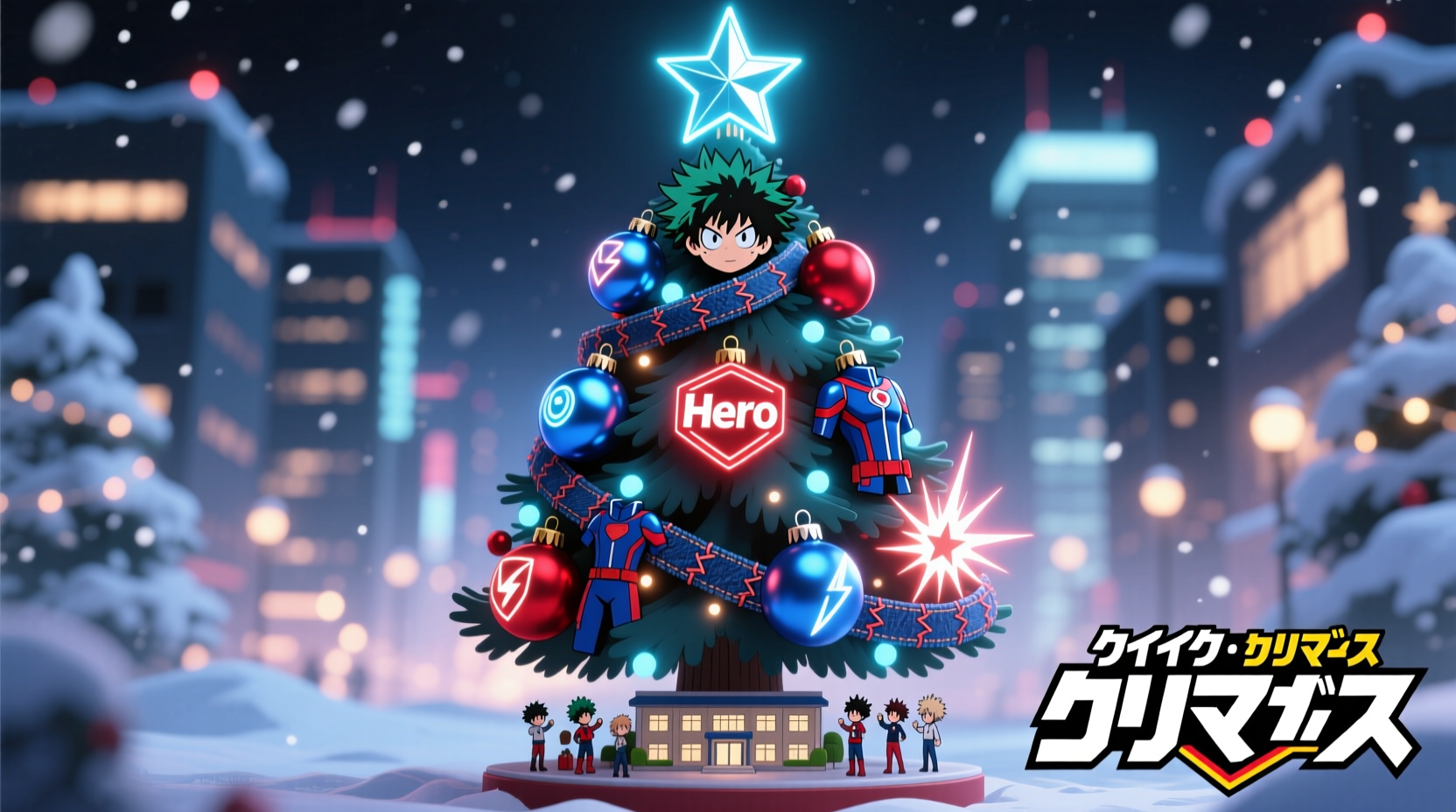
Christmas trees have long been personal canvases—expressions of identity, memory, and joy. When fandom meets tradition, the result is something deeply resonant: a tree that doesn’t just celebrate the season but honors a story that shaped your imagination. Yet many fans hesitate, fearing kitsch, imbalance, or visual clutter. A successful anime-themed tree isn’t about plastering logos across every branch—it’s about distillation. It’s translating narrative essence—color palettes, emotional tone, symbolic motifs, and character relationships—into a three-dimensional, festive composition. This guide walks you through that translation process with precision, grounded in design fundamentals and real-world execution. Whether you love the melancholy elegance of *Your Name*, the vibrant chaos of *My Hero Academia*, or the quiet warmth of *Laid-Back Camp*, this method works because it begins not with decoration—but with understanding.
1. Choose Your Anchor: Selecting the Right Anime & Defining Its Core Identity
Selecting an anime isn’t just about picking your favorite—it’s about identifying which title offers the richest visual and thematic material for seasonal reinterpretation. Not all series translate equally well to tree aesthetics. Prioritize those with strong, consistent color systems; recurring visual motifs (e.g., cherry blossoms, lightning bolts, paper cranes); emotionally evocative settings (a snowy Hokkaido campsite, a neon-lit Tokyo alleyway); and characters whose silhouettes or accessories lend themselves to ornamentation (e.g., Tanjiro’s hanafuda earrings, Asuka’s red plugsuit collar, or K-On!’s light music club badges).
Avoid titles with overly complex lore, fragmented color schemes, or heavy reliance on dialogue-driven humor—these are harder to distill into cohesive physical elements. Instead, look for coherence: a unified mood, a memorable seasonal anchor (like *K-On!*’s spring festival or *Fruits Basket*’s winter solstice arc), or iconic objects that can become ornaments without explanation (e.g., *Demon Slayer*’s breathing technique kanji, *Spy x Family*’s briefcase charm, or *Jujutsu Kaisen*’s cursed energy swirls).
Tip: Flip through your favorite manga volume or rewatch the opening sequence—not for plot, but to note dominant colors, repeated shapes, and background textures. These are your design DNA.2. Build Your Visual Foundation: Color Palette & Material Strategy
Every great themed tree starts with a disciplined color framework—not a rainbow of merch, but a curated palette derived directly from the anime’s visual language. Begin by extracting three to five core colors using screengrabs from key scenes: one dominant hue (e.g., *Demon Slayer*’s deep indigo from Tanjiro’s haori), one accent (the warm crimson of his ear cuffs), one neutral (charcoal gray from the Demon Slayers’ uniforms), and optionally, one metallic or luminous tone (gold leaf for Sun Breathing motifs or pearlescent white for *Mushishi*’s misty glow). Avoid using more than five colors—excess dilutes cohesion.
Material choice reinforces theme beyond color. Velvet ribbons echo *The Ancient Magus’ Bride*’s gothic opulence; matte ceramic ornaments suit *Violet Evergarden*’s delicate realism; translucent acrylic pieces capture *Akira*’s cybernetic sheen; and hand-stitched felt evokes *K-On!*’s cozy, handmade aesthetic. Never default to generic plastic. Each texture should feel intentional—and legible as part of the story.
| Anime Example | Dominant Colors | Suitable Materials | Why It Works |
|---|---|---|---|
| My Hero Academia | Midnight blue, electric yellow, crisp white | Glossy enamel, brushed aluminum, LED-lit acrylic | Matches the sleek, high-energy, tech-infused hero aesthetic; avoids cartoonish plastic |
| Laid-Back Camp | Forest green, cream, soft sky blue, terracotta | Unbleached cotton, wood veneer, linen-wrapped wire | Reflects natural textures, camping gear, and quiet Japanese countryside authenticity |
| Princess Mononoke | Earthy umber, moss green, iron grey, blood rust | Forged iron, raw clay, dyed wool, reclaimed bark | Embodies ancient forest reverence and tactile, pre-industrial craftsmanship |
3. The Ornament Hierarchy: Designing Meaningful, Layered Decorations
A themed tree fails when every ornament screams “look at me.” Success lies in hierarchy: a deliberate distribution of visual weight across three tiers—anchors, connectors, and atmosphere.
- Anchors (5–7 pieces): Large, sculptural ornaments representing core characters or symbols—e.g., a 4-inch ceramic rendition of *Spirited Away*’s No-Face holding a steaming bath token, or a minimalist brass fox mask for *Kemono Friends*. These hang at eye level on major branches and serve as focal points.
- Connectors (15–20 pieces): Medium-sized ornaments that reinforce relationships and themes—e.g., interlocking *Spy x Family* puzzle pieces (Loid + Yor + Anya), tiny *Haikyu!!* volleyballs strung on twine, or *Ghibli*-style soot sprites made from black felt and gold thread. These bridge anchors and create narrative flow.
- Atmosphere (30+ pieces): Small, repetitive elements that unify the tree’s texture—e.g., 20–30 hand-poured resin “stars” infused with crushed mica for *Your Name*, or miniature folded origami cranes in gradient blues for *5 Centimeters Per Second*. These fill space without competing.
This structure prevents visual noise while embedding storytelling at every scale. Crucially, avoid licensed merchandise unless it meets your material and color standards—even official products often clash tonally.
4. Step-by-Step Assembly: From Bare Branch to Narrative Tree
Follow this sequence—not chronologically, but hierarchically—to ensure balance and intentionality:
- Prep the tree: Fluff branches outward and upward. Use a white or charcoal tree skirt—not red or green—to let your palette dominate.
- Install lighting first: Use warm-white LEDs (not multicolor) for base illumination. Wrap lights evenly, then dim to 70% brightness—this creates depth and lets ornaments glow, not glare.
- Hang anchors: Place them at 12, 3, 6, and 9 o’clock positions on the midsection. Space them at least 8 inches apart. Step back after each placement to assess balance.
- Add connectors: Distribute these along the same horizontal plane as anchors, but stagger vertically—some slightly higher, some lower—to create rhythm. Connect related anchors visually (e.g., place a *Demon Slayer* sword charm midway between Tanjiro and Nezuko ornaments).
- Layer atmosphere: Tuck small ornaments deep into branch interiors—not just on tips—to add dimension. Alternate types (e.g., two resin stars, one felt crane, one wood slice) for organic variation.
- Finalize with ribbon and topper: Use wide satin or velvet ribbon in your dominant color, draped in loose, asymmetrical loops—not tight spirals. For the topper, choose meaning over size: a miniature *Studio Ghibli* Catbus silhouette works better than a generic angel if your theme is *My Neighbor Totoro*.
“The strongest fan art doesn’t replicate—it interprets. A great anime tree isn’t a shrine to screenshots; it’s a tactile poem written in color, texture, and silence.” — Kenji Sato, Exhibition Designer & Ghibli Archive Consultant
5. Real-World Execution: A Case Study from Osaka
In December 2023, graphic designer Aiko Tanaka transformed her 6.5-foot Nordmann fir into a tribute to *March Comes in Like a Lion*. She began not with ornaments, but with research: analyzing the manga’s winter palette (slate grey, faded rose, parchment beige), studying recurring motifs (shogi pieces, steam rising from tea cups, snow-dusted temple gates), and sketching compositions that echoed the series’ quiet, contemplative pacing.
Her execution was meticulous: 7 anchor ornaments included a hand-thrown ceramic shogi king piece glazed in matte grey, and a miniature wooden temple gate with removable paper lanterns lit by micro-LEDs. Her 18 connectors featured embroidered felt teacups (each with a different character’s favorite blend), and her 42 atmosphere pieces were frosted glass “snowflakes,” each etched with a single hiragana character from the series’ title. She avoided all licensed goods, sourcing materials from Kyoto craft suppliers and hand-painting every detail. Visitors didn’t just recognize the theme—they felt its stillness. “People stood quietly for minutes,” Aiko shared. “They didn’t see ‘anime decor.’ They saw winter, loneliness, and warmth—all held in balance.”
6. Common Pitfalls & How to Avoid Them
Even thoughtful creators stumble. Here’s what derails most anime trees—and how to course-correct:
- Pitfall: Overloading with character faces. Solution: Use silhouettes, signature accessories (e.g., *Attack on Titan*’s vertical maneuvering gear hooks), or abstract representations (a swirling vortex for *Mob Psycho 100*’s esper energy) instead of direct portraits.
- Pitfall: Ignoring scale and proportion. Solution: Measure your tree height and calculate ornament sizes mathematically. Rule of thumb: largest ornament should be no bigger than 1/10 of tree height (e.g., 6-inch max for a 6-foot tree).
- Pitfall: Forgetting negative space. Solution: Leave 30% of branch surface visibly bare. Clutter obscures meaning; restraint invites interpretation.
- Pitfall: Using inconsistent lighting temperature. Solution: Stick to one Kelvin rating (2700K–3000K for warm white). Mixing cool and warm LEDs fractures the mood.
7. FAQ
Can I mix multiple anime on one tree?
Only if they share a unifying principle—such as all being Studio Ghibli films (*Totoro*, *Howl*, *Ponyo*) with compatible palettes and tones. Thematic crossover (e.g., *Demon Slayer* + *Jujutsu Kaisen*) rarely works: their visual languages—historical ink wash vs. modern urban graffiti—are too divergent. One focused theme always reads stronger than forced fusion.
How do I make ornaments if I’m not craft-inclined?
Start simple: print high-res character motifs on photo paper, seal with Mod Podge, and glue to plain wooden circles. Or buy blank ornaments (wood, ceramic, glass) and use fine-tip acrylic pens for line art. Focus on one type of ornament per tier—consistency compensates for technical simplicity.
What’s the best way to store anime-themed ornaments long-term?
Use acid-free tissue paper and rigid compartment boxes (not plastic bags). Label each section by tier (“Anchors: Totoro”, “Atmosphere: Snowflakes”) and include a printed color swatch. Store flat, never stacked, in a climate-controlled closet—humidity warps paper, heat fades dyes, and cold makes ceramics brittle.
Conclusion
Your favorite anime didn’t resonate because it followed trends—it resonated because it spoke to something specific, true, and human within you. Your Christmas tree deserves that same authenticity. This isn’t about perfection, licensing, or viral appeal. It’s about honoring the stories that shaped your empathy, your sense of wonder, your idea of courage or kindness—by translating them into something you can touch, walk around, and share with quiet pride. Start small: choose one color, one motif, one memory from your chosen series. Let that seed grow—not into clutter, but into clarity. Then step back, adjust the lights, and watch your tree breathe with narrative life. That moment, when fiction and festivity meet in three dimensions—that’s where fandom becomes legacy.
💬 Share your tree story. Which anime did you choose? What motif became your anchor? Post your process—or your first handmade ornament—in the comments. Let’s build a gallery of meaning, one branch at a time.








