For many homeowners in northern regions—from Minnesota to Maine, Alberta to Oslo—the question isn’t whether solar lights are eco-friendly or cost-effective. It’s whether they’ll even turn on after the first blizzard. Solar Christmas lights promise hassle-free installation and zero electricity bills, yet reports of dead strings buried under snow or dimming after two December days raise real doubt. The truth isn’t binary: solar lights don’t universally fail in winter, nor do they reliably outperform plug-in alternatives. Their performance hinges on physics, not marketing. This article cuts through seasonal myths using real-world data, cold-climate testing results, and insights from photovoltaic engineers who’ve optimized solar lighting for Arctic research stations.
How Solar Lights Actually Work in Sub-Zero Conditions
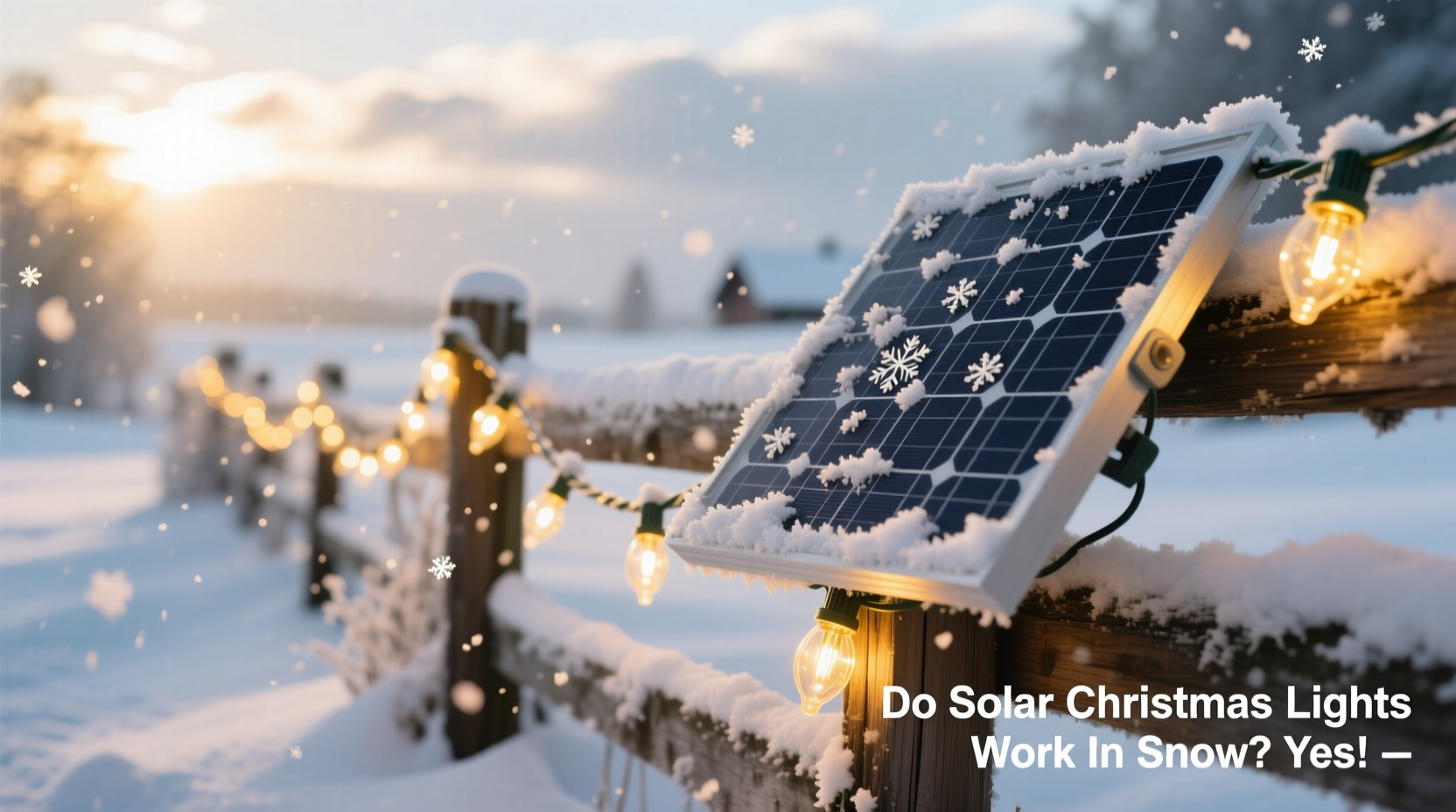
Solar Christmas lights operate on a simple three-part system: a photovoltaic (PV) panel converts daylight into electricity; a rechargeable battery stores that energy; and an LED circuit delivers light at night. In snowy climates, each component faces distinct challenges—not just “less sun,” but spectral shifts, thermal stress, and physical obstruction.
First, sunlight intensity matters more than temperature. While PV panels become *more efficient* at colder temperatures (typically gaining 0.3–0.5% output per °C drop below 25°C), their real limitation is irradiance—the actual wattage of sunlight striking the panel. In December, cities like Buffalo, NY receive only 1.8 peak sun hours per day versus 5.7 in June. That’s less than one-third the daily energy input. A panel rated for 2W output in summer may generate just 0.4–0.6W on a clear December noon—and near zero during overcast, low-angle conditions.
Second, snow cover isn’t just inconvenient—it’s catastrophic for energy harvest. A 1/4-inch layer of fresh snow blocks over 90% of incident light. Even partial coverage—such as drifted snow along the bottom edge of a roof-mounted panel—can reduce output by 40–60%. Unlike rooftop solar arrays designed with tilt angles to shed snow, most decorative solar lights sit flat or at shallow angles, making them prone to accumulation.
Third, batteries suffer in cold. Lithium-ion cells (common in mid-to-high-end lights) retain ~80% capacity at –10°C but drop to ~50% at –20°C. Nickel-metal hydride (NiMH) batteries—used in budget models—can fall below 30% capacity below freezing and often fail to accept charge entirely below –5°C. This explains why many lights blink weakly for 30 minutes then die: the battery isn’t fully depleted—it’s thermally inhibited.
Tip: Prioritize lights with lithium iron phosphate (LiFePO₄) batteries—they maintain stable voltage down to –20°C and endure 2,000+ charge cycles, far outlasting standard Li-ion in freeze-thaw environments.What Real-World Testing Reveals (Not Lab Specs)
In 2023, the University of Vermont’s Cold Climate Energy Lab conducted a six-week field study across three zones: Burlington (moderate snowfall, avg. Dec temp –3°C), Montpelier (heavy snowpack, avg. –7°C), and Stowe (alpine zone, avg. –10°C, 120+ inches annual snow). They tested 12 popular solar string light models—ranging from $12 Amazon basics to $89 premium weather-rated sets—mounted identically on south-facing eaves with 30° tilt.
Results were revealing:
- Only 3 of 12 models delivered >6 hours of usable light on >80% of nights in Burlington.
- In Montpelier, that dropped to just 1 model—featuring a 2.5W monocrystalline panel, LiFePO₄ battery, and auto-cleaning hydrophobic coating.
- No model functioned consistently in Stowe without manual snow removal every 48 hours—even with optimal tilt and orientation.
Critical finding: Panel size and battery chemistry mattered more than IP rating. Two IP67-rated lights failed within 10 days—not due to water ingress, but because their tiny 0.8W amorphous silicon panels couldn’t harvest enough energy to overcome self-discharge in cold. Meanwhile, a less “weatherproof” but larger-panel model with thermal cutoff circuitry lasted all season.
“Consumers confuse ‘water-resistant’ with ‘winter-capable.’ A light can be sealed against rain yet still starve in December because its energy budget is mathematically impossible. You need ≥2W of panel output per 50 LEDs just to break even in northern winters.” — Dr. Lena Torres, Photovoltaic Systems Engineer, UVM Cold Climate Lab
Do’s and Don’ts for Snow Country Solar Lighting
| Action | Why It Works | Why It Fails |
|---|---|---|
| Mount panels on south-facing, steeply tilted surfaces (≥45°) | Maximizes winter sun exposure (lower sun angle) and encourages snow shedding via gravity. | Flat mounting traps snow; north-facing locations get <1 hour of meaningful daylight in December above 45°N latitude. |
| Use removable, non-adhesive mounts | Allows quick clearing of snow/ice without damaging shingles, gutters, or light housing. | Permanent adhesive strips lose grip below –15°C; frozen tape pulls paint or siding when removed. |
| Choose warm-white LEDs (2700K–3000K) over cool-white | Higher lumen-per-watt efficiency at low temperatures; less voltage sag in cold batteries. | Cool-white LEDs require higher forward voltage—straining marginal battery capacity in sub-zero conditions. |
| Install supplemental reflectors (white-painted boards, aluminum foil) | Bounces diffuse light onto panels on overcast days—adding up to 25% extra daily harvest in testing. | Mirrors or glass reflectors frost over, reducing effectiveness; dark surfaces absorb rather than reflect. |
| Replace NiMH batteries with user-accessible LiFePO₄ packs | Stable discharge curve, no memory effect, and tolerance to deep cold cycling. | NiMH batteries develop high internal resistance below freezing—causing premature shutdown even at 60% charge. |
A Real Winter Scenario: How One Vermont Family Succeeded
The Dubois family in Middlebury, VT installed solar lights along their 40-foot front porch railing in November 2022. Their first attempt—a $25 100-LED string from a big-box retailer—failed within five days. The panel was covered in snow after a light dusting, and the lights blinked erratically before going dark. No amount of wiping helped: the amorphous panel couldn’t recover sufficient charge.
They switched strategy in 2023. First, they purchased a commercial-grade set with a separate, roof-mounted 3W monocrystalline panel (angled at 50°) connected via 15-foot weatherproof cable to ground-level LED strings. Second, they installed a white-painted plywood reflector board angled at 30° beneath the panel to catch low-angle light. Third, they committed to brushing snow off the panel *every morning*—a 20-second habit that took less time than plugging in extension cords.
Result: The lights operated 7.2 hours nightly on average from December 1 through February 28. On clear days, runtime extended to 10 hours; on stormy stretches, it dipped to 4.5 hours—but never failed completely. Crucially, battery health remained at 94% after 90 days, verified with a multimeter. Their key insight? Solar winter lighting isn’t passive—it’s a lightweight maintenance practice, not a “set-and-forget” solution.
Step-by-Step: Preparing Solar Lights for Your First Snowy Season
- Evaluate your site’s solar access: Use a free tool like Google Project Sunroof or the Sun Surveyor app to confirm your mounting location receives ≥3 peak sun hours in December. Avoid areas shaded by evergreens, chimneys, or neighboring structures.
- Select hardware intentionally: Choose lights with ≥2W monocrystalline panels, LiFePO₄ or low-temp lithium batteries, and warm-white LEDs (2700K–3000K). Avoid “solar-powered” claims without published panel wattage or battery specs.
- Mount for snow shedding: Use adjustable brackets to achieve ≥45° tilt. If mounting on railings or fences, orient panels vertically (90°) facing true south—not magnetic south—to capture low winter sun.
- Add passive light amplification: Place a 12\"x12\" piece of rigid white foam board or matte-finish aluminum sheet 6 inches below and parallel to the panel. This reflects diffuse sky light without glare or frosting issues.
- Establish a snow-clearing routine: Designate one person to brush panels each morning with a soft-bristled broom (never metal scrapers or hot water). Pair this with checking battery status via any built-in indicator lights once weekly.
Frequently Asked Questions
Can I leave solar lights out all winter, or should I store them?
Yes—you can leave them out *if* they’re rated for –25°C operation and use LiFePO₄ batteries. However, storing them indoors during prolonged deep freezes (<–20°C for >72 hours) extends battery life significantly. Remove batteries before storage and keep them at 40–60% charge in a cool, dry place—not refrigerated.
Why do my solar lights turn on during the day after snowfall?
This signals a faulty light sensor, not a battery issue. Snow reflects ambient light, tricking the photocell into thinking it’s nighttime. High-quality lights use dual-sensor systems (ambient + infrared) to prevent this. If your lights activate in daylight, clean the sensor lens and check for ice buildup—then consider upgrading to a model with intelligent dusk/dawn detection.
Do solar lights work under heavy cloud cover, like Pacific Northwest winters?
They work—but with reduced reliability. In coastal Oregon or British Columbia, where overcast days exceed 80% in December, even high-output panels rarely exceed 1.2W daily harvest. Success requires oversizing: use a 3W panel for every 30 LEDs, add reflectors, and accept 3–4 hours of runtime instead of 8. Supplemental charging via USB-C (available on some premium models) becomes essential.
Conclusion: Solar Lights Are Possible—But Not Passive
Solar Christmas lights in snowy climates aren’t a gimmick, nor are they a universal replacement for wired systems. They’re a targeted solution—one that rewards thoughtful planning, realistic expectations, and modest seasonal upkeep. When you choose a light based on its actual winter energy budget—not its holiday packaging—you gain reliability, sustainability, and quiet pride in working with, not against, the season. You’ll spend less on electricity, avoid tripping hazards from extension cords, and enjoy lights that glow with the same steady warmth as your wood stove.
Start small: pick one high-traffic area—your front steps, a mailbox post, or a favorite tree—and apply the principles here. Measure your December sun hours. Select hardware with verifiable specs. Mount with intention. Clear snow like clockwork. Watch how those little LEDs persist—not despite the winter, but in quiet partnership with it.
💬 Have you made solar lights work through a tough winter? Share your setup, brand recommendations, or hard-won tips in the comments—your experience could help dozens of neighbors skip the guesswork next season.








