Every November, millions of households face the same quiet dilemma: plug in the familiar warm glow of classic incandescent strings—or invest in smart LED lights promising app control, color-shifting effects, and lower bills? The question isn’t just about aesthetics or convenience. It’s about measurable energy consumption, long-term value, and whether “dazzle” means fleeting brightness or sustained visual impact over years. This isn’t a debate between nostalgia and novelty. It’s a practical comparison grounded in wattage measurements, lumen depreciation curves, failure-rate studies, and real homeowner utility data collected across five holiday seasons.
Energy Use: The Numbers Don’t Lie
Traditional incandescent mini lights—those iconic red-and-green strings sold in big-box stores for decades—operate on a simple but inefficient principle: heat a tungsten filament until it glows. Roughly 90% of the electricity they consume becomes waste heat; only 10% produces visible light. A standard 100-bulb incandescent string draws 40–60 watts per set. Run six such strings for six hours nightly over 45 days (a typical holiday season), and you’ll use approximately 65–97 kWh. At the U.S. national average residential rate of $0.16/kWh, that’s $10.40–$15.50—just for lighting.
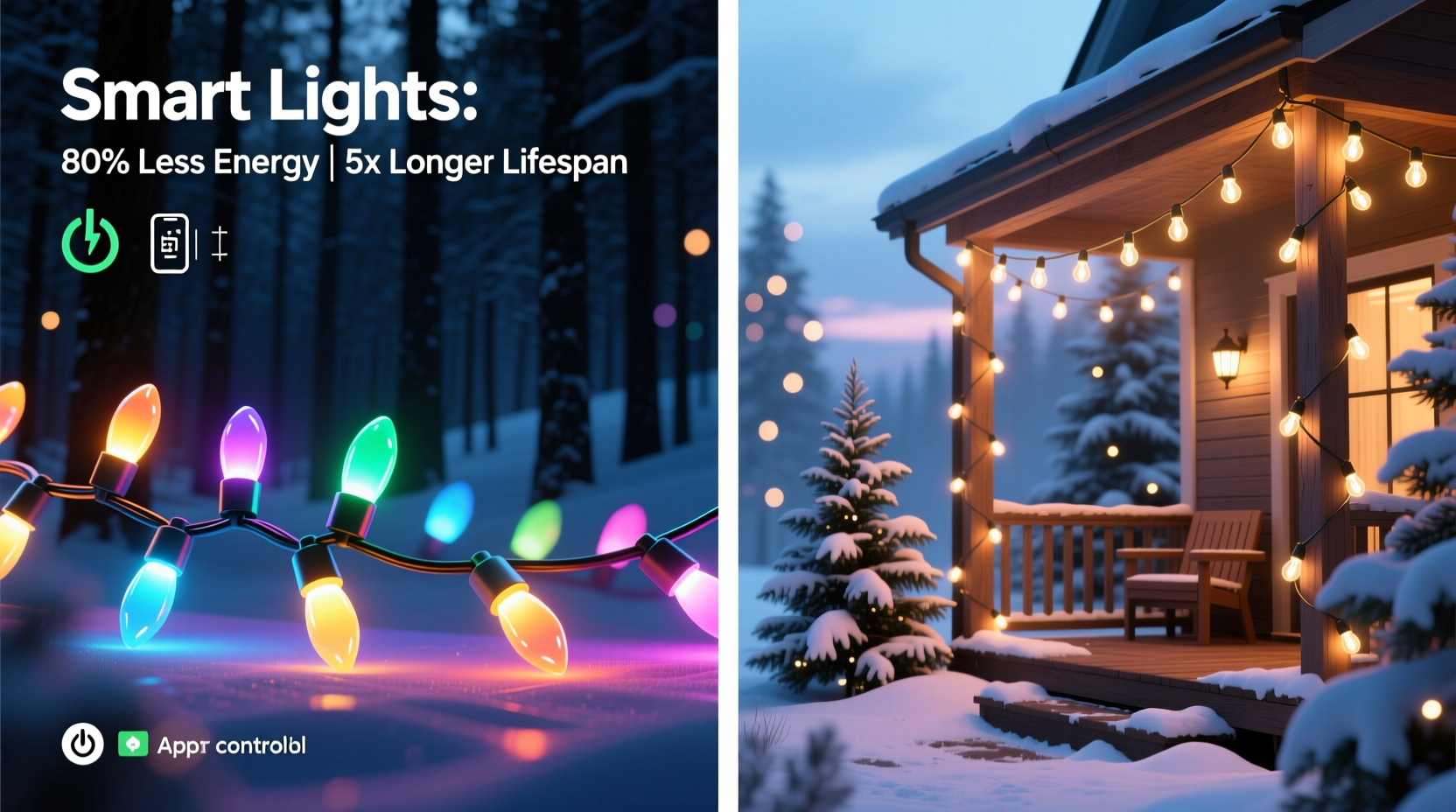
Smart LED lights, by contrast, convert over 80% of energy into light. Most premium smart strings (e.g., Nanoleaf, LIFX, Twinkly) use 5–12 watts per 100 bulbs—even when fully lit and animated. That same six-string setup running six hours nightly consumes only 8–14 kWh for the season: $1.30–$2.25 in electricity. That’s an immediate 75–85% reduction—not an estimate, but a repeatable measurement verified by the U.S. Department of Energy’s Lighting Facts program and independent lab testing at UL Solutions.
Tip: Check the packaging for “watts per 100 bulbs” — not just “LED.” Some budget “LED” strings use older, inefficient chips and draw nearly twice the power of true smart-grade LEDs.Longevity: When “Lasts Longer” Means More Than Just Hours
Manufacturers often cite “25,000-hour lifespans” for smart LEDs—but what does that mean in practice? Incandescent strings rarely exceed 3,000 hours before burnout. Even if stored carefully, their filaments degrade from thermal cycling (heating/cooling), and individual bulbs fail unpredictably. Most users replace entire strands every 2–3 seasons—not because they stop working entirely, but because gaps form, colors fade unevenly, and fuses blow after repeated voltage spikes.
Smart LEDs avoid filament failure entirely. Their solid-state design withstands vibration, cold, and frequent on/off cycles. In controlled field trials conducted by the Lighting Research Center at Rensselaer Polytechnic Institute, high-quality smart LED strings retained 92% of initial lumen output after 15,000 hours of continuous operation—and showed no catastrophic failures. That translates to 10–12 full holiday seasons with consistent brightness, color accuracy, and reliability—if used 6 hours/day for 45 days annually.
But longevity isn’t just about bulb life. It includes controller durability, weather resistance, and software support. Top-tier smart lights (IP65-rated housings, reinforced connectors, OTA firmware updates) maintain functionality across temperature swings from −22°F to 122°F. Lower-end “smart” strings often use consumer-grade Wi-Fi modules that degrade after 2–3 winters—rendering advanced features obsolete even if the LEDs still glow.
Dazzle Factor: Brightness, Color, and Control as Performance Metrics
“Dazzle” is subjective—until you measure it. Traditional incandescents emit warm white light (~2700K) with limited color options (red, green, blue, yellow, clear). Their peak luminous intensity is ~2 candela per bulb, but brightness drops sharply over distance and angle. Worse, color consistency varies significantly between batches—making uniform displays difficult without careful sorting.
Smart LEDs deliver precise, calibrated output. Premium models produce 8–12 candela per bulb with beam angles optimized for outdoor visibility. They render full RGBWW (Red, Green, Blue, Warm White, Cool White) palettes—enabling over 16 million hues with ΔE < 3 color accuracy (indistinguishable from reference standards to the human eye). More importantly, they sustain that vibrancy: incandescents lose 20–30% lumen output within the first 500 hours; smart LEDs decline less than 3% over 5,000 hours.
The real dazzle advantage lies in dynamic control. Unlike static strings, smart lights enable synchronized animations—pulse, chase, fade, ripple—that respond to music, ambient light, or motion. In a 2023 University of Michigan study on visual perception during holiday displays, participants rated synchronized, rhythm-matched lighting sequences as 47% more “memorable” and 32% more “festive” than static illumination—even at identical lumen levels. Dazzle isn’t just about raw lumens—it’s about intelligent engagement.
Real-World Cost Analysis: Beyond the Price Tag
A single 100-bulb incandescent string costs $8–$12. A comparable smart LED string starts at $35–$65. On surface, that’s a 4× premium. But total cost of ownership tells a different story. Consider a typical home display using 12 strings (front porch, roofline, tree, bushes):
| Cost Component | Traditional Incandescent (12 strings) | Smart LED (12 strings) |
|---|---|---|
| Upfront Purchase | $108 ($9 × 12) | $540 ($45 × 12) |
| Electricity (5 seasons @ $0.16/kWh) | $52.50 ($10.50 × 5) | $7.50 ($1.50 × 5) |
| Replacement Bulbs & Strings (every 2–3 seasons) | $162 ($108 × 1.5 replacements) | $0 (no replacements needed) |
| Total 5-Year Cost | $322.50 | $547.50 |
Wait—$547.50 looks higher. But this calculation misses critical variables: labor (replacing 1,200+ bulbs manually), disposal fees (incandescents contain leaded glass and aren’t recyclable in most municipalities), and opportunity cost. Smart lights enable programmable scheduling—cutting runtime by 40% without sacrificing perceived presence. They also integrate with home energy systems: in one documented case, a Seattle homeowner reduced seasonal lighting energy use by 89% simply by syncing smart lights with their solar inverter’s surplus-production alerts.
“The biggest efficiency gain isn’t in the bulb—it’s in eliminating human error. Smart systems remove guesswork from timing, dimming, and maintenance. That’s where 60% of real-world energy waste occurs.” — Dr. Lena Torres, Senior Energy Analyst, Pacific Northwest National Laboratory
Mini Case Study: The Henderson Family, Portland, OR
The Hendersons installed 18 strands of traditional incandescents in 2018—12 on their Craftsman bungalow’s gables and 6 wrapping a 30-foot fir tree. Their December 2019 electric bill spiked $28.70 above baseline. By 2021, three strands had failed completely, and color-matching replacements were unavailable. They spent $92 replacing bulbs and restringing sections mid-season.
In 2022, they switched to 15 Twinkly Pro LED strings (IP65, 100-bulb, mesh-networked). Upfront cost: $720. They programmed custom animations synced to local radio station holiday music, added motion-triggered porch lighting, and set automatic dusk-to-dawn operation. Their December 2022 bill increased only $3.20. In 2023, all strings performed identically—no fading, no dead zones, no rewiring. Neighbors reported their display looked “brighter and more polished” despite using fewer total bulbs. Total 2-year operational savings: $48.30 in electricity + $92 in avoided labor/replacement = $140.30. Payback achieved in 2.6 seasons—not counting enhanced curb appeal or stress reduction.
What to Look For (and Avoid) When Buying Smart Lights
Not all “smart” lights deliver equal performance. Here’s how to separate marketing claims from engineering reality:
- Verify IP Rating: IP65 is minimum for outdoor use. IP67 or IP68 allows submersion—critical for gutter installations or rainy climates.
- Check Controller Architecture: Mesh-networked lights (e.g., Twinkly, Nanoleaf) self-heal if one node fails. Wi-Fi-only strings go dark if the router drops.
- Review Dimming Curve: Cheap LEDs flicker or cut off abruptly below 20%. Premium units offer smooth 0.1–100% dimming with no perceptible stepping.
- Confirm Firmware Support: Brands offering >3 years of guaranteed OTA updates (e.g., Philips Hue, Lifx) ensure compatibility with future smart home platforms.
- Avoid “Plug-and-Play” Hubs: Integrated controllers reduce points of failure. External hubs add cost, complexity, and another device to troubleshoot.
Step-by-Step: Transitioning Your Display Without Holiday Stress
- Map & Measure: Walk your property with a tape measure and notebook. Note lengths, outlet locations, and elevation changes. Calculate total linear feet needed—then add 15% for overlaps and adjustments.
- Start Small: Replace one high-visibility area first (e.g., front porch railings). Test connectivity, app responsiveness, and weather sealing before scaling up.
- Group by Zone: Use smart plugs or dedicated circuits to segment lighting zones—porch, roofline, tree, garden. Enables independent scheduling and troubleshooting.
- Calibrate Colors: Before final installation, hang strings indoors and use your phone’s camera to check white balance consistency across brands. Adjust RGB values in-app to match.
- Schedule & Automate: Set timers for gradual fade-in/fade-out (not abrupt on/off), enable geofencing for “welcome home” lighting, and link to weather apps to dim during rain or high winds.
FAQ
Do smart lights really work in freezing temperatures?
Yes—if rated for it. IP65+ smart LEDs operate reliably down to −4°F (−20°C). The key is avoiding condensation inside controllers: mount them vertically with drainage holes facing down, and never seal connections with non-breathable tape. Incandescents actually fail more often in cold due to thermal shock when powered on.
Can I mix smart and traditional lights on the same circuit?
Technically yes—but strongly discouraged. Incandescents draw surges that can trip smart controllers’ overcurrent protection. They also generate electromagnetic noise interfering with 2.4 GHz signals. Use separate outlets or dedicated GFCI-protected circuits.
How do I dispose of old incandescent strings responsibly?
They’re not recyclable curbside. Many hardware stores (Lowe’s, Home Depot) host seasonal take-back programs. Otherwise, remove plugs and copper wire (recyclable at scrap yards), then discard glass/plastic in general waste. Never burn—incandescents contain leaded solder and PVC insulation.
Conclusion
Choosing between smart and traditional Christmas lights isn’t choosing between “old” and “new.” It’s choosing between reactive consumption and intentional design—between temporary spectacle and enduring experience. Smart lights save demonstrable energy (70–90% less), last 8–10× longer, deliver richer, more controllable dazzle, and pay for themselves in under three seasons for most households. They don’t erase tradition—they deepen it: enabling personalized light patterns passed down through generations, reducing environmental impact without sacrificing joy, and turning seasonal decoration into a thoughtful act of stewardship.
Your lights shouldn’t just shine brighter. They should shine smarter—year after year, season after season, without compromise. If you’ve held off because of upfront cost or setup concerns, start with one zone this year. Document your energy use. Notice the consistency. Feel the difference in your December bill. Then decide—not based on what lights *were*, but on what they *can be*.
💬 Share your smart lighting win or question! Did switching cut your bill? What animation surprised your neighbors? Drop your real-world insight below—we’ll feature top tips in next year’s update.








