As the holiday season approaches, one of the most effective ways to elevate your home’s festive charm is by outlining windows with decorative lighting. But when it comes to choosing between rope lights and twinkle lights, many homeowners find themselves at a crossroads. Both options offer distinct aesthetics, practical benefits, and installation considerations. The decision isn’t just about preference—it’s about aligning function, durability, visual impact, and ease of use with your holiday decorating goals.
This comprehensive comparison dives into the strengths and limitations of rope lights and twinkle lights specifically for window outlining during Christmas. Whether you're aiming for a classic, elegant glow or a whimsical, magical sparkle, understanding the nuances will help you make a choice that enhances your curb appeal and lasts through multiple seasons.
Brightness and Light Output: Consistency vs. Sparkle
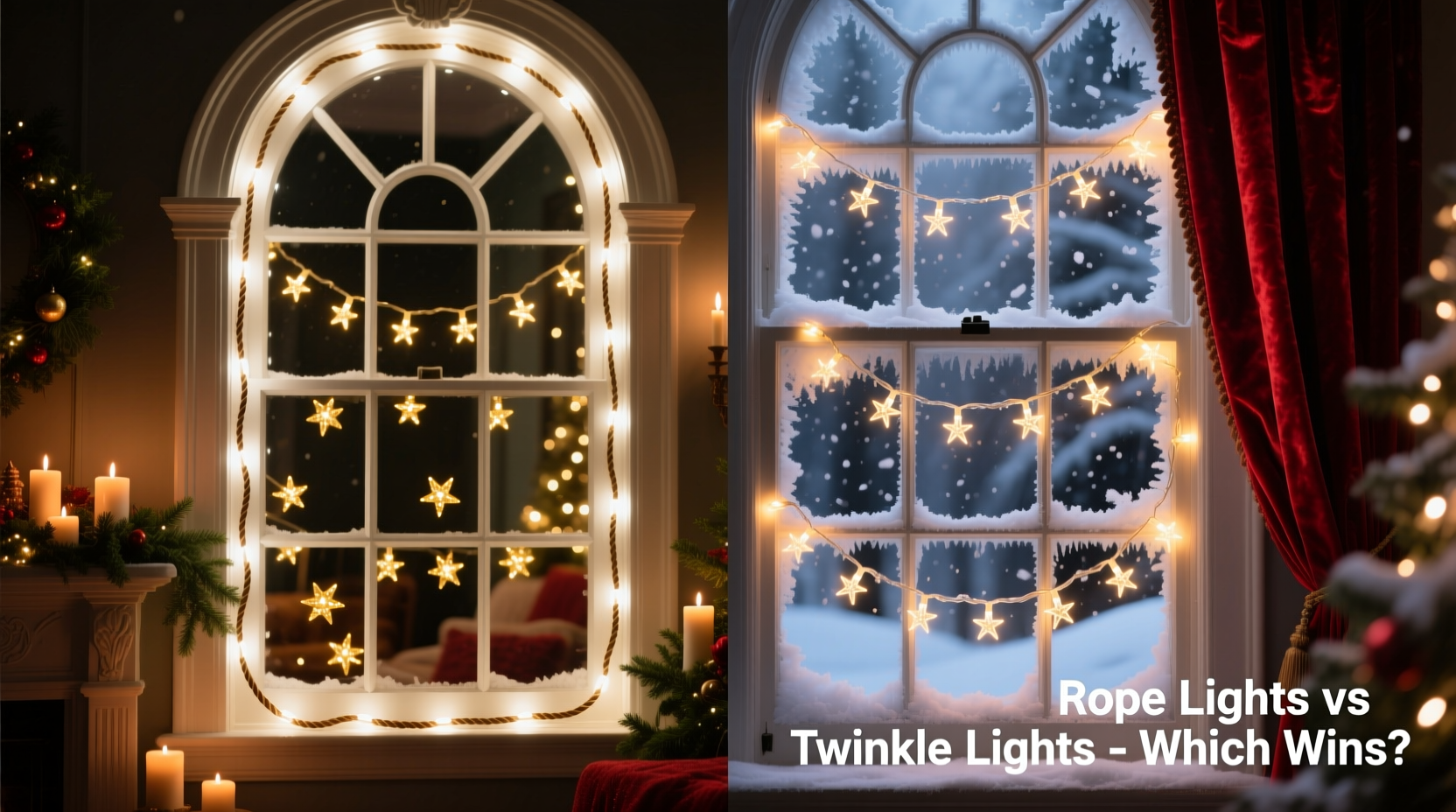
The most noticeable difference between rope lights and twinkle lights lies in how they emit light. Rope lights are designed to provide a uniform, continuous glow along their entire length. This makes them ideal for outlining architectural features like window frames, where clean lines and even illumination are key. The consistent brightness ensures no dark spots, creating a polished, professional appearance from both inside and outside the home.
Twinkle lights, on the other hand, are engineered for movement and variation. Typically composed of individual bulbs spaced apart, they often include flashing, fading, or random twinkling effects. While this creates a dreamy, starry-night effect, it can result in inconsistent coverage when used for outlining. Some sections may appear dim or broken due to gaps between bulbs, especially when viewed up close.
Tip: For crisp, defined outlines—especially on large or multi-pane windows—opt for rope lights to ensure full perimeter visibility.If your goal is subtlety and ambiance over definition, twinkle lights can work well. However, if you want your window frames to stand out clearly against the night sky, rope lights deliver superior luminosity and continuity.
Aesthetic Appeal: Classic Elegance vs. Whimsical Charm
The visual character of each lighting type plays a significant role in holiday styling. Rope lights project a sleek, modern elegance. Their seamless glow mimics the look of commercial holiday displays and high-end residential designs. Available in warm white, cool white, and multicolor options, rope lights blend seamlessly with traditional and contemporary décor. They’re particularly effective when paired with garlands, wreaths, or sheer curtains that diffuse the light softly indoors.
Twinkle lights evoke nostalgia and playfulness. Think of childhood memories of snow-covered trees shimmering under tiny bulbs. When draped loosely around a window or layered behind sheer fabric, they create depth and movement. However, because of their segmented nature, they don’t outline shapes as precisely. Instead, they suggest form rather than define it.
“Rope lights give structure to seasonal lighting—they turn architecture into art. Twinkle lights add emotion and motion, but not precision.” — Daniel Reeves, Holiday Lighting Designer & Founder of Luminary Concepts
Consider your neighborhood context. In areas with more formal or coordinated holiday displays, rope lights tend to integrate better. In cozy cottages or family-focused homes where charm outweighs symmetry, twinkle lights may feel more authentic.
Installation and Durability: Practicality Meets Longevity
Installing lights on windows requires attention to safety, weather resistance, and long-term maintenance. Rope lights typically come in fixed lengths (often 25 to 50 feet) with durable PVC jackets that protect internal wiring. Many are rated for outdoor use, UV-resistant, and capable of withstanding rain, snow, and temperature fluctuations. Because they’re solid strips, there are fewer connection points to fail over time.
Twinkle lights usually consist of wire strands with individual sockets or molded bulbs. While flexible, these strands are more prone to tangling, bulb burnout, and connector corrosion—especially in damp climates. Replacing a single dead bulb can be tedious, and frayed wires near windows (where moisture collects) pose minor risks if not properly maintained.
Rope lights are generally easier to secure along straight edges using clips or adhesive mounts. Their rigidity helps maintain alignment, reducing sagging. Twinkle lights require more fasteners due to their flexibility and are best suited for draping rather than tight outlining.
Step-by-Step Installation Comparison
- Rope Lights: Measure window perimeter → Cut (if permitted) or select correct length → Attach mounting clips every 6–8 inches → Insert rope light into clips → Connect to power source → Test and adjust.
- Twinkle Lights: Estimate needed strand length → Unwind carefully to avoid tangles → Begin securing at one corner with clips or hooks → Drape with slight slack between points → Connect multiple strands if needed → Test sequence mode (twinkle/fade/steady).
Energy Efficiency and Operating Costs
With holiday lighting running for several hours each night over four to six weeks, energy consumption adds up. Modern LED rope lights are highly efficient, drawing approximately 4–7 watts per foot. A typical 25-foot strand consumes about 100–175 watts over its full run—comparable to a single incandescent bulb.
LED twinkle lights are also energy-efficient, averaging 0.5 to 1 watt per set of 50 bulbs. However, because multiple sets may be required to fully outline even a medium-sized window, cumulative usage can surpass that of a single rope light setup. Additionally, blinking circuits consume slightly more power than steady modes due to rapid cycling.
Over time, rope lights often prove more cost-effective—not only in electricity but in replacement frequency. Their sealed construction resists moisture ingress better than socket-based twinkle strings, leading to longer lifespans. One well-maintained rope light strand can last 5–7 seasons; twinkle light sets often need partial or full replacement every 2–3 years.
Comparison Table: Rope Lights vs Twinkle Lights for Window Outlining
| Feature | Rope Lights | Twinkle Lights |
|---|---|---|
| Light Consistency | Uniform, continuous glow | Segmented, intermittent sparkle |
| Best Use Case | Crisp window outlines, architectural highlighting | Decorative accents, indoor ambiance |
| Durability | High – sealed jacket protects wiring | Moderate – vulnerable connectors and sockets |
| Installation Ease | Easier for straight lines and corners | More complex; prone to sagging |
| Lifespan | 5–7+ years (with care) | 2–4 years (bulb/socket wear) |
| Energy Use (approx.) | 4–7W per foot | 0.5–1W per 50-bulb string |
| Aesthetic Style | Modern, clean, elegant | Whimsical, nostalgic, playful |
Real Example: Two Homes, Two Approaches
In suburban Denver, two neighbors took different approaches to their window lighting. Sarah chose thick, warm-white LED rope lights to outline all eight windows on her craftsman-style bungalow. She appreciated the crisp, symmetrical look and found installation straightforward using plastic clip mounts. After five seasons, only one section needed replacing due to accidental damage during window cleaning.
Across the street, Mark opted for clear twinkle lights, layering multiple strands around his living room bay window. He loved the twinkling effect visible from the street and enjoyed pairing them with sheer gold curtains for an indoor glow. However, he replaced two sets within three years due to flickering issues and spent extra time untangling strands each November.
Both homes received compliments, but Sarah’s display was consistently praised for its “professional” quality, while Mark’s was described as “cozy and inviting.” The outcome reflects a key truth: success depends not just on the product, but on personal priorities and willingness to maintain the setup.
Frequently Asked Questions
Can I use twinkle lights to outline windows neatly?
You can, but achieving a clean, precise outline is challenging. Twinkle lights have gaps between bulbs and are more flexible, making them prone to sagging. For sharp definition, rope lights are far superior. If you prefer twinkle lights, consider combining them with a secondary rope light border for structure.
Are rope lights brighter than twinkle lights?
Not necessarily in total output, but rope lights appear brighter along the line because the light is continuous. Twinkle lights concentrate brightness at discrete points, leaving darker spaces in between. For visibility from a distance, rope lights deliver more consistent illumination.
Which option is safer for outdoor window use?
Both can be safe if labeled for outdoor use and installed correctly. However, rope lights generally have better moisture sealing and fewer exposed electrical contacts. Always check for UL certification, avoid daisy-chaining too many sets, and use timers or smart plugs to reduce fire risk.
Checklist: Choosing the Right Lights for Your Windows
- ☐ Determine your primary goal: clean outline (rope) vs. ambient sparkle (twinkle)
- ☐ Measure all window perimeters to estimate needed length
- ☐ Confirm outdoor rating and IP/weather resistance level
- ☐ Decide on color temperature: warm white (traditional), cool white (modern), or multicolor
- ☐ Check compatibility with extension cords and timers
- ☐ Plan storage method—avoid crushing or kinking after removal
- ☐ Test lights before installation to catch defects early
Final Verdict: Which Wins for Window Outlining?
When it comes to outlining windows during Christmas, **rope lights win** for most homeowners seeking durability, clarity, and low-maintenance performance. Their ability to deliver a seamless, bright border enhances architectural details and contributes to a cohesive, upscale holiday presentation. They’re easier to install, last longer, and perform reliably in varied weather conditions.
That said, twinkle lights still have a place—particularly for accenting the interior of windows, layering behind decor, or adding soft glimmers to porches and eaves. Used in combination with rope lights, they can enhance depth without sacrificing definition.
The smartest approach may be hybrid: use rope lights to frame the window’s outer edge, then add a short string of twinkle lights vertically down the center or along the sill for added dimension. This balances structure with sparkle, giving you the best of both worlds.
“The most memorable holiday displays aren’t about using the most lights—they’re about using the right lights in the right places.” — Lena Pruitt, Urban Holiday Stylist & Contributor to *Home & Garden Digest*
Take Action This Season
Don’t wait until the week before Thanksgiving to sort through tangled boxes of burnt-out strings. Assess your current setup now. Measure your windows, evaluate what still works, and invest in a high-quality rope light system if you haven’t already. Pair it with a programmable timer for effortless daily operation. With thoughtful planning, your window outlines can become a signature part of your holiday tradition—year after year.
💬 What’s your go-to lighting for holiday windows? Share your setup, tips, or photos in the comments—help others discover smarter, more beautiful ways to shine this season!