When it comes to decorating outdoor Christmas bushes, the right lighting can transform a simple shrub into a festive centerpiece. But with limited time during the holiday season, speed and simplicity matter. Rope lights and net lights are two of the most popular options—but which one actually installs faster on bushes? The answer depends on bush size, shape, layout, and your experience level. This guide breaks down real-world installation times, compares pros and cons, and delivers actionable insights so you can make the best choice—without sacrificing sparkle.
Understanding Rope Lights and Net Lights
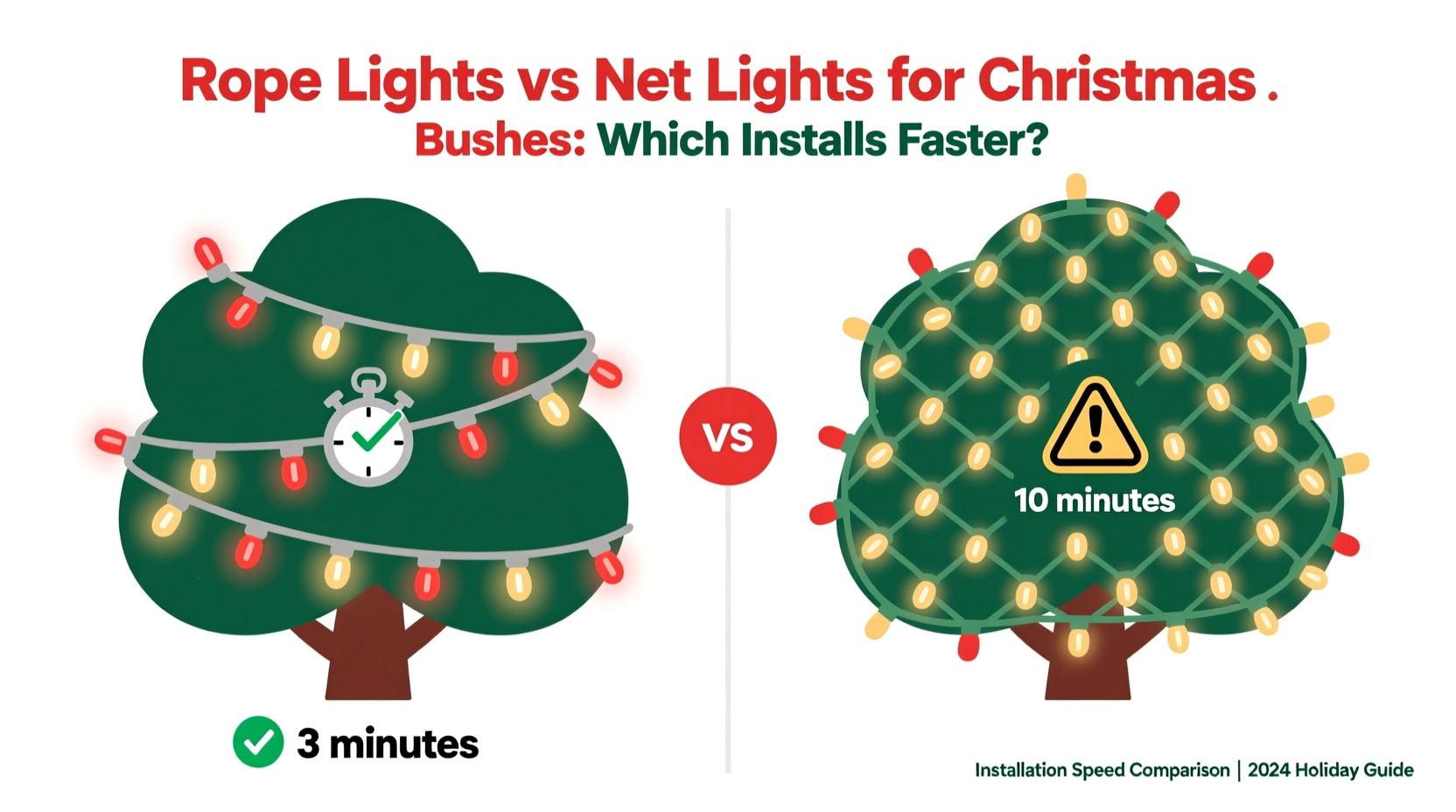
Rope lights and net lights serve similar purposes but differ significantly in design and application. Knowing how each works is essential before comparing installation speed.
Rope lights consist of small LED bulbs encased in a flexible plastic tube, forming a continuous line. They typically come in spools ranging from 15 to 100 feet and are ideal for outlining shapes or wrapping around structures. Their linear nature gives users control over placement but requires more manual positioning.
Net lights, on the other hand, are strings of bulbs woven into a grid pattern resembling fishing netting. They’re usually available in standard sizes like 4'x6', 6'x8', or 8'x12'. Designed to drape over bushes, trees, or hedges, they offer broad coverage with minimal effort. Once laid over a bush, they create a uniform blanket of light.
The fundamental difference lies in coverage strategy: rope lights require strategic wrapping, while net lights rely on blanket-style draping. This distinction becomes critical when evaluating installation speed.
Tip: For dense, rounded bushes under 6 feet tall, net lights often cut installation time by 50% compared to rope lights.Installation Speed: A Side-by-Side Comparison
To determine which option installs faster, consider three key factors: prep time, application method, and adjustment needs. Here’s a detailed comparison based on typical residential landscaping scenarios.
| Feature | Rope Lights | Net Lights |
|---|---|---|
| Setup Time (Avg. 4–5 ft Bush) | 15–25 minutes | 5–10 minutes |
| Tools Required | Zip ties, clips, ladder (often) | Clips or weights (minimal) |
| Coverage Control | High – customizable wrap | Low – fixed grid spacing |
| Best For | Tall, narrow, or irregularly shaped bushes | Dense, rounded, medium-sized shrubs |
| Reusability & Storage | Moderate – prone to kinking | High – lays flat when stored |
| Learning Curve | Steeper – technique affects evenness | Minimal – drape and secure |
For most homeowners, net lights win in raw speed. One homeowner in Portland reported covering three boxwood hedges (each ~5 ft wide) in under 20 minutes using pre-lit net panels. In contrast, wrapping the same bushes with rope lights took her husband nearly an hour the previous year due to uneven spacing and tangled cords.
“Net lights are the fastest way to achieve full, even illumination on compact evergreens. If speed is your priority, they’re hard to beat.” — Daniel Reeves, Landscape Lighting Designer, Holiday Brilliance Co.
Step-by-Step Installation Timelines
Let’s walk through realistic installation sequences for both types on a typical 4.5-foot-tall arborvitae.
Installing Rope Lights (Estimated: 20 Minutes)
- Uncoil and inspect (3 min): Lay out the rope light to check for dead sections or damage.
- Anchor base (2 min): Secure the end near ground level using a plastic stake or clip.
- Wrap upward (10 min): Spiral the light around the bush from bottom to top, maintaining consistent spacing (~6–8 inches between loops).
- Secure midpoints (3 min): Use zip ties or plant clips to prevent sagging, especially on outward branches.
- Connect to power (2 min): Route cord to outlet, connect extension if needed, and test lights.
Installing Net Lights (Estimated: 7 Minutes)
- Lay out net (1 min): Unfold the net light panel and position it over the bush.
- Drape evenly (3 min): Adjust so lights cover all sides; let excess fall naturally at the base.
- Secure corners (2 min): Use landscape pins or clips to anchor edges and prevent wind lift.
- Plug in (1 min): Connect to power source and verify full illumination.
The time savings with net lights come from eliminating the need for precise wrapping. There's no risk of missing a section or creating dark spots between spirals. However, rope lights allow greater precision on oddly shaped or sparse bushes where a net might leave gaps at the center.
When Rope Lights Might Be Faster (Yes, Really)
While net lights generally install faster, there are specific situations where rope lights can be the quicker—and better—option.
- Tall, narrow hedges: A 10-foot-tall privacy hedge is impractical to cover with standard net lights, which would require multiple overlapping panels and complex alignment. A single rope light wrapped vertically or in zigzag fashion covers it efficiently.
- Irregular groupings: Multiple small bushes in a row can be linked with one continuous rope light run, reducing connection points and power sources.
- Partial accent lighting: If you only want to highlight the outer edge or top layer of a bush, rope lights let you target specific areas without covering the whole plant.
In these cases, attempting to adapt net lights could lead to cutting panels, patching gaps, or using excessive fasteners—ultimately increasing installation time and complexity.
Tip: Use rope lights for vertical accents or connecting multiple plants. They streamline setups where continuity matters more than full coverage.Real Example: Front Yard Bush Makeover in Denver
Homeowner Maria Lopez faced a tight deadline before her neighborhood’s annual holiday tour. She had four large juniper bushes (about 5 ft tall and 4 ft wide) flanking her front walkway. Last year, she used rope lights and spent over two hours total installing and adjusting them. This year, she switched to 6'x8' net lights.
She unfolded each net over a bush, letting the excess cascade slightly at the base for a glowing skirt effect. Using six landscape pins per bush (two per side), she secured the edges in under 35 minutes—including testing. Her neighbor, who helped with the previous year’s rope light project, remarked, “It looks more professional, and you didn’t even use a ladder.”
Maria noted that the biggest time-saver was not having to measure spacing or worry about gaps. “I just threw them on and adjusted for symmetry. It felt like cheating—but in a good way.”
Pro Checklist: Choosing the Right Light for Fast Installation
Use this checklist to decide whether rope or net lights will save you the most time based on your specific situation.
- Is your bush round, full, and under 8 feet tall? → Yes = Net lights likely faster
- Do you have multiple scattered bushes? → Yes = Rope lights may reduce connections
- Are power outlets far from the bush? → Consider length: rope lights offer longer runs
- Will wind be a factor? → Net lights need secure anchoring; rope lights resist flapping
- Do you plan to reuse lights next year? → Net lights store easier and maintain shape
- Is the bush sparse or has open centers? → Net lights may show gaps; rope allows targeted coverage
- Are you short on time this weekend? → Net lights give fastest results on standard shrubs
If you checked “yes” to items 1, 5, and 7, net lights are almost certainly your fastest route. If your site involves height, spread, or asymmetry, rope lights may offer a more efficient solution despite longer per-bush installation.
Frequently Asked Questions
Can I combine rope and net lights on the same bush?
Absolutely. Many professionals use net lights for overall coverage and add rope lights along the top edge or trunk for accent. Just ensure both systems are compatible (same voltage, plug type) and avoid overloading circuits.
Do net lights work on very thick bushes?
Yes, but choose a larger mesh size (e.g., 6-inch spacing) to allow deeper penetration into dense foliage. Smaller mesh may sit only on the surface, reducing glow depth. For extra-thick shrubs, consider using two layers or supplementing with interior string lights.
Which type uses less energy?
Modern LED versions of both consume minimal power. A 6'x8' net light panel with 400 LEDs uses about 24 watts. A 50-foot rope light with 100 LEDs uses roughly 10–15 watts. While rope lights are more efficient per foot, net lights often provide better lumens-per-watt in terms of visible brightness due to higher bulb density.
Final Recommendation: Match the Tool to the Task
So, which installs faster—rope lights or net lights for Christmas bushes? The clear winner for most common scenarios is net lights. Their plug-and-drape design delivers full, even coverage in a fraction of the time required for wrapping with rope lights. For standard-sized, densely foliaged bushes, net lights reduce installation from 15–25 minutes down to 5–10, with fewer tools and less physical strain.
However, rope lights remain invaluable for custom applications—especially when dealing with height, asymmetry, or selective highlighting. They offer unmatched flexibility and are better suited for connecting multiple elements or working within architectural constraints.
The smart approach isn’t to pick one over the other permanently, but to assess your landscape each season and choose based on structure, access, and time available. Many experienced decorators keep both types on hand for maximum versatility.
“The fastest installation isn’t always about the product—it’s about matching the method to the moment. Sometimes the simplest tool wins.” — Lena Peterson, Seasonal Decor Consultant
Take Action This Holiday Season
This year, don’t waste precious evenings untangling cords or rewrapping missed sections. Evaluate your bushes: their size, shape, and location. If they’re compact and full, grab a set of LED net lights and see how quickly you can transform your yard. If you’re working with tall hedges or creative layouts, rope lights might still be your best ally.
Whichever you choose, prioritize quality—look for commercial-grade LEDs with sturdy connectors and weather-resistant casings. Proper storage after the season ensures faster setups next year, too.
💬 Have a bush-lighting hack or time-saving tip? Share your experience in the comments and help others deck the halls faster and smarter this year!








