The holiday season transforms homes into festive sanctuaries, where light plays a central role in shaping atmosphere and emotion. For years, static color lights—those familiar strings of red, green, or blue LEDs—have adorned trees, eaves, and windows. But with the rise of smart home technology, RGB smart bulbs offer a new frontier in decorative lighting. These programmable lights don’t just glow—they respond, shift, and synchronize to create immersive environments. The question isn't whether lighting affects holiday mood—it does—but which type enhances it more effectively.
Neuroscience confirms that color and light intensity influence brain chemistry. Warm tones like amber and soft white stimulate feelings of comfort and nostalgia, while vibrant hues such as royal blue or emerald green spark excitement and joy. Static lights deliver a consistent visual cue. Programmable RGB systems, however, allow for emotional layering: calm evenings can transition into lively gatherings with a tap on a phone. This article compares static color lights and RGB smart bulbs not just by function, but by psychological impact, ease of use, versatility, and long-term value—especially during the holidays.
Understanding the Core Differences
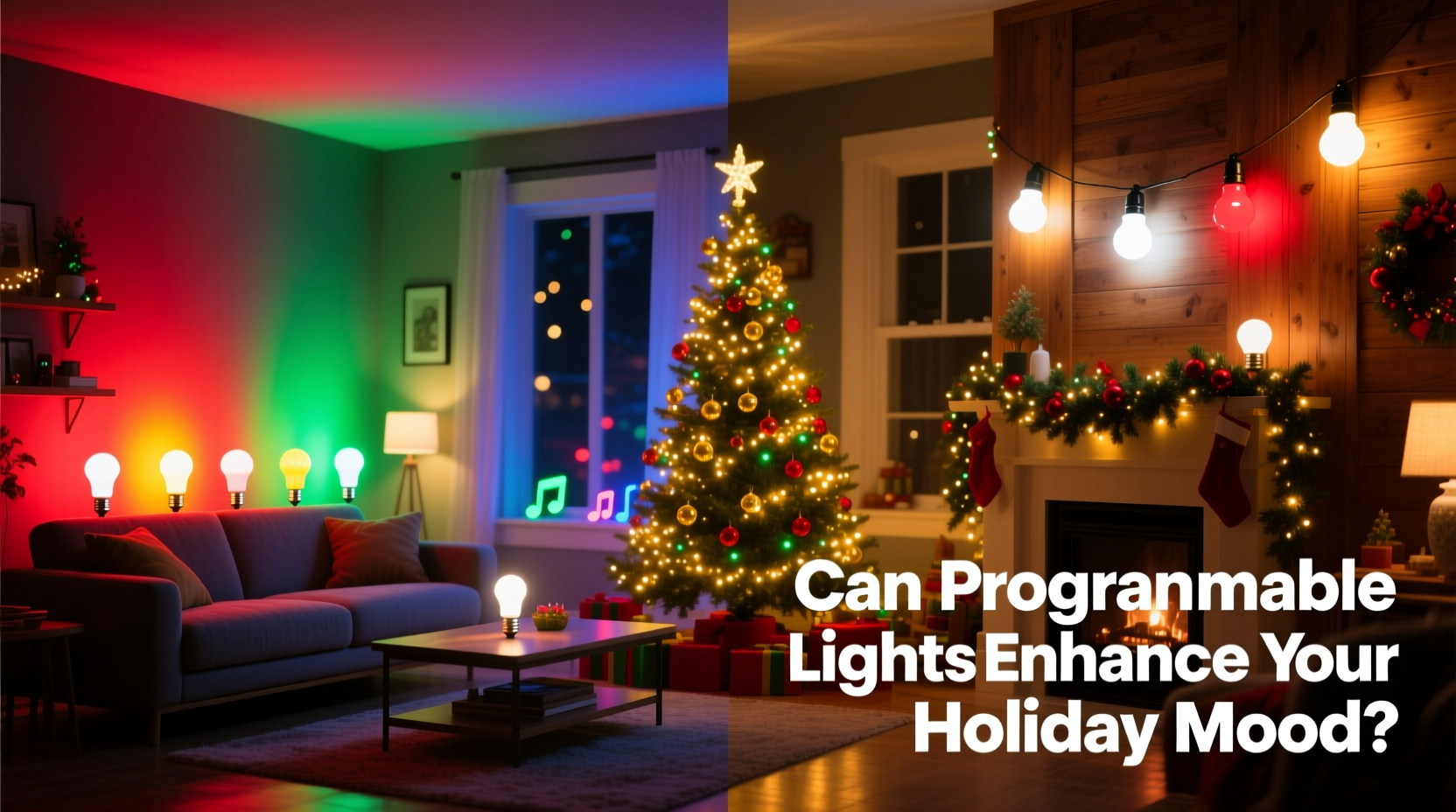
At first glance, both static color lights and RGB smart bulbs serve the same purpose: illumination with color. But their mechanisms, capabilities, and user experience diverge significantly.
Static color lights are typically single-color LED strings powered by low-voltage sources. Once installed, their output remains unchanged unless physically replaced. They’re inexpensive, widely available, and require no configuration. However, they lack flexibility. If you want red today and purple tomorrow, you need two separate sets.
In contrast, RGB smart bulbs contain red, green, and blue diodes within a single unit. By varying the intensity of each, millions of colors can be produced. Controlled via Wi-Fi, Bluetooth, or Zigbee protocols, these bulbs integrate with apps and voice assistants like Alexa, Google Assistant, or Siri. More advanced models support scheduling, music synchronization, motion triggers, and scene automation.
This fundamental difference—fixed output versus dynamic control—shapes everything from ambiance to energy efficiency.
Tip: Use warm white (2700K–3000K) settings on RGB bulbs during family dinners to mimic candlelight and promote relaxation.Emotional Impact: How Light Influences Holiday Mood
Light is not merely functional; it’s emotional. During winter months, reduced daylight contributes to seasonal affective disorder (SAD), affecting mood, energy, and sleep. Strategic lighting can counteract this. According to Dr. Laura Hartmann, a clinical psychologist specializing in environmental psychology:
“Lighting acts as a non-verbal communicator of safety, celebration, and intimacy. The right lighting doesn’t just decorate—it regulates circadian rhythms and reinforces emotional states.” — Dr. Laura Hartmann, Environmental Psychologist
Static lights provide visual continuity, reinforcing tradition. A steady string of green lights signals ‘Christmas’ without ambiguity. But they do so at a fixed emotional pitch. RGB smart bulbs, on the other hand, enable emotional modulation. Imagine dimming to deep indigo with snowfall effects during quiet nights, then shifting to pulsing gold and crimson when guests arrive. This ability to match light to activity enhances presence and engagement.
A 2022 study published in the Journal of Environmental Psychology found that participants exposed to dynamic lighting during social events reported 34% higher levels of enjoyment compared to those under static lighting. The variability kept attention engaged and created memorable sensory moments—key components of holiday joy.
Practical Comparison: Features That Matter
Beyond mood, practical considerations determine real-world usability. Below is a detailed comparison between static color lights and RGB smart bulbs across key dimensions.
| Feature | Static Color Lights | RGB Smart Bulbs |
|---|---|---|
| Color Options | One per set (e.g., red only) | 16 million+ colors via app |
| Installation Complexity | Plug-and-play; minimal setup | Requires app setup, network pairing |
| Energy Efficiency | High (LED-based) | Comparable, but features may increase usage |
| Lifespan | ~25,000 hours | ~20,000–25,000 hours |
| Cost (Initial) | $5–$15 per string | $15–$40 per bulb |
| Scheduling & Automation | Limited to timers (external) | Full integration with routines, geofencing |
| Motion/Scene Response | No | Yes (e.g., welcome home effect) |
| Music Sync | No | Available on most platforms |
| Durability (Outdoor Use) | Generally high (IP65 rated common) | Varies; check individual ratings |
The table reveals a trade-off: simplicity versus capability. Static lights win on cost and ease of deployment. But for users seeking personalization, automation, and emotional resonance, RGB smart bulbs offer unmatched depth.
Real-World Example: A Family’s Holiday Transformation
The Thompson family in Portland, Oregon, switched from traditional Christmas lights to a hybrid system featuring RGB smart bulbs in 2023. Their front porch used to display a standard red-and-green string setup. While festive, neighbors rarely paused, and the kids lost interest after a week.
That year, they installed addressable RGB strips along the roofline and smart bulbs in window displays. Using a free app, they programmed scenes: “Snowfall Mode” (slow white-blue pulses), “Gift Opening” (warm golden sparkle at 9 AM on Christmas), and “Evening Calm” (soft gradient from amber to deep red).
They also enabled a motion-triggered “Welcome Santa” sequence that activated only after midnight on December 24th, delighting their children. Neighbors began taking evening walks to view the synchronized light show, which played every hour after dusk.
“It felt alive,” said Sarah Thompson. “Before, it was just decoration. Now, it tells a story. My youngest asks every day what color the house will be tonight.”
Their electricity bill increased by $8 for the month—well within budget—and the system was reused for Valentine’s Day and Fourth of July with different themes. What started as a holiday upgrade became a year-round asset.
How to Maximize Your Programmable Lighting Experience
Adopting RGB smart bulbs requires more than installation—it demands intentionality. To truly enhance holiday mood, follow this step-by-step guide:
- Assess Your Space: Identify focal points—trees, mantles, porches, staircases—where dynamic lighting will have maximum impact.
- Choose Compatible Hardware: Pick bulbs that work with your existing ecosystem (e.g., Philips Hue, LIFX, or budget-friendly options like Govee).
- Map Out Scenes by Occasion: Create distinct lighting profiles:
- Cozy Night In: Warm white, dimmed to 30%
- Guest Arrival: Bright gold with gentle pulse
- Movie Time: Deep blue ambient edge lighting
- Midnight Reflection: Slow rainbow fade
- Set Schedules: Automate transitions. For example, shift from energetic colors during dinner to calming tones by 8 PM to support melatonin production.
- Add Triggers: Link lights to events—doorbell rings, calendar alerts, or weather changes (e.g., “snow mode” when forecast shows precipitation).
- Involve the Household: Let family members design their own scenes. This fosters ownership and emotional connection.
- Test and Refine: Observe reactions. If a flashing red feels jarring, adjust speed or hue. Mood is subjective—tune accordingly.
Checklist: Upgrading to Smart Holiday Lighting
- ☐ Audit current lighting setup and identify upgrade zones
- ☐ Research compatible smart bulb brands and ecosystems
- ☐ Confirm Wi-Fi strength in target areas (weak signal = lag)
- ☐ Purchase starter kit (e.g., 4 bulbs + hub if required)
- ☐ Install and pair bulbs using manufacturer app
- ☐ Design at least three holiday-specific scenes
- ☐ Schedule daily routines (on/off, transitions)
- ☐ Test music sync and voice commands
- ☐ Share control with family members via app invites
- ☐ Plan for off-season storage and reuse (label circuits)
Frequently Asked Questions
Can RGB smart bulbs really improve my holiday mood?
Yes, when used intentionally. Dynamic lighting stimulates dopamine through novelty and aesthetic pleasure. The ability to control environment increases perceived autonomy—a key factor in emotional well-being. Pairing color shifts with rituals (e.g., lighting up when carols play) strengthens positive associations.
Are smart bulbs safe for outdoor holiday use?
Only if rated for outdoor conditions. Look for IP65 or higher water resistance. Avoid exposing hubs or power adapters to moisture. Most reputable brands offer weatherproof models specifically designed for exterior installations.
Do I need a hub to use RGB smart bulbs?
Not always. Some bulbs (like LIFX or newer Govee models) connect directly via Wi-Fi. Others (e.g., Philips Hue) require a central bridge. Wi-Fi models are easier to start with; hub-based systems offer better stability with many devices.
Expert Insight: The Future of Emotional Lighting
Dr. Alan Zhou, a human-computer interaction researcher at MIT Media Lab, sees programmable lighting as part of a broader trend toward responsive environments.
“We’re moving beyond smart homes that react to commands, toward ones that anticipate needs. Imagine lights that detect stress through biometrics and automatically shift to soothing palettes. During holidays, this could mean adjusting brightness based on crowd size or time of day—subtle cues that reduce cognitive load and deepen emotional connection.” — Dr. Alan Zhou, MIT Media Lab
This vision is already emerging. High-end systems now integrate with wearables and room sensors to modulate light based on occupancy, noise levels, and even conversation tone. While not yet mainstream, the foundation exists in today’s RGB smart bulbs.
Conclusion: Lighting as an Emotional Tool
Holiday lighting has evolved from simple decoration to emotional architecture. Static color lights fulfill tradition and provide reliable cheer. But RGB smart bulbs elevate the experience—offering adaptability, interactivity, and psychological nuance. They transform passive viewing into active participation, allowing households to craft unique atmospheres that reflect changing moods and moments.
The initial investment is higher, and setup takes effort. Yet the return—in joy, engagement, and reusability—is substantial. These aren’t just bulbs; they’re tools for storytelling, memory-making, and emotional regulation during one of the most psychologically complex times of year.
Whether you’re creating a magical moment for children, setting the tone for a gathering, or simply brightening a dark winter night, programmable lights give you control over not just what you see, but how you feel.
🚀 Ready to transform your holiday lighting? Start with one smart bulb in your living room. Program a custom color for each day of advent. Share your creation online—inspire others to light up more than just their homes, but their emotions too.








