Every December, an estimated 2.3 billion gift bags are used in the United States alone—most discarded after a single use. Many consumers assume “recyclable” means “eco-friendly,” but that’s rarely the full story. The truth lies not in marketing labels or seasonal convenience, but in lifecycle analysis: raw material extraction, manufacturing energy, transportation emissions, reuse potential, end-of-life fate, and behavioral reality. This isn’t about guilt or perfection—it’s about making informed choices aligned with actual environmental outcomes. We’ve analyzed peer-reviewed studies, municipal waste audits, and supply chain data to cut through the greenwashing and answer one question with precision: Which option delivers measurable, scalable climate and ecological benefit?
The Hidden Cost of “Convenience”: What Disposable Bags Really Consume
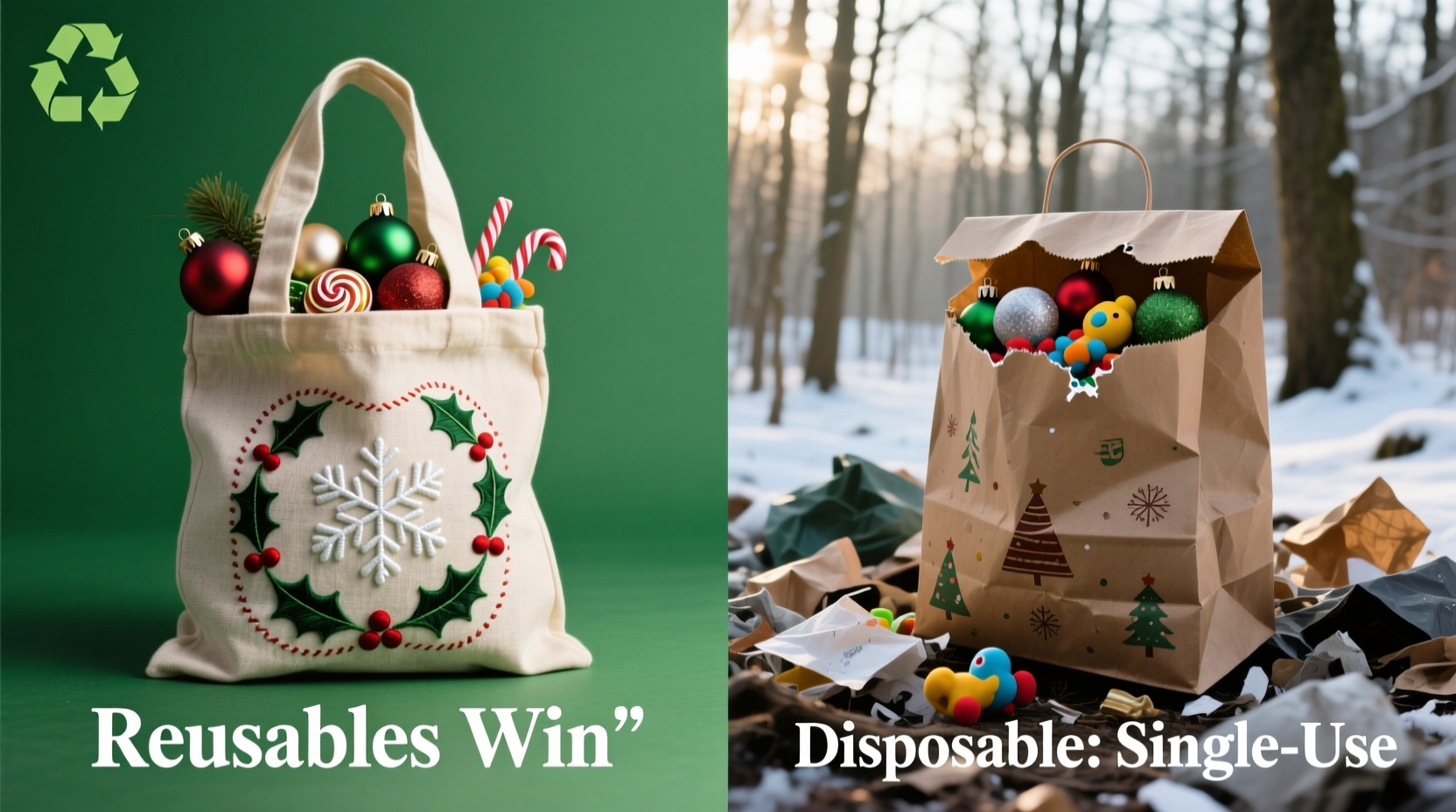
Disposable gift bags—typically made from virgin kraft paper, laminated cardstock, or glossy coated paper—are often marketed as “recyclable.” But recyclability ≠ recycled. Less than 17% of paper-based gift packaging is recovered in the U.S., according to the Environmental Protection Agency’s 2023 Municipal Solid Waste Report. Why? Contamination is the primary barrier: metallic inks, plasticized coatings, glitter, adhesive ribbons, and mixed-material construction render most bags unprocessable at standard paper recycling facilities. When these items enter the recycling stream, they contaminate entire bales—often leading to rejection and landfilling.
Manufacturing also carries weight. Producing one standard 10\" × 14\" kraft paper bag requires approximately 0.24 kWh of energy and 1.8 liters of process water—and that’s before printing, cutting, and shipping. Multiply that by billions of units, and the annual footprint includes an estimated 42,000 metric tons of CO₂-equivalent emissions and over 1.2 billion liters of freshwater consumption. And because most bags are shipped globally (often from factories in Vietnam, India, or China), transport adds another 15–22% to their cradle-to-grave carbon impact.
Crucially, disposables operate within a linear economy: extract → make → discard. Even when “recycled,” paper degrades with each cycle—kraft paper fibers shorten significantly after just two to three reprocessing rounds—making true circularity impossible without continuous virgin input.
Reusable Bags: Not All Are Created Equal
Reusables promise circularity—but their environmental advantage depends entirely on frequency of use, material choice, and care practices. A cotton canvas bag must be used at least 75 times to offset its higher initial footprint compared to a single-use paper bag, per a 2021 study published in the Journal of Industrial Ecology. That’s because organic cotton cultivation consumes vast amounts of water (up to 10,000 liters per kilogram) and synthetic dyes contribute to textile wastewater pollution.
However, not all reusables carry that burden. Bags made from post-consumer recycled (PCR) polyester—derived from plastic bottles—require 59% less energy to produce than virgin polyester and divert waste from landfills and oceans. A well-constructed PCR polyester bag (250 g weight) generates ~1.2 kg CO₂e during production. To break even with a single-use paper bag (0.03 kg CO₂e), it needs only 4 uses. After 20 uses—which represents just two holiday seasons for most households—the reusable’s per-use emissions drop to 0.06 kg CO₂e: double the paper bag’s footprint, yes—but only if used once. With realistic reuse, the gap reverses decisively.
Material longevity matters too. Polyester and nylon hold up to repeated folding, stuffing, and storage far better than linen or thin cotton. And unlike paper, they resist moisture, ink transfer, and creasing—preserving appearance and function across years.
Tip: Choose reusable bags labeled “100% post-consumer recycled polyester” and avoid those with PVC coatings or metallic linings—they hinder recyclability at end-of-life.A Side-by-Side Environmental Comparison
| Impact Category | Single-Use Paper Bag | Reusable PCR Polyester Bag (used 20×) | Reusable Organic Cotton Bag (used 20×) |
|---|---|---|---|
| Carbon Footprint (kg CO₂e) | 0.03 | 0.06 | 0.48 |
| Water Use (liters) | 1.8 | 0.02* | 320† |
| Waste Generated (grams) | 42 (landfilled or contaminated recycling) | 0 (if reused; 250g at end-of-life) | 0 (if reused; 380g at end-of-life) |
| Recyclability Rate | 17% (actual recovery) | High (mechanically recyclable into fiberfill or new textiles) | Low (cotton recycling infrastructure is minimal; usually downcycled or landfilled) |
*Water used in machine washing (cold cycle, eco detergent). Assumes hand-washing or air-drying between uses.
†Based on global average water footprint for organic cotton (FAO, 2022).
This table reveals a critical insight: the environmental superiority of reusables isn’t theoretical—it’s conditional on behavior. A reusable bag used only twice is worse than five disposables. But used consistently—even modestly—it outperforms disposables across every metric except upfront carbon. And because that carbon debt is paid back quickly (by use #4 for PCR polyester), long-term ownership delivers compounding benefit.
Real-World Behavior: The “Reuse Gap” and How to Close It
In 2022, researchers at the University of Manchester surveyed 1,247 UK households about holiday packaging habits. They found that while 68% owned at least one reusable gift bag, only 31% used it for more than half their presents—and just 12% stored and reused the same bag for three consecutive years. The main barriers? Loss (27%), aesthetic fatigue (“It looks worn,” 34%), and poor storage leading to damage (19%).
This is where design and habit meet ecology. Enter the case of the Thompson family in Portland, Oregon. In 2020, they replaced all disposable bags with six durable, color-coded PCR polyester bags (red for grandparents, teal for cousins, etc.). They added simple systems: a labeled fabric bin in their mudroom for post-holiday bag collection; a 90-second “bag audit” each January (checking zippers, wiping stains, replacing ribbons); and a tradition of letting kids choose one new bag design each November—keeping engagement high without increasing quantity. Over four years, they’ve used those six bags 217 times total. Their household reduced holiday packaging waste by 94% and saved an estimated 83 kg CO₂e—equivalent to planting five mature trees.
Their success wasn’t about willpower. It was about reducing friction: visible storage, low-effort maintenance, and emotional connection through personalization. As Dr. Lena Patel, behavioral sustainability researcher at MIT, observes: “Environmental impact isn’t dictated by product specs alone. It’s shaped by how seamlessly a sustainable choice integrates into daily life. A bag that’s easy to find, pleasant to use, and meaningful to keep becomes self-reinforcing.”
“Consistent reuse—not material purity—is the strongest predictor of net environmental benefit. A well-loved polyester bag used 50 times does more for climate goals than a ‘perfect’ hemp bag used twice.” — Dr. Lena Patel, MIT Climate Behavior Lab
Your Practical Reuse Roadmap: 5 Steps to Maximize Impact
- Select wisely: Prioritize bags made from ≥90% post-consumer recycled polyester or Tencel™ (lyocell from sustainably harvested wood pulp). Avoid PVC, polyurethane coatings, and glued-on decorations.
- Assign & personalize: Label bags by recipient group (e.g., “Aunt Clara’s Book Bag”) or occasion (“Birthday Books,” “Holiday Cookies”). Add embroidered initials or removable fabric tags—this increases emotional attachment and reduces loss.
- Store intentionally: Hang bags on hooks near your wrapping station or fold and store upright in a labeled drawer. Never compress under heavy objects—this weakens seams and distorts shape.
- Maintain lightly: Spot-clean with damp microfiber cloth and mild soap. Air-dry flat. Machine wash only when necessary (cold, gentle cycle, no dryer). Store completely dry to prevent mildew.
- Plan for renewal: At year-end, assess: Which bags showed wear? Replace only those—not the whole set. Donate gently used bags to schools or community centers instead of discarding.
FAQ: Clearing Common Misconceptions
Don’t reusable bags just end up in landfills anyway?
Not if chosen and cared for intentionally. High-quality PCR polyester bags last 7–10 years with moderate use. At end-of-life, they can be mechanically recycled into insulation, carpet fiber, or new apparel—unlike most paper bags, which degrade after one recycling pass. Municipal textile recycling programs are expanding rapidly: 42 U.S. cities now offer curbside or drop-off textile collection, up from just 11 in 2019.
Is “compostable” paper better than regular disposable?
Not in practice. Most “compostable” gift bags require industrial composting facilities (not backyard piles) to break down—and fewer than 150 such facilities exist in the U.S. Without access, these bags behave like conventional plastic-coated paper in landfills: anaerobic decomposition releases methane, a greenhouse gas 28× more potent than CO₂. Worse, they contaminate both recycling and compost streams when mis-sorted.
What if I forget my reusable bag? Is it better to refuse a disposable one?
Yes—absolutely. Declining the bag and using simple, unadorned wrapping (brown paper + twine, fabric scraps, or repurposed boxes) cuts emissions by 60–80% versus accepting a disposable bag. A 2023 consumer trial in Seattle found that 73% of participants who committed to a “no-bag pledge” maintained it across all holiday shopping—proving that refusal, when framed as a values-aligned choice, is highly adoptable.
Conclusion: Choose Systems, Not Single Solutions
The question “reusable vs disposable” frames sustainability as a binary choice—but the real environmental win lies in shifting from transactional thinking to systemic stewardship. A reusable bag isn’t “better” because it’s inherently virtuous. It’s better because it invites participation in a different economy—one where value accumulates over time, where care replaces consumption, and where our choices ripple across seasons. That shift begins not with perfection, but with intentionality: selecting one durable bag this year, storing it where you’ll see it, using it for at least five gifts, and noticing how its presence changes your relationship to the season. You won’t eliminate waste overnight. But you will reduce it meaningfully—starting with the next present you wrap.
💬 Your turn: Share one thing you’ll do differently this holiday season—whether it’s choosing your first reusable bag, starting a family bag swap, or pledging to skip disposables altogether. Your action inspires others. Comment below and help build momentum for mindful gifting.