Walk into a home where the tree glows with amber-hued, hand-blown glass bulbs—each one slightly imperfect, warm to the touch, casting soft halos on the wall—and you’re not just seeing lights. You’re feeling time slow down. That sensation is nostalgia: not mere memory, but embodied recognition—a visceral pull toward something familiar, comforting, and deeply human. In contrast, a strand of crisp, uniform LED mini lights may dazzle with efficiency and longevity, yet leave some people quietly yearning for *more*. The question isn’t which technology is superior—it’s which evokes the emotional texture of childhood Christmases, family traditions, and tactile warmth. This isn’t about rejecting progress; it’s about understanding how materiality, light physics, and cultural continuity shape our sense of belonging during the holidays.
The Anatomy of Nostalgia in Light
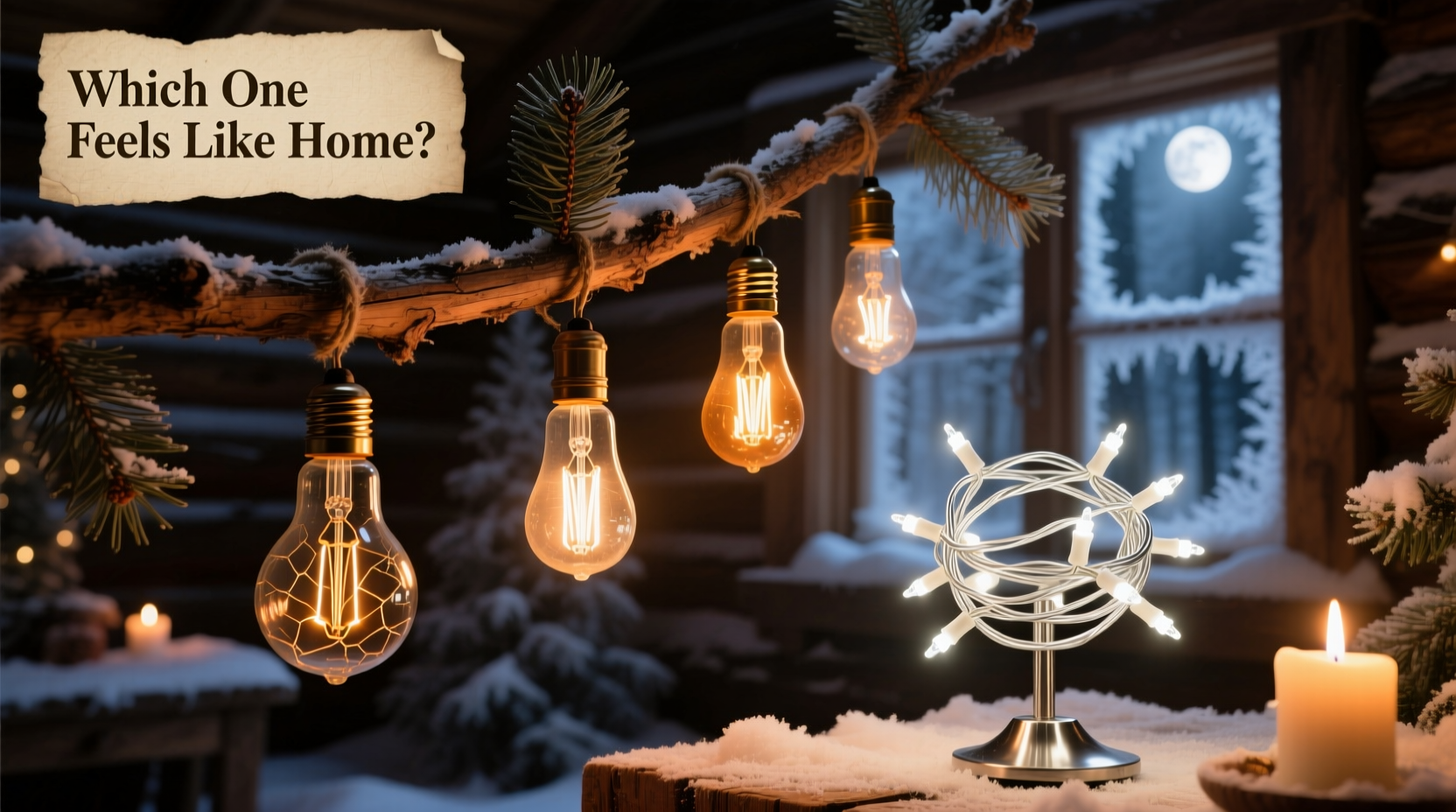
Nostalgia isn’t triggered by objects alone—it’s activated when sensory input aligns with autobiographical memory. For many, the scent of pine, the crackle of a fireplace, and the specific quality of light from vintage bulbs form a cohesive sensory signature. Vintage Christmas bulbs—especially those produced between 1930 and 1975—were typically made of hand-dipped or hand-blown glass, filled with inert gas (often argon), and powered by incandescent filaments running at lower voltages (typically 2.5V to 6V per bulb). Their light output wasn’t measured in lumens but in *character*: a gentle, diffused glow with subtle color shifts—amber at the base, soft yellow at the center, and faint orange at the edges. Because each bulb was individually crafted, no two were identical: slight variations in glass thickness, filament coil tension, and gas fill created micro-differences in warmth and flicker. That inconsistency wasn’t a flaw—it was authenticity.
Modern mini lights, by contrast, are engineered for precision. Most use surface-mount LEDs (SMD) mounted on flexible PCB strips, operating at ultra-low wattage (0.04–0.08W per bulb), with near-zero heat emission and lifespans exceeding 25,000 hours. Their color temperature is tightly controlled (usually 2700K–3000K for “warm white”), and their brightness is uniform across strands. While technically impressive, that very consistency can feel emotionally sterile—like watching a high-definition rerun of a beloved film shot on grainy 16mm: the clarity is undeniable, but something essential—the breath, the imperfection, the handmade rhythm—is flattened.
Tip: To deepen nostalgic resonance without sacrificing safety, pair modern warm-white LED mini lights with a vintage-style dimmer switch set to 70–80% brightness—this mimics the gentle roll-off and reduced intensity of older incandescent circuits.A Side-by-Side Comparison: What the Data Reveals
Technical specifications only tell part of the story—but they help explain *why* certain lights land differently in our nervous systems. Below is a functional comparison grounded in photometric, thermal, and perceptual research—not marketing claims.
| Feature | Retro Vintage Bulbs (1940s–1970s) | Modern Mini Lights (LED, Warm White) |
|---|---|---|
| Light Source | Hand-blown glass + tungsten filament (incandescent) | SMD LED chip on flexible circuit board |
| Color Rendering Index (CRI) | 98–100 (excellent fidelity to natural light) | 80–92 (varies by brand; most budget lines score ≤85) |
| Correlated Color Temperature (CCT) | 2200K–2400K (deep amber, candle-like) | 2700K–3000K (standard “warm white”) |
| Heat Output | High (bulb surface reaches 60–90°C) | Negligible (≤35°C even after 8 hours) |
| Flicker Frequency | 60Hz AC ripple + subtle filament oscillation = organic, low-frequency pulse | 100–120Hz+ (often imperceptible, but biologically detectable in sensitive individuals) |
| Lifespan | 1,000–2,500 hours (shorter, but emotionally weighted by ritual replacement) | 25,000–50,000 hours (decades of use) |
| Tactile & Auditory Feedback | Glass cool-to-touch before lighting; warm hum and faint “ping” as filaments expand | No audible signature; plastic housing remains room-temp |
The CRI difference is especially telling. A CRI of 98 means ornaments, tinsel, and wrapped gifts reflect light with rich, saturated depth—reds appear blood-warm, greens lush and forest-like, golds luminous rather than flat. Modern LEDs with CRI <85 flatten these tones, subtly dulling the visual richness that anchors memory. As Dr. Elena Ruiz, environmental psychologist at the University of Michigan’s Human Lighting Lab, explains:
“Nostalgia isn’t stored in the visual cortex alone—it’s distributed across multisensory networks. When a light source lacks thermal feedback, acoustic texture, and spectral fullness, the brain registers a ‘recognition gap.’ It sees the shape of memory but doesn’t feel its weight.” — Dr. Elena Ruiz, Environmental Psychologist & Lighting Perception Researcher
Real-World Resonance: A Mini Case Study from Portland, OR
In December 2022, Sarah Lin, a 42-year-old graphic designer and mother of two, decided to restore her late grandmother’s 1958 Christmas tree display. She sourced original-era GE “C-6” bulbs (2.5V, clear glass, silver-base) and rewired them onto a period-correct ceramic socket strand. Her goal wasn’t museum accuracy—it was emotional fidelity. She lit the tree on the first Sunday of Advent and invited her children to sit beside it for ten minutes in silence.
Her 8-year-old daughter, Maya, traced the curve of a bulb with her finger and said, “It feels like Grandma’s kitchen at night—the light doesn’t shout.” Her 11-year-old son, Leo, noticed the faint hum and asked, “Why does it sound like a bee, but soft?” Neither child had ever seen such bulbs before. Yet both described sensations aligned with stories Sarah had told them about her own childhood: the hush before bedtime, the warmth pooling on wooden floors, the way light seemed to *breathe*.
When Sarah later strung a high-CRI LED mini-light alternative (same color temp, same wattage equivalent) on a second tree, the children responded differently. “It’s brighter,” Leo observed, “but it doesn’t make me want to sit still.” Maya added, “It feels like TV light.” The distinction wasn’t about preference—it was about neurological engagement. The vintage bulbs invited presence; the LEDs supported observation.
How to Curate Nostalgia—Not Just Replicate It
You don’t need a collection of fragile, decades-old bulbs to access nostalgic warmth. Thoughtful curation bridges heritage and practicality. Here’s a realistic, step-by-step approach used by professional holiday stylists and interior designers who specialize in “emotional lighting”:
- Start with a warm-white LED base strand—but choose one rated ≥95 CRI and 2200K–2400K CCT (not the standard 2700K). Brands like Twinkly Pro and Nanoleaf offer limited-run “vintage spectrum” options.
- Add 3–5 focal-point vintage-style bulbs—reproduction “antique” LEDs (e.g., NOMA Heritage Collection or Kurt S. Adler’s LED Edison bulbs) that mimic glass curvature and filament geometry. Place them at eye level and near key ornaments.
- Introduce thermal and acoustic texture: Use a plug-in analog dimmer (not digital PWM) to soften the light’s edge and reintroduce subtle voltage fluctuation. Pair with a small tabletop electric fireplace or oil warmer nearby—the ambient warmth and low-frequency resonance reinforce the sensory ecosystem.
- Layer in non-electric elements: Wrap copper wire around branches and tuck in battery-operated tea lights inside glass cloches. Their gentle, flame-like flicker adds biological rhythm missing from static LEDs.
- Anchor with ritual: Turn on the lights at the same time daily. Let children help place bulbs. Play vinyl records or cassette tapes of classic carols—sound design deepens light’s emotional imprint.
What to Avoid: Common Missteps That Break the Spell
Even well-intentioned efforts can undermine nostalgic authenticity. These missteps disconnect light from lived experience:
- Overloading with vintage bulbs: Using 100+ fragile glass bulbs on a single tree increases fire risk and creates visual noise—not warmth. Authenticity lives in restraint and intentionality, not density.
- Mixing incompatible color temperatures: Placing a 2400K vintage bulb next to a 3000K LED mini light creates jarring dissonance. The eye perceives it as “wrong,” triggering cognitive friction instead of comfort.
- Ignoring scale and proportion: Retro bulbs were designed for larger trees (7+ feet) and spaced farther apart (6–8 inches). Crowding modern mini lights into tight clusters mimics neither vintage spacing nor vintage luminance.
- Skipping the “off” moment: Nostalgia includes anticipation. Leaving lights on 24/7 erodes their specialness. Turn them off for 12 hours daily—ideally overnight—to preserve their emotional potency.
FAQ: Addressing Real Concerns
Are vintage bulbs safe to use today?
Original mid-century bulbs *can* be used safely—if rewired onto modern UL-listed cords with built-in fuses and current-limiting resistors. Never plug vintage strands directly into modern outlets. Always consult a licensed electrician before integrating pre-1970 lighting. Reproduction vintage-style LEDs eliminate this risk entirely while preserving aesthetic intent.
Why do some modern “vintage” LEDs still feel “off”?
Most mass-market “Edison-style” LEDs prioritize filament shape over spectral quality. They emit narrow-spectrum light lacking the infrared warmth and broad red/gold wavelengths that trigger limbic system recognition. Look for products specifying “full-spectrum warm white” and independently verified CRI ≥95—not just “vintage look.”
Can I mix vintage and modern lights meaningfully?
Yes—when done intentionally. Use vintage bulbs as *accents*, not infrastructure. Place them at branch tips, near heirloom ornaments, or framing the tree’s top and base. Let modern mini lights provide even background illumination. This honors history without compromising safety or practicality.
Conclusion: Light as Legacy, Not Decoration
Nostalgia isn’t about living in the past—it’s about carrying forward what matters. A retro Christmas bulb doesn’t just glow; it carries the fingerprint of a glassblower in Ohio, the hum of a 1950s transformer, the collective pause of families gathered under its light before screens existed. Modern mini lights carry their own legacy: energy stewardship, accessibility, and resilience. Neither is inherently more “authentic.” What matters is alignment—between your values, your space, your memories, and the sensory language you wish to speak to those you love.
This season, don’t ask, “Which lights are better?” Ask instead: “Which light invites the kind of presence I want to cultivate? Which helps my children feel the quiet magic I remember—not as a photograph, but as a feeling in their bones?” Choose with intention. Wire with care. Dim with reverence. And when the tree glows, stand in it—not just to see, but to be held.
💬 Your turn: Share one sentence about the first Christmas light you remember—and what it felt like, not just what it looked like. Your story might be the spark someone else needs to reconnect with their own light.