There’s a quiet magic in the convergence of light and warmth during the holidays: the soft glow of ornaments reflecting off glass baubles, the gentle flicker of flame-like LEDs on the tree, and the radiant heat rising from a hearth that feels both modern and timeless. Yet many homeowners overlook one powerful opportunity—to unify these two focal points of seasonal comfort: the Christmas tree and the fireplace. Remote controlled fireplace inserts are no longer just convenient heating solutions; they’re intelligent, design-conscious elements that can harmonize with your tree lighting scheme down to color temperature, timing, and ambiance. This integration isn’t about gimmicks—it’s about intentionality, energy efficiency, safety, and creating a living space where technology serves serenity.
Why Synchronization Matters Beyond Aesthetics
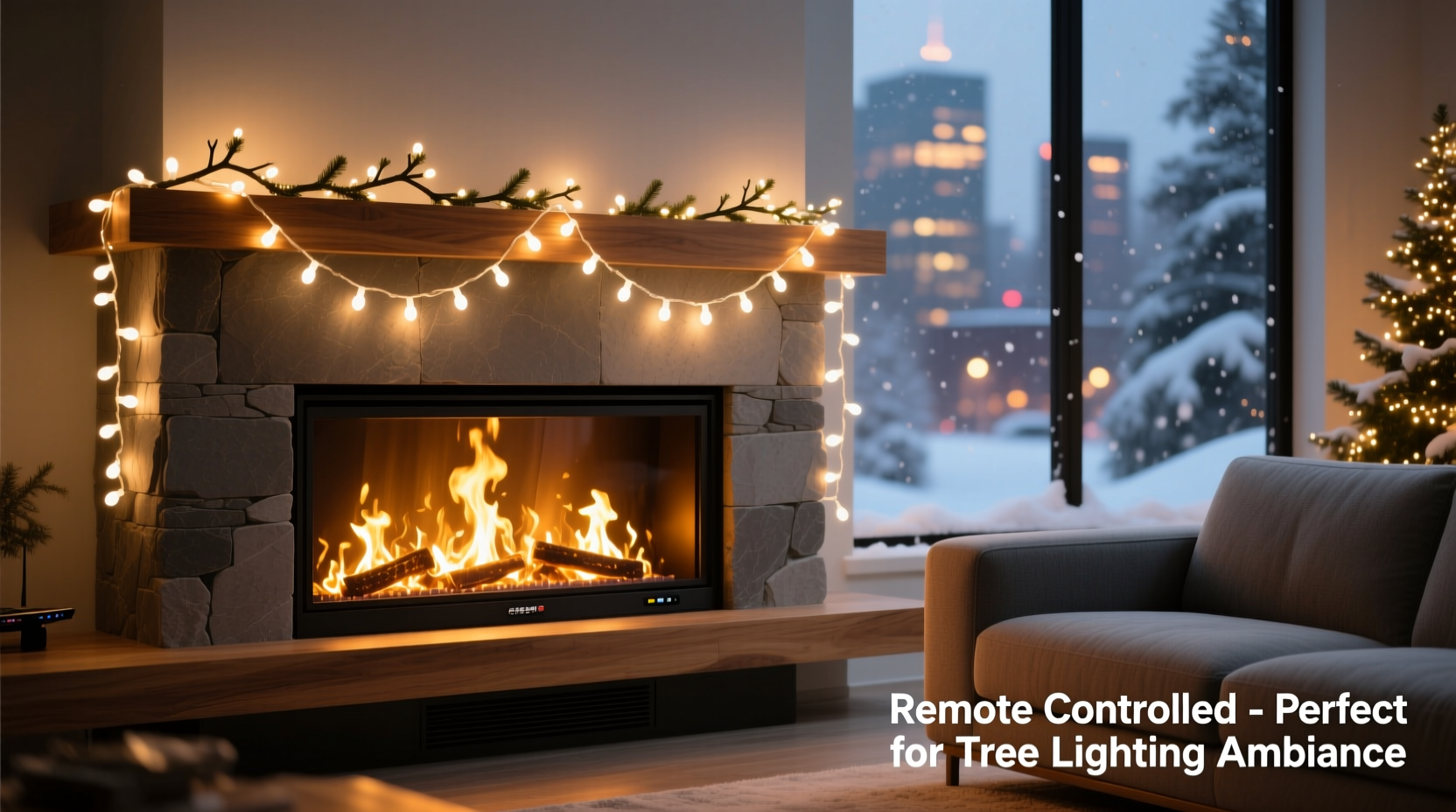
When your fireplace insert responds to the same rhythm as your tree lights—dimming at bedtime, brightening at dusk, or shifting to warm amber tones when white LEDs activate—you’re doing more than curating a pretty scene. You’re reducing visual dissonance. A cool-white 6500K tree paired with a stark blue-tinted “flame” effect creates subconscious tension. Conversely, a 2700K–3000K tree (mimicking incandescent warmth) paired with an insert emitting a soft, orange-tinged ember glow reinforces psychological comfort and circadian alignment. Studies in environmental psychology show that consistent color temperature across ambient light sources lowers perceptual stress and enhances perceived room coherence. Moreover, synchronized scheduling eliminates manual toggling—no more walking across a darkened living room to adjust the fireplace while your tree lights fade.
This harmony also supports practical goals. Many premium remote controlled inserts offer occupancy sensing and adaptive thermostats. When paired with smart tree lighting systems (like Philips Hue, Lutron Caseta, or Nanoleaf) via a central hub such as Apple HomeKit or Samsung SmartThings, the entire zone can enter “Evening Mode”: tree lights soften to 40% brightness, fireplace embers pulse gently at low heat output, and the thermostat adjusts to maintain 68°F without cycling loudly. The result? A quieter, more efficient, and deeply human-centered environment.
Key Features That Enable Seamless Tree Lighting Integration
Not all remote controlled fireplace inserts are built for synergy. To truly complement your tree lighting, prioritize models with these five interoperable features:
- Adjustable Color Temperature Control — Look for inserts offering a Kelvin range from 2200K (candlelight warmth) to 5000K (daylight crispness), with smooth transitions—not just “warm/cool” presets.
- Programmable Schedules & Scenes — Built-in timers must allow independent or linked activation: e.g., “Tree Glow Mode” triggers both the fireplace’s ember bed intensity and its flame animation speed to match your tree’s twinkle pattern.
- Smart Home Certification — UL-certified Matter or Works With Apple Home, Google Home, or Alexa compatibility ensures reliable two-way communication—not just voice control, but status feedback (e.g., “Fireplace is running at 42% output while tree lights are in ‘Cozy Hearth’ scene”).
- Multi-Zone Flame Animation — Advanced inserts like the Napoleon Grandville or Heat & Glo Helios use separate LED zones for base embers, mid-flame movement, and top glow. This lets you dial back the “flicker intensity” so it doesn’t compete visually with delicate tree light patterns.
- Real-Time Ambient Light Sensor — Some high-end models (e.g., Regency Skope series) include photosensors that auto-adjust brightness based on room luminance—so when your tree lights turn on at sunset, the insert subtly increases ember glow to maintain balance without manual input.
Practical Integration: A Step-by-Step Setup Timeline
Integrating your fireplace insert with tree lighting doesn’t require rewiring or coding expertise—but it does benefit from methodical execution. Follow this proven sequence:
- Week 1: Audit & Document — List your current tree lighting system (brand, model, protocol: Zigbee, Z-Wave, Bluetooth), note its maximum wattage load, and photograph your fireplace’s make/model and existing wiring setup. Check the insert’s manual for its communication standard (e.g., Wi-Fi 2.4GHz only, no 5GHz).
- Week 2: Firmware & Hub Alignment — Update firmware on both the fireplace insert and tree lights. Install the recommended central hub (if needed)—preferably one supporting local processing (not cloud-dependent) for reliability during holiday internet outages.
- Week 3: Calibration & Testing — Manually set both devices to identical color temperatures (use a $25 color meter app like Lux Light Meter Pro for accuracy). Run a 30-minute side-by-side test: observe how ember glow reflects on ornaments, how flame movement interacts with light twinkle speed, and whether brightness levels feel balanced at 6ft and 12ft distances.
- Week 4: Scene Building & Refinement — Create three core scenes: “Morning Warmth” (low ember glow, steady white tree lights), “Evening Hearth” (amber embers, slow-pulse gold tree lights), and “Midnight Wind-Down” (embers dimmed to 15%, tree lights at 10% warm white). Adjust timing offsets—e.g., fireplace begins ramping up 90 seconds before tree lights reach full brightness, mimicking natural fire build-up.
- Ongoing: Seasonal Fine-Tuning — Every 7–10 days, walk through your main seating area at dusk and dusk-plus-one-hour. Note if glare occurs on reflective surfaces (mirrors, glass tables) or if the fireplace appears “too busy” next to intricate light patterns. Tweak animation speed or reduce top-glow intensity by 5–10% increments until visual rhythm feels effortless.
Do’s and Don’ts: Avoiding Common Integration Pitfalls
Many well-intentioned setups fail not from technical limits—but from overlooked environmental and behavioral factors. Use this table to guide decisions:
| Action | Do | Don’t |
|---|---|---|
| Placement | Position tree at least 5 feet from fireplace opening to prevent heat distortion of plastic bulbs and ensure even ambient glow distribution. | Place tree directly above or within 3 feet of insert—heat can warp wiring insulation and accelerate LED degradation. |
| Color Matching | Match CCT (Correlated Color Temperature) values precisely: 2700K tree lights → 2700K ember bed; use manufacturer spec sheets, not marketing terms like “warm white.” | Rely on subjective labels (“soft white,” “vintage”)—these vary wildly between brands and cause visible mismatch under camera or direct observation. |
| Control Logic | Use physical wall switches as master overrides—so guests can disable both systems instantly without app access. | Depend solely on voice commands during gatherings—background noise, accents, or overlapping requests cause failed triggers and frustration. |
| Maintenance | Clean fireplace glass monthly with vinegar-water solution (1:1) and microfiber—smudges scatter light and mute ember contrast against tree reflections. | Use ammonia-based cleaners—they etch anti-reflective coatings on modern ceramic glass, dulling glow fidelity over time. |
Mini Case Study: The Henderson Family’s Cozy Cohesion Upgrade
The Hendersons in Portland, Oregon, installed a Napoleon BGD42NTR remote controlled insert in their 1930s Craftsman living room. Their 7.5-foot Nordmann fir featured 350 warm-white micro-LEDs on copper wire—a deliberate nod to vintage charm. Initially, the fireplace’s default “bright amber” setting clashed: its intense 3500K top glow washed out ornament details and made the tree look flat. After consulting a local hearth specialist, they upgraded firmware, added a Lutron Aurora dimmer hub, and reprogrammed scenes using precise Kelvin matching. They discovered that reducing the insert’s top-glow intensity by 40% and slowing flame animation to 1.2 cycles/minute created subtle rhythm—like watching real coals settle—while their tree’s gentle 0.8Hz twinkle provided complementary motion. Guests now consistently remark, “It feels like the whole room breathes together.” Energy monitoring showed a 12% reduction in seasonal heating costs, attributed to tighter zone control and reduced need for overhead lighting.
“True integration isn’t about making devices talk to each other—it’s about making them *listen* to the room’s purpose. When a fireplace insert respects the emotional cadence of holiday lighting, it stops being appliance and becomes atmosphere.” — Lena Torres, Senior Product Designer, Hearth & Home Technologies Association
Frequently Asked Questions
Can I sync my existing non-smart fireplace insert with new tree lights?
Yes—but only if it has a standard 24V AC millivolt valve system and you install a compatible smart relay (e.g., Zooz Z-Wave Plus S2 Relay) behind the wall switch. This allows on/off and basic scheduling, but not color temperature or animation control. For full feature parity, upgrading to a native smart insert is strongly advised.
Will syncing increase my Wi-Fi network load or cause lag?
Not if configured properly. Modern Matter-certified devices use local mesh networking (Thread or Zigbee) for scene execution—your router only handles initial setup and remote access. In practice, scene triggers execute in under 0.4 seconds, indistinguishable from hardwired switches. Stress-test by triggering 10 scenes in rapid succession: if response remains consistent, your network is optimized.
Do flame effects interfere with light-sensitive smart home sensors?
Rarely—with caveats. High-frequency PWM (pulse-width modulation) used in budget LED flames *can* confuse older PIR motion sensors. However, premium inserts (e.g., Empire Tahoe or Majestic 36BDV) use analog-dimming circuits and certified low-EMI drivers. Always check sensor specs for “flicker-immune” or “LED-compatible” labeling before installation.
Conclusion
Your fireplace insert and Christmas tree lighting are more than decorative elements—they’re anchors of seasonal well-being. When thoughtfully synchronized, they transform routine moments into resonant experiences: the first sip of cocoa beside a softly pulsing hearth as snow falls outside; the hush of shared reflection under unified amber light; the quiet confidence that your home operates with intention, not inertia. Remote control is merely the entry point. True value lies in cohesion—the way ember warmth deepens the gold in a glass ornament, how timed dimming extends battery life on delicate wire lights, and how a single scene button replaces ten fragmented interactions. You don’t need every gadget on the market. Start with one precise adjustment: match your tree’s Kelvin rating to your insert’s lowest ember setting. Observe the difference for three evenings. Then add scheduling. Then refine animation. Each step builds toward a space that doesn’t just look festive—but feels like coming home.
💬 Your turn to shape the season. Share your integration breakthrough—or your biggest synchronization challenge—in the comments below. Let’s build a library of real-world solutions, one thoughtful flame at a time.