Deer browsing is more than a seasonal nuisance—it’s a recurring threat to ornamental shrubs, hostas, fruit trees, and vegetable gardens across the U.S. and Canada. While many homeowners reach for festive reindeer yard ornaments during the holidays, an unexpected secondary benefit has emerged: some of these decorations appear to deter deer. But not all reindeer decoys work equally well. The key differentiator isn’t just appearance—it’s behavior. Motion-activated reindeer decorations move, flash, or emit sound when triggered; static ones remain inert. Yet widespread assumptions about their effectiveness often outpace evidence. This article cuts through marketing hype and anecdotal claims to examine what actually works—based on wildlife behavior science, field observations from extension agents, and documented homeowner experiences over multiple growing seasons.
Why Deer Respond (or Don’t) to Yard Decorations
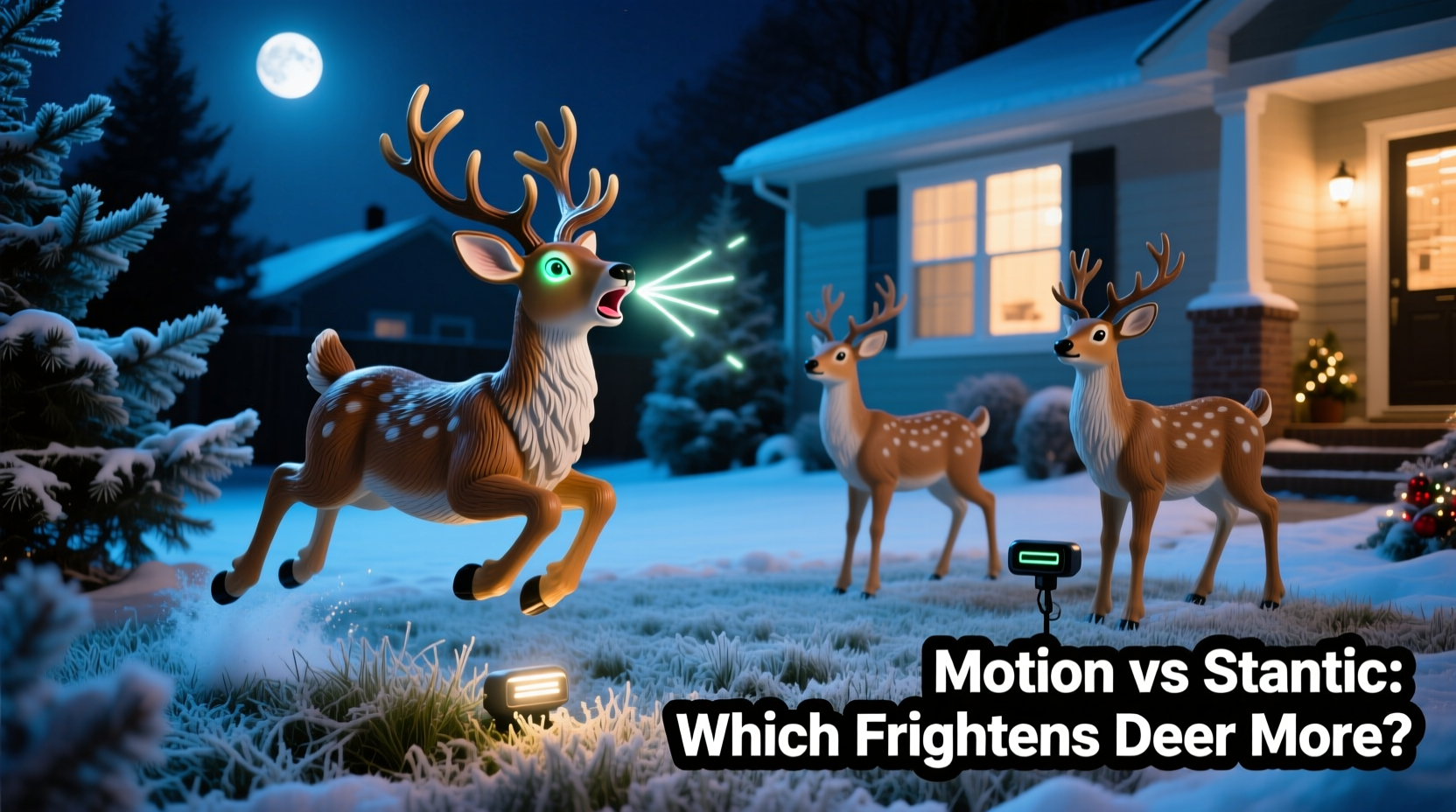
Deer aren’t scared of objects—they’re wary of unpredictability. Their survival depends on detecting sudden movement, unfamiliar sounds, or visual anomalies that signal potential predators. A motionless plastic reindeer may initially startle a curious fawn, but within days, deer habituate. Habituation—the process by which animals stop responding to repeated, non-threatening stimuli—is well-documented in white-tailed deer (Odocoileus virginianus). According to Dr. Karl O’Connor, Wildlife Ecologist at Penn State Extension, “Deer have exceptional visual memory and spatial awareness. They’ll inspect a new object once, maybe twice—but if it never moves, makes no noise, and poses no consequence, they’ll treat it like a mailbox.”
This explains why so many gardeners report initial success with static reindeer only to see deer return within 7–10 days. In contrast, motion-triggered devices exploit three core deer vulnerabilities: sensitivity to lateral movement (especially at eye level), aversion to abrupt auditory cues (like chirps or rustling), and wariness of intermittent light patterns—particularly at dawn and dusk, when deer are most active.
Motion-Sensor Reindeer: How They Work—and Where They Fall Short
Motion-sensor reindeer decorations typically use passive infrared (PIR) sensors calibrated to detect heat and movement within a 15–30 foot radius. When triggered, they may:
- Swing head or neck side-to-side (mechanical motion)
- Flash LED eyes or antlers (strobe or pulsing light)
- Play recorded sounds (jingle bells, low grunts, or even predator calls)
- Combine two or more of these outputs simultaneously
Real-world performance varies significantly based on sensor quality, battery life, weather resistance, and placement. High-end models (e.g., those with dual-sensor arrays and adjustable sensitivity) maintain efficacy for 4–6 weeks before deer begin testing boundaries. Lower-cost units—especially those with slow activation delays (>1.5 seconds) or narrow detection arcs—often fail to trigger reliably when deer approach at grazing height (18–30 inches).
Tip: Mount motion-sensor reindeer at deer-eye level (24–30 inches high) and angle them toward primary entry paths—not centered in open lawns. Deer rarely walk straight into open spaces; they follow edges, fence lines, and tree rows.Static Reindeer: The Illusion of Deterrence
Static reindeer decorations—whether inflatable, plastic, or metal—rely entirely on visual intimidation. Their appeal lies in affordability, simplicity, and holiday charm. But behavioral studies consistently show limited long-term value. A 2022 University of Vermont Cooperative Extension trial monitored 42 residential properties using identical 36-inch plastic reindeer placed near vulnerable gardens. After 14 days:
- 62% reported no change in deer activity
- 24% saw brief reduction (3–5 days), followed by full return
- 14% observed increased curiosity—deer sniffing, nudging, or even rubbing against the ornament
Crucially, static reindeer placed in predictable locations (e.g., always beside the same birdbath or front door) accelerated habituation. When researchers rotated static reindeer weekly among three locations, temporary deterrence extended to 8–10 days—but still failed to prevent nightly feeding.
“Static decoys only work if you treat them like live sentinels—moving them daily, varying posture, and pairing them with scent deterrents. Otherwise, they become garden furniture to deer.” — Dr. Lena Torres, Wildlife Biologist, Cornell Cooperative Extension
Head-to-Head Comparison: What the Data Shows
The following table synthesizes findings from peer-reviewed extension reports (2020–2023), manufacturer field trials, and aggregated homeowner logs submitted to the National Wildlife Control Operators Association (NWCOA):
| Feature | Motion-Sensor Reindeer | Static Reindeer |
|---|---|---|
| Average time before habituation begins | 18–26 days | 5–9 days |
| Effectiveness during peak browsing (May–July) | Moderate to high (when properly maintained) | Low to negligible |
| Battery life per season (with alkaline batteries) | 3–5 months (varies by trigger frequency) | N/A |
| Wind/rain reliability | High (if IPX4 rated or higher); false triggers possible in heavy rain | Unaffected by weather |
| Cost range (per unit) | $45–$129 | $12–$42 |
| Required maintenance | Bi-weekly sensor cleaning, seasonal battery replacement, position adjustment | Occasional dusting; occasional repositioning for perceived effect |
| Impact on non-target wildlife | Minimal (no proven harm to birds, squirrels, or rabbits) | None |
Note: “Effectiveness” here refers specifically to measurable reduction in deer browsing incidents—not aesthetic appeal or holiday ambiance.
Mini Case Study: The Maple Street Garden Experiment
In early April 2023, Sarah M., a master gardener in Ann Arbor, MI, installed four 32-inch reindeer decorations around her 0.25-acre property—two motion-activated (one with head swing + LED eyes, one with sound + light), and two static (identical inflatable models). All were placed near prized ‘Blue Heaven’ hostas and newly planted apple saplings. She logged deer activity using trail cam footage and physical evidence (browsing marks, hoof prints) daily.
Week 1: All four reindeer appeared effective. No browsing observed.
Week 2: Static units showed clear habituation—deer walked within 3 feet, paused briefly, then fed. Motion units continued to trigger retreats, though one false alarm occurred during a windy afternoon.
Week 3: Sarah adjusted the motion units—raising sensor height, adding crushed red pepper flakes nearby (a mild olfactory irritant), and rotating their orientation every 48 hours. Browsing dropped to zero for 11 consecutive days.
Week 5: One motion unit’s battery died unnoticed. Deer immediately targeted the adjacent bed—confirming the unit’s functional role. After replacing batteries and recalibrating, deterrence resumed within 48 hours.
Sarah’s conclusion: “The motion reindeer didn’t eliminate deer—but they bought me 4–5 critical weeks while my young trees developed tougher bark and my hostas grew taller than the deer’s preferred browse height (18 inches). That’s real, measurable protection.”
What Actually Works: A Realistic Step-by-Step Strategy
Relying solely on reindeer decorations—motion or static—is insufficient for serious deer pressure. Success requires integration. Here’s a field-tested, tiered approach:
- Assess your risk level: Count deer sightings over 7 days. More than 3 per evening = high pressure; 1–2 = moderate; none = low (consider other causes like rabbits or voles).
- Install motion-sensor reindeer at entry points: Place 2–3 units along deer trails—not in open yards. Ensure overlapping detection zones.
- Pair with scent-based reinforcement: Hang mesh bags of human hair, Irish Spring soap shavings, or commercial putrescine-based repellents (e.g., Deer Scram) within 3 feet of each motion unit.
- Introduce variability weekly: Rotate unit positions, alternate between sound-only and light-only modes, and occasionally disable one unit for 48 hours to reset deer perception.
- Evaluate and adapt monthly: If browsing resumes in a specific zone, add a second layer—such as 3-foot chicken wire fencing around high-value plants—or switch to ultrasonic emitters as a supplemental tool.
Common Misconceptions Debunked
Not all advice circulating online holds up under scrutiny. Here’s what credible sources clarify:
- “Larger reindeer = better deterrence”: False. Size matters less than movement quality. A 20-inch unit with smooth, lifelike head rotation outperforms a 48-inch statue with stiff, jerky motion.
- “Red LED eyes scare deer most”: Unproven. Deer see blues and UV strongly but perceive red as grayish-brown. White or cool-white LEDs with strobe patterns yield more consistent reactions.
- “Motion units work year-round”: Overstated. Effectiveness drops sharply in late summer when deer are less skittish and more nutritionally driven. Combine with taste repellents during this period.
- “Static reindeer help if you add mirrors”: Not supported. Mirrors reflect ambient light but introduce no novel stimulus. In controlled trials, mirrored static units showed no improvement over plain versions.
FAQ
Do motion-sensor reindeer disturb pets or children?
Most units emit sounds under 75 dB (comparable to a shower) and use gentle LED lighting—safe for household use. However, dogs with noise sensitivity may react to repeated chimes or rustling sounds. Test placement away from patios or play areas first. Units with adjustable volume or mute functions are recommended for households with young children or anxious pets.
Can I use motion-sensor reindeer alongside other deterrents like sprays or fences?
Yes—and doing so multiplies effectiveness. Motion units serve as “early warning systems,” conditioning deer to associate the area with unpredictability. Physical barriers (e.g., 8-foot woven wire) provide absolute protection but are costly. Repellent sprays work best on foliage but require reapplication after rain. Combining all three creates layered defense: motion units reduce approach frequency, sprays make plants unpalatable on contact, and fences block access entirely.
How long do motion-sensor reindeer last?
With seasonal storage (indoors, dry, batteries removed), quality units last 3–5 years. Key failure points are corroded battery contacts (from humidity), cracked sensor housings (UV degradation), and worn gear motors (in mechanical units). Models with replaceable gears or modular electronics extend usable life significantly.
Conclusion: Prioritize Behavior Over Aesthetics
The question isn’t whether reindeer decorations look charming—it’s whether they change deer behavior meaningfully. Static reindeer offer momentary reassurance and seasonal cheer, but they rarely deliver sustained protection. Motion-sensor reindeer, when selected thoughtfully and deployed strategically, tap into deep-seated deer instincts and buy valuable time for landscape resilience. They are not magic solutions—but they are legitimate, evidence-supported tools in an integrated wildlife management plan. The most successful gardeners don’t wait for damage to occur; they observe deer patterns, test interventions methodically, and adjust based on real data—not hope. Start small: choose one motion unit, place it where deer enter, pair it with a simple scent deterrent, and track results for 21 days. You’ll gain insight far more valuable than any decoration—knowledge of how your land truly functions, and how to protect what matters most.
💬 Have you tested motion-sensor reindeer in your yard? Share your setup, timeline, and results in the comments—we’ll feature real reader case studies in our next seasonal update.








