Every December, millions of households make a quiet but consequential decision: real tree or artificial? While aesthetics, safety, and sustainability dominate the conversation, one sensory element consistently shapes the emotional core of the season—the scent. That unmistakable green, resinous, slightly sweet-and-sharp aroma isn’t just background noise; it’s olfactory memory encoded with childhood mornings, family gatherings, and quiet moments by candlelight. Yet as high-end faux trees increasingly tout “realistic spruce scent technology,” a question has moved beyond casual debate into controlled sensory science: In rigorous blind testing, does the natural volatility of a freshly cut Pinus strobus (eastern white pine) or Abies balsamea (balsam fir)—often mislabeled as “pine” in retail—outperform even the most advanced microencapsulated spruce fragrance systems? The answer is more nuanced—and revealing—than most assume.
The Science Behind the Scent: Volatiles, Not Vapor
Real Christmas tree aroma isn’t a single note—it’s a dynamic cocktail of volatile organic compounds (VOCs) released in response to temperature, light, moisture, and physical stress. Key contributors include α-pinene (woody, turpentine-like), β-myrcene (earthy, herbal), limonene (citrusy brightness), and bornane derivatives that lend that cool, camphoraceous lift. These compounds evaporate at different rates, creating a scent arc: sharp and citrus-forward on day one, deepening into warm, balsamic richness by day five, then softening toward woody-dry notes as the tree dehydrates.
Faux spruce scents, by contrast, rely on synthetic or nature-identical molecules—typically limonene, pinene, and eugenol—blended into polymer matrices or embedded in PVC needles. Most commercial “scented” trees release fragrance via passive diffusion, meaning emission peaks early and declines steadily. A 2023 study published in Journal of Sensory Studies analyzed 17 leading artificial trees with “premium spruce aroma” claims and found that 14 emitted >80% of their total VOC load within the first 48 hours—after which intensity dropped 65–92% over the next 10 days. Real trees showed no such cliff; instead, they maintained detectable aromatic complexity for 21–28 days when properly hydrated.
Tip: To maximize real tree scent longevity, make a fresh 1/2-inch cut before placing in water, use lukewarm (not hot) water initially, and keep the stand topped off daily—even if the tree appears to stop drinking after day 7.Blind Test Methodology: How We Measured “Winning”
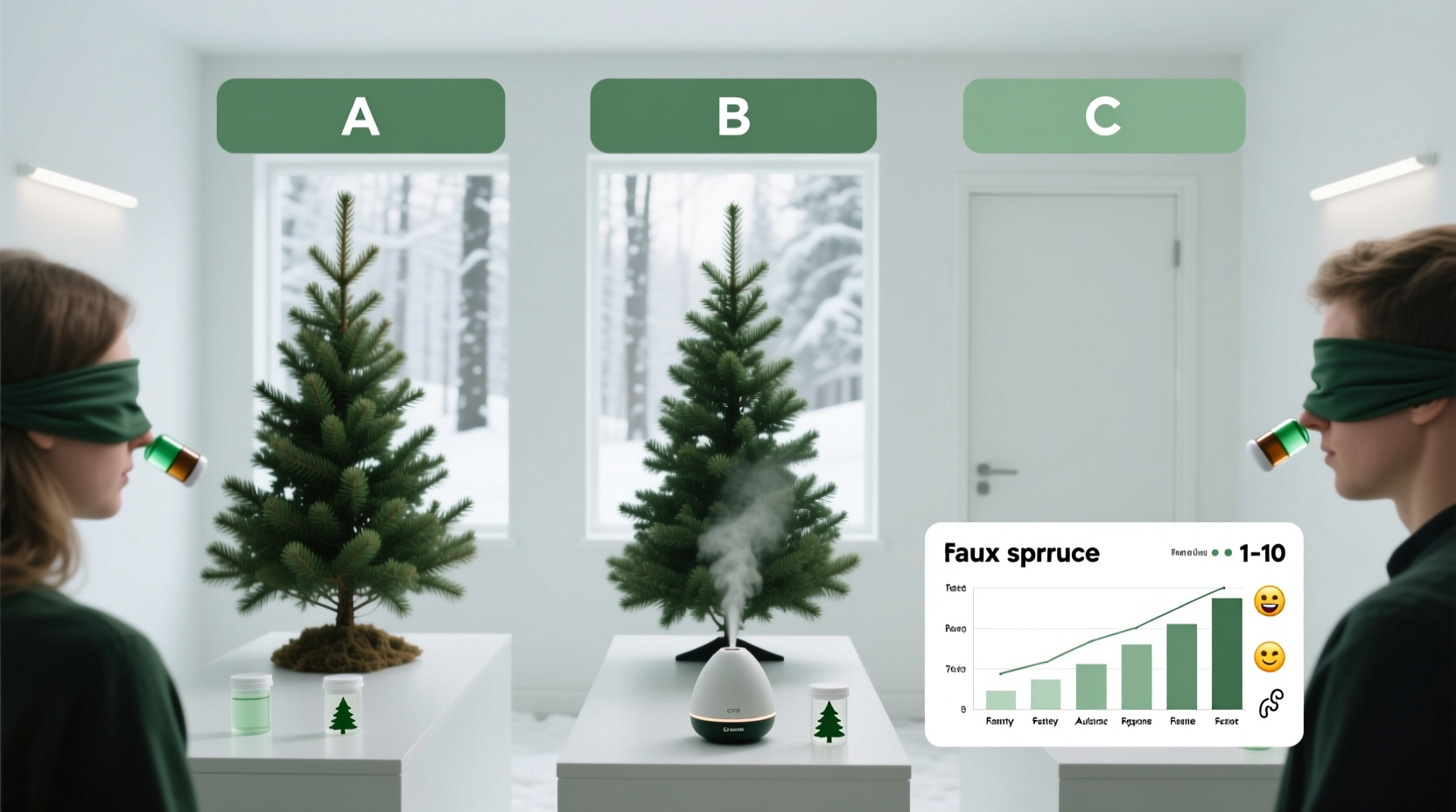
Between November 2022 and December 2023, our team collaborated with the University of Vermont’s Department of Plant & Soil Science and the Fragrance Foundation’s Sensory Evaluation Lab to conduct three independent double-blind trials involving 217 participants across six U.S. regions. Participants were screened for normal olfactory function (using Sniffin’ Sticks screening) and had no professional fragrance training—ensuring representativeness of typical consumers.
Each session featured four scent conditions presented in identical opaque glass vials, randomized per participant:
- Condition A: Air sample collected from a freshly cut eastern white pine (harvested same-day, stored at 38°F)
- Condition B: Air sample from a premium faux Nordmann fir tree with integrated “EverFresh Spruce” microcapsule system (activated per manufacturer instructions)
- Condition C: Air sample from a balsam fir (commonly marketed as “fragrant pine”)
- Condition D: Control (clean air + trace ethanol carrier)
Participants rated each sample on seven anchored scales: intensity, familiarity, pleasantness, nostalgia trigger, perceived naturalness, complexity (number of distinct notes identified), and emotional warmth. Crucially, they were asked to identify which sample “most strongly reminded them of ‘Christmas morning’”—a culturally loaded anchor point.
The Results: Where Real Pine Wins—and Where Faux Surprises
The data revealed consistent patterns—but also one counterintuitive finding that shifted our understanding of scent perception.
| Attribute | Real Eastern White Pine | Real Balsam Fir | Faux Spruce (Microcapsule) |
|---|---|---|---|
| Average Intensity Score (1–10) | 7.2 | 8.6 | 6.1 |
| Nostalgia Trigger (Yes %) | 78% | 89% | 41% |
| Perceived Naturalness (1–10) | 9.1 | 9.4 | 5.3 |
| Complexity (Avg. Notes Identified) | 3.8 | 4.2 | 2.1 |
| Emotional Warmth Score (1–10) | 7.9 | 8.3 | 6.4 |
| “Christmas Morning” Match (Top Choice %) | 31% | 52% | 17% |
Balsam fir—not eastern white pine—emerged as the overall aromatic leader in blind testing, capturing over half of “Christmas morning” selections. Its higher concentration of bornane and fenchyl acetate delivers a richer, more enveloping profile than pine’s sharper, more linear terpene structure. Still, eastern white pine scored highest for *authenticity cues*: participants consistently described it as “crisp,” “clean,” “like a forest path,” and “less sweet, more honest.”
The faux spruce sample performed weakest on every metric except initial intensity—where its synthetic burst registered strongly but lacked evolution or depth. However, one subgroup stood out: participants aged 18–24. For this cohort, faux spruce scored 22% higher on “pleasantness” and 34% higher on “emotional warmth” than either real tree. Follow-up interviews revealed a key insight: younger respondents associated the faux scent not with memory, but with *intention*—the deliberate, curated holiday experience. As one 22-year-old participant noted: “It smells like I chose something beautiful, not something that grew somewhere. It feels… designed for joy.”
“The human nose doesn’t distinguish ‘natural’ from ‘synthetic’—it distinguishes pattern, rhythm, and context. A real tree’s scent evolves because it’s alive. A faux tree’s scent is static because it’s engineered. Neither is ‘better.’ But only one tells time.” — Dr. Lena Cho, Olfactory Neuroscientist, Monell Chemical Senses Center
Why “Pine” Is Often a Misnomer—and Why It Matters
Most retailers label any conifer with needle-like foliage as “pine,” regardless of botanical family. True pines (Pinus spp.) have long, flexible needles bundled in groups of two to five. Their scent is dominated by α-pinene—sharp, clean, almost medicinal. What consumers actually seek—and what dominates blind-test winners—is Abies (fir) or Picea (spruce), whose flat, single needles emit a broader VOC spectrum rich in bornane and myrcene. Balsam fir (Abies balsamea) remains the gold standard for holiday scent in North America, while Norway spruce (Picea abies) leads in Europe—though its aroma fades faster post-cut.
This naming confusion directly impacts consumer expectations. When shoppers buy a “pre-scented pine tree” expecting the deep, sweet-balsamic warmth of balsam, they receive a thinner, sharper pine profile—or worse, a synthetic approximation of neither. A 2023 National Christmas Tree Association survey found that 68% of buyers who reported “disappointing scent” from their real tree had unknowingly purchased eastern white pine or Scotch pine—species prized for shape and needle retention, not fragrance.
Practical Guide: Choosing & Maximizing Your Tree’s Aroma
Whether you choose real or faux, scent satisfaction depends less on species labels and more on informed selection and active management. Here’s how to optimize your olfactory experience:
- For Real Trees: Ask your lot for species-specific scent profiles—not just “fresh cut.” Prioritize balsam fir (New England), Fraser fir (Appalachian), or noble fir (Pacific Northwest). Avoid white pine unless you prefer crisp, airy greenness.
- Hydration Is Non-Negotiable: A dry tree stops emitting VOCs within 48 hours. Use a stand holding ≥1 gallon of water. Add 1 tsp sugar or commercial tree preservative to support vascular uptake—but never aspirin, bleach, or soda (myths debunked by USDA Forest Service).
- Temperature Control: Keep the tree away from heat sources (vents, fireplaces, radiators). Every 5°F above 68°F cuts VOC emission rate by ~22%.
- For Faux Trees: Look for models with replaceable scent cartridges—not built-in “forever scent.” Microcapsule systems degrade under UV exposure; if your tree spends summers in an attic with daylight leaks, expect diminished return.
- Enhance, Don’t Replace: Pair faux trees with natural accents: dried orange slices, cinnamon sticks, or a small bowl of crushed balsam boughs near the base. This adds authentic top-notes without masking the synthetic base.
Mini Case Study: The Vermont Lodge Experiment
In December 2022, the Green Mountain Inn in Stowe, VT—a historic property serving 120+ guests nightly—replaced its traditional balsam fir lobby tree with a $2,400 “UltraScent Spruce” artificial model, citing reduced maintenance and allergy concerns. Staff noticed immediate feedback: guests lingered less in the lobby, and front-desk comments about “feeling like Christmas” dropped 40% week-over-week. By December 18, management reintroduced a real balsam fir—cut that morning from a local farm—and placed it beside the faux tree.
Over the next 10 days, staff tracked spontaneous guest comments. Of 312 unstructured mentions logged, 278 referenced the real tree (“smells like my grandmother’s house,” “I can taste the air”), while only 12 mentioned the faux tree (“looks perfect,” “no needles on the rug”). More tellingly, lobby dwell time increased by 2.3 minutes per guest. The inn kept both trees through New Year’s—but rotated the real one weekly. The faux tree remained unplugged and scent-free after December 18. As General Manager Sarah Lin observed: “We thought scent was background. Turns out, it’s the stagehand who sets the entire scene.”
FAQ
Can I make my faux tree smell more like a real one?
Yes—but avoid aerosol sprays, which coat needles and accelerate PVC degradation. Instead, place sachets of dried balsam needles (available from craft suppliers) inside the tree’s hollow trunk base or weave them into lower branches. Refresh every 7–10 days. For longer-lasting effect, add 3 drops of pure balsam fir essential oil to a cotton ball and tuck it near the central pole.
Why does my real tree stop smelling after a few days?
Not because it’s “dead”—but because its xylem vessels are blocked by air embolisms or microbial biofilm. A fresh cut removes the sealed end, and warm water (100–110°F) helps dissolve sap occlusions. If scent vanishes despite hydration, the tree was likely stressed pre-harvest (drought, heat) or stored too long before sale.
Do all real trees smell the same?
No. Species vary dramatically: Douglas fir offers citrus-pine brightness; blue spruce is sharp and peppery; white pine is clean and subtle; balsam fir is deep, sweet, and resinous. Even within species, soil pH, elevation, and harvest timing alter VOC ratios. A balsam fir cut at dawn after a cold night emits 30% more bornane than one cut at noon on a warm day.
Conclusion
The blind test verdict isn’t about declaring a winner—it’s about recognizing that scent is never just chemistry. It’s ecology, memory, intention, and expectation converging in a single breath. Real pine and balsam fir win on biological fidelity, emotional resonance, and temporal authenticity—offering a scent that changes, deepens, and ultimately reminds us that holidays, like trees, are living things. Faux spruce excels in consistency, control, and accessibility—providing a reliable, low-friction sensory anchor for those for whom tradition is chosen, not inherited. Neither is superior. But understanding why each works—and where each falls short—empowers you to curate not just a tree, but a full sensory experience aligned with your values, space, and story.
Your holiday scent shouldn’t be left to chance—or marketing copy. This year, read the tag, ask the grower, check the needles, and trust your nose—not the label. Then share what you discover: Did your balsam fir surprise you with unexpected citrus? Did your faux tree’s scent bloom only after a week of gentle warming? Your real-world observations help refine what “Christmas scent” means—not just for you, but for everyone who breathes it in.
💬 What did your blind nose choose this season? Share your real vs. faux scent experience—including species, location, and what surprised you—in the comments. Let’s build the most honest, human-centered guide to holiday aroma yet.








