There’s a quiet revolution happening at park benches, campsite tables, and rooftop balconies across the country: people refusing to settle for warm beer or pre-bottled mocktails when they’re away from home. The desire for well-crafted, on-the-spot cocktails—served cold, properly diluted, and balanced—is no longer reserved for home bars or professional venues. But choosing the right gear for that mission isn’t about aesthetics or Instagram appeal. It’s about physics, friction, weight distribution, and the unglamorous reality of packing into a backpack, folding chair bag, or picnic basket. A full bar set promises authenticity. A portable shaker promises feasibility. Which delivers more joy—and fewer logistical headaches—when your bar is wherever you happen to sit down?
Why “Better” Depends on Your Definition of Success
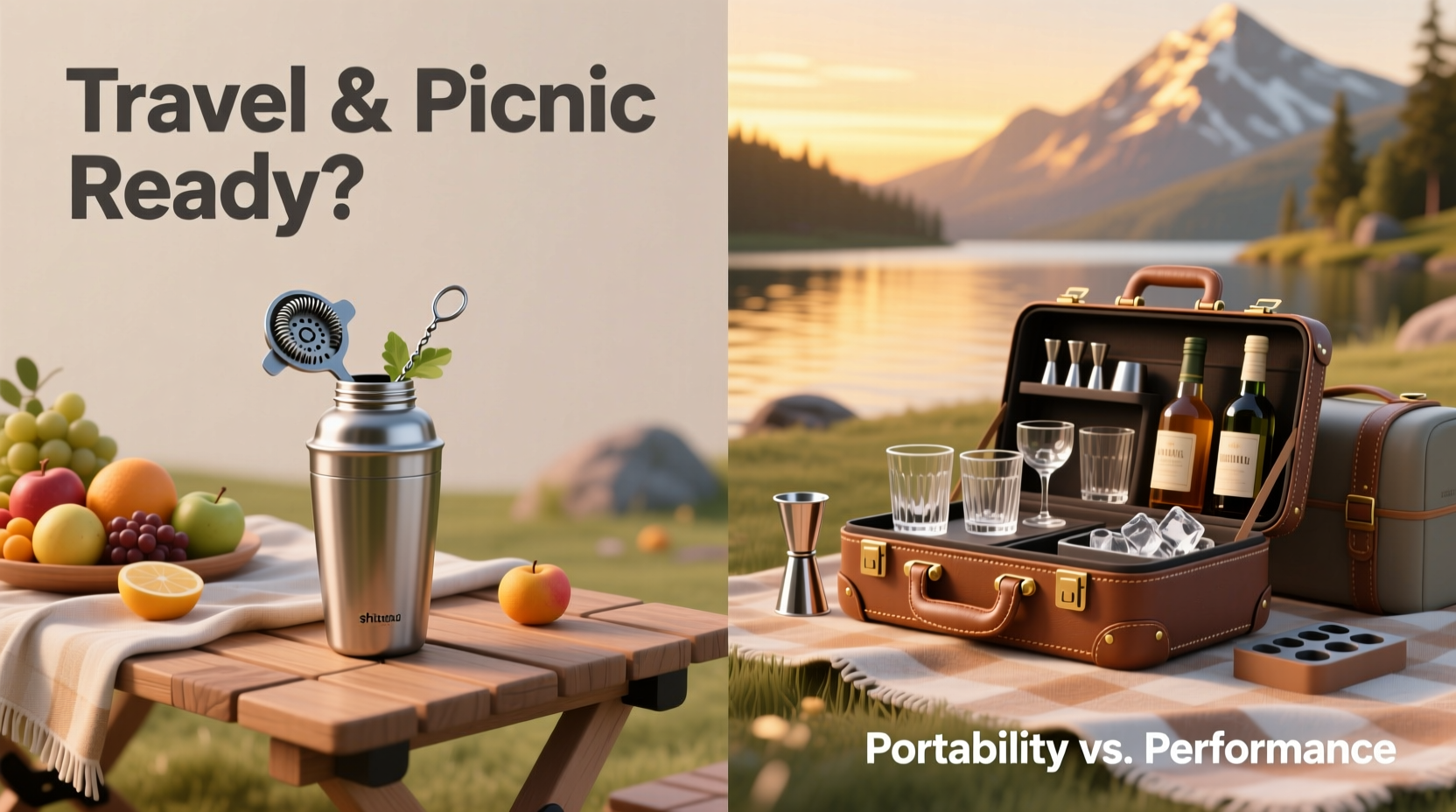
“Better” isn’t absolute—it’s contextual. For a weekend camper who hikes 3 miles with all their gear, “better” means equipment that fits in a 12L dry sack and weighs under 400g. For a couple hosting a lakeside brunch for six, “better” might mean being able to stir a Negroni *and* shake a Whiskey Sour *and* garnish both without juggling three separate tools. The real question isn’t “which is superior?” but “which aligns with your travel rhythm, group size, and tolerance for compromise?”
Consider this: A standard Boston shaker (two-piece tin set) weighs 680–950g empty. Add a jigger, Hawthorne strainer, bar spoon, citrus peeler, and a small bottle of bitters, and you’re approaching 1.3kg—not counting ice, liquor, or garnishes. A high-quality portable shaker—like a double-walled stainless steel unit with integrated strainer and measurement markings—typically weighs 220–340g. That 1kg difference doesn’t vanish once you’re seated. It lives in your shoulders, your luggage weight limit, and the time it takes to unpack, assemble, clean, and repack.
Tip: Before buying any bar gear for travel, weigh your fully packed kit on a kitchen scale—and then add 25% more for ice, bottles, and condensation. If it exceeds 1.8kg, reassess your priorities.Performance Breakdown: What Each Delivers (and Sacrifices)
Let’s move beyond marketing claims and examine how each option functions where it matters most: chilling efficiency, dilution control, mixing consistency, and post-use cleanup.
- Chilling & Dilution: Full bar sets—especially with chilled tins—achieve rapid, aggressive cooling and precise dilution through vigorous shaking (12–15 seconds for spirit-forward drinks; 18–22 for citrus-heavy ones). Portable shakers often use smaller volumes (12–18oz max), limiting ice surface area and increasing risk of over-dilution if shaken too long—or under-dilution if rushed.
- Mixing Consistency: Boston shakers allow for “dry shaking” (shaking without ice to emulsify egg whites), “reverse dry shaking,” and fine-tuned agitation. Most portable units lack the air-tight seal stability needed for true dry shakes, making silky-textured sours harder to achieve reliably.
- Cleanup: A Boston shaker requires disassembly, rinsing both tins, drying the strainer spring, and wiping the spoon. A portable shaker with a single-lid design and smooth interior typically needs only one rinse and a quick wipe—often done with a single paper towel.
“The moment you introduce variables like uneven terrain, wind, limited water access, or shared space, simplicity becomes the highest form of sophistication in mobile mixology.” — Javier Mendez, Beverage Director at Trail & Tonic, a pop-up bar series operating exclusively at national parks and music festivals
Real-World Field Test: A Midsummer Picnic in Golden Gate Park
Sarah, a graphic designer and avid hiker, planned a Sunday picnic for four friends near Spreckels Lake. She’d recently invested in a compact bar kit: a 24oz portable shaker with metric/oz dual measurements, a collapsible silicone jigger, a foldable citrus squeezer, and two 100ml amber dropper bottles (one for simple syrup, one for lemon juice). Her friend Maya brought a full bar set: 28oz Boston tins, weighted bar spoon, OXO jigger, Hawthorne strainer, and a stainless steel citrus reamer.
At the park, Sarah set up in under 90 seconds—her shaker doubled as a serving vessel for her Palomas. She filled it with ice, tequila, grapefruit soda, and lime juice; shook firmly for 14 seconds; and poured directly into glasses using the built-in strainer. Cleanup took 47 seconds: one rinse, one wipe, and back in her tote.
Maya’s setup required leveling a wobbly blanket, assembling tins (which slipped once on damp grass), measuring each component separately, straining through a spring that caught pulp, and then disassembling everything while managing melting ice runoff. When a breeze blew her jigger into the lake, she improvised with a plastic spoon—resulting in inconsistent pours across four drinks. Total active time: 6 minutes 22 seconds. Cleanup involved chasing stray ice cubes and drying three separate metal pieces.
Neither drink was technically inferior—but Sarah’s guests received colder, more uniformly diluted cocktails, and everyone spent less time watching preparation and more time talking.
Decision Framework: Choosing Based on Your Travel Profile
Instead of asking “which is better?”, ask “what does my next five outings actually demand?” Below is a comparative table designed around measurable constraints—not preferences.
| Factor | Portable Cocktail Shaker | Full Bar Set |
|---|---|---|
| Weight (empty, core tools only) | 220–340g | 680–1,300g |
| Packability (fits in standard backpack side pocket?) | Yes — cylindrical, low-profile | No — tins require dedicated case or risk denting |
| Ice Capacity (practical, not theoretical) | 8–12 standard cubes (max 18oz total volume) | 16–24 cubes (24–32oz total volume) |
| Garnish Flexibility (citrus twists, herbs, edible flowers) | Limited — no built-in peeler/reamer; twist prep must be off-site | High — full toolkit enables on-the-spot expression and twisting |
| Cleanup Time (average, no sink) | ≤ 60 seconds (single-rinse, no disassembly) | ≥ 3 minutes (multiple parts, spring cleaning, drying) |
Your Action Plan: Building a Smart, Scalable Mobile Bar
Most people don’t need to choose *only* one option—they need a tiered system that evolves with their context. Here’s how to build intelligently:
- Start with a portable shaker as your baseline tool. Choose one with a leak-proof lid, internal measurement lines (both metric and imperial), and a fine-mesh integrated strainer. Avoid plastic bodies—even reinforced ones—unless weight is non-negotiable; stainless steel retains cold longer and resists flavor transfer.
- Add modular accessories only when needed. A foldable citrus squeezer (not a reamer) adds 45g and unlocks fresh juice. A 15mL silicone jigger adds 12g and eliminates guesswork. Never carry glass, wood, or multi-part strainers unless you’re hosting a seated event with running water.
- Pre-batch whenever possible. Make 200ml batches of sour mix (lemon/lime juice + simple syrup) and store in leakproof 100ml amber bottles. Pre-squeeze citrus at home and refrigerate juice for up to 48 hours—no on-site squeezing required.
- Use your environment as infrastructure. A picnic table edge becomes a jigger rest. A folded towel becomes a grip pad. A thermos of chilled sparkling water doubles as a mixer *and* an ice reservoir (pour over ice to super-chill without diluting).
- Test your full kit—including ice—before departure. Pack everything as you would for the trip. Shake vigorously over a sink. Check for leaks, lid integrity, and strain flow. If liquid escapes during shaking, it will escape onto your friend’s lap at the park.
Frequently Asked Questions
Can I make stirred drinks like Martinis or Manhattans with a portable shaker?
Technically yes—but not ideally. Stirring requires gentle, consistent rotation for 25–30 seconds to chill without excessive dilution. Portable shakers are engineered for shaking force, not controlled rotation. You’ll get a cold drink, but likely one that’s either under-chilled or over-diluted. For stirred classics on the go, opt for a pre-chilled coupe glass and serve “up” without dilution—just ensure your base spirit and vermouth are refrigerated beforehand.
Won’t a portable shaker dent or warp after repeated use?
Quality matters. Single-wall stainless units under $25 often develop dents after 10–15 firm shakes. Look for double-walled, food-grade 18/8 stainless steel with reinforced seams and a welded base (not rolled edges). These withstand thousands of shakes and retain structural integrity even after being dropped on pavement. Read user reviews specifically mentioning long-term durability—not just first-impression shine.
Is it worth carrying both a portable shaker *and* a mini bar spoon for stirring?
Rarely. A well-designed portable shaker includes measurement lines that let you eyeball spirit ratios accurately enough for travel contexts. A bar spoon adds weight, snag risk, and zero functional advantage unless you’re building layered shots or performing advanced techniques—which rarely survive the transition to outdoor settings. Save the spoon for home. Carry a sturdy, short-handled citrus zester instead—it’s lighter and more versatile.
The Bottom Line: Prioritize Ritual Over Rigor
A cocktail isn’t defined by its tools—it’s defined by intention, presence, and shared delight. At its best, mobile mixology isn’t about replicating a speakeasy behind a folding chair. It’s about pausing, measuring something carefully, adding a splash of brightness, and handing a beautifully chilled drink to someone you care about—while birdsong replaces clinking glasses and the breeze carries away the last trace of citrus oil.
The portable shaker wins for 80% of travel and picnic scenarios because it removes friction, not flavor. It respects your energy, your space, and your desire to be part of the moment—not stuck assembling, measuring, or scrubbing. The full bar set earns its place when the occasion calls for ceremony: a sunset toast on a dock, a birthday celebration in a friend’s backyard, or a weekend where “unpacking the bar” is part of the fun—not the barrier to it.
So pack what serves your rhythm—not what looks impressive in an unopened box. Start light. Master one great drink. Refine your process. Then, and only then, consider what *else* might deepen the experience—not complicate it.
💬 Your turn: What’s the most unexpectedly perfect cocktail you’ve ever made outdoors? Share your recipe, gear combo, and location in the comments—we’re building a crowd-sourced guide to joyful drinking beyond the bar rail.