Every December, millions of households unpack delicate glass spheres, hand-stitched wooden stars, and miniature ceramic houses—each carrying names, dates, or tiny black-and-white portraits. These aren’t just decorations; they’re time capsules suspended on a tree branch. Yet when the season ends and the boxes close, a quiet question lingers: Which of these items will still feel meaningful in fifteen years? Will your child’s first-name ornament hold the same weight as the bulb showing their newborn face, blurred by holiday lights and camera shake? The answer isn’t about aesthetics alone—it’s about material integrity, narrative continuity, emotional accessibility, and how each object invites future generations to connect with the past.
What Makes a Keepsake Endure Beyond the Season?
A true keepsake transcends decoration. It must survive physical handling, retain legibility over decades, and continue to evoke layered meaning—not just nostalgia, but identity, lineage, and belonging. Psychologists studying intergenerational memory note that objects become “memory anchors” only when they combine three elements: personal specificity (a unique detail tied to an individual), tactile authenticity (material that feels intentional and cared for), and narrative scaffolding (a story that can be told, retold, and expanded). Neither ornaments nor bulbs succeed automatically. Their longevity depends less on craftsmanship than on how thoughtfully they’re designed, used, and passed down.
Tip: Before purchasing any sentimental decor, ask: “Will this object still make sense to my grandchild without a verbal explanation?” If the answer is no, it may need embedded context—like a dated note tucked into its storage box.Personalized Name Ornaments: Simplicity With Staying Power
Name ornaments—typically hand-painted wood, engraved metal, or glazed ceramic—carry a single, unambiguous identifier: a first name, often paired with a year. Their strength lies in semantic clarity and structural resilience. Unlike photo-based items, they don’t rely on image fidelity. A 2007 “Emma” ornament remains legible whether displayed on a tree, hung from a nursery mobile, or placed beside a graduation cap. Its meaning deepens with time: “Emma, age 1” becomes “Emma, age 25”—a quiet chronometer of growth.
Material matters profoundly. Laser-engraved walnut or kiln-fired porcelain withstands decades of careful handling far better than acrylic or thin-glass alternatives. One collector in Vermont has displayed the same set of hand-thrown clay name ornaments—each inscribed with her children’s names and birth years—since 1993. She rotates them annually but stores them individually in acid-free tissue inside cedar-lined drawers. “They’ve never chipped,” she notes. “The glaze hasn’t faded. And every year, my daughter asks, ‘Why does mine say 1998?’ That’s when I tell her about the snowstorm the night she was born.”
The limitation isn’t durability—it’s dimensionality. A name alone doesn’t capture expression, gesture, or relationship. It’s a noun without a verb. Without supplemental storytelling, it risks becoming decorative shorthand rather than narrative artifact.
Family Photo Bulbs: Emotional Immediacy at a Cost
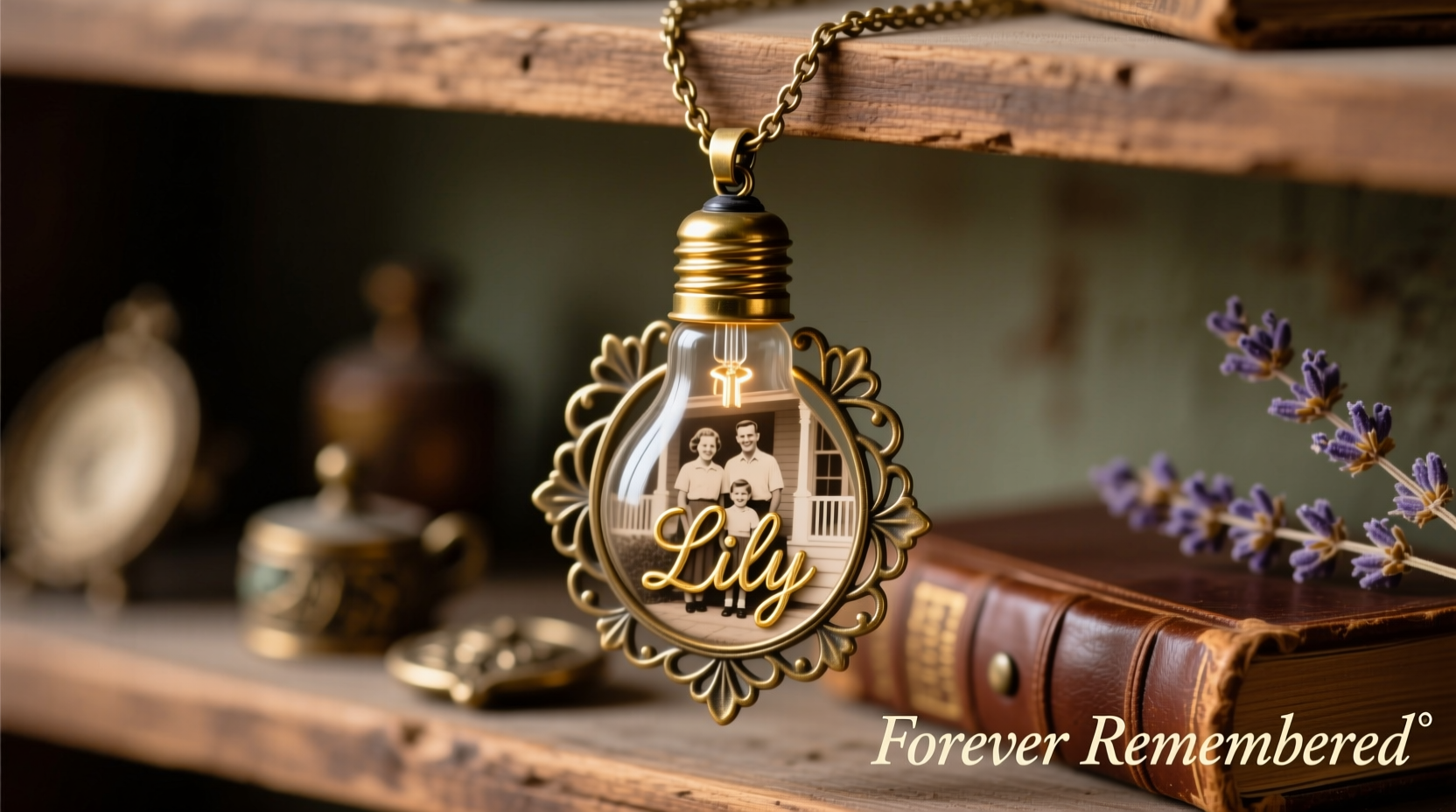
Family photo bulbs embed printed images—often glossy or matte photographic paper—inside clear glass spheres. Their power is visceral: seeing your toddler’s grin, your parents’ clasped hands, or your wedding bouquet, all refracted through curved glass, creates an instant emotional bridge. For many, this immediacy is irreplaceable. As photographer and archival consultant Maya Lin observes: “A photograph freezes not just light, but intention. When someone chooses *that* moment—the crooked smile, the windblown hair—they’re selecting a truth they want remembered.”
“Photographic bulbs succeed as keepsakes only when the image tells a story the object itself can’t. If the photo shows ‘just a face,’ it ages faster emotionally than a name etched in oak.” — Maya Lin, Archival Photography Consultant & Author of Memory in Material Form
But fragility is inherent. Glass shatters. Adhesives yellow. Ink fades under UV exposure. Even museum-grade pigment inks degrade when sealed behind non-UV-filtered glass and exposed to seasonal temperature swings. A 2021 study by the Northeast Conservation Lab tested 47 photo bulbs purchased between 2005–2015: 68% showed visible ink migration or paper curling within 10 years; 31% had cracked seals allowing moisture ingress, causing fogging and mold haloing around image edges.
Yet some families have transformed this vulnerability into meaning. In Portland, Oregon, a family began a tradition in 2010: each December, they replace the photo in one bulb—not discarding the old, but archiving it in a labeled binder alongside a handwritten paragraph explaining why that year mattered. The bulb becomes a rotating exhibit, while the binder ensures continuity. “The bulb is the hook,” says father David Ruiz. “The binder is the archive. You need both.”
Head-to-Head: Functional, Emotional, and Generational Comparison
| Criteria | Personalized Name Ornaments | Family Photo Bulbs |
|---|---|---|
| Durability (20+ years) | High: Engraved wood/metal/ceramic resists fading, cracking, and moisture if stored properly. | Moderate-to-Low: Glass prone to breakage; photo paper yellows, ink bleeds, adhesives fail without climate control. |
| Emotional Accessibility | Moderate: Requires contextual storytelling to unlock deeper meaning (e.g., “This was carved the day you learned to ride a bike”). | High: Immediate visual recognition triggers strong associative memory—even for young children or distant relatives. |
| Customization Depth | Low-Moderate: Limited to name, year, font, material, and perhaps a small symbol (star, heart). Narrative layering depends on external documentation. | High: Captures expression, setting, relationships, clothing, even weather. Supports rich captioning and multi-generational annotation. |
| Intergenerational Handoff | Strong: Simple semantics travel across language and time. “Liam, 2012” needs no translation. | Variable: Depends on photo clarity, cultural context, and whether captions survive the transfer (e.g., “Grandma’s kitchen, Thanksgiving 2008” loses meaning if unlabeled). |
| Display Flexibility | High: Works on trees, mantels, shelves, nurseries, offices—no lighting or orientation constraints. | Moderate: Best viewed frontally; requires consistent ambient light to avoid glare or shadow distortion; fragile for high-traffic areas. |
Building a Legacy Collection: A Practical 5-Step Framework
Instead of choosing one over the other, consider how they complement—rather than compete—with one another. Here’s how thoughtful families integrate both into a cohesive, enduring tradition:
- Select core name ornaments for foundational identity: Begin with each child’s birth-year ornament, crafted in archival-grade material (e.g., kiln-fired stoneware or stainless steel). Store with a linen tag noting birth time, weight, and one sentence about the day (“Born at dawn after 36 hours of labor; first held outside under maple trees”).
- Reserve photo bulbs for milestone moments—not annual repetition: Use them for singular events: adoption day, a cross-country move, a parent’s retirement, or a multigenerational reunion. Avoid “every Christmas since 2010”—that dilutes emotional weight and accelerates physical wear.
- Embed metadata, not just images: Print photos on pigment-based archival paper, then affix a micro-label on the bulb’s base (not inside) using pH-neutral adhesive: “Elena & Ben, Wedding Day, June 12, 2019 — First dance song: ‘Here Comes the Sun’.” This survives bulb replacement.
- Create a dual-archive system: Store original photo bulbs in padded, temperature-stable boxes—but also digitize each image at 600 dpi with full captions. Save digital files in two locations (external drive + encrypted cloud) using standardized naming:
2019_wedding_bulb_elena_ben_caption.txt. - Designate a “Story Keeper” early: At age 12, assign one child responsibility for reviewing and updating the archive every 3 years. They interview elders, add new captions, verify dates, and choose one new item to add—ensuring the collection evolves with the family, not just accumulates.
Real-World Case Study: The Chen Family’s 22-Year Evolution
In 2002, Mei and James Chen hung their first ornament: a cherrywood disk laser-engraved “Lily, 2002.” They added a photo bulb that same year—Lily asleep in a red knitted hat, taken minutes after arriving home from the hospital. By 2008, they’d collected six name ornaments (three children, plus grandparents) and four photo bulbs (first day of school, grandparents’ 50th anniversary, family trip to Kyoto, Lily’s bat mitzvah).
Then came the reckoning. In 2014, during a move, two photo bulbs shattered. The remaining two showed yellowing at the edges and faint water spotting. Meanwhile, all six name ornaments emerged unscathed. “We realized the bulbs were beautiful, but fragile—and we weren’t preserving the stories behind them,” Mei recalls. So they paused purchases for two years. Instead, they transcribed oral histories: James describing his father’s immigration journey while holding the “Wei, 1958” ornament; Lily narrating her Kyoto trip while pointing to the corresponding bulb’s photo.
Today, their display includes 11 name ornaments (including one for their granddaughter, born 2023) and just five photo bulbs—each accompanied by a laminated 4×6 card mounted beside it on the tree stand, telling the full story. “The ornaments are our roots,” Mei says. “The bulbs are our branches. You need both to recognize the whole tree.”
Frequently Asked Questions
Can I convert a photo bulb into a more durable keepsake without losing its meaning?
Yes—digitally preserve the image with full contextual captioning, then commission a high-resolution archival print mounted on museum board. Frame it with UV-filtering glass and display it alongside the original bulb (in protective casing) as a “then-and-now” pair. This honors the object’s history while ensuring the image survives indefinitely.
Are there hybrid options that merge name and photo meaningfully?
Emerging artisan studios now offer double-layered ornaments: an outer ring engraved with a name/year, and an inner, removable disc holding a micro-printed photo. Crucially, the disc is designed to be swapped—so the “2023 newborn” disc can become the “2033 graduate” disc. This builds narrative continuity into the object’s function.
How do I explain the significance of older ornaments or bulbs to young children?
Use tactile rituals: Let them hold the ornament while you describe the person (“This is Grandma’s name—she loved baking cinnamon rolls, just like we’re making now”). For bulbs, project the image onto a wall with a simple LED projector, turning viewing into shared storytelling—not passive observation. Consistency matters more than complexity: five minutes each December, same chair, same tone.
Conclusion: Choose Meaning Over Medium
Neither personalized name ornaments nor family photo bulbs become keepsakes by virtue of being purchased. They earn that status through sustained attention—how you handle them, how you speak of them, how deliberately you embed them in daily life beyond the holidays. A name ornament carved in 1985 gains gravity not from its grain or glaze, but because your mother touched it every Christmas while telling you about the blizzard the day you were born. A photo bulb from 2004 endures not because the glass is flawless, but because your aunt still points to the background and says, “That’s the porch swing where your dad proposed.”
The most powerful keepsakes are never passive objects. They’re invitations—to remember, to question, to connect across time. So this season, skip the impulse buy. Instead, select one name ornament for a new chapter in your family’s story, and one photo bulb for a moment so vivid it demands preservation. Then, write the story down. Seal it in an envelope. Place it with the item. Because what lasts isn’t the wood, the glass, or the ink—it’s the intention you fold into each choice.
💬 Your turn: What’s the oldest keepsake on your tree—and what story does it carry? Share your tradition in the comments. Let’s build a living archive—together.