
When it comes to decorating your home for the holidays or seasonal events, two modern options have gained popularity: outdoor projector lights and traditional physical ornaments. Both can transform a house into a festive display, but they differ significantly in how they're installed, maintained, and used over time. For homeowners weighing convenience against visual impact, the question often comes down to one key factor: ease of installation. This article compares outdoor projector lights and physical ornaments across multiple dimensions—setup complexity, tools required, adaptability, safety, and long-term use—to help you decide which option truly offers the simpler path.
Understanding the Two Options
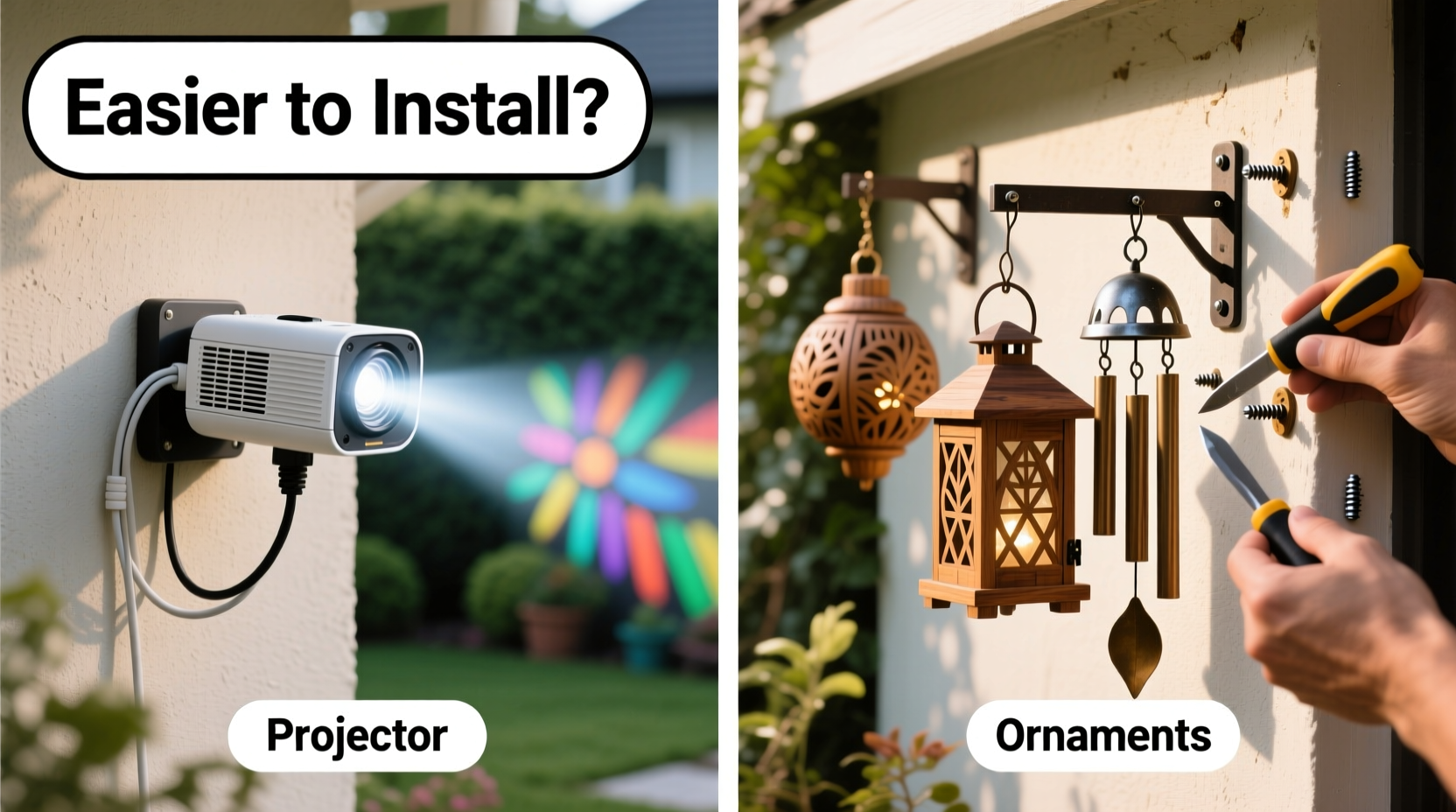
Before diving into installation logistics, it’s important to understand what each system entails.
Outdoor projector lights are devices that project animated or static light patterns onto surfaces like walls, driveways, or lawns. These units typically plug into an outdoor outlet, aim at a target surface, and instantly create the illusion of decorated trees, snowmen, or falling snow without any physical objects being placed outside.
Physical ornaments, on the other hand, include string lights, inflatable figures, wreaths, lawn sculptures, and other tangible decorations. Installing these requires physically placing, securing, and wiring each piece, often involving ladders, stakes, extension cords, and weatherproof connectors.
The fundamental difference lies in tangibility: one relies on optics and positioning; the other on manual placement and structural support.
Installation Complexity: Step-by-Step Comparison
Setting Up Outdoor Projector Lights
Installing a projector light system is generally a straightforward process that can be completed in under 15 minutes. Here's a typical timeline:
- Choose a location: Find a stable, level surface near an outdoor power source—such as a porch step or deck railing.
- Position the projector: Place the unit so it faces the desired wall or yard area. Most models have adjustable stands or swivel bases.
- Aim and focus: Adjust the angle and zoom (if available) to ensure the image fits the surface properly. Some projectors offer remote control for fine-tuning.
- Plug in and test: Connect to power and turn on. Many units have built-in timers or scheduling features.
- Secure if needed: Use included screws or weights to prevent tipping in wind or rain.
No drilling, no climbing, no tangled wires. One device, one outlet, one switch.
Tip: For best results, use projector lights on light-colored, flat surfaces. Dark brick or textured stucco may reduce clarity and brightness.Installing Physical Ornaments
Setting up traditional outdoor decor is more labor-intensive and time-consuming. A typical full-yard decoration session might follow this sequence:
- Unpack and inventory: Check all items—lights, inflatables, stakes, cords—for damage or missing parts.
- Plan layout: Decide where each item goes, ensuring access to outlets and visibility from the street.
- String lights: Drape along rooflines, wrap around trees, secure with clips or staples. Avoid piercing wires.
- Erect inflatables: Unfold, stake down corners, connect blower to power, adjust position as it inflates.
- Place ornaments: Set up figurines, nativity scenes, or lighted signs using ground stakes or hooks.
- Connect and test: Plug everything into extension cords and power strips. Test each circuit individually.
- Weatherproof connections: Elevate junctions off the ground and cover with waterproof enclosures.
- Safety check: Inspect for tripping hazards, overloaded circuits, or unstable structures.
This process can take several hours—even days for elaborate setups—and often requires two people, especially when working on roofs or tall trees.
“From a practical standpoint, projector lights represent a leap forward in holiday efficiency. They eliminate the most common pain points: storage, tangles, and ladder work.” — Mark Delaney, Residential Lighting Consultant
Comparative Analysis: Installation Factors
To better understand the differences, here's a side-by-side breakdown of key installation factors.
| Factor | Outdoor Projector Lights | Physical Ornaments |
|---|---|---|
| Time Required | 5–15 minutes per unit | 2–6+ hours for full setup |
| Tools Needed | None (or small screwdriver) | Ladder, staple gun, zip ties, voltage tester, stakes |
| Physical Effort | Low (standing or kneeling) | High (climbing, lifting, bending) |
| Setup Repeatability | High—same spot every year | Variable—depends on memory and labeling |
| Skill Level | Beginner-friendly | Intermediate to advanced |
| Safety Risks | Minimal (electrical only) | Falls, electrocution, fire hazards |
The data shows a clear advantage for projector lights in nearly every category related to ease of installation. However, visual impact and customization matter too—so let’s examine trade-offs.
Real-World Example: The Johnson Family Holiday Setup
The Johnsons live in a suburban neighborhood known for competitive Christmas lighting. For years, they spent entire weekends installing thousands of mini-lights, three inflatables, and a lighted sleigh. The process involved two ladders, multiple extension cords, and required both parents and their teenage son to participate.
Last year, Mr. Johnson injured his shoulder while stapling lights to the eaves. That incident prompted a change. They invested in two high-lumen outdoor projectors—one for the front wall, another for the driveway. In less than 20 minutes, they achieved a dynamic light show featuring falling snow and a glowing Santa animation.
Neighbors noticed the display was different, but not less festive. The Johnsons saved time, avoided risk, and still received compliments. More importantly, they didn’t need medical attention this December.
While they kept a few physical items (a wreath and porch candles), the bulk of their visual impact now comes from projection. “It’s not just easier,” Mrs. Johnson said. “It’s sustainable for us long-term.”
Hidden Challenges of Each Option
Despite the simplicity of projector lights, they aren’t flawless. Similarly, physical ornaments offer unmatched texture and presence—but come with well-known drawbacks.
Projector Limitations
- Surface dependency: Works poorly on uneven, dark, or obstructed walls.
- Weather interference: Heavy rain or fog can blur or scatter the image.
- Static visuals: Cannot replicate the 3D depth of real trees or inflatables.
- Power needs: Requires accessible outdoor outlets; extension cords may still be needed.
Physical Ornament Drawbacks
- Tangling: String lights are notorious for knotting during storage and setup.
- Storage space: Requires bins, shelving, and organization systems.
- Degradation: Exposure to sun, moisture, and pests shortens lifespan.
- Annual troubleshooting: Burnt bulbs, broken fuses, and failed blowers add frustration.
Checklist: Choosing the Easier Installation Option
Use this checklist to determine which solution aligns best with your priorities:
- ☐ Do you have easy access to outdoor electrical outlets?
- ☐ Is your home’s exterior wall large, flat, and light-colored?
- ☐ Are you or anyone helping you uncomfortable with heights or ladders?
- ☐ Do you have limited storage space for bulky decorations?
- ☐ Have you experienced issues with tangled lights or blown fuses in the past?
- ☐ Do you want a consistent display that takes under 30 minutes to set up?
- ☐ Are you looking for lower long-term maintenance?
If you answered “yes” to four or more of these, outdoor projector lights are likely the easier choice for your situation.
Expert Insight: Industry Trends and Adoption
According to the National Retail Federation’s holiday spending report, sales of smart and simplified décor—including projection systems—have risen by 37% over the past three years. Consumers are increasingly prioritizing convenience without sacrificing ambiance.
“We’re seeing a shift toward ‘set-and-forget’ holiday solutions. Projector lights fit perfectly into that trend—especially among aging homeowners and busy families.” — Lisa Tran, Home Automation Analyst at TechHome Insights
Manufacturers are responding with higher-resolution projectors, multi-image carousels, and app-controlled models that sync with music. Meanwhile, traditional ornament makers are adding plug-and-play light sets and pre-strung garlands to reduce setup time—acknowledging the demand for simplicity.
Frequently Asked Questions
Can I use multiple projector lights together?
Yes. Many homeowners use two or more projectors to cover different sides of the house or create layered effects (e.g., snowfall on the wall and reindeer on the lawn). Ensure each has its own power source and avoid overlapping beams unless designed for synchronization.
Do physical ornaments last longer than projector lights?
Possibly, but it depends on care. High-quality LED string lights can last 5–7 seasons with proper storage. Projector lights typically have a lifespan of 3,000–5,000 hours of use—equivalent to about 10 holiday seasons at six hours per night. However, projector bulbs or LEDs may degrade faster in extreme climates.
Are projector lights visible in rainy or snowy conditions?
They remain visible, but heavy precipitation can soften the image or cause flickering due to water droplets on the lens. Mounting under a small awning or using a protective cover (without blocking the beam) can help maintain clarity.
Final Verdict: Which Is Easier to Install?
Out of all considerations—time, effort, tools, safety, repeatability—outdoor projector lights are objectively easier to install than physical ornaments. They require fewer materials, minimal physical exertion, and virtually no technical skill. You don’t need to climb, staple, untangle, or troubleshoot individual components.
That said, “easier” doesn’t mean “better” for everyone. Some homeowners value the tactile charm, dimensionality, and tradition of physical decorations. Others prioritize flexibility—being able to rearrange items or mix media. But if your primary goal is simplicity, speed, and safety, projector lights deliver unmatched advantages.
For maximum impact with minimal hassle, consider a hybrid approach: use a projector for large-scale background effects and reserve a few key physical ornaments—like a lit tree or doorway wreath—for depth and authenticity.
💬 Ready to simplify your next holiday display? Start with one projector light this season and experience the difference. Share your setup story or ask questions in the comments—we’d love to hear how you balance beauty and convenience!








