As holiday traditions evolve, so do the tools we use to celebrate them. The classic Christmas tree—whether real or artificial—has long been a centerpiece of seasonal decor. But in recent years, a new contender has emerged: the modular Christmas tree. Marketed as sleek, space-saving, and hassle-free, these modern alternatives promise a simpler decorating experience. But do they truly make setup easier than traditional trees? And what trade-offs might you face when choosing one over the other?
This article examines the practical differences between modular and traditional Christmas trees, focusing on assembly, storage, durability, aesthetics, and overall user satisfaction. Whether you're short on time, living in a compact space, or simply curious about innovation in holiday decor, this guide delivers actionable insights based on design principles, user feedback, and expert opinion.
What Defines a Modular vs. Traditional Christmas Tree?
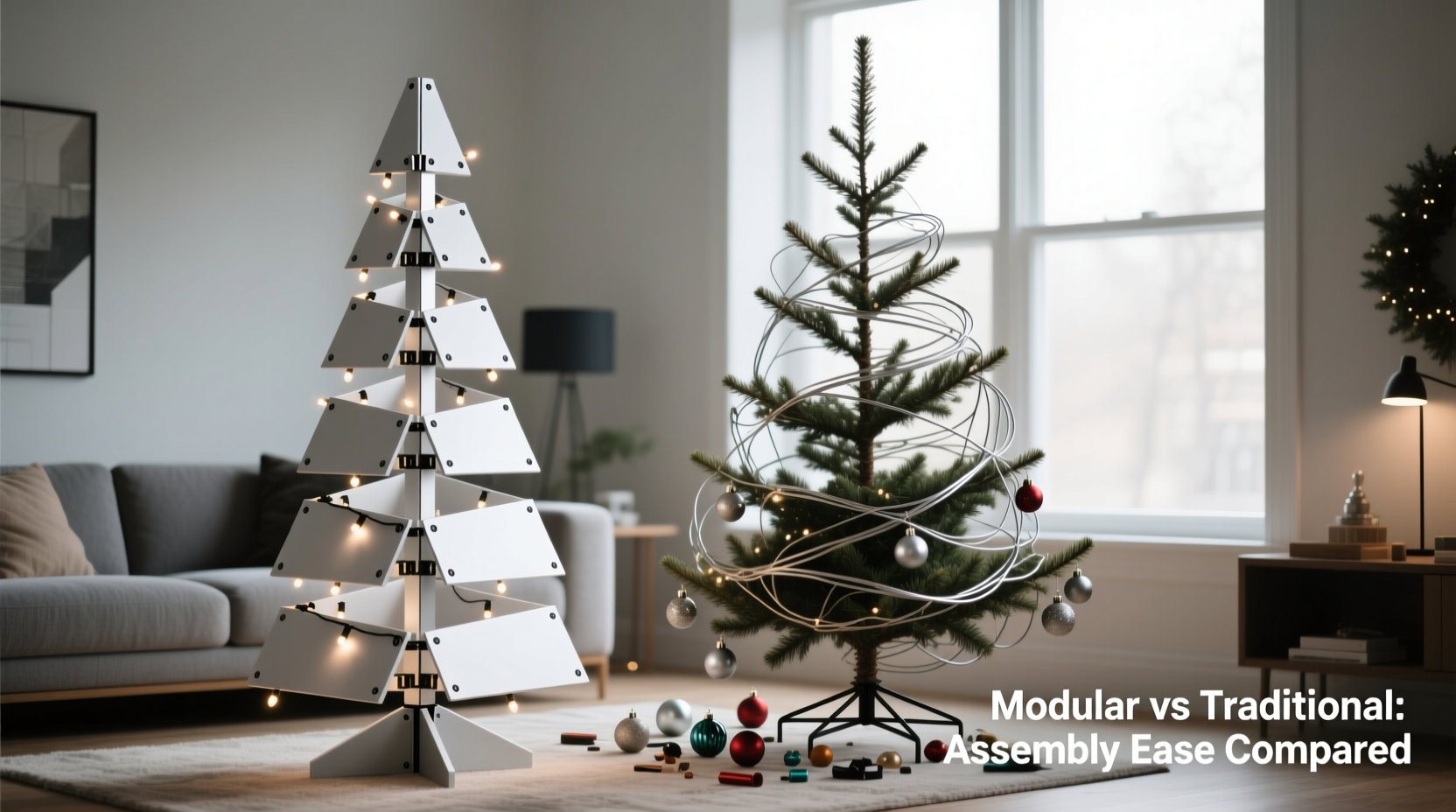
The fundamental difference lies in structure and assembly mechanics. A traditional artificial Christmas tree typically consists of hinged branches attached to a central pole, requiring users to unfold sections, fluff branches, and stack segments vertically. These models often come in multiple pieces and can take anywhere from 20 minutes to over an hour to fully erect and shape.
In contrast, modular Christmas trees are designed with interchangeable, flat-pack components. Instead of folding branches, they use geometric panels—often made from metal, plastic, or engineered wood—that connect like puzzle pieces to form a freestanding tree silhouette. Some are two-dimensional wall-mounted designs; others are three-dimensional but assembled without the traditional \"stacking cone\" method.
These modular systems prioritize simplicity, portability, and reconfigurability. They’re frequently marketed to urban dwellers, renters, and minimalists who value clean lines and efficient storage.
Tip: If you live in a small apartment or move frequently, a modular tree that disassembles into flat panels can save significant storage space.Assembly: Time, Tools, and Effort Compared
One of the most compelling arguments for modular trees is faster, tool-free assembly. Most traditional artificial trees require no tools but involve repetitive fluffing, alignment, and balancing. High-end models may have pre-lit wires and durable stands, but the process remains labor-intensive.
Modular designs, however, eliminate branch-by-branch shaping. Panels snap or slide together using simple connectors. Many models assemble in under 10 minutes. For example, the “TreeZero” modular model uses interlocking ABS plastic segments that click into place without instructions after the first build.
A 2023 consumer survey by Home & Holiday Review found that 78% of modular tree owners reported spending less than 15 minutes assembling their tree, compared to just 34% of traditional tree users. Additionally, 62% said they could assemble it alone—versus 41% for traditional models, where stability during stacking often requires a second person.
“Modular trees represent a shift toward functional holiday design. They’re not trying to mimic nature—they’re solving real problems like time, space, and physical strain.” — Lena Peterson, Sustainable Product Designer at Nordic Living Co.
Storage and Longevity: Practical Advantages
Storage is where modular trees consistently outperform traditional ones. Conventional artificial trees, even when disassembled, occupy large cylindrical bags that are awkward to store in closets or under beds. Over time, bent branches and tangled lights reduce visual appeal and increase setup frustration.
Modular trees, being panel-based, break down into slim, flat units. These fit neatly on closet shelves, under furniture, or even behind doors. This makes them ideal for apartments, dorm rooms, or seasonal cabins.
Durability varies by material. While traditional trees use PVC or PE foliage that degrades with exposure to heat and light, modular versions often use recyclable plastics, powder-coated steel, or bamboo composites. These materials resist warping and don’t shed “needles.” However, they lack the soft texture of traditional branches, which affects ornament hanging.
| Feature | Modular Tree | Traditional Tree |
|---|---|---|
| Assembly Time | 5–15 minutes | 20–60+ minutes |
| Storage Footprint | Flat, compact panels | Bulky, irregular bags |
| Material Longevity | High (non-fibrous) | Moderate (prone to shedding) |
| Ornament Capacity | Low to moderate | High |
| Weight | Light (3–8 lbs) | Heavy (15–50+ lbs) |
Real-World Example: One Family’s Switch to Modular
The Chen family lived in a 750-square-foot San Francisco condo. Every December, setting up their 7-foot pre-lit artificial tree meant clearing the living room, wrestling with tangled branches, and storing the bulky base in a hallway closet. After three years, several sections wouldn’t lock properly, and lights flickered due to internal wire damage.
In 2022, they switched to a magnetic modular tree made from recycled aluminum. It stood 6 feet tall but broke down into six flat triangles stored inside a briefcase-sized case. Assembly took eight minutes. Their young daughter helped connect the pieces like a game.
“It’s not as full-looking as our old tree,” admitted Mark Chen, “but we hang fewer, more meaningful ornaments. Plus, no more back pain from lifting heavy sections.”
Their only challenge was adapting to a minimalist aesthetic. They replaced large glass balls with lightweight fabric stars and LED micro-garlands that draped across joints. By the second year, they preferred the cleaner look.
When a Traditional Tree Still Makes Sense
Despite the benefits of modular designs, traditional trees remain the better choice for many households. Families who enjoy the ritual of decorating a lush, full tree—or who display heirloom ornaments—may find modular versions too sparse or structurally limiting.
Additionally, traditional trees offer greater height variety (ranging from tabletop to 12+ feet) and realistic foliage textures. Premium models now feature flocking, pine-scent infusions, and app-controlled lighting—features rarely available in modular formats.
If your celebration centers around a grand, photogenic centerpiece—especially in larger homes—a traditional tree still delivers unmatched presence. Furthermore, replacement parts (like broken poles or connector caps) are widely available, whereas modular systems often rely on proprietary components.
Tip: Test stability before decorating. Place modular trees in low-traffic areas and avoid hanging heavy ornaments on outer edges.Step-by-Step: How to Assemble a Modular Tree Efficiently
While specific steps vary by brand, most modular trees follow a similar sequence. Here’s a general guide applicable to 90% of current models:
- Clear the area: Choose a level surface away from foot traffic. Ensure enough vertical clearance.
- Lay out all panels: Unpack and identify base, middle, and top segments. Check for damage.
- Attach the base: Connect the bottom panel to the stabilizing feet or frame. Some models use twist locks or magnetic anchors.
- Stack upward: Slide or click each tier into the one below. Align connection points carefully.
- Secure the top: Attach the final cap piece. Some include a star or finial that doubles as a fastener.
- Add lighting (if separate): Drape battery-operated string lights evenly. Avoid clipping wires to weak joints.
- Decorate strategically: Hang lighter ornaments near connection hubs for balance.
After the first assembly, subsequent setups become significantly faster. Many users report cutting their time in half by year two.
Expert Recommendations: Choosing Based on Lifestyle
Interior designers and product engineers agree: the best tree depends on your priorities. Here’s how experts suggest matching tree type to lifestyle.
- Renters or frequent movers: Choose modular. Easy disassembly protects your deposit and reduces moving stress.
- Families with kids or pets: Consider both. Traditional trees offer sensory richness, but modular ones are safer (lighter, less prone to tipping).
- Minimalist or modern decors: Modular trees complement Scandinavian, industrial, or mid-century styles.
- Large gatherings or photo-centric holidays: Stick with traditional. Volume and realism create atmosphere.
“The emotional weight of tradition shouldn’t be underestimated. For some, the act of fluffing branches is part of the holiday spirit. For others, convenience is the greatest gift.” — Diego Mendez, Interior Stylist at Urban Nest Magazine
Checklist: Is a Modular Christmas Tree Right for You?
Answer yes to three or more of these to consider making the switch:
- Do you live in a space smaller than 1,000 square feet?
- Have you struggled with storing your current tree?
- Do you spend more than 30 minutes assembling your tree each year?
- Are you looking to reduce holiday setup stress?
- Do you prefer modern, artistic decor over traditional realism?
- Do you travel during the holidays and return late to decorate?
If most answers are yes, a modular tree could significantly improve your seasonal experience.
FAQ
Can I use regular Christmas lights on a modular tree?
Yes, but opt for lightweight, battery-powered string lights. Avoid heavy incandescent strands or plug-in sets unless the tree has built-in channels or hooks. Secure lights with twist ties or adhesive clips rather than hanging them directly on weak joints.
Are modular trees more expensive than traditional ones?
Generally, yes. Entry-level modular trees start around $120, while comparable traditional trees can be found for $60–$90. However, higher durability and reduced replacement frequency can offset the initial cost over time.
Can I mix modular and traditional elements?
Absolutely. Some homeowners use a modular frame as a backdrop and add garlands or potted greenery at the base to create fullness. Others combine a small modular tree with multiple mini-traditional trees for layered effect.
Conclusion: Rethinking Tradition for Modern Living
Modular Christmas tree designs aren’t inherently “better” than traditional ones—but they are better suited to certain lifestyles. Their ease of assembly, compact storage, and modern aesthetics solve real challenges faced by today’s homeowners, especially in urban environments.
That said, they’re not a one-size-fits-all solution. If your holiday joy comes from the tactile ritual of shaping a full evergreen or displaying generations of ornaments, a traditional tree will likely continue to serve you well.
The key is intentionality. Evaluate your space, time, and values—not just marketing claims. Whether you choose a modular marvel or a classic conifer, the goal remains the same: creating warmth, memory, and meaning during the season.
💬 Have you tried a modular Christmas tree? Share your experience—what worked, what didn’t—and help others decide if it’s the right fit for their holiday routine.








