Ambiance isn’t just about brightness—it’s about emotional resonance. The way light falls on a mantel, glints off glass ornaments, or wraps around a porch railing shapes how we feel in a space during the holidays. For decades, two dominant lighting formats have competed for that role: delicate, densely strung mini lights (often 2.5–5mm bulbs) and bold, nostalgic big bulb lights (typically 10–25mm, including C7, C9, and retro-style G40/G50). Yet most shoppers choose based on price, ease of storage, or childhood nostalgia—not on how each type actually performs in creating atmosphere. This isn’t about “which is better” in the abstract. It’s about understanding how scale, color temperature, light diffusion, spacing, and context converge to shape mood—and why the right choice depends entirely on your space, intention, and sensory priorities.
How Light Scale Shapes Emotional Perception
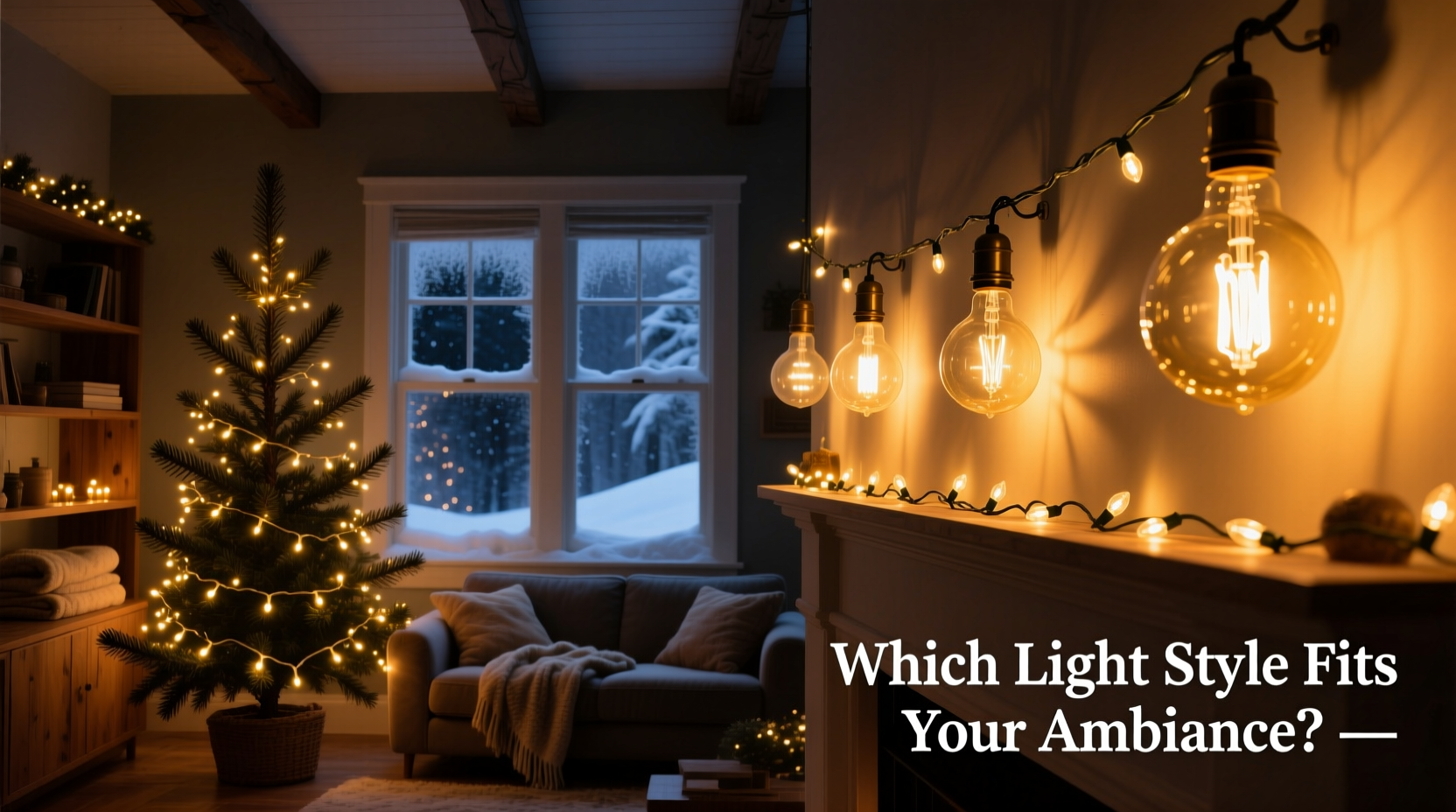
Human visual processing interprets scale before intensity. A string of 100 micro-incandescent minis emits roughly the same total lumen output as ten warm-white C9 bulbs—but the psychological effect diverges sharply. Mini lights create a field of light: soft, even, and immersive. Their small size allows tight spacing (often 2–4 inches apart), producing a continuous glow—ideal for outlining architecture or filling dense greenery without visual interruption. Big bulbs, by contrast, are discrete points of emphasis. Each C9 (typically 7–10 watts) casts a stronger localized pool of light with sharper falloff. This creates rhythm, punctuation, and presence—like notes in a musical phrase rather than a sustained chord.
This difference becomes visceral in practice. In a dimly lit living room, mini lights woven through a flocked artificial tree produce a gentle, snow-globe shimmer—intimate and dreamlike. Place the same tree with spaced C9s, and it reads as sculptural, almost theatrical: each bulb a deliberate accent against deep shadow. Neither is objectively superior—but one may align more closely with your desired emotional signature: hushed reverence versus joyful exuberance.
Tip: Stand three feet from your lit display and close one eye. If you see individual bulbs as distinct dots, you’re experiencing point-source ambiance. If you see a luminous halo or gradient, you’re in field-light territory—ideal for cozy, layered spaces.Ambiance Deep-Dive: Key Technical & Sensory Factors
Choosing between mini and big bulb lights hinges on five interlocking variables—not just aesthetics, but physics and perception:
- Color Temperature (CCT): Most mini lights are sold in 2700K–3000K (warm white), while big bulbs frequently offer wider ranges—including true vintage amber (2200K) and crisp daylight (5000K). Warmer CCTs (≤2700K) enhance intimacy; cooler tones read as modern or festive-but-formal.
- Light Diffusion: Mini bulbs use frosted or opaque plastic shells that scatter light broadly. Big bulbs—especially clear or transparent glass C7/C9—emit directional, slightly focused beams. This makes them better at highlighting textures (e.g., wood grain on a pergola) but harsher on bare skin.
- Spacing & Density: Standard mini sets run 100–200 bulbs per 25 ft; big bulb strings rarely exceed 25 bulbs per 25 ft. High density = ambient fill; low density = intentional voids and breathing room.
- Flicker & Dimming Behavior: Incandescent minis and big bulbs both offer natural thermal flicker (subtle, organic). LED versions differ: cheap mini LEDs often pulse unnaturally at low dim levels, while premium big-bulb LEDs (like those from Feit or GE) maintain smooth dimming curves down to 5%.
- Contextual Contrast: Big bulbs thrive where background darkness is deep (outdoor eaves, barn rafters). Minis excel where ambient light exists (indoor rooms, covered patios)—they layer gracefully without competing.
Real-World Ambiance Comparison: A Side-by-Side Table
| Factor | Mini Christmas Lights | Big Bulb Lights (C7/C9/G40) |
|---|---|---|
| Best For | Indoor trees, wreaths, garlands, mantels, stair railings, enclosed porches | Outdoor rooflines, large trees, pergolas, commercial displays, vintage-themed parties |
| Ambiance Character | Soft, enveloping, magical, delicate, “twinkling” | Bold, nostalgic, celebratory, architectural, “festive statement” |
| Shadow Quality | Diffuse, low-contrast, minimal hard edges | Defined, dramatic, with rich gradients and crisp silhouettes |
| Viewing Distance Sweet Spot | 0–6 feet (intimate proximity) | 6–30+ feet (architectural scale) |
| Sensory Overload Risk | Low—blends easily into environment | Moderate to high if overused indoors or in small spaces |
Mini Case Study: The Urban Apartment Balcony Transformation
Maya, a graphic designer in Portland, lived in a 600-square-foot apartment with a narrow, 4-ft-deep balcony overlooking a brick alley. Her goal: “cozy winter refuge,” not “holiday spectacle.” She first tried 50 warm-white C9 bulbs strung across the railing. At night, they cast sharp, isolated pools on the floorboards—bright enough to read by, but visually jarring against the dark brick wall. The effect felt clinical, not comforting.
She replaced them with 200-count LED mini lights—warm white, non-dimmable, with memory wire stems. She wound them tightly around potted rosemary and dwarf Alberta spruce, draped them in loose S-curves along the railing, and tucked a strand behind sheer ivory curtains. The result? A low-lit, golden perimeter. Light didn’t dominate; it *framed*. On rainy evenings, the soft reflection on wet brick created an illusion of depth and warmth. Neighbors commented on the “quiet magic” of her space—not its brightness, but its calm. Maya later added battery-operated mini lights inside mason jars on her coffee table. The continuity of scale—from balcony to living room—reinforced a unified, restful ambiance no single big bulb could replicate.
Expert Insight: The Psychology of Light Density
“High-density lighting triggers our brain’s ‘safe haven’ response—the same neural pattern activated by firelight or candle glow. It signals enclosure, protection, and warmth. Low-density lighting, especially with large sources, activates ‘celebration circuits’: dopamine release tied to novelty, social gathering, and visual excitement. Neither is ‘better’—but misaligning density with intent creates cognitive dissonance. A bedroom lit with C9s feels like a stage, not a sanctuary.” — Dr. Lena Torres, Environmental Psychologist & Lighting Researcher, Cornell University
Practical Decision Framework: 5-Step Selection Guide
Don’t guess. Use this sequence to match light type to ambiance goal:
- Define the emotional outcome: Is it “serene and intimate” (choose mini), “vibrant and communal” (big bulb), or “elegant and refined” (consider medium-scale G30 or vintage-style filament LEDs)?
- Measure viewing distance: Under 5 ft? Prioritize mini. Over 15 ft? Big bulbs gain clarity and impact. Between 5–15 ft? Test both—density matters more than size.
- Assess background light: Dark exterior? Big bulbs shine. Well-lit interior? Minis layer without glare. Mixed lighting (e.g., city windows + balcony)? Use minis for cohesion.
- Evaluate texture and material: Rough surfaces (wood, stone, burlap) benefit from big bulbs’ directional quality. Smooth or reflective surfaces (glass, polished metal, satin ribbon) pair better with mini lights’ diffuse glow.
- Confirm power and safety constraints: Mini lights draw less wattage per foot—critical for long indoor runs. Big bulbs require heavier-gauge cords and outdoor-rated outlets. Never daisy-chain more than three C9 strings without consulting an electrician.
FAQ: Clarifying Common Ambiance Misconceptions
Do LED mini lights ruin the “warm” ambiance of traditional incandescents?
No—if chosen wisely. Early LED minis suffered from blue-shifted whites and harsh color rendering (CRI < 80). Today’s premium options (e.g., NOMA Warm Glow or Twinkly Pro) deliver 2200K–2400K color temperatures with CRI > 95. They mimic the spectral curve of incandescent filaments, preserving the amber richness essential for cozy ambiance. Avoid budget LEDs labeled only “warm white”—verify Kelvin rating and CRI.
Can I mix mini and big bulb lights in one display without clashing?
Yes—with discipline. Use mini lights for background fill (e.g., wrapping branches, lining shelves) and big bulbs for focal accents (e.g., top of tree, center of wreath, main doorway). Maintain consistent color temperature (all 2700K, never mix 2200K and 3000K) and avoid placing them within 18 inches of each other. The key is hierarchy: minis recede; big bulbs advance.
Why do big bulb lights feel “more Christmassy” to so many people?
It’s deeply rooted in cultural encoding. From 1940s department store displays to mid-century suburban rooflines, large bulbs defined public holiday iconography for generations. Our brains associate their scale and spacing with collective celebration, generosity, and visible joy. Minis entered mass markets later (1970s onward) and became linked with personal, domestic, and craft-oriented traditions. Neither is more authentic—just different chapters in the visual language of the season.
Conclusion: Choose Intention Over Habit
Ambiance isn’t accidental. It’s the deliberate orchestration of light, space, and human perception. Mini Christmas lights excel when your priority is immersion—when you want light to cradle a moment, soften edges, and invite quiet reflection. Big bulb lights command attention, structure space, and broadcast celebration across neighborhoods and memories. The most compelling holiday environments often understand this duality: using minis to weave warmth into the fabric of daily life, and big bulbs to mark thresholds, honor tradition, or gather people under shared light.
Your choice shouldn’t be dictated by what’s easiest to hang or cheapest to replace. It should flow from the feeling you wish to cultivate—whether that’s the hush of snow falling on a lit window, or the resonant cheer of a porch aglow against winter dusk. Test both. Observe how light moves across your walls at 7 p.m. Notice where shadows fall, where warmth pools, where the eye rests. Then choose—not the brighter option, not the trendier one, but the one that makes your space feel unmistakably, authentically *yours*.
💬 Which light type shaped your most memorable holiday moment? Share your story—was it the delicate shimmer of minis on a grandmother’s tree, or the bold welcome of big bulbs on a childhood porch? Your experience helps others find their perfect ambiance.








