Sleep quality hinges on more than just hours logged—it’s deeply tied to the condition and comfort of your bed. Over time, even high-quality mattresses lose their supportive edge, leading to stiffness, pressure points, or restless nights. When discomfort strikes, many turn to a mattress topper as a budget-friendly alternative to buying new. But when does a topper truly help—and when is it merely a temporary fix masking deeper problems?
Understanding the line between a viable upgrade and a stopgap measure requires evaluating your current mattress’s structure, your sleep preferences, and long-term health goals. A well-chosen topper can transform a firm bed into a plush retreat or add cooling relief to an overheating surface. Yet, if your mattress sags, creaks, or no longer aligns your spine, no amount of foam or fiber will restore what’s structurally compromised.
Understanding the Role of a Mattress Topper
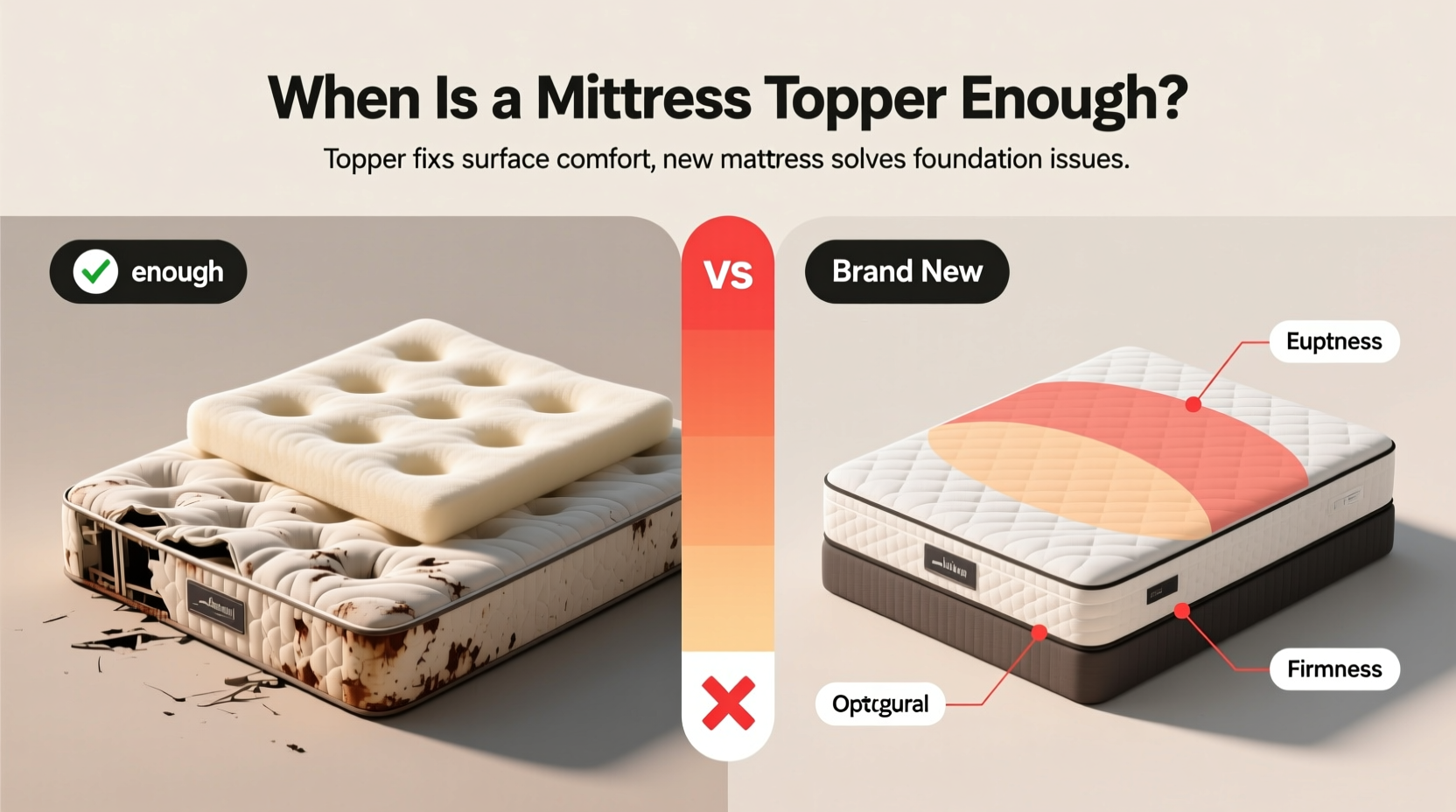
A mattress topper is a removable layer—typically 2 to 4 inches thick—placed on top of your existing mattress. It’s designed to enhance comfort, not replace foundational support. Materials vary widely: memory foam, latex, gel-infused foam, wool, down alternatives, and even air chambers. Each offers different benefits in terms of pressure relief, temperature regulation, and feel.
Topper use cases include:
- Softening a mattress that has become too firm over time
- Adding cushioning for side sleepers who need shoulder and hip relief
- Introducing cooling properties to counteract heat retention
- Extending the life of a still-functional mattress nearing mid-life
- Accommodating changing sleep preferences without replacing the entire bed
While effective in specific scenarios, a topper cannot correct structural flaws. It adds comfort, not support. If your base mattress lacks proper spinal alignment or has deep impressions, a topper may only delay the inevitable need for replacement.
Tip: Choose a topper with a breathable cover and at least a 3-inch thickness for noticeable comfort changes—especially if you're addressing firmness or temperature.When a Mattress Topper Is Enough
There are clear situations where a topper isn’t just sufficient—it’s the smartest choice. These typically involve a mattress that remains structurally sound but falls short in surface-level comfort.
Signs Your Mattress Still Has Life
- No visible sagging (less than 1.5 inches of indentation)
- Firm, consistent support across the sleeping surface
- No squeaking springs or broken coils
- No allergens, mold, or persistent odors
- You’ve owned it less than 7 years (within typical lifespan)
Common Issues a Topper Can Fix
- Firmness mismatch: You bought a firm mattress for back support but now find it uncomfortable for side sleeping. A plush memory foam or latex topper adds cushioning without sacrificing underlying support.
- Temperature control: Foam mattresses often trap heat. A phase-change material (PCM) or wool topper can wick moisture and regulate temperature effectively.
- Minor wear: Slight body impressions that don’t affect alignment can be smoothed over with a responsive topper.
- Partner comfort differences: Dual-layer toppers allow couples to customize each side of the bed without buying two separate mattresses.
“Many patients come in with neck and back pain thinking they need a new mattress. Often, all they needed was a pressure-relieving layer to complement a still-viable base.” — Dr. Lena Patel, Chiropractor and Sleep Posture Specialist
When a New Mattress Is the Only Real Solution
No amount of padding can compensate for a mattress that’s failed its primary job: supporting the spine. If your sleep suffers due to structural degradation, investing in a new mattress isn’t indulgence—it’s necessity.
Red Flags That Demand Replacement
- Visible sagging or indentations deeper than 1.5 inches
- Creaking or uneven surfaces indicating broken coils or foam breakdown
- Waking up with stiffness or pain that wasn’t present before using this bed
- Motion transfer so severe that partner movement disrupts sleep consistently
- Allergies or respiratory irritation possibly linked to dust mites, mold, or off-gassing from degraded materials
- Ownership beyond 8–10 years, especially with minimal rotation or care
In these cases, a topper might make the bed temporarily more comfortable but won’t resolve the root cause. You’re essentially placing a bandage on a failing foundation. The added layer could even worsen alignment by increasing sinkage without improving support.
The Cost-Benefit Reality
While a high-end topper can cost $150–$400, a quality mattress starts around $800 and goes up to $3,000+. However, consider longevity: a good mattress lasts 8–10 years; most toppers last 3–5. Spending $300 on a topper for a 9-year-old mattress may extend comfort by a year or two—but not much more.
Ask yourself: Are you delaying replacement because of cost, inconvenience, or uncertainty? If the mattress is past its prime, postponing replacement may compromise sleep health and lead to chronic discomfort.
Comparison: Topper vs. New Mattress – Key Factors
| Factor | Mattress Topper | New Mattress |
|---|---|---|
| Cost | $80–$400 | $800–$3,000+ |
| Lifespan | 3–5 years | 8–10 years |
| Support Level | No additional structural support | Full-body support with proper spinal alignment |
| Comfort Customization | High—can change feel quickly | Moderate—limited to model selection |
| Best For | Minor firmness issues, cooling needs, short-term fixes | Chronic pain, sagging, aging mattresses, long-term investment |
| Installation & Setup | Minutes—lay on top and secure | Hours—unboxing, expansion, acclimation |
Step-by-Step Guide: How to Decide What You Need
Follow this process to determine whether a topper will suffice or if it’s time for a new mattress:
- Inspect your mattress visually and physically. Run your hand across the surface. Look for dips, lumps, or exposed seams. Press down—if you feel springs or hard foam chunks, the core is breaking down.
- Test for sag depth. Place a ruler or level across the mattress. Measure any gap between the tool and the sleeping surface. Gaps over 1.5 inches indicate significant wear.
- Evaluate your sleep quality. Are you waking up with pain? Do you toss and turn more than before? Track symptoms for a week to identify patterns.
- Assess your mattress age. Most mattresses peak in performance between years 2–7. Beyond 8 years, replacement should be seriously considered—even if it “feels okay.”
- Try a rental or trial topper. Some brands offer 30-day trial toppers. Use one to test if added softness or cooling resolves your issues.
- Consult a sleep specialist or chiropractor. If pain persists, get professional input. Spinal misalignment from poor support can contribute to long-term musculoskeletal issues.
- Make your decision. If the base is solid and only surface comfort is lacking, go for a topper. If support is compromised, prioritize a new mattress.
Real-Life Example: Sarah’s Dilemma
Sarah, a 42-year-old office worker, began experiencing lower back pain after switching to remote work. Her 6-year-old hybrid mattress had always felt supportive, but lately, she noticed a dip forming under her hips. She considered a new bed but hesitated due to cost.
Instead, she tried a 3-inch gel memory foam topper. Within days, her hip pressure eased, and she slept more soundly. A follow-up with her physical therapist confirmed that while her mattress was slightly worn, it still provided adequate support. The topper addressed the comfort gap without requiring a full replacement.
In contrast, her neighbor Mark, using a 10-year-old innerspring mattress, tried the same topper. He found temporary relief but continued waking with stiffness. Upon inspection, his mattress had multiple sag zones and broken coils. His solution? A new latex hybrid mattress, which resolved his pain within two weeks.
The difference? Structural integrity. Sarah’s base was salvageable; Mark’s wasn’t.
Checklist: Should You Buy a Topper or a New Mattress?
Use this checklist to guide your decision:
- ☐ My mattress is less than 8 years old
- ☐ There are no deep sags (under 1.5 inches)
- ☐ The support feels consistent across the bed
- ☐ I only have issues with softness or heat retention
- ☐ I wake up refreshed, just slightly uncomfortable
- ☐ No strange noises or lumps when lying down
- ☐ I’m looking for a short-term or reversible change
If you answered “yes” to most of these, a topper is likely sufficient. If you checked fewer than four, strongly consider a new mattress.
FAQ
Can a topper fix a sagging mattress?
No. A topper can mask minor indentations but cannot fill deep sags or restore structural support. In fact, adding soft material over a sagging area may worsen spinal misalignment by increasing sinkage.
How thick should a topper be for real comfort improvement?
For noticeable change, choose at least 3 inches. Thinner toppers (1–2 inches) offer minimal impact. Thicker options (4 inches) provide dramatic softness but may alter bed height significantly.
Are there health risks to keeping an old mattress?
Yes. Mattresses over 8–10 years accumulate dust mites, mold, and allergens. Degraded foam can emit volatile organic compounds (VOCs). Poor support also contributes to chronic back and neck pain.
Conclusion: Make the Choice That Supports Your Long-Term Sleep Health
The decision between a mattress topper and a new mattress isn’t about frugality—it’s about function. A topper is a strategic enhancement, not a rescue tool. When your mattress still delivers solid support and you’re adjusting for comfort, temperature, or evolving preferences, a high-quality topper is a smart, economical upgrade.
But when the foundation fails—when you sink, ache, or struggle to find a comfortable position—no overlay will fix what’s broken beneath. Replacing a worn mattress is an investment in rest, recovery, and long-term well-being. Sleep isn’t a luxury; it’s a pillar of health. Treat your bed accordingly.
💬 Have you upgraded with a topper or replaced your mattress recently? Share your experience and help others make informed decisions about their sleep setup.








