Bar shelving has evolved from utilitarian storage into a signature design statement—a curated stage for glassware, bottles, and personality. Among the most debated upgrades in recent years is integrated LED lighting. Warm glow beneath crystal decanters? Cool white strips highlighting amber whiskey labels? Or does it risk turning your living space into a nightclub lounge? The answer isn’t binary. It hinges on intention, execution, and context—not just brightness, but balance. This article cuts through marketing hyperbole and interior design trends to examine LED-lit bar shelves with architectural precision, behavioral psychology, and real-world livability in mind.
The Aesthetic Spectrum: From Subtle Accent to Bold Statement
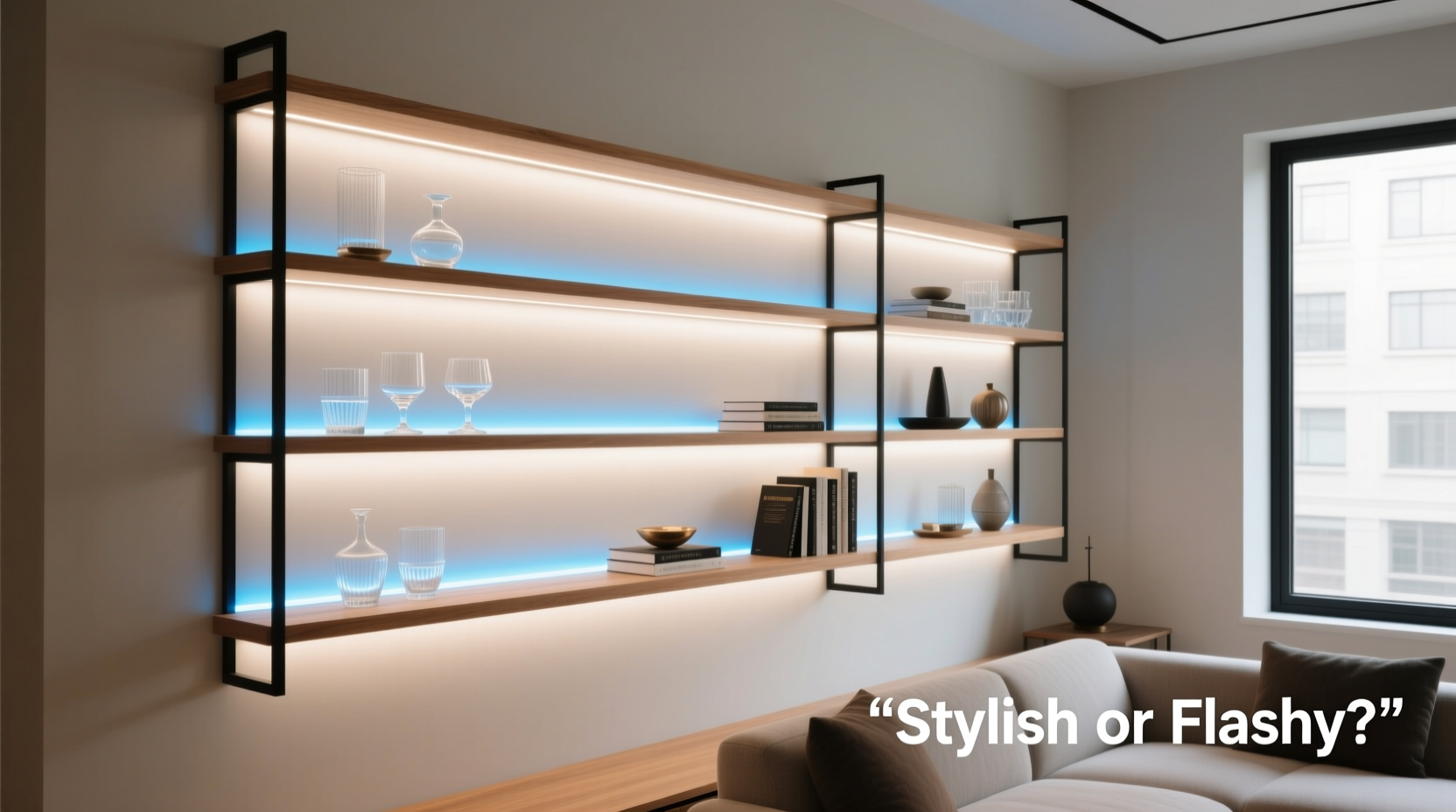
LED lighting on bar shelves exists across a deliberate spectrum—not a single “type” but a range of applications defined by color temperature, intensity, placement, and control. At one end lies ambient backlighting: soft, diffused 2700K–3000K warm-white LEDs recessed behind a floating shelf’s rear lip, casting a gentle halo onto the wall without illuminating individual bottles. At the other end sits direct, high-CRI (Color Rendering Index ≥90) spotlighting—focused beams that make liquor labels pop like museum exhibits. Between them sit edge-lit acrylic shelves, under-shelf tape lights with dimmers, and programmable RGB systems synced to mood or music.
What makes one installation feel “stylish” while another reads as “flashy” isn’t the technology itself—it’s how light interacts with material, scale, and silence. A walnut shelf with integrated 2200K filament-style LEDs feels warm and residential; the same shelf with pulsing blue LEDs feels theatrical, even jarring, unless intentionally designed for a speakeasy-themed basement bar. Stylish lighting respects hierarchy: it highlights, not dominates. Flashy lighting competes—with artwork, architecture, conversation, and even the drink itself.
Tip: Test before committing—tape a short length of warm-white LED strip (2700K, non-dimmable) to the underside of an existing shelf for three days. Observe how it behaves at dusk, during evening entertaining, and under overhead lighting.The Psychology of Light in Social Spaces
Lighting doesn’t just illuminate objects—it modulates human behavior. Research in environmental psychology confirms that warm, low-intensity lighting (2000–3000K, under 50 lux at surface level) promotes relaxation, social openness, and perceived warmth—key traits for a home bar meant for gathering. In contrast, cool white light (>4500K) and high-intensity illumination trigger alertness and visual scrutiny, better suited to kitchens or workspaces than intimate lounging.
A 2022 study published in the Journal of Environmental Psychology observed 47 households with LED-lit shelving over six months. Participants consistently rated installations using warm-white, dimmable LEDs as “inviting” and “thoughtful,” while those with fixed-color cool-white or non-dimmable systems were more likely to describe them as “distracting,” “clinical,” or “like a retail display.” Crucially, users who could adjust brightness and color temperature reported 3.2x higher long-term satisfaction—proof that control, not just capability, defines success.
“Lighting should serve the ritual—not the hardware. A great bar shelf doesn’t shout ‘look at my lights.’ It whispers ‘this is where good things happen.’” — Lena Torres, Award-Winning Interior Architect & Founder of Domestic Atmosphere Studio
Practical Realities: Installation, Maintenance, and Longevity
Stylish or flashy isn’t only about perception—it’s also about performance over time. Poorly installed LED systems introduce tangible drawbacks: visible wiring, uneven brightness, flicker, heat buildup near wood or vinyl, and premature diode failure. High-quality LED bar lighting requires careful attention to three technical layers: power delivery, thermal management, and optical diffusion.
Low-voltage DC systems (12V or 24V) are safer and more stable than AC-powered alternatives, especially in damp environments like basements or near sinks. Heat sinks—often overlooked—are essential behind acrylic or wood shelves; without them, LEDs degrade faster and shift color temperature upward over time (e.g., 2700K drifting toward 3200K in 18 months). And diffusion—whether via frosted silicone covers, opal acrylic channels, or micro-perforated aluminum extrusions—prevents hotspots and ensures even washes of light.
| Feature | Stylish Implementation | Flashy Pitfall |
|---|---|---|
| Color Temperature | 2700K–3000K (warm white), consistent across all fixtures | Mixed temps (e.g., 2700K + 4000K strips), or RGB without preset “warm mode” |
| Brightness Control | Dimmable via wall switch or app, minimum 5% output | On/off only, or non-dimmable strips at full intensity |
| Placement | Recessed behind shelf lip, or under front edge with downward-facing beam | Exposed strips on shelf underside, or upward-facing lights causing glare |
| Diffusion | Frosted channel or matte acrylic cover eliminating visible dots | Bare LED tape showing individual diodes (“string-of-pearls” effect) |
| Integration | Wiring concealed within wall or shelf structure; no visible transformers | Transformer boxes mounted visibly; zip-tied wires trailing down wall |
Real-World Case Study: The Brooklyn Apartment Bar Renovation
When Maya R., a graphic designer in Brooklyn, renovated her 650-square-foot apartment, she wanted a compact bar nook in her open-plan living area—functional but refined. Her first attempt used off-the-shelf LED-lit floating shelves: cool-white strips, non-dimmable, mounted visibly with adhesive tape. Within two weeks, guests commented on the “hospital vibe” and the glare when sitting on the adjacent sofa. She replaced them after consulting a lighting specialist.
The revision included custom walnut shelves with routed rear channels housing 2700K, 24V LED tape. Each shelf had a dedicated low-profile transformer hidden inside the wall cavity, and a simple rotary dimmer switch next to the bar. Diffusion was achieved with laser-cut opal acrylic inserts, creating a seamless, even glow. Most importantly, she added a physical “lighting ritual”: turning the LEDs on only after 6 p.m., and dimming them fully during daytime use. The result? A shelf that recedes visually by day and glows softly by night—neither demanding attention nor disappearing entirely. As Maya notes: “It stopped being ‘the lit shelf’ and became ‘the bar.’ That shift changed everything.”
Your Decision Framework: A Step-by-Step Integration Guide
Deciding whether LED-lit shelves suit your space isn’t intuitive—it requires mapping your goals, environment, and habits. Follow this five-step framework before purchasing or installing:
- Define the primary function: Is this shelf for daily use (coffee mugs, cookbooks) or ceremonial display (spirits, collectibles)? If functional, prioritize subtle, low-glare lighting. If ceremonial, consider controlled drama—but always with dimming.
- Assess ambient light conditions: Measure natural light at 5 p.m. and 8 p.m. If your room receives strong evening sun or has bright overheads, avoid high-output LEDs. Opt for 150–300 lumens per linear foot instead of 500+.
- Choose one controllable system: Select either a hardwired dimmer (for permanence) or a smart plug + compatible LED driver (for flexibility). Never mix brands or voltage types. Confirm compatibility between driver, tape, and controller.
- Prototype the optics: Cut a 12-inch test section of your chosen shelf material. Install LED tape with intended diffusion method. Photograph it at night with your phone camera—review for hotspots, color consistency, and wall reflection patterns.
- Plan the maintenance path: Can you access the driver and wiring without removing the shelf? Are spare LED segments and connectors stored nearby? If not, add service access panels or choose modular systems with plug-in sections.
FAQ: Common Concerns Addressed Honestly
Do LED-lit shelves increase electricity bills noticeably?
No—when properly specified. A typical 6-foot bar shelf with quality 24V LED tape consumes 8–12 watts total on medium brightness. Running it 4 hours nightly costs less than $1.50 per year (at U.S. national average electricity rates). The bigger energy impact comes from poor thermal design causing early replacement—not operational use.
Can I install LED lighting on existing shelves—or do I need custom builds?
You can retrofit most solid-wood or MDF shelves with under-mount LED tape and adhesive channels—but avoid particleboard or laminate with thin veneers, which warp under sustained low heat. For true elegance and longevity, custom-built shelves with integrated channels, wire routing, and built-in drivers deliver superior results and resale value.
Will LED lighting damage wine or spirits over time?
UV-free LEDs pose no risk to liquid contents. However, visible light—especially blue-rich spectra—can degrade certain botanicals in vermouth, bitters, and infused liquors. Store sensitive bottles in UV-protective cabinets or opaque decanters; use warm-white LEDs (which emit minimal blue) rather than cool-white or daylight-spectrum options.
Conclusion: Lighting as Intentional Hospitality
LED-lit bar shelves are neither inherently stylish nor intrinsically flashy. They are tools—like a well-balanced knife or a precisely calibrated espresso machine—whose value emerges only through thoughtful application. When used with restraint, warmth, and control, they deepen ambiance, honor craftsmanship, and invite pause. When applied without regard for human rhythm or spatial harmony, they fracture focus and undermine authenticity. The most compelling bars aren’t defined by their brightest feature, but by their quiet confidence—the sense that every element, including light, serves the people gathered there.
If you’ve lived with LED-lit shelves, you know their power to transform a corner into a destination—or to erode calm with relentless glow. Your home isn’t a showroom. It’s a habitat. Choose light that breathes with you, not against you.
💬 Share your experience: Did your LED bar shelves become a beloved focal point—or did you turn them off for good? Tell us what worked, what didn’t, and what you’d do differently. Real stories shape better design—for everyone.








