
Walk through any neighborhood in December 2024, and you’ll see a quiet but telling divergence: one home pulses with crisp, uniform white LEDs; another glows with the soft, uneven amber flicker of vintage-style incandescents. The LED revolution has been declared complete for over a decade — yet incandescent Christmas lights haven’t vanished. They’ve retreated, adapted, and found stubbornly loyal niches. This isn’t nostalgia alone. It’s a convergence of physics, perception, economics, and emotional resonance that continues to shape holiday lighting choices in ways manufacturers and energy analysts didn’t fully anticipate.
The question isn’t whether LEDs dominate — they do, accounting for over 92% of new light string sales in the U.S. per the 2024 Holiday Lighting Retail Survey (National Retail Federation). The real question is: why do the remaining 8% still matter — and what do their choices reveal about human priorities beyond efficiency? This article examines the technical, behavioral, and cultural dimensions behind today’s lighting decisions — without oversimplifying either technology or the people who choose them.
How LED Lights Changed the Game — and Where They Still Fall Short
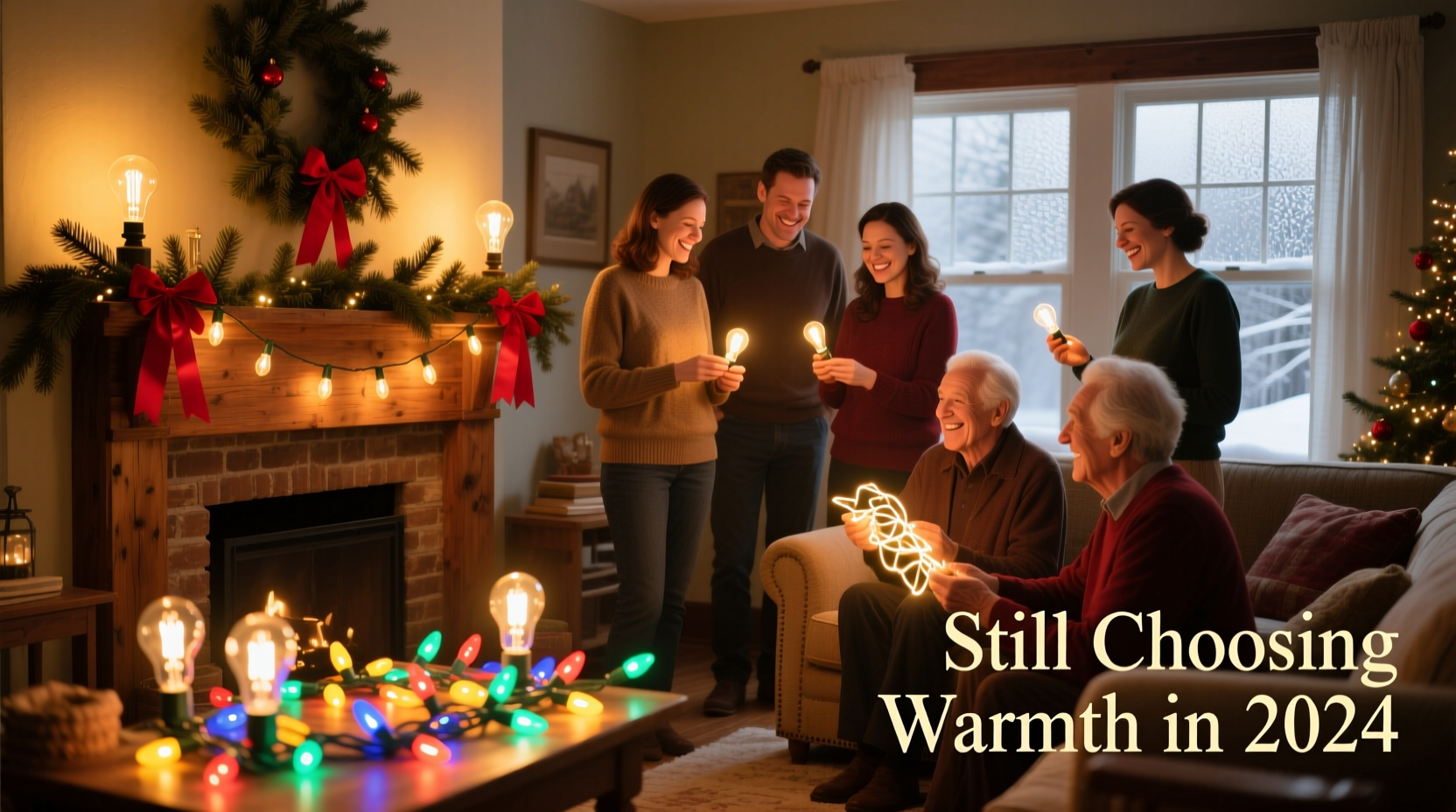
LEDs brought undeniable advantages: up to 90% less energy consumption, lifespans exceeding 25,000 hours (vs. 1,000–2,000 for incandescents), near-zero heat emission, and vastly improved durability. A single 100-light LED string draws roughly 4.8 watts; its incandescent counterpart consumes 40–60 watts. Over a six-week holiday season, running ten LED strings costs under $0.50 on average — while the same number of incandescent strings can exceed $7.50.
But performance gaps persist — not in raw metrics, but in perceptual fidelity. Early LEDs suffered from harsh color temperatures (5,000K+ “cool white”), narrow viewing angles, and rigid, plasticky housings. While modern premium LEDs have largely solved these issues — offering 2200K “vintage warm” options, wide-angle diffusion lenses, and copper-wire construction — budget-tier strings still dominate big-box shelves. These often deliver inconsistent color rendering (CRI scores below 75), visible pixelation at close range, and a sterile, “backlit screen” quality that lacks the organic depth of a heated tungsten filament.
Tip: If warmth matters, skip “warm white” labels and check the Kelvin (K) rating: true vintage tone sits between 2100K–2400K. Anything above 2700K reads noticeably cooler.The Enduring Appeal of Incandescent Lights — Beyond Nostalgia
Incandescents aren’t clinging on solely because Grandma used them. Their persistence reflects measurable sensory and functional qualities that LEDs still struggle to replicate economically:
- Natural dimming behavior: Incandescents dim smoothly and warmly — the filament cools as voltage drops, shifting toward deeper amber. Most LED dimmers require compatible drivers and often produce flicker or abrupt cut-off below 10% brightness.
- Full-spectrum light: Tungsten filaments emit continuous black-body radiation, rendering subtle reds, browns, and golds on ornaments and wood trim with unmatched richness. Even high-CRI LEDs (95+) have spectral spikes and valleys.
- Thermal signature: That gentle warmth isn’t just physical — it’s psychological. Studies in environmental psychology show ambient thermal cues reinforce perceptions of coziness and authenticity in domestic spaces, especially during winter months.
- Repairability & modularity: A burnt-out incandescent bulb is replaced in seconds with a $0.10 part. Most LED strings are sealed units — failure of one diode often cascades or disables an entire section.
This isn’t resistance to progress. It’s selective adoption — choosing the tool best suited to the desired outcome. For a minimalist modern facade, LEDs excel. For a heritage brick porch draped in heirloom glass balls? Many decorators and homeowners still reach for incandescents — not out of ignorance, but intention.
Real-World Usage: A Mini Case Study from Portland, OR
In late November 2023, landscape lighting designer Maya Chen was hired to refresh holiday lighting for the historic 1927 Willamette Heights bungalow owned by retired teacher Helen Riggs. Helen had used the same set of C7 incandescent bulbs since 1984 — stored carefully each January, tested annually, and lovingly rewired twice.
Maya presented three options: a premium 2200K LED retrofit kit ($149), a mid-tier LED string ($42), and a new incandescent set ($38). Helen chose the incandescents — not because she disliked LEDs, but because “the new ones don’t make the pinecones *glow* like these do. And when the fog rolls in off the river, you can *see* the heat shimmer around the bulbs — it feels alive.”
Maya compromised: she installed UL-listed heavy-gauge wiring and GFCI-protected outlets to mitigate fire risk, added a programmable timer to limit runtime, and sourced bulbs with argon-krypton gas fill for 25% longer life. The result? A display that meets modern safety standards while preserving the luminous character Helen associated with family, memory, and place. It wasn’t backward-looking — it was context-aware design.
Side-by-Side Comparison: What the Data Really Shows
| Feature | LED Lights (2024 Standard) | Incandescent Lights (2024 Premium) |
|---|---|---|
| Energy Use (100-bulb string) | 4.2 – 6.5 watts | 40 – 65 watts |
| Avg. Lifespan | 25,000 – 50,000 hours | 1,200 – 3,000 hours |
| Heat Output | Negligible (safe for dry foliage) | Significant (requires 3\" clearance from combustibles) |
| Color Accuracy (CRI) | 70–98 (varies widely by price tier) | 100 (full continuous spectrum) |
| Cost to Operate (6 wks @ $0.14/kWh) | $0.02 – $0.06 | $0.28 – $0.46 |
| Repairability | Low (section failure usually requires full replacement) | High (individual bulb replacement, standard E12/E17 base) |
What Experts Say — and What the Market Reveals
The National Electrical Manufacturers Association (NEMA) updated its holiday lighting safety guidelines in March 2024, explicitly acknowledging dual-market reality: “While LED adoption continues to accelerate, incandescent products remain in active, responsible use — particularly in residential heritage applications and theatrical settings where spectral quality and dimming fidelity are primary design criteria.”
“The idea that ‘efficient’ must mean ‘emotionally neutral’ is outdated. Today’s best lighting design balances kilowatt-hours with kilojoules of human feeling. When a client says ‘I want it to feel like Christmas morning in 1978,’ handing them a 2700K LED string isn’t enough. You need to understand why that memory has warmth, weight, and slight imperfection — and sometimes, that means specifying a 2200K incandescent with controlled runtime.”
— Derek Lin, Principal Lighting Designer, Lumina Collective & Adjunct Faculty, RISD Interior Architecture
Market data confirms this nuance. According to the 2024 ThomasNet Industrial Sourcing Report, sales of specialty incandescent bulbs (C7, C9, F15) grew 6.3% year-over-year — driven not by mass retailers, but by boutique lighting suppliers, architectural salvage yards, and Etsy artisans restoring vintage light frames. Meanwhile, LED sales growth slowed to 4.1%, suggesting market saturation among price-sensitive buyers — and maturation into a feature-driven segment.
Your Practical Decision Framework: 5-Step Selection Guide
Choosing between LED and incandescent isn’t binary — it’s contextual. Follow this sequence before purchasing:
- Define your primary goal: Is it maximum energy savings? Long-term hands-off operation? Authentic vintage ambiance? Or compatibility with existing vintage wiring/sockets?
- Assess exposure conditions: Outdoor use in freezing rain? High wind? Proximity to flammable materials (dry wreaths, wooden railings)? Incandescents require stricter clearance and weatherproofing.
- Calculate total lifecycle cost: Include purchase price + electricity (use DOE’s Lighting Cost Calculator) + expected replacement frequency. For infrequent, short-duration use (<100 hrs/year), incandescents may cost less over 5 years.
- Test color fidelity: View sample bulbs against matte red glass ornaments, natural wood, and cream-colored fabric in daylight and dusk. Does the light deepen tones or flatten them?
- Verify control compatibility: If using timers, smart hubs, or dimmers, confirm specifications. Not all “dimmable” LEDs work with leading-edge triac dimmers — and most incandescents do.
Frequently Asked Questions
Can I mix LED and incandescent strings on the same circuit?
No — and it’s unsafe to attempt. Incandescents draw significantly higher current and generate heat that can degrade LED wiring insulation. More critically, mixing loads disrupts ground-fault protection and may cause erratic dimmer behavior or overheating at junction points. Use separate circuits or dedicated outlets.
Are incandescent Christmas lights banned in the U.S.?
No. The 2007 Energy Independence and Security Act phased out general-service incandescent bulbs — but specifically exempted “special purpose” lamps, including decorative lighting (C7, C9, F15, miniature wedge-base), appliance bulbs, and plant-grow lights. They remain legal, widely available, and manufactured to updated safety standards (UL 588).
Why do some LED strings flicker or fail early?
Most premature failures stem from poor thermal management (LEDs mounted directly to thin plastic without heatsinking) or voltage surges. Cheap strings often omit transient voltage suppression (TVS) diodes. Look for UL 588 certification, aluminum-core wire (not copper-clad aluminum), and packaging that specifies “surge protected” or “10kV rated.”
Conclusion: Light Is Never Just About Lumens
The LED vs. incandescent debate in 2024 isn’t about obsolescence — it’s about intentionality. LEDs represent the triumph of engineering: efficient, scalable, and relentlessly optimized. Incandescents represent the persistence of craft: imperfect, warm, and deeply tied to human sensory experience. Neither is “wrong.” Each serves distinct purposes in our evolving relationship with light, memory, and home.
What matters isn’t which technology you choose — it’s whether your choice aligns with your values, environment, and vision. If you prioritize safety, longevity, and sustainability for large-scale outdoor displays, LEDs remain the unequivocal recommendation. If you’re illuminating a hand-carved nativity scene passed down for four generations — and the way light catches the grain of 19th-century walnut matters more than wattage — then a responsibly used incandescent string isn’t a step backward. It’s a conscious, informed act of continuity.
This holiday season, look past the packaging and specs. Hold a bulb in your hand. Turn it on beside a candle. Watch how it interacts with texture, shadow, and time. That moment — not the datasheet — reveals what kind of light you truly want to bring into your home.
💬 Have a story about your lighting choice? Did you switch to LEDs and love the change — or hold onto incandescents for a reason that goes deeper than specs? Share your experience in the comments. Real stories help others make confident, meaningful decisions.