LED bar lighting has surged in popularity among homeowners seeking cinematic flair, functional task illumination, or subtle mood enhancement. From under-cabinet kitchen strips to behind-TV backlighting and bedroom cove accents, these flexible, low-profile fixtures promise versatility and modernity. Yet many users report unexpectedly high electricity bills—or worse, disappointment: lights that flicker, cast uneven pools of glare, or fade within a year. The truth lies not in the technology itself, but in how thoughtfully it’s specified, installed, and managed. This isn’t about rejecting LED bars—it’s about deploying them with intention. Energy efficiency and atmospheric impact aren’t mutually exclusive; they converge only when technical specs align with human behavior and architectural context.
How LED bars actually consume energy—and why wattage alone misleads
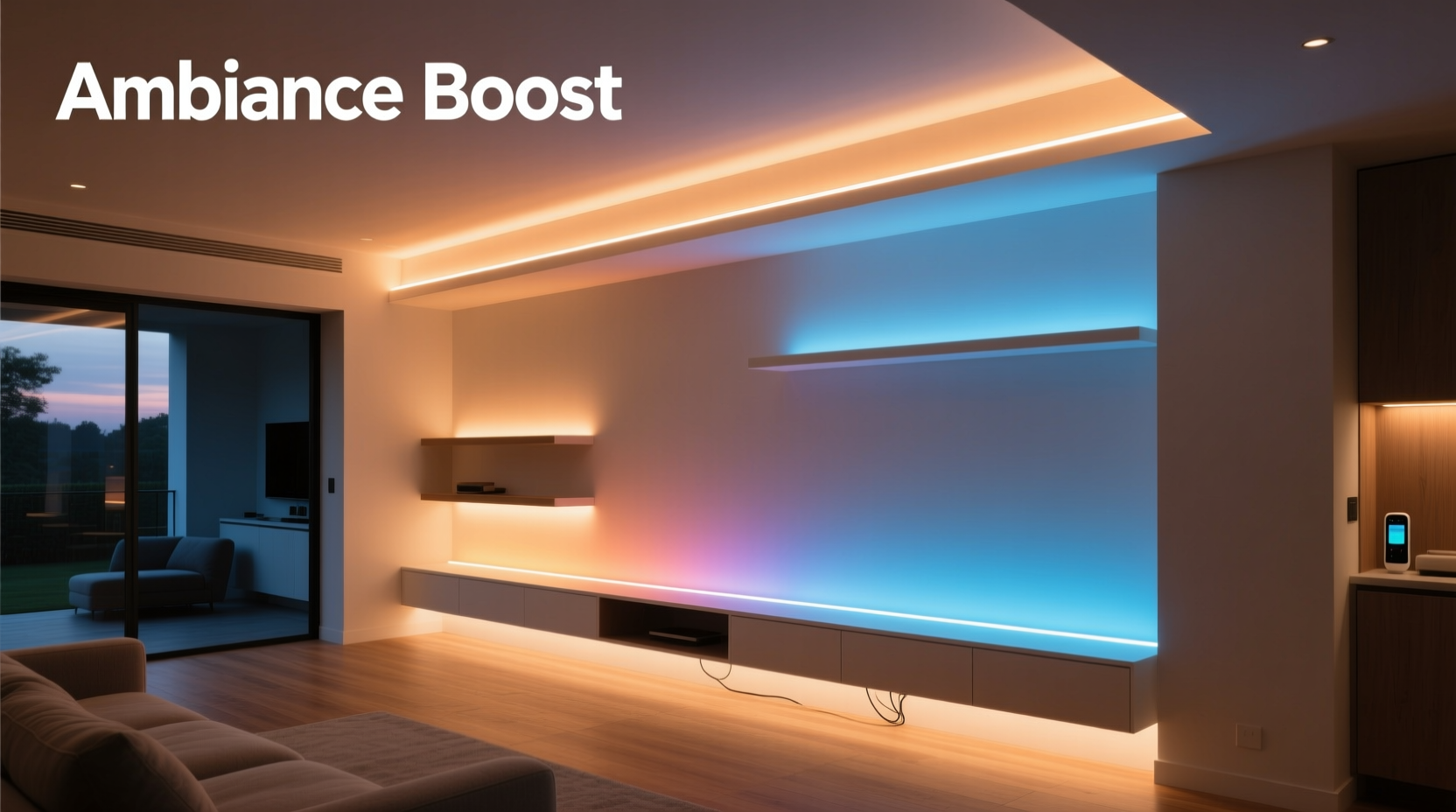
On paper, LED bars appear inherently efficient: most operate between 4–12 watts per meter, far less than halogen or incandescent alternatives. But real-world consumption depends on three interdependent variables—length deployed, brightness setting, and duty cycle (how long they’re powered on). A 3-meter strip running at full brightness for 10 hours nightly consumes ~270 kWh annually if rated at 9 W/m. That’s equivalent to running a modern refrigerator for two months—not trivial for an “accent” light.
More critically, many consumers overlook driver inefficiency and standby draw. Cheap constant-voltage drivers can lose 15–20% of input power as heat. Worse, some controllers—even those labeled “smart”—draw 0.5–1.2 watts continuously when “off,” adding up to 4–10 kWh/year per unit. Over five zones, that’s the annual energy use of a desktop PC left on 24/7.
Efficiency also degrades with poor thermal management. LEDs mounted directly to enclosed wood or drywall without heatsinking experience lumen depreciation up to 30% faster. Lower output means users instinctively crank brightness higher—creating a hidden energy feedback loop.
Tip: Always calculate total system wattage—including driver losses—and assume real-world usage is 2–3× longer than intended “ambiance time.” If you plan 2 hours of evening glow, budget for 6 hours of actual runtime.The anatomy of effective ambiance: color, control, and context
Ambiance isn’t created by light alone—it’s shaped by spectral quality, dynamic responsiveness, and spatial integration. Most budget LED bars use 2800K–3000K warm white chips with a Color Rendering Index (CRI) below 80. These flatten textures, mute rich tones in wood or fabric, and create a flat, “dull” warmth that feels artificial rather than inviting. In contrast, high-CRI (≥90) bars with tunable white (2700K–5000K) or full RGBWW (red-green-blue-warm-white-cool-white) enable nuanced layering: cool white for focused reading nooks, warm amber for winding-down rituals, or soft violet for immersive media viewing.
But even premium LEDs fail without intelligent control. Fixed-color bars wired to a wall switch offer zero adaptability. True ambiance requires dimming that’s smooth below 10% (not just “on/off” PWM), scene memory, and scheduling synced to circadian rhythms. Research from the Lighting Research Center shows that exposure to >250 lux of 4000K+ light between 10 p.m. and 2 a.m. suppresses melatonin by 50%—disrupting sleep more than a smartphone screen. Ambient lighting should support biology, not oppose it.
“Good ambient lighting doesn’t compete with architecture—it reveals it. A well-placed LED bar shouldn’t be seen; it should make the space feel deeper, warmer, or more grounded.” — Dr. Lena Torres, Architectural Lighting Designer & Fellow of the IALD
Real-world case study: The living room retrofit that cut energy use while doubling ambiance value
In Portland, Oregon, Maya R., a graphic designer and parent of two, installed 8 meters of generic RGB LED bars in her open-plan living-dining area: behind the sofa, under floating shelves, and along baseboard recesses. She used a $25 Bluetooth controller and ran all zones at full brightness for 5–6 hours nightly. Within three months, her electricity bill rose $22/month. More frustratingly, the colors clashed—cool blue behind the TV made skin tones sallow, while warm white under shelves washed out artwork.
She consulted a local lighting specialist who recommended a phased retrofit: • Replaced all bars with CRI 95+ tunable-white strips (3000K–4500K), 7W/m • Installed a DALI-2 compatible controller with occupancy sensing and sunset/sunrise scheduling • Added a dedicated 24V Mean Well driver (94% efficiency) instead of bundled adapters • Limited active zones to 3: TV backlight (dimmed to 15% during films), shelf accent (3000K, 20% brightness), and floor wash (4000K, 10% at night)
Result: Annual energy use dropped 68% versus the original setup. More importantly, Maya reported guests consistently commenting on the “calm depth” of the space—especially how the shelf lighting subtly highlighted book spines without glare, and how the floor wash created a gentle visual anchor after dark. The system now runs 4.2 hours average nightly, but feels richer, not sparser.
Smart selection checklist: 7 non-negotiables before buying
Don’t rely on Amazon ratings or “10,000 lumens!” claims. Use this field-tested checklist:
- Driver compatibility: Verify the strip voltage (12V or 24V) matches your driver’s output—and that the driver’s max load is ≥20% above your strip’s total wattage.
- CRI ≥90: Check manufacturer datasheets—not marketing copy—for CRI (Ra) and R9 (saturated red rendering). Avoid anything below Ra 85.
- Thermal rating: Look for aluminum-backed strips or integrated heatsinks if mounting to surfaces <40°C ambient (e.g., above refrigerators or near HVAC vents).
- Flicker index <0.1: Critical for video calls, reading, and migraine-prone users. Request test reports from reputable brands (e.g., Philips Hue, Sylvania, or Govee Pro series).
- IP rating for location: IP20 for dry indoor use only; IP65 required for kitchens (splashes), bathrooms (steam), or outdoor soffits.
- Controller protocol: Prefer Zigbee 3.0, Matter-over-Thread, or DALI-2 over proprietary Bluetooth/WiFi—ensures future interoperability and smoother dimming.
- Lifetime warranty: Reputable manufacturers (e.g., Luminous, Waveform Lighting) offer 5-year warranties covering lumen maintenance (L70 ≥25,000 hrs).
Energy vs. ambiance: A comparative decision framework
Not all LED bar applications serve the same purpose—or justify the same investment. Use this table to match your goal with technical requirements and realistic outcomes:
| Use Case | Key Priority | Minimum Viable Spec | Risk of Energy Waste | Atmosphere Impact Potential |
|---|---|---|---|---|
| Kitchen under-cabinet task lighting | Uniformity & glare control | 4000K, CRI ≥90, 120° beam angle, diffused lens | Low (if dimmed when not cooking) | Moderate (enhances functionality, not “mood”) |
| TV backlighting (bias lighting) | Color accuracy & flicker-free operation | CRI ≥95, flicker index <0.05, D65 white point (6500K) | High (if left on 24/7 or mismatched to screen content) | High (reduces eye strain, deepens perceived contrast) |
| Bedroom cove lighting | Circadian alignment & dimming finesse | Tunable white (2700K–4000K), 0.1–100% smooth dimming, auto-schedule | Moderate (if cool white used late at night) | Very High (supports relaxation or alertness based on timing) |
| Stairway step lighting | Safety & reliability | IP65, motion sensor + manual override, 3000K max | Very Low (motion-triggered, short duration) | Low (functional, not atmospheric) |
| Accent lighting for art or shelving | Beam precision & color fidelity | 3000K, CRI ≥95, R9 >90, narrow beam (25°–40°) | Moderate (if over-bright or poorly aimed) | High (reveals texture, creates hierarchy) |
Step-by-step: Optimizing existing LED bars without rewiring
You don’t need to rip out installed strips to improve efficiency and ambiance. Follow this sequence:
- Measure actual power draw: Plug your driver into a Kill-A-Watt meter for 24 hours. Note baseline consumption and standby draw.
- Map usage patterns: Log when each zone is active (e.g., “TV bar: 7–11 p.m. daily; shelf bar: 6–9 p.m. Mon–Fri”). Identify redundant overlaps.
- Calibrate brightness: Dim each zone to the lowest perceptible level that still achieves intent (e.g., TV bias light should be ~10% screen luminance—use a phone light meter app).
- Add scheduling: If using smart controls, set automatic off-times (e.g., all bars off by 11:30 p.m.) and sunrise ramp-up (e.g., 5% brightness at 6 a.m.).
- Introduce adaptive triggers: Add a $15 PIR sensor to stair or closet bars; pair with voice commands (“Alexa, dim living room to 20%”) to avoid wall-switch overrides.
- Replace one driver: Swap the least efficient driver first (often the bundled one) with a certified 90%+ efficient model. Measure savings—then scale.
- Re-evaluate after 30 days: Compare Kill-A-Watt data. If standby draw exceeds 0.3W/unit, replace controllers or add smart plugs with physical off switches.
FAQ: Addressing common misconceptions
Do cheaper LED bars really cost more over time?
Yes—significantly. A $15 5-meter strip may fail within 12–18 months due to capacitor degradation or thermal runaway. Replacement labor (removing old adhesive, repositioning) often exceeds the cost of the strip itself. Meanwhile, a $45 premium strip with 50,000-hour L70 rating, thermal management, and a 5-year warranty delivers consistent output and avoids repeat installation costs. Over five years, the premium option typically saves 30–40% in total cost of ownership.
Is RGB lighting inherently wasteful for ambiance?
Not inherently—but commonly misapplied. Pure RGB strips lack a dedicated white channel, forcing white light generation via red+green+blue mixing. This reduces efficiency by 30–50% versus dedicated white LEDs and often yields poor color temperature stability. For ambiance, tunable-white or RGBWW strips deliver richer, more stable whites and smoother transitions—using less energy to achieve higher perceptual quality.
Can LED bars cause light pollution indoors?
Absolutely—if improperly shielded or over-bright. Uncontrolled upward spill from ceiling coves or glare from undershelf strips contributes to visual clutter and pupil constriction, increasing eye fatigue. Ambient light should be indirect, diffuse, and layered—never direct or specular. Always use frosted silicone diffusers (not clear lenses) and mount bars recessed or behind baffles to eliminate visible LED dots.
Conclusion: Intentional light, not incidental illumination
LED bar lighting sits at a crossroads: it can be the quiet hero of your home’s sensory experience—or an invisible drain on resources and tranquility. The difference hinges on moving beyond aesthetics to embrace physics, physiology, and practicality. Choose for longevity, not just lumens. Design for human rhythms, not just remote-control convenience. Install for thermal reality, not just adhesive strength. When you treat light as infrastructure—not decoration—you gain ambiance that breathes with your life, not against it. Start small: audit one zone this week. Measure its draw, observe when and how it’s used, then adjust brightness, timing, or diffusion. Notice how the space feels—not just how it looks. That awareness is the first, essential watt saved.
💬 Your experience matters. Did optimizing your LED bars transform your space—or reveal unexpected pitfalls? Share your setup, wattage savings, or ambiance breakthroughs in the comments. Let’s build a smarter, more intentional lighting culture—one bar at a time.








