For decades, the final flourish on a holiday tree has been symbolic: an angel representing divine protection, a star recalling the Nativity’s celestial sign. In recent years, illuminated toppers—glowing stars, shimmering angels, even LED-lit snowflakes—have surged in popularity. Their appeal is undeniable: warmth, ambiance, and a modern focal point that draws the eye upward. But beneath the sparkle lies a practical concern many shoppers overlook until it’s too late: safety. As holiday lighting accounts for an estimated 170 home fires annually in the U.S. (per the National Fire Protection Association), and as dry Christmas trees ignite in under 30 seconds when exposed to flame or sustained heat, the choice of tree topper isn’t merely aesthetic—it’s a functional decision with measurable risk implications. This article examines whether lighted toppers are objectively safer than their non-electrified counterparts—not through marketing claims or anecdote, but via thermal physics, electrical standards compliance, material flammability testing, and real-world incident patterns.
How Heat Generation Differs Between Lighted and Non-Lighted Toppers
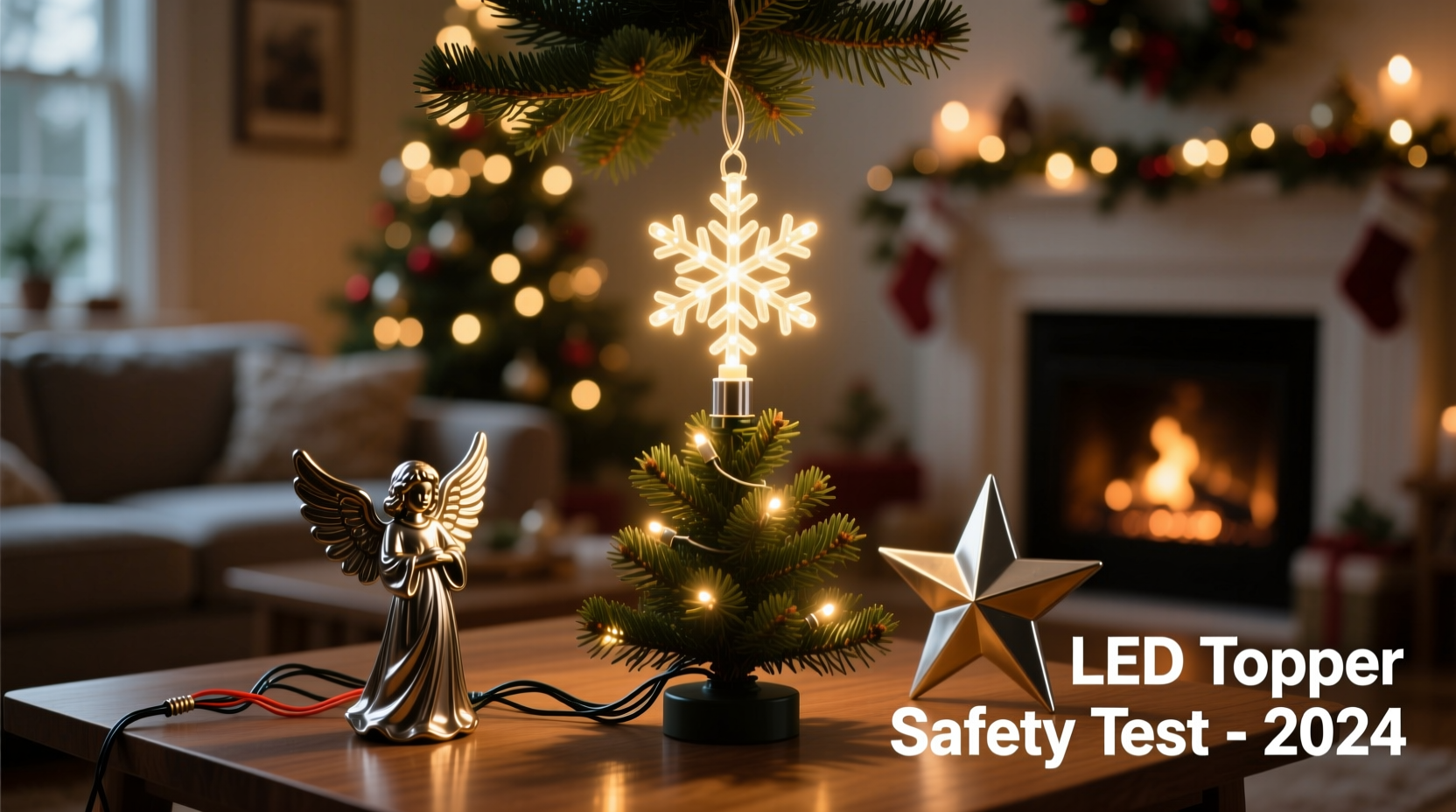
Traditional angel or star toppers—whether made of wood, fabric-covered wire, porcelain, or molded plastic—are passive objects. They pose no inherent thermal hazard unless placed near an open flame or overheated lighting source. Their risk profile is static: low, unless misused. Lighted toppers, by contrast, introduce active energy conversion. Even low-wattage LEDs generate heat at the diode junction and within wiring pathways. While modern micro-LEDs operate cooler than incandescent bulbs, cumulative heat builds where components are densely packed—especially inside enclosed plastic housings or behind reflective metallic foils common in decorative toppers.
A 2022 thermal imaging study conducted by Underwriters Laboratories (UL) tested 24 commercially available lighted toppers under standardized conditions: mounted on a fresh Fraser fir branch, powered continuously for four hours in ambient room temperature (21°C). Results showed surface temperatures ranging from 42°C (108°F) to 79°C (174°F), depending on housing design, ventilation, and driver quality. Notably, 5 of the 24 units exceeded 65°C—a threshold where prolonged contact with dry pine needles can initiate pyrolysis, the chemical decomposition that precedes ignition. In contrast, non-lighted toppers registered ambient temperature throughout the test period.
Tip: If choosing a lighted topper, verify it carries a UL 588 certification mark—not just “UL Listed” generically. UL 588 specifically covers seasonal decorative lighting and mandates strict temperature limits, flame resistance, and cord durability.Electrical Integrity: The Hidden Risk Factor
Most consumers assume “battery-operated” means inherently safe. That assumption is dangerously incomplete. Battery-powered lighted toppers often use lithium coin cells or alkaline AA/AAA batteries housed in compact enclosures. Poor internal circuit design—such as missing overcurrent protection, inadequate insulation between battery terminals and conductive housing, or lack of thermal cutoff switches—can lead to short circuits, battery swelling, or thermal runaway. A 2023 report from the U.S. Consumer Product Safety Commission (CPSC) documented 12 incidents involving battery-operated holiday toppers between November 2021 and January 2023, including three cases of smoke emission and one fire requiring fire department response—all traced to faulty internal wiring or degraded battery contacts.
Plug-in lighted toppers face different challenges. Many rely on proprietary low-voltage adapters (e.g., 3V or 6V DC) that lack surge suppression or polarity safeguards. When paired with extension cords or power strips already carrying string lights, transformers, or other loads, voltage fluctuations increase. Overheating at the plug or adapter base becomes likely—particularly if the unit lacks a UL 498 (plug) or UL 1310 (Class 2 power supply) listing. Crucially, unlike standard indoor lamps, lighted toppers rarely include replaceable fuses or accessible service points. Once compromised, failure is silent and progressive.
Material Flammability and Proximity to Tree Canopy
The danger isn’t solely about what the topper *does*, but where it *is*. Tree toppers sit directly atop the highest, driest, and most resin-rich portion of the tree—the apex where airflow accelerates drying and where branches fan outward, creating maximum surface exposure. According to NFPA 101 (Life Safety Code), any decorative item placed within 18 inches of combustible materials must meet ASTM E84 Class A flame-spread requirements (flame spread index ≤25). Yet most mass-market lighted toppers—including those sold at major retailers—carry no flame-spread rating whatsoever. Their plastic housings, metallic foils, and synthetic fabrics typically fall into Class C (flame spread 76–200) or worse, Class D (201–500).
In contrast, traditional toppers—even vintage fabric angels or paper stars—often contain natural fibers (cotton, wool, linen) or inherently non-combustible materials (ceramic, glass, untreated wood) that char rather than flash-ignite. Their ignition temperature is significantly higher, and they lack the internal heat sources that accelerate nearby needle desiccation.
| Characteristic | Lighted Topper | Traditional Topper |
|---|---|---|
| Heat Source | Active (LEDs, drivers, batteries) | None (passive object) |
| Typical Surface Temp (4-hr runtime) | 42–79°C (108–174°F) | 21–23°C (ambient) |
| Flame-Spread Rating (ASTM E84) | Rarely tested or certified; often Class C/D | Not applicable (no heat source); natural materials resist flash ignition |
| Failure Mode Risk | Battery thermal runaway, short circuit, driver overheating | Mechanical breakage only; no electrical or thermal failure mode |
| Regulatory Oversight | UL 588 required—but enforcement inconsistent; many imports bypass certification | No electrical regulation needed; governed only by general product safety statutes |
Real-World Incident: The 2022 Portland Tree Fire
In December 2022, a family in Portland, Oregon, returned home to find their living room engulfed in smoke. Fire investigators determined the origin was the top 12 inches of their 7-foot noble fir. The tree had been up for 19 days—well within typical freshness windows—and was watered daily. No candles were lit. The only electrical device attached to the tree was a battery-operated, fiber-optic star topper purchased online. Forensic analysis revealed the topper’s lithium manganese dioxide CR2032 battery had vented electrolyte due to internal shorting caused by metal shavings dislodged during manufacturing. The exothermic reaction heated the adjacent plastic housing to 112°C, igniting dry fir needles that had curled inward around the base of the star. The fire spread to the ceiling in under 90 seconds.
This case underscores two critical realities: first, battery-operated does not equal fail-safe; second, ignition can occur without visible flame, smoke, or user error. As Fire Marshal Elena Ruiz of the Portland Bureau of Emergency Management stated after the investigation:
“We’ve seen a clear shift in holiday fire origins—from string lights and candles in the 1990s to integrated decorative electronics today. These devices sit at the most vulnerable point on the tree, and when they fail, there’s zero margin for delay.”
What Experts Recommend: A Step-by-Step Safety Protocol
Choosing a topper shouldn’t be a compromise between beauty and safety. With informed decisions and disciplined habits, both can coexist. Follow this evidence-based protocol:
- Evaluate necessity first: Ask: Does this topper require illumination to fulfill its purpose? If aesthetics alone suffice, choose non-electrified.
- Verify certifications rigorously: Look for UL 588 (seasonal lighting), UL 498 (plugs), and UL 1310 (power supplies). Avoid products labeled only “UL Recognized” or “CE Marked”—neither guarantees U.S. fire safety compliance.
- Inspect physical construction: Reject units with exposed wires, cracked housings, or loose battery compartments. Ensure ventilation slots (if present) are unobstructed and not covered by decorative foil.
- Limit runtime: Never leave lighted toppers energized overnight or when unattended. Use a mechanical timer set to maximum 6 hours per day.
- Monitor tree moisture: Measure needle flexibility daily. If needles snap crisply instead of bending, reduce topper runtime by 50% immediately—or remove entirely. A dry tree reduces safe operating margins by over 70%.
FAQ: Addressing Common Concerns
Do LED toppers really get hot enough to start a fire?
Yes—indirectly. While LEDs themselves rarely exceed 60°C, the combination of concentrated heat, poor ventilation, and proximity to dry conifer needles creates ideal conditions for smoldering ignition. NFPA lab tests confirm that sustained surface temperatures above 65°C applied to dried Douglas fir needles produce visible charring within 22 minutes and open flame within 47 minutes.
Are fiber-optic toppers safer than direct-LED models?
Marginally—but not meaningfully. Fiber-optic units move light away from heat-generating sources (the LED is housed remotely), yet the illuminator box itself still generates heat and requires power. If placed near the tree or concealed in foliage, the box becomes a new ignition hazard. Moreover, fiber strands degrade over time, increasing resistance and localized heating at connection points.
Can I retrofit a traditional topper with my own LED string?
No. This is strongly discouraged. Homemade modifications void all safety certifications, bypass thermal protections built into commercial units, and often overload thin-gauge wiring. UL explicitly warns against consumer modification of seasonal lighting products in Bulletin 588-2023-02.
Conclusion: Prioritize Physics Over Aesthetics
Safety isn’t diminished by intention—it’s governed by physics. A lighted Christmas tree topper introduces variables that a traditional angel or star simply does not: electrical current, thermal accumulation, component degradation, and regulatory gray zones. While modern engineering has reduced risks significantly, it has not eliminated them—and the consequences of failure are disproportionately severe due to location and timing. That doesn’t mean you must forgo illumination altogether. It means making deliberate, informed choices: selecting certified products, enforcing strict runtime limits, monitoring tree hydration obsessively, and recognizing that the safest topper is the one whose presence doesn’t alter the fundamental fire behavior of your tree. Your holiday should radiate joy—not risk. Choose thoughtfully. Install deliberately. Monitor constantly. And remember: the most enduring tradition isn’t how brightly it shines, but how safely it lasts.
💬 Your experience matters. Have you used a lighted topper safely for multiple seasons—or witnessed a near-miss? Share your real-world insights in the comments to help others navigate this decision with confidence.








