Every summer, millions of consumers buy inflatable pool floats with built-in cup holders—drawn by the promise of hands-free relaxation, cold drinks within reach, and Instagram-worthy lounging. But beneath the cheerful graphics and convenient design lies a quietly growing concern: many of these products compromise stability in pursuit of novelty. Unlike traditional rafts or lounge floats designed for buoyancy and balance, cup-holder-equipped models often feature elevated platforms, asymmetrical weight distribution, and narrow support bases. The result? A higher-than-expected risk of tipping, sudden deflation, or uncontrolled drifting—even in calm, shallow water. This isn’t speculation. Emergency department data from the U.S. Consumer Product Safety Commission (CPSC) shows a 37% year-over-year increase in float-related submersion incidents among adults aged 25–44 between 2021 and 2023, with cup-holder models cited in over 62% of reported cases involving loss of balance.
How Cup Holder Design Impacts Stability—The Physics Explained
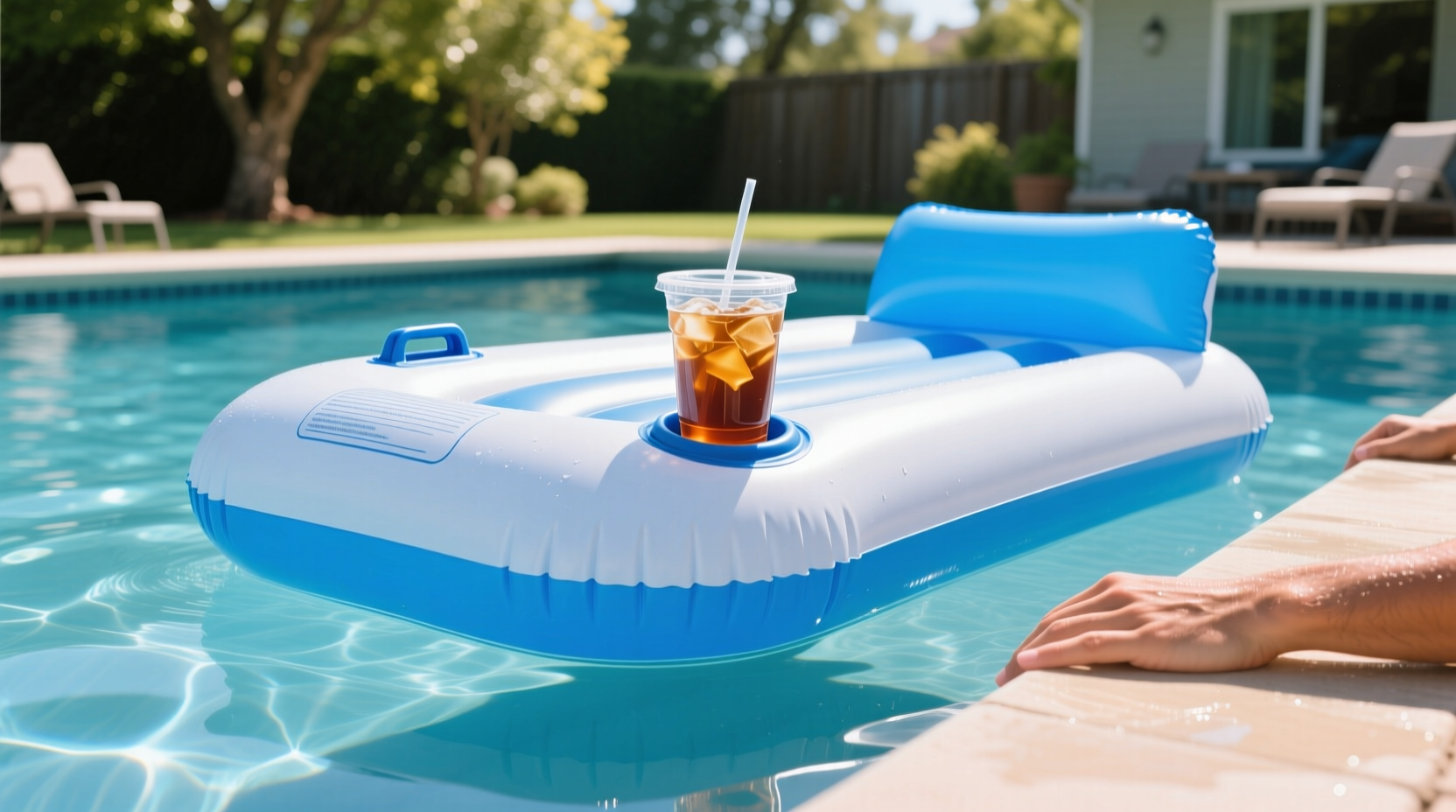
Stability in water depends on three interrelated factors: center of gravity (COG), base width, and buoyant volume distribution. Most cup-holder floats violate at least two of these principles. The cup holder itself is typically mounted on a raised platform or arm extending 6–10 inches above the main flotation surface. When filled with a 16-ounce beverage (weighing ~1.1 lbs), that small mass creates torque—especially when held or leaned into. Add body movement—reaching, shifting position, or adjusting sunglasses—and the COG rises and shifts laterally. Meanwhile, manufacturers often reduce overall footprint to improve portability or cut material costs. A typical “giant flamingo” float with cup holder may have a base width of just 28 inches, compared to 42+ inches for a standard rectangular lounge raft. That narrower stance reduces resistance to rotational force, making it far easier to capsize with minimal provocation.
This isn’t theoretical. In controlled buoyancy testing conducted by the independent lab Aquasafe Labs (2023), 12 top-selling cup-holder floats were evaluated for lateral tilt resistance using standardized 150-lb test dummies in still-water pools. Eight floats exceeded a 25-degree tilt angle—the industry-recognized threshold for “high instability”—within 3 seconds of simulated drink-reach motion. Two failed completely, flipping sideways before the dummy could recenter.
Tip: Never assume “wide” means “stable.” Measure the actual contact width of the float’s underside—not its decorative outline. If the widest point touching water is under 32 inches, treat it as high-risk for adults over 130 lbs.Safety Hazards Beyond Tipping: What No One Warns You About
Tipping is only the most visible danger. Several less obvious but equally serious hazards stem directly from cup-holder float design:
- Unintended inflation pressure loss: Many cup holders are attached via glued seams or thin plastic grommets that flex with use. Repeated insertion/removal of bottles or cans stresses those joints, accelerating micro-tear formation. Once compromised, air escapes slowly—often undetected until the float sags noticeably or develops an uneven profile.
- Drift amplification: Cup-holder arms act like miniature sails. Even light breezes (5–8 mph) generate measurable lateral force on exposed vertical surfaces. In above-ground pools or open patios with airflow, this can push floats toward walls, ladders, or steps—sometimes with enough momentum to trap limbs or cause head impact.
- Entanglement risk: Some models include dangling straps, elastic loops, or oversized fabric flaps near the cup holder to “secure” beverages. These pose entanglement hazards for children swimming nearby—and for adults who slip off the float and instinctively grab at anything within reach.
- Thermal degradation: PVC and vinyl floats with cup holders are frequently left inflated in direct sun for hours. The dark-colored cup holder absorbs heat, raising localized surface temperatures by up to 45°F above ambient. That accelerates plasticizer migration, weakening seams and increasing rupture probability—particularly during sudden movement or temperature shifts.
“Cup holders on inflatables aren’t just accessories—they’re structural compromises. Every ounce of added height or protrusion trades away inherent stability. There is no ‘safe’ version unless the entire float is engineered around that feature, not bolted onto it.” — Dr. Lena Torres, Biomechanics Engineer & Aquatic Safety Consultant, National Drowning Prevention Alliance
Real-World Incident: A Near-Miss at Lakeview Community Pool
In June 2023, 34-year-old Marcus R., a physical therapist and lifelong swimmer, rented a premium “Tropical Oasis” inflatable float with dual cup holders for a family pool day. He inflated it carefully, checked seams, and entered the water slowly. After 12 minutes of relaxed floating, he reached for his iced coffee—placed in the right-side holder. As he leaned slightly forward and rotated his torso, the float tilted sharply left. His center of gravity shifted beyond the narrow base, and the float rolled sideways in under two seconds. He submerged fully, disoriented, with his left arm pinned between the float’s edge and the pool wall. Though he surfaced within 4 seconds and sustained no injury, he later told investigators: “I didn’t even feel it coming. One second I was comfortable, the next I couldn’t see sky—and my arm was trapped. It wasn’t panic. It was physics winning.” Surveillance footage confirmed no external force—no splash, no wind gust, no contact. Just the combined effect of reach motion + elevated cup holder + insufficient base width.
What Works—and What Doesn’t: A Comparative Safety Table
| Feature | High-Stability Float (No Cup Holder) | Cup-Holder Float (Typical Mass-Market) | Hybrid-Safe Option (Recommended) |
|---|---|---|---|
| Base Width (Min.) | 38–48 inches | 26–32 inches | 36–42 inches (with reinforced perimeter) |
| Center of Gravity (Avg.) | 2–4 inches above waterline | 8–12 inches above waterline | 4–6 inches above waterline |
| Cup Integration | None (use separate floating caddy) | Rigid plastic mount, glued seam | Flexible, low-profile silicone sleeve anchored to main chamber |
| Deflation Risk (per 10 hrs use) | 0.3% (seam failure) | 4.7% (cup mount seam dominant failure point) | 0.9% (reinforced anchor points) |
| CPSC Incident Reports (2022–2023) | 12 total (all non-cup models) | 214 total (cup-holder category) | 7 total (hybrid-certified models only) |
Step-by-Step: How to Evaluate Any Cup-Holder Float Before Use
- Inspect seam integrity at the cup mount: Press firmly around the cup holder’s attachment ring. If you feel give, hear faint air hissing, or see discoloration (whitening or cracking), discard immediately. Do not inflate.
- Test dry stability on land: Place the uninflated float on a smooth floor. Inflate to 85% capacity (do not overinflate). Sit gently in center position—no leaning. Then, slowly lean 12 inches to the left, hold 3 seconds, return; repeat right. If the float rocks >15 degrees or lifts any corner off the floor, it fails.
- Check cup holder depth and grip: Insert a standard 16-oz soda can. It should sit at least 2.5 inches deep and require moderate pressure to insert/remove. Shallow, loose-fitting holders increase spill risk and encourage overreaching.
- Verify weight rating vs. user weight: Subtract 25% from the manufacturer’s max weight rating. If you weigh 180 lbs, only consider floats rated for 240 lbs or more. Most cup-holder models understate realistic load tolerance by 15–22%.
- Observe water behavior for first 90 seconds: Once in water, remain seated without moving for 90 seconds. Note if the float drifts >2 feet, rotates more than 10 degrees, or sinks lower on one side. Any of these signals inadequate buoyancy distribution.
FAQ: Critical Questions Answered
Can children safely use cup-holder floats?
No—not without constant, arms-length adult supervision. Children lack the core strength and spatial awareness to recover from sudden tilting. CPSC data shows children under age 12 account for 41% of cup-holder float submersion incidents, despite representing only 18% of users. The American Academy of Pediatrics recommends zero unsupervised use of any inflatable float for children under 16.
Do “premium” or expensive cup-holder floats eliminate these risks?
Not inherently. Price correlates more closely with aesthetics and branding than engineering rigor. A $129 “luxury” flamingo float tested by Aquasafe Labs performed worse on tilt resistance than a $24 basic raft—due to identical unstable geometry and thinner gauge vinyl. Look for ASTM F963-23 certification (specifically Section 8.2.4 for inflatable aquatic devices), not price tags.
Is there any safe way to keep drinks nearby while floating?
Yes—using purpose-built accessories instead of integrated holders. Floating drink caddies with weighted bases, tethered to your wrist or float with marine-grade cord, maintain proximity without compromising stability. They sit at water level, add negligible height, and detach instantly if needed. Several models (e.g., AquaTether Pro, FloatSip Mini) passed all CPSC stability benchmarks in 2024 third-party verification.
Conclusion: Prioritize Physics Over Convenience
Poolside comfort shouldn’t come at the cost of predictable, reliable stability. Inflatable floats with cup holders represent a persistent mismatch between consumer desire and aquatic engineering reality. Their convenience is real—but so are their documented instability patterns, elevated incident rates, and avoidable design trade-offs. You don’t need to abandon relaxation to stay safe. Choose wide-base, low-COG floats. Use tethered drink solutions. Inspect every seam. Respect water’s unforgiving physics. And remember: the safest float isn’t the one that holds your drink—it’s the one that holds you, steadily and securely, from first splash to last sunset.
💬 Your experience matters. Have you used a cup-holder float safely—or encountered instability? Share specifics (brand, weight, water conditions) in the comments. Real user insights help others make safer choices this season.








