Furoshiki is not merely a wrapping technique—it’s a 1200-year-old Japanese practice rooted in sustainability, mindfulness, and aesthetic intention. Originating during the Nara period (710–794 CE), furoshiki began as cloth used in public bathhouses to carry belongings—hence the name: *furo* (bath) + *shiki* (spreading). Over centuries, it evolved into a refined art of carrying, gifting, and presenting with grace and zero waste. In an era where global households discard over 2.3 million miles of gift tape each holiday season—most non-recyclable and petroleum-based—furoshiki offers a quiet, powerful alternative: beautiful, reusable, and deeply human.
This method requires no adhesive, no scissors, no plastic, and no disposable ribbons. Just fabric, intention, and attention to form. And unlike conventional wrapping, furoshiki doesn’t end when the gift is opened—it begins a new life as a scarf, table runner, produce bag, or even a child’s play cape. That duality—function and beauty, utility and ritual—is what makes it uniquely suited for modern Christmas gifting: ethical without austerity, elegant without excess.
Why furoshiki matters this holiday season
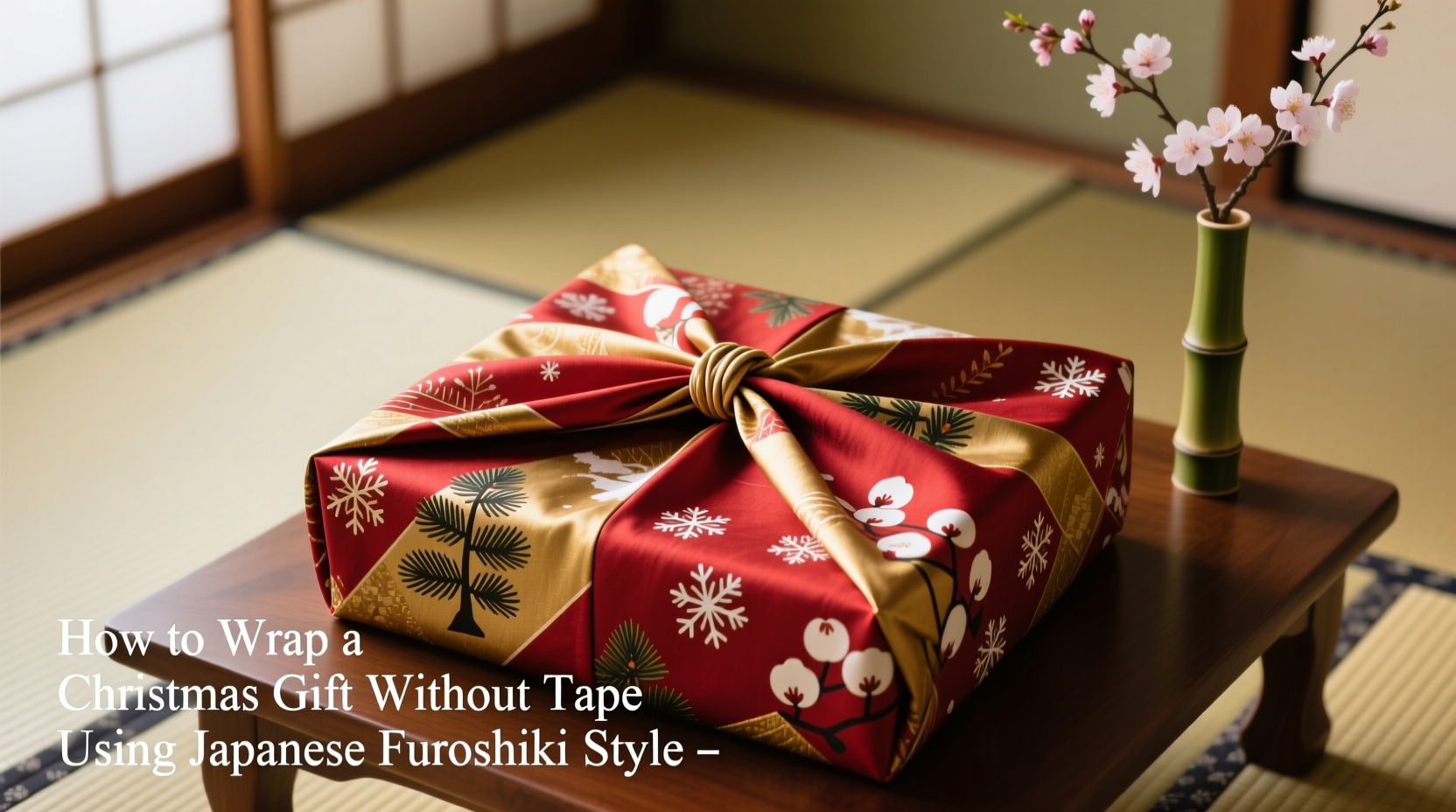
The environmental cost of traditional gift wrapping is staggering. According to the UK’s Waste & Resources Action Programme (WRAP), up to 50% of festive packaging—including glossy paper, metallic finishes, laminated ribbons, and adhesive tape—is unrecyclable due to mixed materials and contamination. In the U.S., the Environmental Protection Agency estimates that household waste increases by over 25% between Thanksgiving and New Year’s Day—with wrapping paper alone contributing nearly 4 million tons annually.
Furoshiki counters this not through sacrifice, but through substitution grounded in culture and craft. A single 70 cm square cotton furoshiki cloth can replace over 100 rolls of tape and 200 square feet of paper—year after year. It also invites presence: choosing fabric that reflects the recipient’s taste, folding with care, tying a knot that holds meaning—not just tension. As textile historian Dr. Yumi Tanaka observes:
“Furoshiki is anti-disposability made tangible. Every fold is a pause. Every knot is a promise—to the person receiving the gift, to the planet, and to the quiet dignity of everyday objects.” — Dr. Yumi Tanaka, Curator of Japanese Textiles, Tokyo National Museum
This isn’t about perfection. It’s about participation—in a tradition that honors both giver and receiver, material and moment.
Selecting the right furoshiki cloth
Not all squares are created equal. The ideal furoshiki cloth balances drape, grip, durability, and aesthetic resonance. While traditional furoshiki uses silk, cotton, or rayon, contemporary practitioners prioritize natural fibers with medium weight and slight texture—enough friction to hold folds without slipping, yet supple enough to tie cleanly.
| Fabric Type | Best For | Size Recommendation | Key Considerations |
|---|---|---|---|
| Medium-weight cotton (e.g., quilting cotton or sateen) | Beginners; rectangular boxes; books; bottles | 70 cm × 70 cm (27.5″) | Washable, affordable, holds creases well. Avoid stiff, heavily starched versions. |
| Hemp-cotton blend | Eco-conscious gifting; heavier items (wine, candles, small electronics) | 90 cm × 90 cm (35.5″) | Natural grip, breathable, ages beautifully. Slight stiffness softens with use. |
| Chirimen silk (crepe-weave) | Special occasions; delicate items; heirloom gifts | 60 cm × 60 cm (23.5″) | Luxurious drape, subtle sheen, lightweight. Requires hand-washing; best for experienced folders. |
| Upcycled fabric (linen bedsheets, vintage scarves) | Personalized, sentimental gifts; zero-budget wrapping | Variable—minimum 65 cm square | Adds narrative depth. Test grip: if fabric slides easily off itself, add a light ironed crease or choose a different piece. |
The “Otsukai” method: step-by-step furoshiki for standard rectangular gifts
The Otsukai (“errand”) fold is the most versatile and accessible furoshiki technique for Christmas gifts—ideal for books, board games, candle sets, and small electronics. It creates a secure, symmetrical bundle with two tidy knots that double as handles. No tape. No glue. No frustration.
- Center the gift: Place your item diagonally in the center of the furoshiki cloth, with one corner pointing toward you and the opposite corner away. Ensure at least 15 cm (6″) of fabric extends beyond each edge.
- First pair of corners: Lift the corner nearest you and the corner farthest from you. Bring them together over the top of the gift, aligning edges precisely. Let them rest flat on the surface—do not twist.
- Secure the top: With both corners held taut, cross the right corner over the left, then tuck the end beneath the folded layer. Pull gently to tighten—this forms the first knot, sitting squarely atop the gift.
- Second pair of corners: Now lift the remaining two corners (left and right). Bring them together behind the gift, meeting directly at the center back.
- Form the handle knot: Cross the right corner over the left behind the gift, then bring both ends forward—over the top of the first knot—and tie a second, identical square knot. Adjust tension so both knots sit flush and the bundle feels snug but not strained.
- Refine: Gently smooth fabric along the sides. If corners flare, re-tighten the front knot slightly. The finished wrap should stand upright on its own, with clean lines and visible grain.
This method works reliably for items measuring 10–25 cm (4–10″) in any dimension. For oversized or irregular shapes, the “Bin Tsutsumi” (box wrap) or “Kata Tsutsumi” (shoulder wrap) offer alternatives—but Otsukai remains the gold standard for holiday reliability.
Real-world application: Sarah’s zero-waste Christmas in Portland
Sarah Chen, a high school art teacher and mother of two in Portland, Oregon, adopted furoshiki three years ago after her daughter asked, “Why do we throw away the paper *right after* saying ‘Merry Christmas’?” What began as a classroom experiment—students wrapping handmade ornaments in repurposed bandanas—grew into a family tradition. Last December, Sarah wrapped all 27 gifts using six furoshiki cloths: three inherited from her grandmother (indigo-dyed cotton), two thrifted silk scarves, and one hand-printed linen made with her children.
She discovered practical advantages beyond ethics: her 5-year-old learned spatial reasoning by matching fabric patterns to box dimensions; her elderly father, who struggles with arthritis, appreciated the absence of tape dispensers and scissors; and guests consistently complimented the tactile warmth of unwrapping—“It felt like opening a letter from someone who knew me,” said one friend, holding a wine bottle swaddled in navy cotton with cherry-red stitching.
Most significantly, Sarah kept a log: zero tape used, 92% reduction in wrapping-related trash, and 100% of cloths reused post-holiday—for grocery trips, picnic blankets, and even as emergency hair ties. “The magic isn’t in the cloth,” she notes. “It’s in the slowness. When you wrap without tape, you can’t rush.”
Essential furoshiki etiquette and common pitfalls
Furoshiki carries cultural nuance. In Japan, color, pattern, and knot placement convey meaning—red for celebration, white for purity, cranes for longevity. While Western adoption need not replicate every convention, honoring core principles ensures respect and effectiveness.
- Never use printed fabric with offensive, culturally appropriative, or politically charged motifs—especially kimonos, torii gates, or calligraphy unless authentically sourced and contextually appropriate.
- Avoid overly slippery synthetics (e.g., polyester satin) for primary gifting—they slide unpredictably and contradict furoshiki’s ethos of mindful materiality.
- Don’t force knots: If fabric resists tightening, reassess size or try a different fold. Furoshiki rewards patience, not pressure.
- Always fold with the “good side” out—no hidden seams or wrong sides showing. This signals care in presentation.
- Never discard used furoshiki. Even stained or frayed cloth can be cut into cleaning rags, sewn into sachets, or composted (if 100% natural fiber).
Frequently asked questions
Can I use furoshiki for oddly shaped gifts like potted plants or stuffed animals?
Absolutely—and often more securely than tape-based methods. For round or bulbous items, use the “Hira Otsukai” (flat errand) variation: lay the cloth flat, center the item, gather all four corners upward, and tie once at the top. Add a second knot below the first for stability. For soft items like plush toys, pre-stuff a small cardboard cylinder inside the cloth before gathering—this creates structure and prevents sagging.
What if my furoshiki cloth isn’t perfectly square?
Imperfection is welcome. Rectangular scarves (e.g., 70 × 140 cm) work beautifully using the “Nagamaki” (long wrap) method: drape lengthwise over the gift, wrap ends around the sides, and tie at the back or top. Slight asymmetry adds character—and authenticity. Historically, many furoshiki were hand-cut and rarely mathematically precise.
How do I explain furoshiki to skeptical relatives or young children?
Lead with experience, not doctrine. Say: “This cloth wraps your gift *and* becomes part of it—like a hug that keeps going.” Let kids choose their favorite fabric, help tie the first knot, and name the cloth (“This is our ‘Snowflake Scarf’—it’ll carry cookies next week!”). For elders, emphasize continuity: “My great-grandmother wrapped rice cakes this way. We’re keeping that care alive.”
Conclusion: unwrap a new tradition
Furoshiki is not nostalgia—it’s recalibration. In choosing cloth over cling, knot over adhesive, reuse over replacement, we make a quiet declaration: that how we give matters as much as what we give. This Christmas, every furoshiki fold is a refusal of disposability. Every tied knot is a commitment to continuity. Every unwrapped cloth is an invitation to imagine what comes next—not as waste, but as possibility.
You don’t need perfection. Start with one gift. One square of cotton. One intentional minute. Fold slowly. Breathe. Notice the texture, the weight, the way light catches the weave. Then watch what happens when someone opens it—not just the present, but the thought behind it.
💬 Your turn: Try furoshiki this season—and share your first wrap in the comments. What fabric did you choose? Which fold surprised you? How did the recipient react? Let’s build a living archive of kindness, one square at a time.