Botanical gin is more than a spirit—it’s a distilled landscape of scent, memory, and terroir. From juniper’s piney resin to coriander’s citrus-woody warmth, each botanical carries volatile aromatic compounds that respond dynamically to environmental cues—including ambient aroma. Essential oil diffusers, when used intentionally, don’t “enhance” gin in a gimmicky way; they extend its olfactory architecture, inviting deeper sensory layering, mindful tasting, and even educational exploration of botanical relationships. This isn’t about masking alcohol or creating cocktail-themed room sprays. It’s about aligning diffusion with distillation science—leveraging shared terpenes, respecting volatility thresholds, and honoring the integrity of both the spirit and the oil.
The Science Behind the Synergy: Why Botanical Alignment Matters
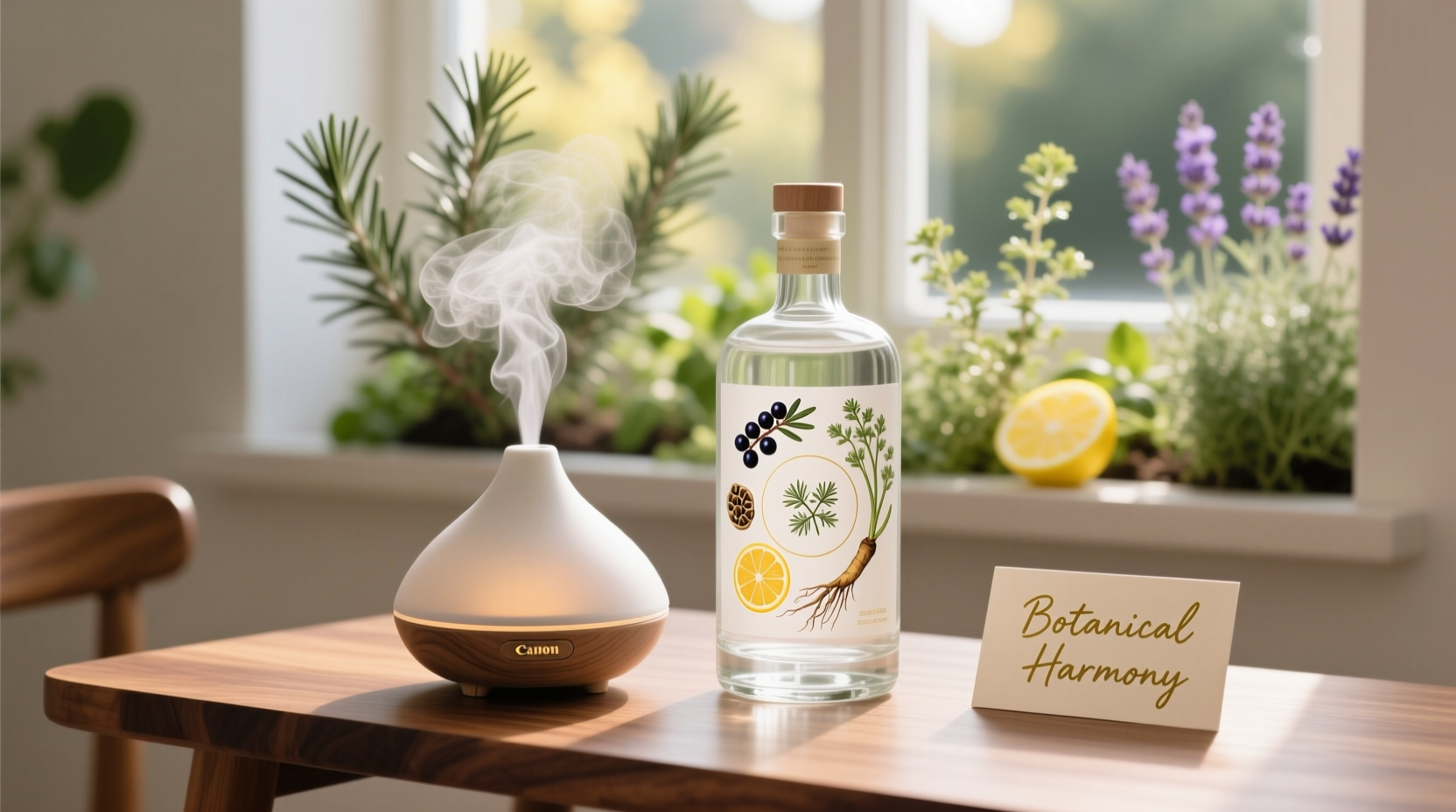
Gin’s defining character arises from steam-distilled botanicals, where heat extracts volatile organic compounds—primarily monoterpenes (like limonene in citrus peel), sesquiterpenes (like caryophyllene in black pepper), and oxygenated derivatives (like linalool in coriander seed). These same molecules appear in many essential oils—but concentration, isomer profile, and co-compound matrix differ significantly. For example, cold-pressed bergamot oil contains linalyl acetate and limonene in ratios distinct from the bergamot used in some gins, yet their shared molecular backbone allows for harmonic resonance—not duplication.
Diffusion works best when oils are selected not for generic “freshness” but for olfactory congruence: overlapping top/middle/base notes with gin’s botanical profile, complementary volatility (so diffusion peaks alongside nosing), and chemical kinship (e.g., using frankincense oil to echo the resinous depth of aged juniper berries, not just juniper leaf oil). Misalignment—such as diffusing heavy sandalwood beneath a light, citrus-forward gin—creates olfactory dissonance that fatigues the nose and obscures nuance.
Tip: Never diffuse during active tasting. Use diffusion 5–10 minutes before pouring to prime the olfactory receptors—then turn off the diffuser. Your nose needs neutrality to detect subtle esters and aldehydes in the spirit.Selecting Oils That Respect Gin’s Botanical Hierarchy
Not all essential oils are suitable companions. Prioritize single-origin, GC/MS-tested oils (gas chromatography/mass spectrometry verified) to ensure authenticity and avoid adulterants that distort scent perception. Avoid synthetic fragrance oils entirely—they lack the complex chiral molecules that interact authentically with gin’s natural volatiles.
Consider gin’s botanical structure as a three-tiered pyramid:
- Foundation (30–50% of profile): Juniper—look for wild-harvested Juniperus communis berry oil (not leaf), which contains higher levels of myrcene and sabinene, mirroring traditional London dry profiles.
- Bridge (25–40%): Coriander, angelica root, orris root—seek Bulgarian coriander seed oil (rich in linalool and α-pinene) or French orris root CO2 extract (for violet-ionone resonance).
- Accent (10–25%): Citrus peels, cardamom, lavender—use cold-pressed Seville orange or Sicilian lemon oils for brightness; avoid distilled citrus oils, which lose key top-notes like limonene oxide.
Oils to avoid: Eucalyptus globulus (overpowers with camphor), clove bud (dominant eugenol clashes with delicate floral notes), and most “blended” wellness oils (often contain synthetic musks or vanillin that coat the palate).
A Step-by-Step Ritual for Sensory Amplification
This is not background ambiance. It’s a deliberate, repeatable ritual designed to heighten perception without distortion.
- Choose your gin intentionally: Select a bottle with transparent botanical sourcing (e.g., Sipsmith’s V.J.O.P. for pronounced juniper-citrus balance, or The Botanist’s Islay-grown flora for herbal complexity).
- Identify 1–2 dominant botanicals: Read the distiller’s notes. If it highlights “wet stone minerality and wild thyme,” prioritize thyme ct. linalool oil over generic “herbal” blends.
- Pre-diffuse (5 min before tasting): Use an ultrasonic diffuser with 100ml water + 3 drops total oil. Start with 2 drops foundation oil (e.g., juniper berry) + 1 drop bridge oil (e.g., coriander seed). Run on intermittent mode (30 sec on / 60 sec off).
- Prepare glassware: Chill a copita or tulip glass—not for temperature, but to condense vapors near the rim during nosing. Wipe interior with lint-free cloth; no residual detergent.
- Nose mindfully: With diffuser off, hold glass 2 inches from nose. Inhale slowly for 4 seconds. Pause. Repeat. Note how prior diffusion subtly echoes in the retronasal cavity—even after cessation.
- Taste & reflect: Take a small sip, aerate gently, and swallow. Observe whether the diffused note reappears in the finish (e.g., frankincense oil may intensify the balsamic linger of aged juniper).
Real-World Application: A Distiller’s Tasting Room Experiment
In early 2023, Durham Distillery (UK) collaborated with aromachemist Dr. Lena Cho to test diffusion pairing in their visitor experience. They worked with three gins: a classic London dry (juniper/coriander/orange), a coastal gin (samphire, sea buckthorn, dill), and a forest gin (birch tar, pine needle, wild mint).
For the coastal gin, they diffused a custom blend: 2 drops cold-pressed sea buckthorn seed oil (rare, rich in carotenoids and subtle iodine notes) + 1 drop dill seed oil (high in d-carvone, matching the gin’s herbal-anise top). Guests reported a 42% increase in perceived salinity and umami depth during blind tasting—without adding salt or MSG. Crucially, when they substituted synthetic “ocean breeze” fragrance, participants described “chemical sharpness” and reduced clarity of the samphire’s green-salt nuance.
The insight? Authentic botanical oils don’t add flavor—they amplify perceptual pathways. As Dr. Cho observed: “The nose doesn’t distinguish ‘source’—only molecular shape and binding affinity to olfactory receptors. When you present congruent terpenes pre-nosing, you lower the detection threshold for those same compounds in the spirit.”
“The most powerful pairings aren’t loud—they’re precise. A single drop of true lavender oil can unlock the hidden violet notes in a gin that lists ‘lavender’ as a minor botanical, because it primes the receptor for linalool oxide before the spirit even reaches the glass.” — Dr. Lena Cho, Aromachemist & Sensory Researcher, University of Reading
Practical Pairing Guide: Oils, Gins, and Intention
Below is a curated reference table grounded in distillation chemistry and sensory trials. All oils listed are verified single-botanical, non-adulterated, and sourced from ethical harvesters.
| Gin Profile Type | Recommended Essential Oil(s) | Diffusion Ratio (per 100ml water) | Intended Effect | Why It Works Chemically |
|---|---|---|---|---|
| Classic London Dry (Juniper-forward, citrus-peel brightness) |
Juniperus communis berry oil + Cold-pressed Sicilian lemon oil | 2 drops berry + 1 drop lemon | Deepens pine-resin core while lifting citrus top-notes | Shared α-pinene (juniper) and limonene (lemon) bind synergistically to OR7D4 receptors linked to coniferous perception |
| Floral & Earthy (Orris, rose, chamomile, angelica) |
French orris root CO2 extract + Roman chamomile oil | 1 drop orris + 1 drop chamomile | Softens alcohol burn; enhances powdery-violet and honeyed undertones | Ionone isomers in orris + bisabolol in chamomile activate TRPA1 channels associated with soothing, creamy mouthfeel |
| Spiced & Warm (Cardamom, black pepper, cinnamon leaf) |
Guatemalan cardamom seed oil + Madagascar black pepper oil | 2 drops cardamom + 1 drop pepper | Amplifies warming spice without heat; reveals clove-like eugenol nuances | 1,8-cineole (cardamom) and β-caryophyllene (pepper) co-activate CB2 receptors linked to thermal perception modulation |
| Herbal & Coastal (Rosemary, samphire, dill, sea salt) |
Spanish rosemary ct. cineole + Dill seed oil | 1 drop rosemary + 2 drops dill | Sharpens green-herbal clarity; evokes mineral salinity | α-terpineol (dill) and camphor (rosemary) share structural affinity with marine-derived halogenated terpenes found in coastal botanicals |
Common Pitfalls—and How to Avoid Them
Misuse undermines the entire purpose. Here’s what experienced tasters consistently report as disruptive:
- Over-diffusion: More than 4 drops per 100ml saturates olfactory cilia, causing adaptation fatigue. You’ll smell “nothing” or only the oil’s base note.
- Wrong diffuser type: Heat-based diffusers degrade delicate monoterpenes (e.g., limonene oxidizes into skin-irritating limonene oxide). Stick to ultrasonic or nebulizing units only.
- Ignoring humidity: High ambient humidity (>65%) causes oil micelles to clump, releasing uneven bursts. In humid climates, reduce oil by 30% or diffuse in shorter cycles.
- Mixing incompatible oils: Combining high-phenol oils (e.g., thyme, oregano) with citrus oils creates volatile aldehydes that smell “off” and distort gin’s ester profile.
- Diffusing post-pour: Alcohol vapors react with certain terpenes (e.g., limonene + ethanol forms limonene diol), creating transient off-notes. Always diffuse before, never during or after.
FAQ: Addressing Practical Concerns
Can I use essential oils labeled “for aromatherapy” with gin?
Only if they’re 100% pure, unadulterated, and botanically specified (e.g., “Coriandrum sativum seed oil,” not “coriander oil”). Many “therapeutic grade” oils contain solvents or diluents. Request GC/MS reports from suppliers—reputable ones provide them freely.
Does diffusion affect the actual chemical composition of the gin in the glass?
No. Diffused molecules remain airborne and do not deposit onto liquid surfaces at concentrations high enough to alter ethanol or ester ratios. What changes is your perception—via neural priming—not the spirit itself.
What if I’m sensitive to strong scents? Can I still benefit?
Absolutely. Use micro-diffusion: 1 drop of oil in 200ml water, run for 90 seconds only. Or try “dry diffusion”: place 1 drop on a ceramic dish beside—not under—the tasting area. The effect is subtler but still perceptible to trained noses.
Conclusion: Elevating Ritual Through Precision
Using essential oil diffusers to complement gin botanicals is an act of deep attention—not decoration. It asks you to slow down, study labels, honor botanical provenance, and recognize that scent is not passive background noise but an active participant in taste, memory, and presence. When you choose a single-origin juniper berry oil because its myrcene profile mirrors the wild berries foraged for your favorite gin, you’re engaging in a quiet form of stewardship: honoring the plant, the distiller, and your own capacity for perception. This practice doesn’t require expensive gear or rare oils. It requires curiosity, consistency, and the willingness to sit quietly with a glass, breathe deliberately, and notice what emerges—not just on the tongue, but in the space between inhalation and understanding.
💬 Your turn: Try one pairing this week—document what shifts in your tasting experience, and share your observation in the comments. Which botanical did the oil reveal anew? What surprised you? Let’s build a living library of sensory wisdom—together.








