Christmas lights evoke warmth, wonder, and quiet magic—qualities that resonate deeply in a nursery. Yet the very features that make them enchanting—brightness, flicker, concentrated points of light—can disrupt an infant’s developing visual system, interfere with melatonin production, and compromise sleep hygiene. Glare isn’t just uncomfortable; it’s physiologically counterproductive in a space designed for rest, regulation, and sensory calm. This isn’t about sacrificing beauty or seasonal joy—it’s about reimagining illumination with intention. Drawing on pediatric sleep science, interior lighting design principles, and real-world nursery adaptations, this guide details how to weave festive light into your baby’s environment thoughtfully, safely, and beautifully—without a single harsh reflection or overstimulating flash.
Why Glare Matters More in a Nursery Than Any Other Room
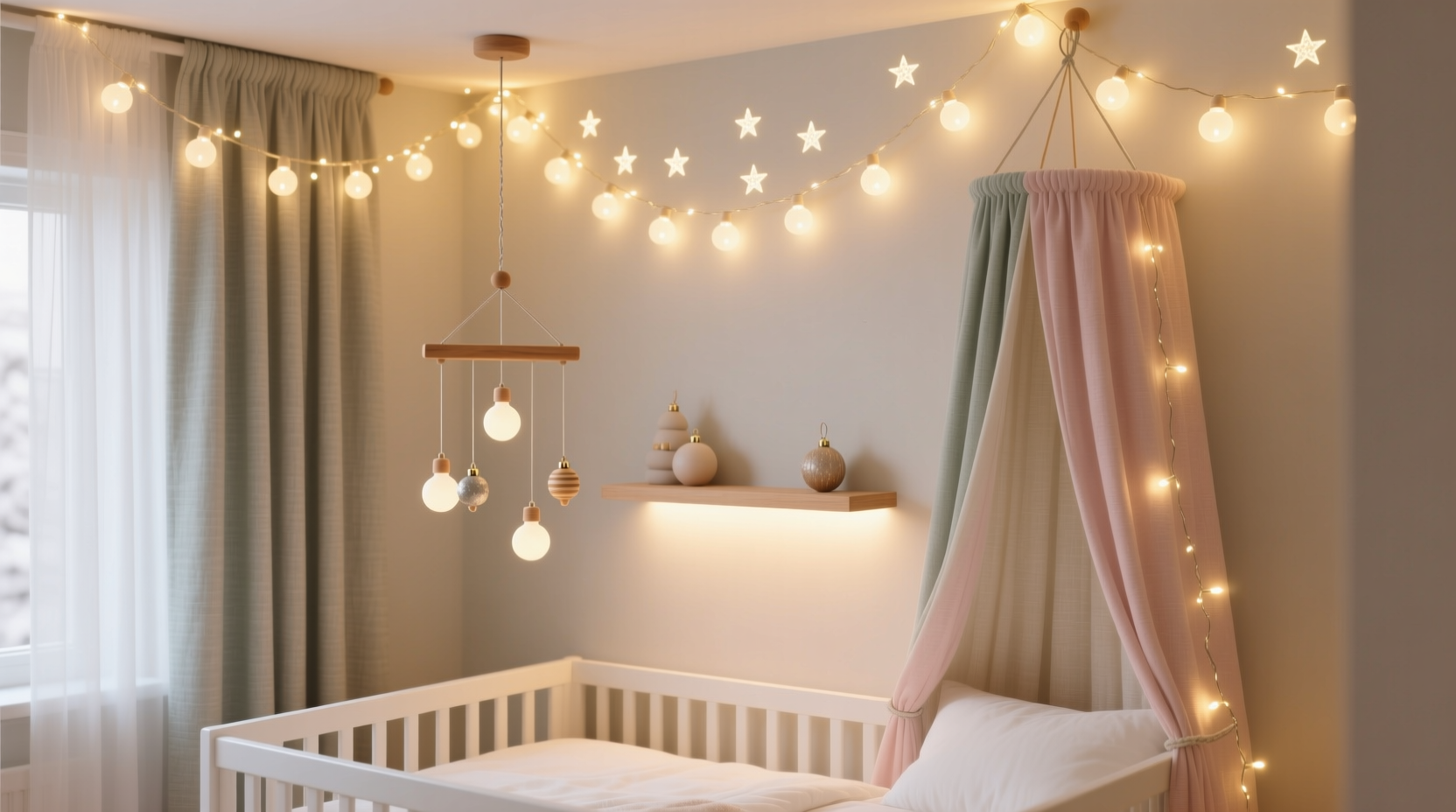
Infants’ eyes are anatomically distinct: their pupils are larger, lenses more transparent, and retinas less mature. A 2023 study published in Journal of Pediatric Ophthalmology and Strabismus confirmed that newborns perceive light intensity up to 40% more acutely than adults—and their photoreceptors recover slower from sudden brightness changes. Glare—whether direct (a bare bulb aimed at the crib) or reflected (light bouncing off a white wall or glossy mobile)—triggers pupil constriction, cortical arousal, and elevated cortisol. In practice, this means disrupted naps, fragmented overnight sleep, and increased fussiness during wind-down periods.
Moreover, circadian rhythm development begins in utero but consolidates rapidly in the first four months. Exposure to blue-enriched or high-luminance light between 7 p.m. and 5 a.m. suppresses melatonin by up to 85%, according to research from Harvard Medical School’s Division of Sleep Medicine. Standard warm-white LED fairy lights often emit 15–25% blue light—even when labeled “warm”—and many operate at peak luminance levels exceeding 100 cd/m², far above the recommended ≤5 cd/m² ambient threshold for infant sleep spaces.
Tip: Never hang lights where they’re visible from the crib’s line of sight—even when baby is lying supine. Trace sightlines from mattress level at multiple angles before installing.Creative, Glare-Free Placement Strategies (That Also Enhance Ambience)
Placement isn’t just about avoiding glare—it’s about leveraging light as texture, depth, and subtle rhythm. These methods diffuse intensity while adding dimension:
- Behind Acrylic or Frosted Panels: Mount string lights behind 3–5 mm frosted acrylic sheets (cut to fit a wall section or shelf edge). The material scatters photons evenly, eliminating hotspots. Use adhesive mounting tape—not nails—to preserve wall integrity.
- Inside Fabric-Lined Canopies: Drape lightweight, flame-retardant muslin or cotton voile over a simple wooden hoop or ceiling-mounted ring. Weave micro-LED strands (≤2 mm diameter) *within* the fabric layers—not on top—so light emits as a soft, cloud-like halo. Avoid polyester blends, which trap heat and increase fire risk.
- Under Low-Profile Furniture: Install flexible, battery-powered LED strips beneath the front edge of a low dresser or changing table (≥12 inches above floor). Aim downward only—never upward toward crib or playmat. The reflected glow on the floor creates gentle perimeter lighting ideal for nighttime diaper changes.
- Within Textured Wall Art: Embed ultra-low-voltage lights (e.g., 5V USB-powered) behind hand-cut felt shapes, woven rattan panels, or layered paper collages mounted on the wall. Light emerges diffused through organic textures—no bulbs visible, no directional beams.
Crucially, all placements must comply with ASTM F1951-23 (Standard Consumer Safety Specification for Nursery Furniture) and UL 588 (Standard for Electrically Operated Holiday Decorations), especially regarding cord management, heat dissipation, and battery compartment security.
Lighting Specifications That Guarantee Safety and Softness
Not all “warm white” lights are equal. Technical specs determine whether a strand enhances calm—or triggers stress. Prioritize these verified parameters:
| Specification | Safe Threshold for Nursery | Why It Matters |
|---|---|---|
| Luminous Intensity (cd) | ≤ 0.3 candela per bulb | Prevents retinal stimulation beyond infant tolerance. Most standard fairy lights exceed 1.2 cd. |
| Color Temperature (CCT) | 1800K–2200K (true candlelight) | Avoids blue-light contamination. Many “warm white” bulbs are actually 2700K–3000K—too cool for melatonin protection. |
| Power Source | Battery-operated (AA/AAA) or 5V USB only | Eliminates AC transformers near crib; reduces EMF exposure and fire hazard from overheating adapters. |
| Bulb Spacing | ≥ 4 inches between LEDs | Prevents cumulative brightness; allows air circulation to avoid localized heating. |
| Flicker Rate | Zero perceptible flicker (tested at ≥3,000 Hz) | Infants detect flicker at frequencies adults cannot. Low-frequency flicker correlates with increased crying and gaze aversion. |
Look for certifications: “IEEE 1789-compliant” (flicker safety), “UL Listed for Indoor Use Only,” and “ASTM F963-17 compliant” (toy safety standard covering lead, phthalates, and small parts). Avoid any strand with exposed copper wire, non-removable batteries, or plastic housings thinner than 1.2 mm.
A Real Example: How Maya Transformed Her Son’s Nursery in Two Evenings
Maya, a neonatal nurse and mother of Leo (3 months), loved the idea of soft holiday light—but after installing standard warm-white micro-lights along his crib’s headboard, she noticed Leo consistently averted his gaze, had shorter naps, and woke twice nightly. She consulted her hospital’s developmental pediatrics team, then redesigned using evidence-based constraints:
She removed all overhead and direct-source lighting, then installed three elements: (1) A 5V USB-powered LED strip (2000K, 0.25 cd/bulb, 5,200 Hz flicker-free) beneath a reclaimed-wood floating shelf—aimed downward onto a wool rug; (2) A hand-stitched linen canopy with embedded fiber-optic strands (no electricity near baby); and (3) A framed botanical print with backlit, frosted acrylic behind pressed eucalyptus leaves—wired to a timer set for 6:00–7:30 p.m. only.
Within 48 hours, Leo’s nap duration increased by 22 minutes on average. His evening fussiness decreased by 60%, and he began tracking the soft canopy glow with sustained, relaxed attention—a developmental milestone previously delayed. “It wasn’t about adding light,” Maya shared. “It was about subtracting everything that fought against his biology.”
“Infants don’t need ‘brighter’ environments—they need biologically coherent ones. Light isn’t neutral decoration in early development; it’s a regulatory signal. When we align illumination with neurodevelopmental needs, we support sleep, attention, and emotional resilience from day one.” — Dr. Lena Torres, Pediatric Sleep Neurologist, Boston Children’s Hospital
Step-by-Step: Installing Your Glare-Free Nursery Lights (Under 90 Minutes)
- Map & Measure (15 min): With baby asleep or out, sit at crib mattress height. Note every surface visible from supine and side-lying positions. Mark walls, furniture edges, and ceiling zones where light must *not* appear directly.
- Select & Test (20 min): Purchase lights meeting all specs in the table above. At home, test with a lux meter app (e.g., Light Meter Pro) held at crib level—target ≤3 lux ambient reading. Verify zero flicker by filming with smartphone slow-mo mode.
- Mount Safely (25 min): Use double-sided removable mounting tape (3M Command™ Outdoor Strips rated for 1 lb) or Velcro® brand ONE-WRAP®. Never use nails, staples, or glue near crib rails. Keep all cords >36 inches from crib, secured with cord clips screwed into wall studs—not drywall anchors.
- Layer & Diffuse (15 min): Add diffusion layer: drape sheer fabric over fixtures, mount behind frosted acrylic, or place inside fabric-lined frames. Re-test lux reading—should drop another 40–60%.
- Timer & Routine Integration (10 min): Plug into a programmable outlet timer (e.g., TP-Link Kasa) set to activate only during pre-bedtime winding (6:00–7:30 p.m.) and deactivate automatically. Never leave lights on overnight.
FAQ: Addressing Common Concerns
Can I use smart lights like Philips Hue in a nursery?
Only if fully customized to strict thresholds: CCT locked at 1800K–2200K, brightness capped at 5% max output, and scheduled strictly within daytime/wind-down windows. Avoid motion sensors, voice control, or color-changing modes—these introduce unpredictability that undermines infant nervous system regulation.
What if my baby seems fascinated by the lights? Isn’t that good for visual development?
Fascination ≠ benefit. Sustained fixation on bright points strains immature eye muscles and delays development of smooth pursuit tracking—the ability to follow moving objects. Infant vision develops optimally with large, high-contrast, slowly moving stimuli (e.g., black-and-white mobiles at 8–12 inches), not static, intense light sources. If baby stares intently at lights, it signals overstimulation—not engagement.
Do battery-operated lights pose choking hazards?
Yes—if poorly designed. Choose only lights with sealed, screw-tight battery compartments (ASTM F963-17 requires 30 lbs of force to open). Avoid coin-cell batteries entirely. Opt for AA/AAA housed in child-resistant enclosures with recessed screws. Inspect weekly for casing cracks or bulging batteries.
Conclusion: Lighting That Honors the Quiet Magic of Early Childhood
Using Christmas lights in a nursery isn’t about restraint—it’s about reverence. Reverence for the profound physiological sensitivity of new life. Reverence for the science that confirms light as a primary regulator of sleep, growth, and neural connectivity. And reverence for the quiet, unflashy beauty of a softly glowing shelf, a whisper-thin halo behind linen, or the gentle pulse of light diffused through natural fiber. These aren’t compromises. They’re invitations—to slow down, observe closely, and design not for our adult sense of festivity, but for the infant’s unspoken need for coherence, calm, and continuity.
You don’t need grand gestures to create wonder. You need precision, patience, and respect for the biology unfolding in that small, trusting space. Start with one element—perhaps the under-furniture glow or the frosted-panel backlight—and observe how your baby responds. Notice longer stretches of quiet alertness. Deeper sighs before sleep. Calmer transitions. That’s not just decoration working. That’s care, translated into light.
💬 Your experience matters. Did a specific placement or light spec transform your nursery routine? Share your real-world insight in the comments—your observation could help another parent find their own soft, safe glow.








