Empty absinthe bottles—those elegant, emerald-green or cobalt-blue vessels once holding one of history’s most mythologized spirits—are more than curiosities. Their thick-walled glass, distinctive silhouette (often fluted or ribbed), and inherent vintage gravitas make them ideal structural canvases for thematic shelf decor. When paired with intentional anime-inspired design and protected by true UV-stable pigments, they become durable, conversation-starting display pieces—not fragile novelties. This isn’t about slapping on craft paint and hoping for the best. It’s about marrying material science with fandom aesthetics: understanding glass adhesion chemistry, selecting lightfast pigments rated for decades of indoor exposure, and executing layered techniques that honor both the bottle’s heritage and the character’s visual language.
Why Absinthe Bottles? Beyond Aesthetic Appeal
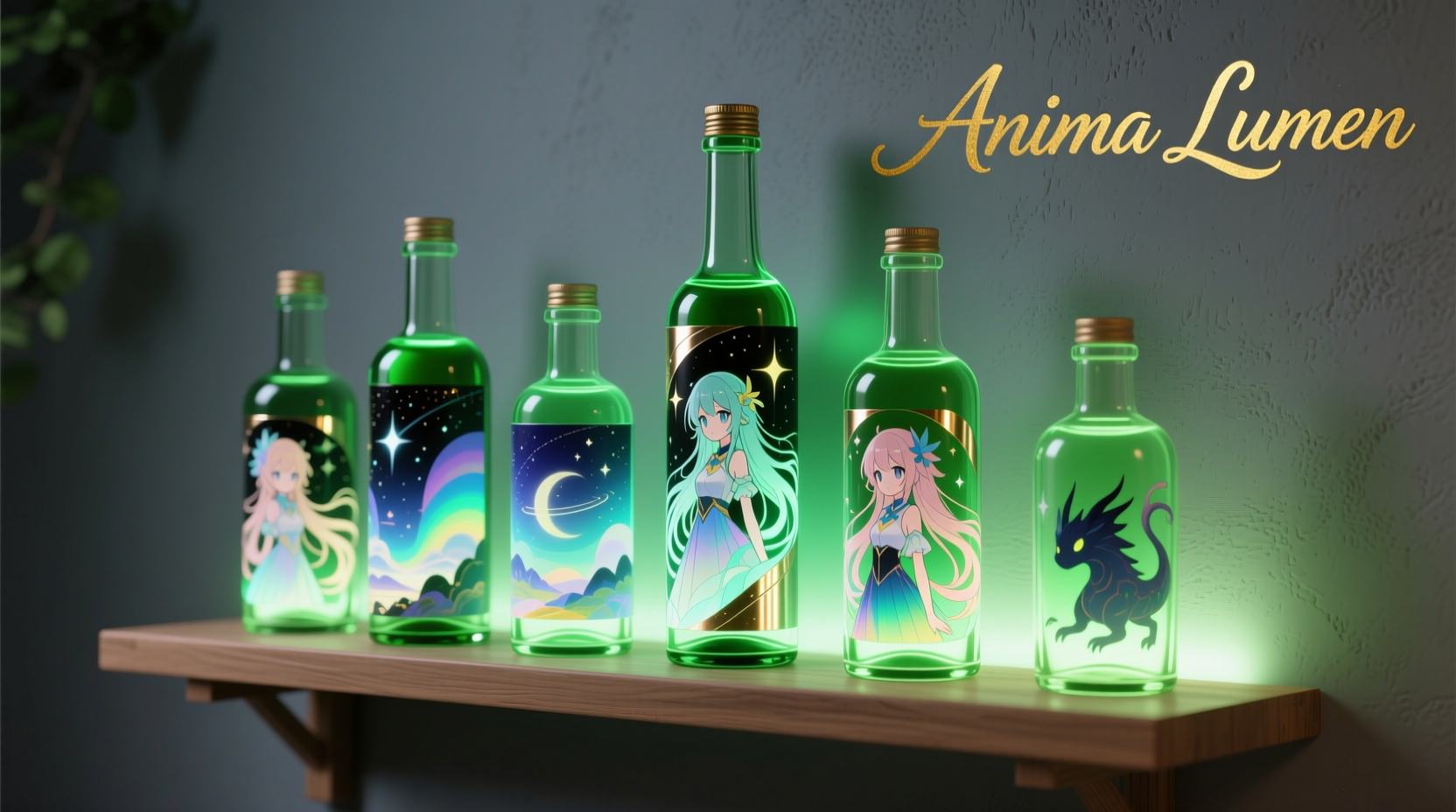
Not all glass bottles are equal for decorative repurposing. Absinthe bottles stand apart due to three critical physical properties: wall thickness (typically 3–5 mm), base stability (wide, heavy-bottomed design), and surface texture (many feature subtle vertical ribs or sandblasted frosted zones). These features directly impact paint adhesion, durability, and visual depth. Unlike thin-walled soda or wine bottles, absinthe glass resists chipping during handling and provides a forgiving substrate for multi-stage painting. The green or blue tint also interacts uniquely with overlying acrylics and metallics—creating subtle chromatic shifts under ambient light that flat clear glass cannot replicate. Crucially, their historical association with art nouveau illustration and fin-de-siècle bohemian culture creates an unexpected but harmonious conceptual bridge to anime’s own rich lineage of stylized, symbolic storytelling—from *Princess Mononoke*’s forest spirits to *Cowboy Bebop*’s jazz-infused melancholy.
Tip: Rinse bottles immediately after emptying with warm water and baking soda paste to neutralize residual thujone oils—this prevents long-term hazing and improves paint bonding.UV-Safe Paint: What It Really Means (and What It Doesn’t)
“UV-safe” is widely misused in craft marketing. True UV resistance isn’t about preventing yellowing alone—it’s about pigment stability under photon bombardment. When UV light strikes organic pigments (like many reds, oranges, and violets), it breaks molecular bonds, causing fading, color shift, or complete bleaching. Inorganic pigments—especially those based on iron oxides, titanium dioxide, or complex metal oxides like cobalt aluminate—resist this degradation far better. For anime decor, where character palettes often rely on vibrant, saturated hues, selecting paints with ASTM D4303 or ISO 105-B02 lightfastness ratings is non-negotiable. Artist-grade acrylics from Golden, Liquitex Professional, or Winsor & Newton meet this standard; student-grade or craft acrylics rarely do. Solvent-based glass paints (e.g., Pebeo Vitrea 160) offer superior adhesion but require oven curing at 160°C for 40 minutes—a step incompatible with many home ovens and potentially dangerous for sealed bottles. Water-based UV-cured alternatives exist but demand industrial UV lamps. For home studios, high-lightfast acrylics + proper sealing is the pragmatic, safe, and archival path.
“The difference between ‘lightfast’ and ‘UV-resistant’ is semantic precision. Lightfastness measures pigment survival under standardized light exposure; UV resistance implies full-spectrum protection. No paint is truly UV-proof—but ASTM I or II ratings mean your Sailor Moon bottle will retain its rose-gold hair highlights for 25+ years in indirect light.” — Dr. Lena Torres, Conservation Scientist, Corning Museum of Glass
Step-by-Step Transformation Process
This 7-phase method prioritizes longevity over speed. Each stage addresses a specific failure point common in DIY glass decor: poor cleaning → poor adhesion → uneven coverage → mechanical abrasion → UV degradation.
- Decontamination & Surface Prep: Soak bottles overnight in warm water + 2 tbsp white vinegar + 1 tsp dish soap. Use a bottle brush with nylon bristles (never steel wool) to scrub interior ridges. Rinse thoroughly, then wipe exterior with 91% isopropyl alcohol. Let air-dry completely on a lint-free cloth.
- Base Coating: Apply two thin coats of Golden GAC 200 mixed 1:1 with matte medium (not water) as an adhesion promoter. This polymer seals micro-pores and creates a uniform absorbent layer. Dry 2 hours between coats.
- Character Blocking: Sketch outlines lightly with a graphite pencil (avoid pressing hard). Fill large areas first using a synthetic flat brush (size 6–8). For gradients (e.g., Luffy’s straw hat shadow), blend wet-on-wet with a damp, nearly dry brush.
- Detail Layering: Switch to fine liner brushes (sizes 00–1). Use undiluted paint for crisp lines. For metallic effects (Levi’s blades, Asuka’s plugsuit accents), apply Molotow Liquid Chrome *after* base layers are fully cured (72 hours).
- Sealing Protocol: Apply first seal coat of Golden Archival Varnish (Matte) thinned 10% with distilled water. Let cure 24 hours. Apply second coat full-strength. Avoid glossy varnish—it amplifies fingerprints and glare on curved surfaces.
- Curing & Acclimation: Place bottles upright on a wire rack in a dust-free, low-humidity room (40–50% RH) for 7 days. Do not handle or move during this time—polymer chains need uninterrupted cross-linking.
- Mounting Integration: Drill pilot holes only if mounting to wood bases (use diamond-tipped glass bit at 400 RPM). For freestanding display, add felt pads to the base rim to prevent scratching shelves.
Do’s and Don’ts: Critical Material & Technique Boundaries
| Action | Do | Don’t |
|---|---|---|
| Cleaning Agents | Isopropyl alcohol (91%), vinegar-water soaks, baking soda paste | Bleach, ammonia, abrasive scouring powders |
| Paint Application | Thin layers, synthetic brushes, 2-hour drying between coats | Thick globs, natural-hair brushes (shed hairs), rushing drying times |
| UV Protection | Golden Archival Varnish (Matte), Rust-Oleum Protective Enamel (non-yellowing) | Polyurethane sprays, Mod Podge, clear nail polish |
| Storage Pre-Display | Upright in cardboard dividers, away from direct sunlight | Stacked horizontally, near heat sources, in plastic bags (traps moisture) |
| Long-Term Display | North-facing shelves, LED lighting (CRI >90), 3–5 ft from windows | South-facing sunbeams, halogen track lights, humid bathrooms |
Real-World Application: The “Spirited Away” Bottle Series
Mika Tanaka, a Tokyo-based prop designer and collector, transformed six empty La Fée Paris absinthe bottles into a rotating display inspired by Studio Ghibli’s *Spirited Away*. She selected bottles with varying neck heights and base widths to evoke different spirit characters: a tall, slender bottle became No-Face (painted matte black with subtle silver spectral glints), while a stout, rounded one embodied the Radish Spirit (ochre base with hand-stippled texture mimicking root hairs). Crucially, Mika avoided pure white for Chihiro’s dress—instead mixing titanium white with a whisper of cadmium yellow light to counteract the bottle’s green undertone, ensuring the hue remained true under her apartment’s fluorescent lighting. All pieces used Golden Heavy Body Acrylics (ASTM I rated) and were sealed with three ultra-thin varnish coats. After 18 months on her bookshelf—under consistent ambient light with no direct sun exposure—the colors remain indistinguishable from day one. “The bottle isn’t a container for the art,” she notes. “It’s a collaborator—their weight, their curve, their color becomes part of the character’s presence.”
Essential Materials Checklist
- Empty absinthe bottles (rinsed, de-oiled, dried)
- 91% isopropyl alcohol & lint-free cloths
- Golden GAC 200 polymer medium
- Artist-grade acrylics: Titanium White, Carbon Black, Cadmium Red Light (ASTM I), Phthalo Blue RS (ASTM I), Iron Oxide Yellow
- Synthetic brushes: Flat 6 & 8, Round 00 & 2, Liner 0
- Golden Archival Varnish (Matte)
- Diamond-tipped glass drill bit (if mounting)
- Felt self-adhesive pads (1/4\" diameter)
FAQ
Can I use regular acrylic craft paint if I seal it heavily?
No. Sealing cannot compensate for inherently unstable pigments. Craft acrylics often contain fugitive dyes (e.g., “neon pink”) that fade within months—even under varnish. ASTM I/II-rated artist acrylics are formulated with lightfast inorganic pigments from the outset. Your sealant protects the binder film, not the pigment itself.
Will the green glass tint affect my character’s skin tone or clothing colors?
Yes—and strategically. Emerald glass subtly cools warm tones (adding a serene, ethereal quality to pastel kimonos or magical girl outfits), while cobalt blue enhances contrast in dark hair or armor. Test swatches on scrap glass first. For true color accuracy, prime with two coats of titanium white GAC 200 mixture before painting.
How do I clean finished bottles without damaging the paint?
Never submerge or scrub. Dampen a microfiber cloth with distilled water only, wring until nearly dry, and gently wipe. For stubborn dust, use a soft-bristled makeup brush. Avoid all solvents, even diluted alcohol—repeated exposure degrades acrylic polymer binders over time.
Conclusion
Repurposing absinthe bottles as anime shelf decor merges reverence for material history with passionate creative expression. It demands attention to chemical compatibility, pigment science, and patient craftsmanship—but the result transcends trend. You’re not just making decor; you’re building heirlooms. Each bottle carries dual narratives: the legacy of Belle Époque artisans who shaped its glass, and the modern storytellers whose characters animate your space. When executed with archival intent, these pieces withstand time—not as nostalgic relics, but as living intersections of craft, culture, and fandom. Start with one bottle. Choose a character whose visual language resonates with the vessel’s form. Respect the glass. Honor the pigment. Let the process be deliberate, not hurried. Then place it on your shelf—not as an object to be seen, but as a quiet invitation to pause, observe, and connect across eras and aesthetics.
💬 Your turn: Share which anime character you’d bring to life on an absinthe bottle—and why their essence aligns with the glass’s shape, color, or history. We’ll feature thoughtful responses in our next community spotlight!








