A minimalist liquor shelf isn’t about scarcity—it’s about intentionality. It’s the quiet confidence of serving a perfectly balanced Negroni from three thoughtfully chosen bottles instead of rummaging through fifteen half-used ones. In an era of overstocked home bars and influencer-driven “bar cart clutter,” minimalism offers clarity, ease of use, and elevated aesthetics. But many assume that paring down means compromising on variety, craftsmanship, or visual appeal. That’s a misconception. A truly minimalist shelf reflects discernment—not deprivation. It prioritizes quality over quantity, coherence over chaos, and daily usability over decorative hoarding. This guide walks through the philosophy, curation logic, spatial strategy, maintenance rhythm, and stylistic nuance required to build a liquor shelf that feels both serene and sophisticated.
The Philosophy Behind Minimalist Curation
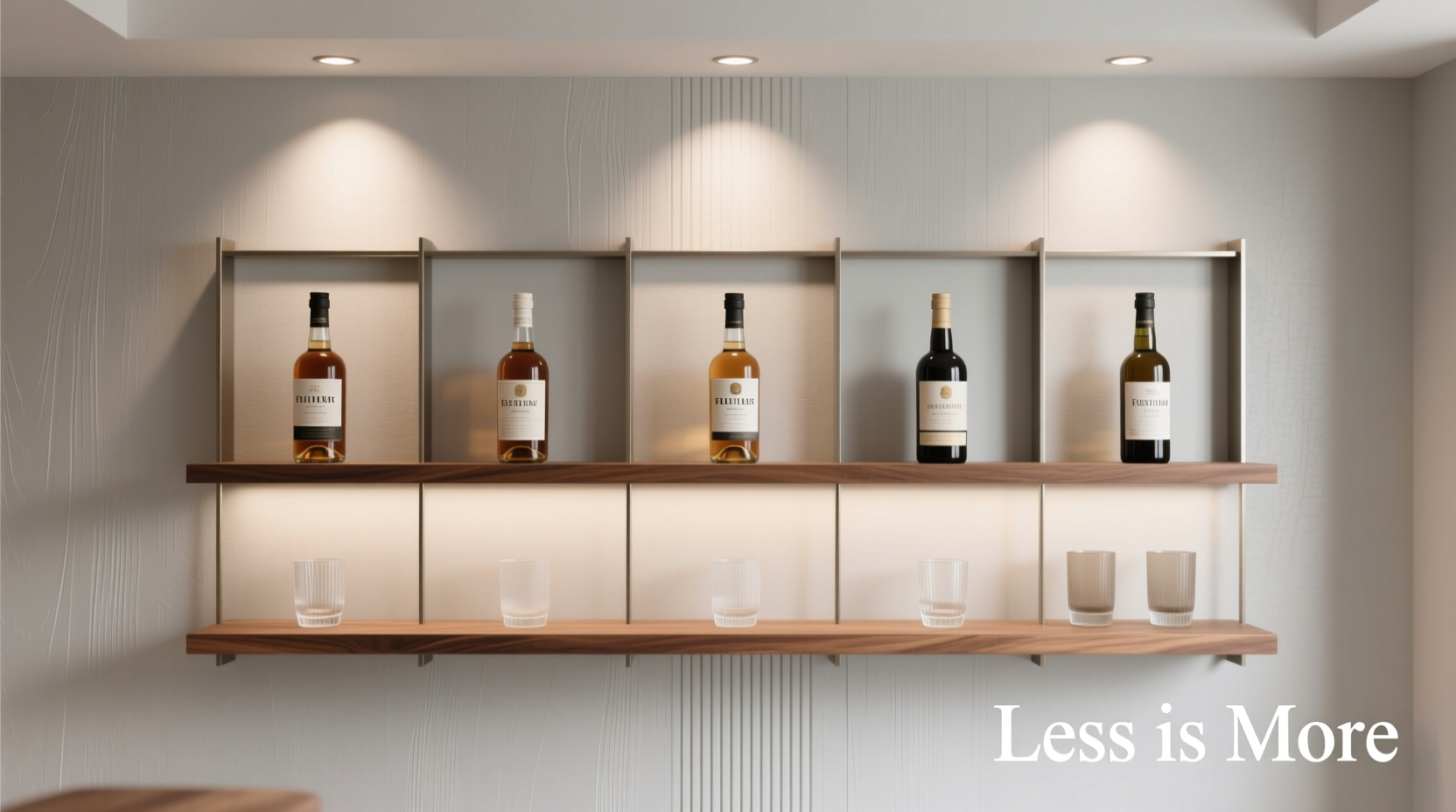
Minimalism in beverage curation begins with rejecting the “just in case” mindset. Too often, home shelves accumulate bottles based on trends (a mezcal phase), gifting (that unopened bottle of Japanese whisky), or impulse buys (a limited-edition gin “for later”). These accumulate not as assets but as visual noise and decision fatigue. A minimalist approach asks three foundational questions before acquisition: Will I use this within three months? Does it meaningfully expand my mixing repertoire? Does its label, shape, or presence enhance the shelf’s overall harmony?
This isn’t austerity—it’s alignment. As bar designer and author David T. Smith notes in *The Thoughtful Bar*, “The most elegant bars aren’t defined by volume, but by resonance. Every bottle should speak to your habits, your palate, and your space.” Resonance means choosing a London dry gin that works equally well in a Martini, a Gimlet, and a French 75—not three different gins each suited to one drink. It means selecting a single, high-character bourbon that delivers depth in an Old Fashioned and brightness in a Whiskey Sour, rather than owning five bourbons with overlapping profiles.
Minimalism also embraces the concept of *rotational curation*. Your core shelf remains stable—perhaps six to eight bottles—but you rotate one or two seasonally: a crisp pisco for summer, a rich amaro for winter, a vibrant fruit liqueur for holiday cocktails. This keeps the collection dynamic without undermining its groundedness.
Tip: Before adding a new bottle, remove one you haven’t used in 90 days—even if it’s still full. This enforces active curation, not passive accumulation.Your Core Bottle Framework: The 7-Bottle Foundation
A functional, stylish minimalist shelf rests on a deliberate foundation—not arbitrary reduction. The following seven-bottle framework covers 95% of classic and modern cocktail applications while maintaining visual cohesion. Each category serves a distinct structural role; substitutions should preserve function, not just flavor.
| Category | Role | Minimum Specs | Style-Forward Example |
|---|---|---|---|
| Gin | Botanical backbone for Martinis, Gimlets, Tom Collins | London Dry or contemporary dry style; neutral juniper-forward profile | Sipsmith V.J.O.P. (tall, tapered bottle; clean label) |
| Vodka | Clean spirit base for Cosmopolitans, Bloody Marys, Espresso Martinis | Distilled from grain or potato; minimal aroma, silky mouthfeel | Ketel One Botanical Grapefruit & Rose (matte glass; soft pastel label) |
| Bourbon | Rich, caramel-vanilla base for Old Fashioneds, Manhattans, Whiskey Sours | At least 45% ABV; balanced oak and spice notes | Four Roses Single Barrel (amber glass; elegant serif typography) |
| Tequila Blanco | Agave-driven freshness for Margaritas, Palomas, Ranch Water | 100% agave; bright, peppery, unaged | Fortaleza Blanco (hand-blown glass; earthy, artisanal label) |
| Dry Vermouth | Aromatic modifier for Martinis, Manhattans, Negronis | Refrigerated after opening; consumed within 3 weeks | Dolin Dry (iconic blue label; slender, symmetrical bottle) |
| Sweet Vermouth | Complex herbal-sweet balance for Manhattans, Negronis, Americanos | Refrigerated after opening; consumed within 6 weeks | Carpano Antica Formula (deep amber glass; vintage typography) |
| Bitters (Aromatic + Citrus) | Flavor catalysts—no substitutes needed | Angostura aromatic + Regans’ Orange bitters | Small 5 oz bottles; consistent matte black labels |
Note: This framework excludes liqueurs, rums, and specialty spirits—not because they’re unwelcome, but because they’re *expansion points*, not foundations. Once your core is mastered and visually settled, add only one at a time, ensuring it complements (not competes with) existing shapes, colors, and materials.
Step-by-Step Shelf Arrangement: Form Meets Function
Arrangement transforms a collection into a composition. Follow this sequence to achieve both utility and elegance:
- Empty & Assess: Remove all bottles. Wipe the shelf thoroughly. Measure shelf depth, height, and spacing between supports.
- Group by Height & Shape: Sort bottles into categories: tall (750ml standard), medium (500ml or squat 750ml), short (bitters, small-format vermouth). Avoid mixing heights within a row unless intentional (e.g., staggered front-to-back).
- Anchor with Symmetry: Place your tallest, most visually substantial bottle (e.g., bourbon or tequila) at center. Flank it with matching pairs: gin + vodka on left, vermouths on right. Bitters sit front-center or on a lower tier.
- Apply the ⅔ Rule: Fill no more than two-thirds of shelf depth. This creates breathing room, prevents visual crowding, and makes retrieval effortless. Use shallow shelves (8–10 inches deep) if possible.
- Refine the Front Line: Ensure all front-labels face forward uniformly. Tilt bottles slightly backward (5–10 degrees) so labels remain fully visible without leaning. Align bottle bases along a single horizontal line using a level or straight edge.
- Add Texture Contrast (Optional): Introduce one non-glass element: a matte ceramic decanter for simple syrup, a brushed brass jigger stand, or a single leather-bound cocktail book. Never more than one accent object.
This method ensures every bottle is both instantly accessible and aesthetically integrated. No searching. No visual competition. Just calm precision.
Real-World Case Study: Maya’s City Apartment Shelf
Maya, a graphic designer in Brooklyn, lived with a chaotic bar cart for years—14 bottles, mismatched sizes, peeling labels, and dust accumulating behind half-empty cordials. She rarely made cocktails because “it felt like a chore.” After adopting the minimalist framework, she distilled her collection to eight bottles: Sipsmith Gin, Reyka Vodka, Four Roses Single Barrel, Fortaleza Blanco, Dolin Dry, Carpano Antica, Angostura, and Regans’ Orange. She installed a custom 36-inch walnut shelf (10 inches deep) with integrated LED strip lighting beneath.
She arranged bottles by height symmetry: bourbon centered, gin and vodka flanking left, vermouths right, bitters in front. She removed all decorative objects except a single brass pour spout holder. Within two weeks, her cocktail-making frequency tripled—not because she had more options, but because the process felt effortless and inviting. “It’s not that I drink more,” she shared. “It’s that making a drink feels like a small act of self-respect now. The shelf doesn’t shout. It invites.”
Maintenance & Longevity: Preserving the Minimalist Ethos
A minimalist shelf degrades quickly without routine care. Dust dulls glass. Spills stain wood. Oxidation clouds vermouth. Here’s the maintenance rhythm that sustains both function and form:
- Weekly: Wipe bottle shoulders and labels with a microfiber cloth dampened with distilled water. Check for drips or smudges on the shelf surface.
- Biweekly: Rotate bottles gently to prevent sediment settling (especially in aged spirits and vermouths). Verify bitters caps are tight.
- Monthly: Inspect labels for lifting or fading. Replace any compromised labels with discreet, minimalist printed replacements (e.g., thin black sans-serif font on matte white vinyl).
- Quarterly: Audit usage. Discard or gift any bottle unused in 90 days. Refresh vermouths—mark opening dates on labels with a fine-tip archival pen.
- Annually: Deep-clean the shelf: remove bottles, vacuum crevices, wipe with diluted vinegar solution (1:3), then dry thoroughly. Reassess your core framework—has your drinking evolved? Adjust thoughtfully.
“The greatest risk to a minimalist bar isn’t running out of a spirit—it’s letting neglect erode the clarity you worked so hard to create. Maintenance isn’t maintenance; it’s stewardship of intention.” — Javier Ruiz, Beverage Archivist & Author of *The Curated Cabinet*Tip: Store vermouths upright in the refrigerator—not sideways like wine—to minimize cork contact and oxidation. Mark opening dates on the cap with a silver Sharpie.
FAQ
Do I really need both dry and sweet vermouth?
Yes—if you plan to make Martinis, Manhattans, or Negronis regularly. They serve fundamentally different roles: dry vermouth adds aromatic lift and structure; sweet vermouth contributes body, depth, and herbal complexity. Substituting one for the other yields unbalanced results. However, if you only make Martinis, you can start with dry vermouth alone—and add sweet when your repertoire expands.
Can I include a “showpiece” bottle—a rare or expensive spirit—on a minimalist shelf?
You can, but only if it meets all three criteria: (1) You’ve tasted it and confirmed it fits your palate, (2) You have a clear, realistic plan to use it (e.g., as a finishing pour in a specific cocktail), and (3) Its bottle design harmonizes with your shelf’s material language (e.g., a hand-blown glass bottle among other artisanal glassware, not a flashy metallic decanter beside matte ceramics). If it sits untouched for over six months, it’s decor—not curation.
What’s the best shelf material for minimalist aesthetics?
Black-stained oak, matte black steel, or warm-toned walnut—all with clean lines and no ornate trim. Avoid high-gloss finishes (they highlight dust and fingerprints) and busy grain patterns (they compete with bottle forms). Depth matters more than width: a 30-inch shelf with eight bottles reads more intentional than a 60-inch shelf with the same eight bottles spaced awkwardly apart.
Conclusion
A minimalist liquor shelf is a declaration of values: that restraint enables richness, that clarity amplifies pleasure, and that beauty lives in purpose—not abundance. It rejects the exhausting pressure to “have it all” and replaces it with the quiet satisfaction of knowing exactly what you need—and why you chose it. You don’t need fifteen bottles to craft exceptional drinks. You need seven, chosen with rigor. You don’t need ornate displays to feel sophisticated. You need alignment—between bottle and shelf, habit and hardware, palate and principle.
Start small. Empty your current shelf. Ask yourself, honestly: Which bottles do I reach for without thinking? Which ones gather dust? Which labels make me pause—not because they’re loud, but because they’re lovely? Build from there. Let your shelf evolve slowly, deliberately, like a well-aged spirit. There’s profound elegance in knowing less is not less—it’s more space for meaning, more room for ritual, more breath for beauty.
💬 Your turn: Share one bottle you recently retired from your shelf—and what replaced it—in the comments. Let’s inspire each other toward clarity, one intentional pour at a time.








