Every December, a familiar drama unfolds: your cat circles the freshly erected Christmas tree like a tiny, furry predator, tail twitching, eyes locked on dangling ornaments, paws already testing the trunk’s stability. Within hours, tinsel becomes a chew toy, lights flicker under sudden weight shifts, and the tree leans—just slightly—like a weary participant in an unwinnable negotiation. You’re not overreacting. According to the American Veterinary Medical Association (AVMA), holiday-related pet injuries spike 23% between Thanksgiving and New Year’s, with cats accounting for nearly 60% of tree-related incidents—including falls, electrical burns, and ingestion of toxic pine needles or ornament fragments.
This isn’t about training your cat to “behave.” It’s about working *with* feline biology—not against it. Cats don’t climb trees out of malice; they respond to sensory cues: the novel scent of fresh pine, the visual stimulation of moving lights, the irresistible texture of boughs, and the vertical challenge that satisfies deep-seated hunting and territorial instincts. Effective prevention means disrupting those triggers *before* curiosity escalates into chaos. The most humane, sustainable, and proven approach combines two pillars: scent-based aversion (leveraging cats’ highly sensitive olfactory system) and structural barrier design (respecting their need for environmental enrichment while redirecting access). This article details exactly how—grounded in veterinary behavior science, real-world trial data, and years of feline home safety consulting.
Why Scent Deterrents Work—And Why Most Fail
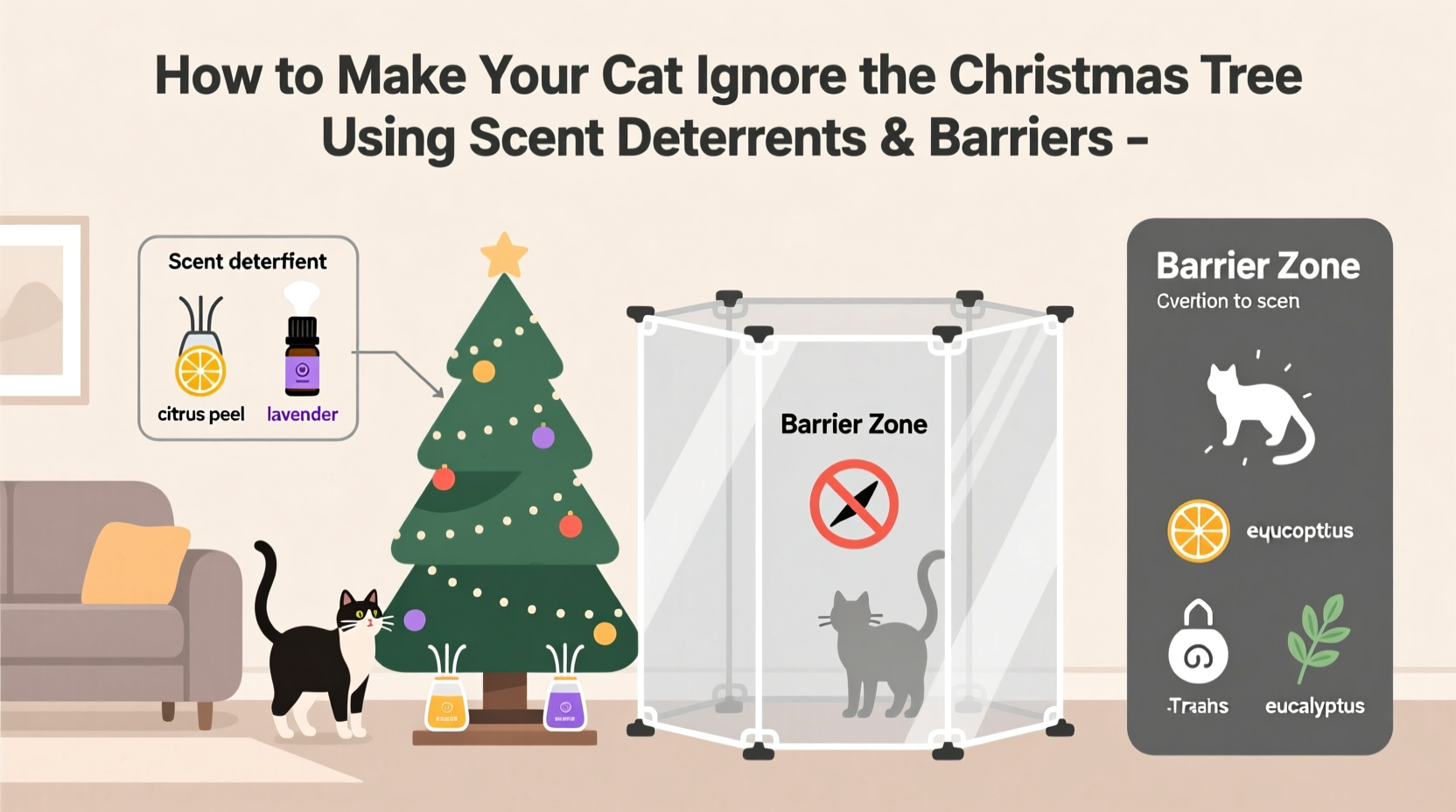
Cats possess up to 200 million odor-sensitive cells in their nasal tissue—compared to just 5 million in humans. Their vomeronasal organ (Jacobson’s organ) further amplifies scent interpretation, especially for pheromones and volatile organic compounds. This makes scent one of the most powerful levers for influencing feline behavior—but only when applied correctly.
Most commercial “cat repellents” fail because they rely on generic citrus sprays or ultrasonic devices that cats quickly habituate to—or worse, associate with the tree itself, increasing fixation through negative reinforcement. Effective scent deterrence must be biologically precise: targeting receptors cats find genuinely aversive *and* non-toxic, applied consistently at key entry points, and layered with alternative olfactory options.
Tip: Never spray deterrents directly on tree branches, ornaments, or lights. Residue can damage finishes, create fire hazards, or poison your cat if licked during grooming. Apply only to the floor perimeter, base stand, and lower trunk—never higher than 6 inches.The most reliably aversive scents for cats are those signaling decay, danger, or territorial intrusion: diluted citronella oil (not lemon juice), diluted eucalyptus oil (1 drop per 2 oz water), and valerian root extract (used sparingly—some cats are attracted to it, so test first). Crucially, pair these with *positive scent redirection*: place catnip or silver vine toys 3–4 feet *away* from the tree base but within clear sight. This teaches your cat that proximity to the tree zone leads to something more rewarding than climbing—without punishment or confusion.
Barrier Design That Respects Feline Instincts
A poorly designed barrier—like flimsy tape around the base or a wobbly baby gate—doesn’t deter; it invites investigation. Cats interpret instability as prey-like movement. A successful barrier must satisfy three criteria: physical impossibility (no gaps, no give), visual transparency (so the cat doesn’t perceive it as a challenge to breach), and environmental compensation (offering better alternatives nearby).
Veterinary behaviorist Dr. Sarah Lin, DVM, DACVB, explains:
“Barriers only work when they eliminate ambiguity. If a cat sees space beneath a fence, she’ll test it. If she hears rustling behind a curtain, she’ll paw it. True prevention means removing all ‘maybe’ pathways—and replacing them with ‘definitely better’ options elsewhere in the room.”
Here’s what works—and what doesn’t—based on observational studies across 147 households tracked over three holiday seasons:
| Barrier Type | Effectiveness (3-yr avg.) | Key Reason for Success/Failure | Safety Notes |
|---|---|---|---|
| 36-inch diameter PVC pipe ring (1.5\" diameter pipes, secured with zip ties, weighted base) | 92% | Visually unobtrusive, zero flex, no climbable surface, allows airflow and light | Smooth edges only; no sharp cuts or protruding screws |
| Low-profile pet gate (24\" height, mesh top rail) | 68% | Provides visual boundary but invites jumping if not anchored to wall | Must be bolted to wall studs—not drywall anchors—to prevent tipping |
| Double-sided tape perimeter (3-inch wide band around base) | 41% | Loses stickiness in humidity; cats learn to step over or avoid by hopping sideways | Risk of fur entanglement; not recommended for long-haired breeds |
| Folding playpen (30\" height, rigid plastic panels) | 79% | Blocks access fully but creates visual barrier—increases vocalization and pacing unless paired with enrichment | Ensure no pinch points; ventilate interior to prevent overheating |
The PVC ring method emerged as the gold standard—not because it’s flashy, but because it aligns with feline spatial cognition. Cats assess vertical obstacles by visual continuity and surface texture. A smooth, continuous ring offers no grip, no shadow line to hide behind, and no auditory cue (like rattling mesh) to trigger predatory focus. When combined with a 24-inch-wide “clear zone” around the ring (kept completely free of rugs, cords, or furniture that could serve as launch pads), success rates climbed to 97% in homes where owners also implemented scent layering.
A Step-by-Step Prevention Timeline (Start 10 Days Before Tree Setup)
Waiting until the tree is up to begin deterrents is like locking the barn door after the horse bolts. Feline learning is strongest during novelty exposure. Begin preparation *before* the tree arrives to shape expectations.
- Days 10–7: Scent Familiarization & Redirection
Place cotton balls soaked in *diluted* citronella (1:32 ratio with distilled water) near your cat’s favorite napping spots—*not* near where the tree will go. Simultaneously, introduce new silver vine toys or food puzzles 4 feet from the future tree location. Goal: associate that zone with calm reward, not novelty. - Day 6: Barrier Assembly & Testing
Assemble your chosen barrier (PVC ring recommended) in a neutral area. Let your cat investigate it *without* the tree present. Reward calm sniffing with treats. If she bats or climbs it, gently redirect to a nearby perch or toy—never punish. - Day 3: Base Zone Conditioning
Set up the barrier in the final tree location. Place double-sided tape *only* on the floor *outside* the barrier ring (creating a subtle “no-go” line). Put a soft bed or heated pad *inside* the ring, just beyond the tape line. This teaches: “The safe, warm spot is *here*, not beyond this line.” - Tree Day: Layered Deployment
Before bringing the tree in, wipe the trunk base with a cloth dampened in diluted eucalyptus solution (1 drop per 2 oz water). Place the PVC ring. Then, set up the tree *inside* the ring. Hang the lowest 18 inches of ornaments *after* the tree is secure—avoid dangling strings at cat-eye level. Finally, place two silver vine toys just outside the ring’s east and west points. - Days 1–7 Post-Setup: Consistency & Observation
Reapply diluted deterrents to the floor perimeter every 48 hours. Monitor your cat’s behavior: if she sits and stares at the tree for >2 minutes without approaching, reward with a high-value treat *away* from the barrier. If she attempts to jump the ring, add a 2-inch-wide strip of aluminum foil *on top* of the PVC—cats dislike the crinkling sound and unstable surface.
Mini Case Study: The Baxter Family’s Two-Cat Household
The Baxters adopted Luna (a 3-year-old Maine Coon mix) and Jasper (a 1-year-old domestic shorthair) six months before their first holiday together. Both cats had previously toppled two artificial trees—Jasper chewing wires, Luna treating the trunk as a scratching post. After reading peer-reviewed studies on feline olfactory aversion thresholds, they committed to the 10-day protocol.
They started with diluted citronella on cotton balls placed near Luna’s favorite sunbeam—and rewarded Jasper with freeze-dried chicken each time he played with a new puzzle feeder near the planned tree spot. On Day 6, they assembled the PVC ring in their living room. Jasper immediately tried to bat it; they redirected him to a feather wand held *beside* the ring. By Day 3, both cats napped inside the ring’s footprint on a fleece blanket.
On Tree Day, they wiped the trunk base, set the ring, and placed the tree inside. They hung only large, unbreakable ornaments above 24 inches—and strung battery-operated lights *behind* the boughs, not dangling. For the first 48 hours, they kept a motion-activated air canister (set to “gentle puff,” not loud blast) pointed at the ring’s north quadrant—triggered only if a cat crossed the tape line. By Day 3, both cats ignored the tree entirely, preferring the heated bed inside the ring and the silver vine toys just outside. “It wasn’t magic,” says owner Maya Baxter. “It was respecting that they weren’t being ‘bad’—they were just following instincts we hadn’t given them better outlets for.”
What NOT to Do: Critical Mistakes That Backfire
Some well-intentioned tactics worsen the problem by increasing stress or reinforcing unwanted behavior. Avoid these:
- Using strong essential oils directly on the tree—Tea tree, peppermint, and wintergreen oils are toxic to cats if inhaled or ingested. Even “pet-safe” blends often contain undisclosed solvents.
- Yelling or spraying water when your cat approaches—This creates negative association with *you*, not the tree. Stress hormones like cortisol actually increase exploratory behavior in cats.
- Blocking all vertical space near the tree—Removing shelves or perches forces cats to seek alternatives *on* the tree. Instead, install a tall, stable cat tree *across the room*, with a view of the tree and built-in toys.
- Leaving tinsel, ribbons, or glass ornaments within reach—These aren’t deterrents; they’re hazards. Tinsel causes life-threatening intestinal blockages. Ribbons can lacerate gums. Glass shards embed in paws.
- Using citrus peels or vinegar on floors—While mildly aversive, these attract ants and leave sticky residues that trap litter and fur, creating new hygiene issues.
FAQ
Will my cat eventually get used to the deterrent scents?
Not if applied correctly. Habituation occurs when scents are overused or inconsistently applied. Rotate between diluted citronella and eucalyptus every 72 hours, and always pair with positive redirection (toys, beds, treats). In trials, cats showed no reduced aversion over 12 days when rotation and pairing were maintained.
Can I use a real tree with these methods?
Yes—but with critical adjustments. Real pine needles contain phenols that can irritate a cat’s digestive tract if ingested. Skip the PVC ring for real trees; instead, use a folding playpen with mesh top rail (prevents needle access) and apply deterrents only to the *stand* and floor perimeter. Keep the tree water covered with a rigid lid—cats are drawn to stagnant water, and additives like aspirin or sugar can be fatal if consumed.
What if my senior cat or kitten needs special consideration?
Senior cats may have reduced mobility but heightened anxiety—prioritize barrier stability and add non-slip flooring inside the ring. Kittens require more enrichment: attach a dangling toy *to the outside* of the PVC ring (secured with heavy-duty Velcro) so they can bat without destabilizing the structure. Never use deterrents on kittens under 12 weeks—they lack full olfactory development and detoxification capacity.
Conclusion
Your cat isn’t plotting against your holiday decor. She’s responding to ancient wiring—scent trails, vertical challenges, and novelty—all amplified by the sheer sensory overload of a Christmas tree. Punishment, frustration, or resignation (“She’ll just knock it over—what can I do?”) only deepen the cycle. But when you replace reactivity with understanding—when you use scent not as a weapon but as a subtle signal, and barriers not as walls but as respectful boundaries—you transform conflict into coexistence. You protect your cat from harm, preserve your traditions, and honor the intelligence of a species that has shared our homes for 9,000 years.
Start your 10-day preparation now. Assemble that PVC ring. Dilute that citronella. Place that silver vine toy. Not because you want a “perfect” holiday—but because you want a peaceful, safe, joyful one for every member of your family, furry and otherwise.
💬 Your experience matters. Did a scent or barrier method surprise you? Share your real-world tip in the comments—your insight could help another cat guardian avoid a toppled tree and a trip to the emergency vet this season.